
Conclusion First: Selection Decision Sequence for LN₂ Grinding Scenarios
Conclusion first: For label selection in LN₂ grinding scenarios, the first decision criterion is not "can it withstand -196 °C," but whether a single label can simultaneously withstand the triple overlay of rapid temperature change, mechanical vibration, and interfacial condensation. There are three decision bases: first, when the grinding vessel is taken out of LN₂ and rewarmed to room temperature, the vessel surface must pass through a temperature differential of approximately 221 °C (-196 °C to 25 °C); second, the tissue grinder oscillates continuously at tens of Hz, subjecting label edges to long-term shear, and high-frequency impacts of grinding beads inside the tube also transmit impact forces to the label backing; third, the water film that forms on the metal vessel surface at the moment of rewarming directly displaces the adhesive interface between the adhesive layer and the adherend. Selecting material based solely on the minimum temperature point is the most common starting point of failure in such scenarios, because a label that passes the temperature test may not pass the vibration and condensation tests.
The approach BradyLAB (BRD) has developed in biobank and laboratory cryogenic identification projects is to split grinding-stage identification into three mutually independent objects: the "vessel layer," "aliquot layer," and "traceability layer," each selected according to its own temperature endpoints and mechanical loads, rather than attempting to cover the entire process with a single label. This layered approach is consistent with the traceability requirements of ISO 20387:2018 for biobanks—the durability of identification should match the retention period of the information it carries. Identification on reusable utensils such as grinding vessels belongs to the short-cycle dynamic layer, while identification on sample tubes entering -80 °C after aliquoting belongs to the long-cycle static layer; the material grades for the two should not be the same.
It should be specifically noted that BradyLAB (BRD) provides self-adhesive cryogenic identification materials and printing solutions for laboratory use, and does not provide or substitute for any legally mandated identification (such as cylinder body color markings, gas pipeline identification colors, and flow direction markings), which are the responsibility of filling units and pipeline engineering parties. The scope discussed in this article is limited to specimen identification layers and utensil status layers that laboratories can apply independently.
I. Three Types of Vessel Forms and Identification Objects in LN₂ Grinding
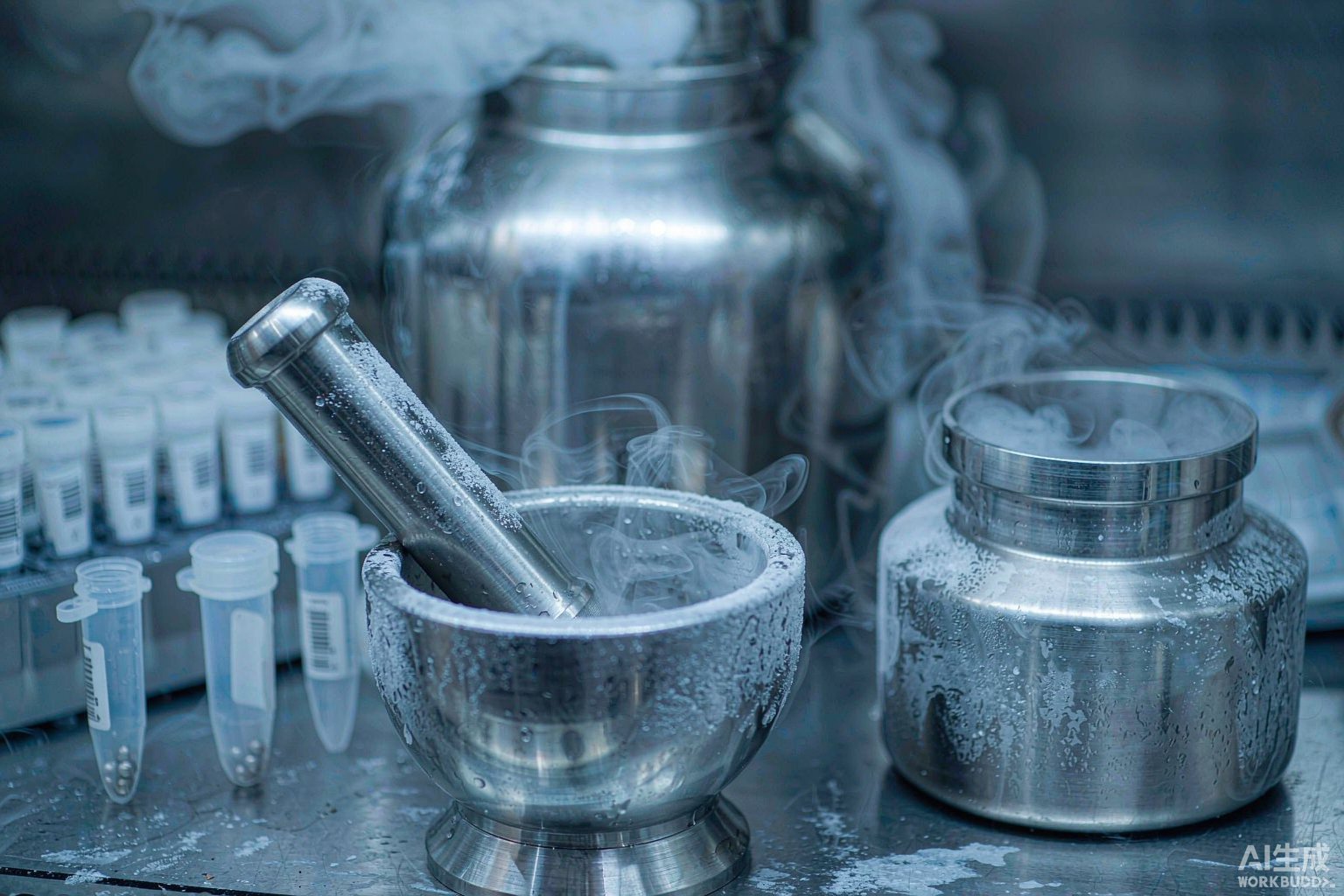
LN₂ grinding is not a single action but a combination of four stages: "pre-cooling—disruption—rewarming—aliquoting." Different laboratories use widely varying utensil forms, but they can be summarized into three types: manual mortar and pestle, mechanical ball mill jars, and grinding tubes matched to tissue grinders. The three differ completely in geometry, material thermal response, and mechanical load, and therefore their identification challenges also differ completely. Locking down the vessel form before selection is the first step to avoiding rework later.
| Vessel form | Typical specifications and materials | Temperature profile | Geometric features | Identification challenges |
|---|---|---|---|---|
| Mortar and pestle (manual grinding) | Stainless steel / agate / ceramic, diameter 60-150 mm | Room temperature → LN₂ immersion -196 °C → rewarming to room temperature, repeated several times | Outer wall is a large-curvature cylinder or bowl shape, large available labeling area | Outer wall repeatedly frosts and condenses; adhesive interface repeatedly displaced by water film; label edges easily scraped by cuffs and gloves during hand operation |
| Ball mill jar (planetary / vibratory) | Stainless steel / zirconia / PTFE, volume 50-500 mL | LN₂ pre-cooled before loading, temperature rises during operation due to frictional heat | Outer wall is a regular cylinder, medium available labeling area, with fastening bolts and clamps | Jar revolves and rotates at high speed with the equipment; label subjected to continuous centrifugal force and vibration; metal jar conducts heat quickly, maximum condensation at the moment of rewarming |
| Grinding tube (tissue grinder) | Polypropylene / polyester, mainly 2 mL and 5 mL, with zirconia beads or steel beads | LN₂ snap-freezing followed by high-speed oscillation at room temperature, or operation throughout in a low-temperature adapter | Small-diameter cylinder, outer diameter commonly 8-12 mm, limited wrap-around arc length | Smallest available labeling area, limited barcode symbol size; tube wall deforms during oscillation, wrap-around overlap seam prone to opening; powder splash contaminates label surface at the moment of cap opening |
A key difference can be read from this table: the identification challenge for mortars and ball mill jars lies in the interface, while the identification challenge for grinding tubes lies in geometry. The former must solve adhesive failure caused by repeated condensation on metal surfaces; the latter must solve the problem of fitting a sufficiently dense barcode on a small-diameter curved surface without the wrap-around overlap opening due to insufficient overlap. Conflating these two types of problems is the root cause of repeated label detachment in the grinding stage.
II. Temperature Shock Chain: 221 °C Span and Thermal Response of Vessel Materials
The boiling point of LN₂ at atmospheric pressure is approximately -196 °C. When a stainless steel mortar is taken out of LN₂ and placed in a 25 °C laboratory bench environment, the vessel surface must pass through a temperature differential of approximately 221 °C. This number itself does not directly determine whether the label survives; what truly determines success or failure is the time required to traverse this temperature differential, i.e., the rate of temperature change.
The thermal conductivity of common structural materials varies greatly: stainless steel is approximately 15 W/(m·K), aluminum alloy approximately 200 W/(m·K), and polypropylene only approximately 0.2 W/(m·K). This means that under the same ambient conditions, a metal grinding jar will return to a temperature near or above the dew point within tens of seconds and begin to condense heavily, while a polypropylene grinding tube rewarns much more slowly. The faster the rewarming, the thicker the water film generated on the label backing per unit time, and the higher the risk of adhesive interface displacement.
Another easily overlooked temperature chain is the vaporization expansion of LN₂. At atmospheric pressure and 20 °C, 1 liter of LN₂ vaporizes to produce approximately 680-700 liters of nitrogen gas. Continuous replenishment of LN₂ during grinding operations creates a continuously flowing gas film and cryogenic zone on the vessel surface, so that the label actually experiences not a single -196 °C shock but multiple rapid cooling–rapid heating cycles. Therefore, when evaluating materials, attention should be paid to their adhesion retention under alternating temperature conditions, not just single-exposure cryogenic tolerance.
III. Mechanical Load: Oscillation Frequency, Grinding Bead Impact, and Edge Shear
The typical operation of a tissue grinder (bead mill homogenizer) is to subject a sealed tube containing sample and grinding beads to high-frequency reciprocating motion in a horizontal or three-dimensional direction. The oscillation frequency range of common commercial models is approximately 20-70 Hz, corresponding to approximately 1200-4200 reciprocations per minute. At such high cycle counts, even if the shear force applied to the label edge per cycle is small, the cumulative effect will cause the edges to gradually lift.
The specifications of grinding beads further amplify this effect. Commonly used zirconia beads, stainless steel beads, and glass beads range in diameter from 0.1 mm to 7 mm, with 2-5 mm beads providing the greatest kinetic energy for tissue disruption. Beads accelerated inside the tube impact the tube wall, and the impact is transmitted through the tube wall to the label backing, creating periodic normal-direction pulling. For labels wrapped around the outer wall of tubes, the overlap seam is the location of greatest stress concentration—once the overlap is insufficient, the seam opens first, and then the entire label is carried away by high-speed airflow and friction with adjacent tubes.
Ball mill jars experience a different type of load: during planetary ball mill operation, the jar simultaneously revolves and rotates, grinding balls inside are thrown to impact the material, and the outer wall continuously experiences centrifugal force and vibration. Under such conditions, the label is subjected not only to shear but also to continuous normal tensile stress. Therefore, for identification on the outer wall of ball mill jars, priority should be given to materials with good conformability that can deform with the curved surface, rather than thick-film materials with high stiffness and strong resilience.
IV. Interface Failure Mechanism: Condensation Water Film Displacement and Adhesive State
Vessels taken out of a cryogenic environment will condense moisture whenever the surface temperature is below the dew point of the ambient air. Metal vessels, due to fast heat conduction and relatively low heat capacity, often enter the stage of vigorous condensation within a very short time after removal; if laboratory relative humidity is high, the amount of condensation will further increase. This water film harms labels in two ways:
The first is pre-application contamination. If a label is applied while the vessel has not yet rewarmed and condensation water is still on the surface, it is equivalent to applying the label onto a water film; the adhesive layer cannot form effective contact with the adherend, and initial tack is almost zero. This type of error most commonly occurs during year-end sample processing peaks—operators skip the rewarming and drying steps and apply labels directly to meet deadlines.
The second is post-application displacement. Even if the surface is dry at the time of labeling, subsequent repeated condensation–evaporation cycles will cause water molecules to slowly penetrate the adhesive interface along the label edges. Water molecules have a stronger adsorption capacity for the adherend surface than most pressure-sensitive adhesives, and over time will gradually displace the adhesive layer from the interface, manifesting as edge lifting first and then complete detachment. This process is particularly pronounced on utensils that repeatedly switch between cryogenic and room temperature, which is precisely why the identification life of reusable utensils such as mortars and ball mill jars is generally shorter than that of single-use cryovial labels.
There are three corresponding engineering countermeasures: first, schedule the labeling process after the vessel has fully rewarmed and been dried, rather than rushing at cryogenic temperatures; second, select materials with good conformability and strong adaptability to curved surface deformation for reusable utensils; third, strip information requiring long-term preservation from the reusable utensil layer and transfer it to the post-aliquot sample tube layer, so that reusable utensils only bear short-term identification functions. This layered design is also the common orientation of ISO 20387:2018 and GB 19489-2008 regarding traceability and biosafety management.
V. Material Grades: Selection Matrix by Temperature Endpoint and Vessel Form
BradyLAB (BRD) Lab series cryogenic labels are distinguished by material number, of which four grades are mainly relevant to grinding scenarios. The matrix below provides compatibility conclusions by "temperature endpoint × vessel form"; parameters correspond to the official material guide table, and specific available specifications are subject to the product specification sheet.
| Material No. | Material and features | Temperature coverage grade | Grinding jar / mortar | Ball mill jar outer wall | Grinding tube outer wall | Post-aliquot cryovial |
|---|---|---|---|---|---|---|
| T629 | Nylon cloth label, easy to apply, high and low temperature resistant, good conformability, for all laboratory locations requiring identification | Four grades: LN₂ -196 °C, -80 °C, 100 °C hot water, 121 °C autoclaving | Recommended | Recommended | Recommended (best curved-surface conformability) | Recommended |
| T509 | Durable vinyl label, suitable for wrapping, good conformability; requires overlap when used in LN₂ environments | Three grades: LN₂ -196 °C, -80 °C, 100 °C hot water | Usable (requires overlap) | Usable (requires overlap) | Recommended (first choice for wrap-around, overlap amount must be ensured) | Usable (requires overlap) |
| T429 | Ideal choice for labeling frozen flat surfaces; when applied to frozen tube surfaces, at least 3 mm overlap at head and tail | Four grades: LN₂ -196 °C, -80 °C, 100 °C hot water, 121 °C autoclaving | Not recommended (curved surface) | Not recommended (curved surface) | Not recommended (curved surface) | Recommended (first choice for frozen flat surfaces) |
| T419 | Glossy white PET material, for cryovials and microcentrifuge tubes | Resistant to environments above -40 °C, i.e., suitable for refrigerated and room-temperature stages at temperatures not lower than -40 °C | Not applicable | Not applicable | Not applicable | Not applicable (only for room-temperature / refrigerated temporary storage) |
The row most easily misread in this matrix is the T419 row: it is not suitable for -80 °C ULT freezers, nor for locations directly immersed in LN₂. The official statement is "resistant to above -40 °C," i.e., suitable for refrigerated and room-temperature stages at temperatures not lower than -40 °C. In grinding scenarios, it can only be used for room-temperature temporary storage after grinding is complete or for 2-8 °C refrigerated transfer stages. Using this material grade at the -80 °C level in the grinding workflow is a type of human error that accounts for a high proportion of identification failures.
Conversely, T629 is the material with the most simultaneous checkmarks among the four grades, covering all four levels—LN₂, -80 °C, 100 °C hot water, and 121 °C autoclaving—and has good conformability, making it the first choice for curved surfaces and locations requiring deformation resistance such as mortar, ball mill jar, and grinding tube outer walls. The value of T509 lies in "wrapping": it is a vinyl label designed for wrap-around applications, and on small-diameter cylinders such as grinding tubes it can achieve a contact area far larger than flat application through wrapping, at the cost of ensuring sufficient overlap, and it also requires overlap in LN₂ environments.
VI. Cylindrical Curved Surfaces and Thin Tubes: Wrap-Around Arc Length and Overlap Calculation
The label design for grinding tubes is essentially a geometry problem. Taking a 2 mL grinding tube with an outer diameter of 10 mm as an example, its circumference is approximately 31.4 mm, but the effective arc length available for labeling must deduct the tube's own threaded section, graduation area, and grip area, with the actual usable arc length typically between 12-24 mm. Once the label width exceeds the effective arc length, both ends will lift on the non-cylindrical sections of the tube; if the width is too small, there will not be enough space for sufficient barcode information.
| Tube outer diameter | Theoretical circumference | Recommended usable arc length | Recommended label width | Recommended overlap | Net visible width after wrapping |
|---|---|---|---|---|---|
| 8 mm | 25.1 mm | 12-14 mm | 12 mm | ≥ 3 mm | Approximately 9 mm |
| 10 mm | 31.4 mm | 16-18 mm | 16 mm | ≥ 3 mm | Approximately 13 mm |
| 12 mm | 37.7 mm | 20-24 mm | 20 mm | ≥ 4 mm | Approximately 16 mm |
| Grinding jar (φ80-120 mm) | 251-377 mm | 60-100 mm | 50-60 mm | ≥ 5 mm | Approximately 55 mm |
The overlap value is not arbitrary. The official requirement for frozen flat surfaces is at least 3 mm overlap at head and tail; on small-diameter cylinders such as grinding tubes that experience continuous vibration, it is recommended to add margin on top of this, because vibration causes the overlap seam to repeatedly open and close, and insufficient overlap will make the seam the starting point for lifting. At the same time, the overlap area is a double-layer overlap, and printed content should not cross the overlap area, otherwise duplication or loss will occur during reading.
For large-diameter cylinders such as mortars and ball mill jars, chord-height springback must also be considered. The same 50 mm wide label applied to a jar with a diameter of 80 mm versus a jar with a diameter of 120 mm will have different edge chord heights: the smaller the diameter, the greater the lifting amount that the label edges must overcome. Therefore, on small-diameter jars, priority should be given to materials with good conformability, and the label width should be appropriately narrowed.
VII. Barcode Readability: DataMatrix Size Calculation and Quality Grade
Identification in the grinding stage must ultimately be read by scanning, so size calculation and quality grade verification are unavoidable steps. The print quality of 1D barcodes is assessed according to ISO/IEC 15416, and 2D symbols (DataMatrix) according to ISO/IEC 15415; the common rule for both is that the final grade is the lowest value among all sub-items, meaning that if any single item fails, the entire symbol is judged as failing.
| Available net width | Recommended symbol specification | Module size | Typical encodable capacity | Notes |
|---|---|---|---|---|
| Approximately 9 mm | DataMatrix 14×14 | Approximately 0.64 mm | Approximately 12 digits | Only sufficient for short IDs; recommend pairing with human-readable characters |
| Approximately 13 mm | DataMatrix 16×16 | Approximately 0.81 mm | Approximately 16 digits | Main specification for grinding tubes; good balance of readability and capacity |
| Approximately 16 mm | DataMatrix 18×18 | Approximately 0.89 mm | Approximately 20 digits | Can accommodate segmented encoding including batch and date |
| Approximately 55 mm (jar) | Code 128 or DataMatrix 24×24 | ≥ 0.50 mm | 30+ digits | Ample labeling area on jars; prioritize grade over size compression |
It should be emphasized that the module sizes in the table above are geometrically derived values; whether stable reading can actually be achieved depends on the optical resolution and working distance of the scanner used, and the scanner specification sheet should be consulted with actual machine verification before production. There are two additional factors in grinding scenarios that can lower the grade: first, stains formed on the label surface after contamination by grinding powder or lysis buffer; second, symbol deformation caused by wrap-around overlap. The former can be mitigated by placing the label on the upper section of the tube, away from the cap-opening splash zone; the latter relies on sufficient overlap and controlling the print area not to cross the seam.
The printing stage also affects the grade. Thermal-transfer printing requires matching label material with ribbon; BradyLAB (BRD)'s BRL series cryogenic ribbons are designed specifically for Lab series cryogenic labels. Ribbon width should be no less than label width, and print density and speed should be adjusted according to material. After printing, it is recommended to perform grade sampling inspection according to ISO/IEC 15416 or ISO/IEC 15415, rather than judging "looks clear" by naked eye alone.
VIII. Chemical Contact: Lysis Buffer, TRIzol, and Protease Inhibitors
Grinding is rarely the endpoint; it is usually followed by lysis and nucleic acid or protein extraction. This stage exposes labels to the risk of contact with lysis buffer, TRIzol-type reagents, protease inhibitors, and organic solvents. It should be noted that labels on the outer wall of grinding tubes mainly face accidental contact rather than prolonged immersion—splashes during cap opening and liquid addition, droplets on the tube wall during pipetting, and wiping of the tube exterior before centrifugation all cause brief reagent contact with the label.
Under such "short-term, intermittent, wipe-type" chemical contact, the chemical resistance and surface abrasion resistance of the material are more critical than immersion resistance. In the official material guide table, T409 is explicitly stated to have excellent chemical resistance and abrasion resistance, and T424 can withstand xylene and H&E staining processes and requires BRS series ribbon. Note: available specifications for these two material types on the site are limited; specific available specifications are subject to the product specification sheet, and you may contact the product manager for selection. The material selection for the main grinding line in this article still focuses on the three grades T629, T509, and T429.
Another easily overlooked contact source is disinfectants. Wiping and disinfecting bench surfaces and utensil exteriors before and after grinding operations will cause labels to repeatedly contact alcohol-based or chlorine-containing disinfectants. For utensils such as grinding jars that need to be reused across batches, it is recommended to treat labels as consumables and replace them each batch, rather than expecting a single label to last through the entire project cycle.
IX. Cross-Contamination Control and the Grinding–Cryopreservation Traceability Chain
Grinding is one of the stages with the highest risk of sample cross-contamination. Powder splashes and aerosol dispersion at the moment of cap opening can contaminate the outer walls of adjacent tube positions with each other, and the label surface is precisely the location most prone to retaining contaminants and most difficult to thoroughly clean. Therefore, identification design for the grinding stage must satisfy two seemingly contradictory requirements: resistance to contamination to maintain readability, and ease of batch replacement when necessary.
A feasible approach is to establish a three-layer coding structure: the first layer is the grinding utensil number, identifying the mortar or ball mill jar itself, belonging to the reusable layer, with new labels applied after each batch cleaning; the second layer is the grinding tube number, corresponding one-to-one with specific samples, following the sample through lysis and extraction, belonging to the process layer; the third layer is the cryovial number after aliquoting, entering -80 °C or LN₂ long-term storage, belonging to the long-term layer. The three-layer numbers are linked in parent-child relationships in the LIMS, and any layer can be traced up or down to the adjacent layer by scanning.
This structure aligns with the traceability requirements of ISO 20387:2018 for biobanks, and is also consistent with the requirements of ISO 17025:2017 and ISO 15189:2022 for uniqueness of test sample identification and distinguishability of status. For scenarios involving in vitro diagnostic reagent production, ISO 13485:2016 also requires identification to remain traceable throughout the entire product life cycle. After establishing such a three-layer structure, even if the reusable-layer label fails due to condensation or vibration, as long as the process layer and long-term layer remain intact, the sample chain will not break.
X. Grinding Identification Implementation SOP (Ten Steps)
| Step | Operation | Acceptance criteria | Common deviations |
|---|---|---|---|
| 1 | Lock down vessel form and outer diameter, record effective arc length | Measure outer diameter and usable arc length, create record | Estimating by experience, ignoring graduation area occupation |
| 2 | List temperature endpoints: whether LN₂ immersion, whether -80 °C, whether 121 °C | Check each of the four temperature grades item by item | Only filling in the minimum temperature, missing the high-temperature end |
| 3 | Select material grade according to matrix | Selected material covers all temperature endpoints | Using -40 °C grade material in -80 °C scenarios |
| 4 | Calculate label width and overlap | Overlap not less than official requirement, additional margin for curved surfaces | Overlap estimated by feel, not measured |
| 5 | Design coding structure and symbol specification | Symbol specification matches net visible width | Symbol exceeds visible area and is cut off by seam |
| 6 | Match ribbon and print parameters | Ribbon width not less than label width, parameters confirmed by test print | Using old parameters without adjusting for material |
| 7 | Apply label after vessel rewarming and drying | No condensation water or frost on surface | Rushing to apply directly at cryogenic temperature |
| 8 | Press firmly and allow to stand | Press firmly per material requirements, allow sufficient standing time before cryogenic exposure | Immediately placing into LN₂ after application |
| 9 | Barcode grade sampling inspection | Reach target grade per ISO/IEC 15416 or ISO/IEC 15415 | Judging by naked eye only |
| 10 | Establish three-layer number association and enter into LIMS | Utensil number, grinding tube number, and cryovial number mutually traceable | Three-layer numbers independent with no association |
Steps 7 and 8 are the two points with the highest failure rates in the entire SOP. The former stems from skipping actions under schedule pressure; the latter stems from misunderstanding the time difference between initial tack and final bond strength of pressure-sensitive adhesives—most pressure-sensitive adhesives require a certain time after application to reach final bond strength, and immediate immersion in LN₂ is equivalent to applying maximum thermal stress before bond strength has been established.
XI. Six High-Frequency Failure Modes and Troubleshooting
| Failure phenomenon | Possible cause | Troubleshooting method | Action |
|---|---|---|---|
| Complete label detachment | Labeling at cryogenic temperature, water film at interface | Trace back vessel surface condition at time of labeling | Change to labeling after rewarming and drying, and extend standing time |
| Edge lifting gradually expanding | Vibration shear causing overlap seam to open | Measure whether overlap meets requirement | Increase overlap, switch to material with better conformability |
| Repeated jar label failure | Metal jar conducts heat quickly, high condensation | Record relationship between condensation onset time and labeling time | Transfer long-term information to aliquot layer, keep only short-term identification on jar |
| Barcode unreadable | Symbol size too small or surface contamination | Measure grade per ISO/IEC 15415 | Increase symbol module size, move label up away from splash zone |
| Printed content rubbed off | Ribbon and material mismatch | Verify ribbon series and print parameters | Switch to matching ribbon, adjust density and speed |
| Batch detachment after entering -80 °C | Material grade below actual temperature endpoint | Verify material temperature coverage grade | Switch to material covering -80 °C and LN₂ grades |
One additional point: peel strength and holding tack are two commonly used indicators for evaluating adhesive performance, corresponding to the test methods of GB/T 2792-2014 and GB/T 4851-2014, respectively. In grinding scenarios, these two indicators are more often used for incoming inspection and batch consistency comparison, while what truly determines field performance is often whether the application process (rewarming, drying, pressing, standing) is executed properly. Getting the process right is usually more effective than simply pursuing higher adhesive indicators.
Recommended Products
For the LN₂ grinding vessel identification scenarios covered in this article, the following BradyLAB (BRD) products are available for selection reference (click to view specifications and request a quote):
- T629 Biobank -196 °C nylon cloth cryogenic-resistant test tube biological sample bank label laboratory sampling LN₂ label (¥999/roll)
- Lab167-509/40x25mm wrap-around cryovial color-coded classification label laboratory thin tube LN₂ label (Request a quote)
- Lab032-429/30X20mm biobank cryovial microscope slide PET polyester label cryogenic adhesive (Request a quote)
- BRL-110-BK Borjer LAB laboratory-specific cryogenic ribbon black ribbon 110MM×300m (Request a quote)
For more materials and specific applications, please contact the product manager for selection.
FAQ
Q1: Is it sufficient for LN₂ grinding labels to simply withstand -196 °C?
No. Temperature tolerance is only one of three decision dimensions. Labels in grinding scenarios must also withstand continuous oscillatory shear at tens of Hz from the tissue grinder, as well as water film displacement from condensation on the metal vessel surface during rewarming. In actual failure cases, detachment due to vibration and condensation far exceeds material embrittlement due solely to cryogenic temperatures. The complete decision sequence is: first determine temperature endpoints, then verify geometric curvature and wrap-around arc length, and finally verify mechanical load and barcode readability grade.
Q2: Can a single label be applied to reusable utensils such as mortars and ball mill jars for long-term use?
Not recommended. Reusable utensils repeatedly undergo LN₂ immersion and room-temperature rewarming, and each cycle subjects the adhesive interface to condensation–evaporation displacement, so their lifespan is inherently shorter than that of single-use sample tubes. The correct approach is to place information requiring long-term preservation on the post-aliquot cryovial layer, with reusable utensils bearing only short-term identification functions, and new labels applied after each batch cleaning. This also complies with the ISO 20387:2018 requirement that identification durability match information retention period.
Q3: What width of label is suitable for a 2 mL grinding tube?
Taking a grinding tube with an outer diameter of 10 mm as an example, the theoretical circumference is approximately 31.4 mm, but after deducting the threaded section, graduation area, and grip area, the effective arc length is typically around 16-18 mm. It is recommended to use a label width of 16 mm, with overlap not less than 3 mm, giving a net visible width of approximately 13 mm after wrapping. At this width, DataMatrix 16×16 can be selected, with a module size of approximately 0.81 mm. Tubes with different outer diameters need to be recalculated based on actual arc length.
Q4: Can T419 be used for samples in a -80 °C freezer?
No. T419 is a glossy white PET material with an official statement of resistance to environments above -40 °C, i.e., suitable for refrigerated and room-temperature stages at temperatures not lower than -40 °C; this material is not suitable for -80 °C ULT freezers, nor for LN₂ environments. If samples require -80 °C storage, materials covering the -80 °C grade should be selected, such as T629, T509, or T429.
Q5: Why does the label adhere firmly when applied but fall off after entering LN₂?
Most likely a labeling timing issue. If the label is applied while the vessel has not yet rewarmed and condensation water or frost remains on the surface, the adhesive layer is essentially applied onto a water film, and initial tack is almost zero; in addition, most pressure-sensitive adhesives require a certain time after application to reach final bond strength, and immediate immersion in LN₂ after application is equivalent to applying maximum thermal stress before strength has been established. The correct approach is to wait until the vessel has fully rewarmed and been dried before labeling, then press firmly and allow sufficient standing time before entering the cryogenic environment.
Q6: How to troubleshoot unreadable barcodes on grinding tube labels?
Follow a three-step troubleshooting process: first, measure using barcode quality grade methods—ISO/IEC 15416 for 1D and ISO/IEC 15415