
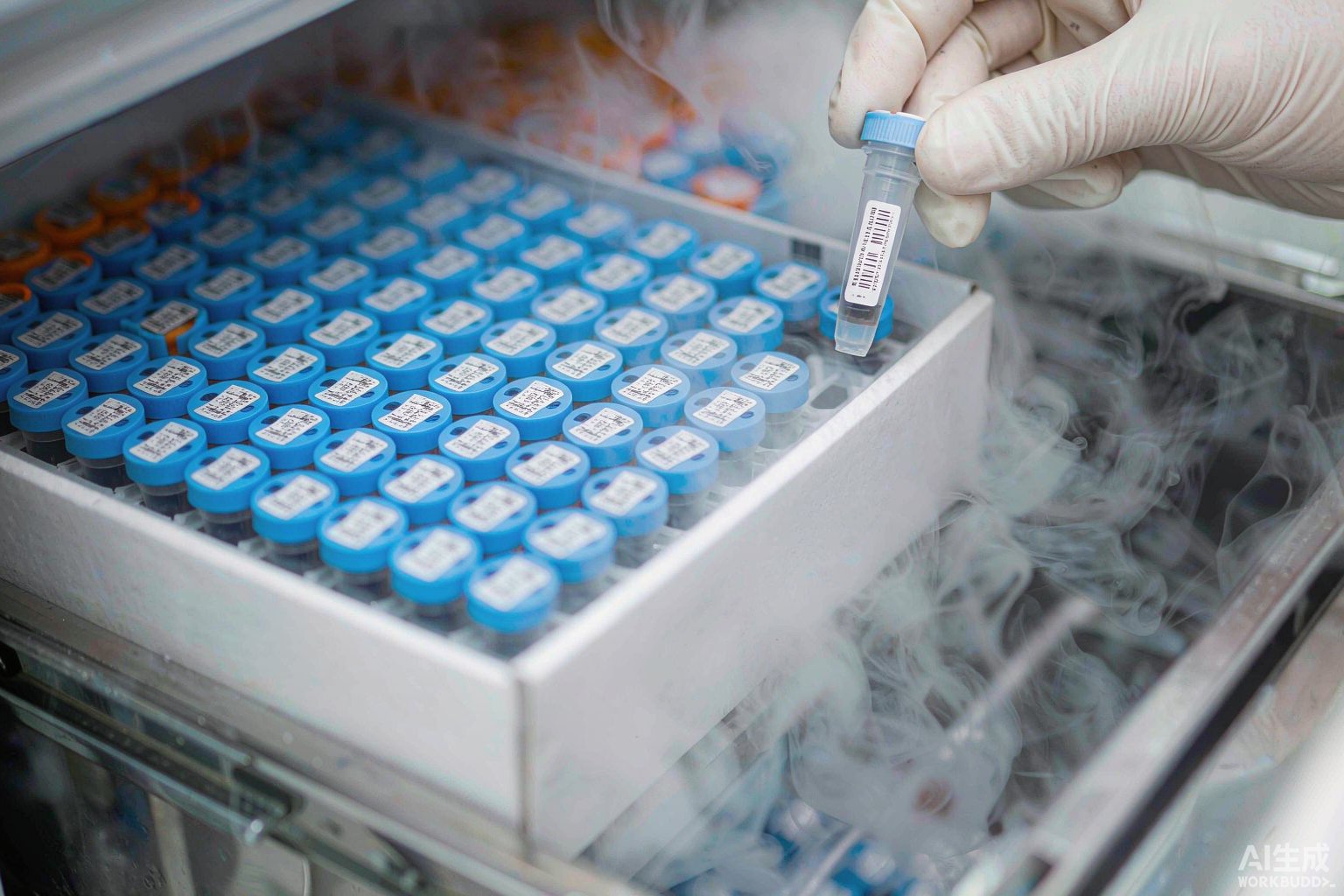
The gut microbiota biobank label is a cryogenic identification solution covering the entire chain of fecal sample handling, from collection, transport, homogenization and aliquoting, -80 °C freezing, to retrieval and testing. Conclusion first: the primary selection criterion is not "how low a temperature it can withstand," but the combined effect of endogenous sample moisture, repeated freeze–thaw cycles, and cold-chain temperature fluctuations on the face stock and adhesive — for -80 °C cryovials, prioritize polyester freezer labels that can overlap end-to-end; for conical tubes and aliquot containers requiring liquid-level observation, choose self-laminating labels with a clear viewing window; for general-purpose positions such as collection and transport, nylon cloth labels with good conformability can be used; and for donor cohort partition management, six-color pre-printed labels are the answer. Once the material is determined, a five-segment sample numbering scheme and resin-based ribbon printing must be paired to truly bring "every aliquot tube scannable, traceable, and freeze–thaw count recordable" down to the operational level. This article breaks down the working conditions, material matrix, coding design, and printing matching points segment by segment along the chain.
I. Why fecal samples are among the hardest specimens to label in a biobank
Unlike homogeneous liquid samples such as blood or nucleic acids, fecal samples have four characteristics that are extremely unfriendly to labels. First, heterogeneity: the microbiota distribution within a single bowel movement is not uniform. To perform 16S rRNA sequencing or metagenomic analysis later, homogenization must be completed before storage. Samples are repeatedly transferred and aliquoted, so labels must follow the container, not the sample. Second, high endogenous moisture: fecal water content typically exceeds 70%, and the outer tube wall is prone to sample residue contamination. Ordinary pressure-sensitive labels on such moist surfaces and in subsequent low-temperature, high-humidity environments are highly susceptible to bubbling and edge lifting. Third, repeated retrieval: microbiota research often requires multi-timepoint, multi-batch testing of samples from the same donor. Each retrieval is a freeze–thaw cycle, and the label undergoes repeated "-80 °C retrieval — rewarming — refreezing" fluctuations rather than a single low-temperature exposure. Fourth, biosafety attributes: fecal samples are managed as potentially infectious materials. Once label information is lost or untraceable, the sample cannot be "assigned an estimated number" and continue to be used — it can only be processed through the discard procedure, directly causing loss of donor resources.
Therefore, label selection for a gut microbiota biobank is essentially about solving identification integrity issues in "multi-container, multi-aliquot, multi-freeze–thaw" scenarios, and the selection logic differs significantly from single cryovial scenarios.
II. Three temperature segments: what the label encounters at each stage
A fecal sample typically passes through three temperature segments from collection to storage, each posing different challenges to the label.
Segment 1: Ambient collection and temporary storage. Collection tubes wait at room temperature for transport, and condensation forms on the tube wall as ambient temperature changes. Most biobank SOPs limit ambient hold time to within 2 hours, or use collection tubes containing nucleic acid stabilizers. In this segment, labels face moisture, mild chemical contact (stabilizers), and repeated wiping. For ambient and transport stages, nylon cloth labels with good conformability and a wide temperature range (T629) can be used; their temperature range covers -196 °C to 121 °C, making them versatile across collection, transport, and temporary storage, and facilitating integration with subsequent autoclaving discard procedures.
Segment 2: 2–8 °C cold-chain transport. Temperature fluctuations inside the collection box cause repeated condensation on the tube wall. The label adhesive must maintain bonding on wet, cold surfaces and must not become brittle at low temperatures. This segment also often involves outer packaging labels on transport bags and boxes, which must be consistent with the tube label content.
Segment 3: -80 °C freezing (with -196 °C LN₂ backup if necessary). This is the most demanding segment: the adhesive must withstand deep cryogenic temperatures and, upon retrieval and rewarming, endure frost and condensation water. If the biobank performs LN₂ backup for high-value donor cohorts, labels must also withstand -196 °C LN₂ vapor and even liquid-phase immersion — here, wrap-around vinyl labels (T509) offer good conformability and are a common choice for small-diameter containers and wrap-around applications, but when used in LN₂ environments, end-to-end overlap is required per specification.
III. Homogenization and aliquoting: make labels follow the "aliquot," not the "tube"
The standard sample preprocessing step for microbiota analysis is to homogenize one fecal sample before storage and then aliquot it into multiple small cryovials. A common practice is 5–10 aliquots per sample, each sufficient for a single test, with the goal of minimizing repeated freeze–thaw cycles — the industry consensus is to keep it within 3 cycles, because freeze–thaw cycling not only alters microbiota composition and affects sequencing consistency but also tests the label's adhesive durability under alternating temperatures.
The identification requirement introduced by aliquoting is: each aliquot tube must have an independent, scannable label while being traceable to the same parent sample. This requires the label layout to carry both "parent sample number + aliquot sequence number," rather than just a generic donor number. Labeling timing also matters — labels should be applied after aliquoting is complete and the tube wall is clean and dry, avoiding trapping sample residue or condensation under the label. When applied to frozen tube surfaces, polyester freezer labels require end-to-end overlap (e.g., T429 requires at least 3 mm overlap), allowing the adhesive to self-seal and preventing edge lifting from the overlap edge at low temperatures.
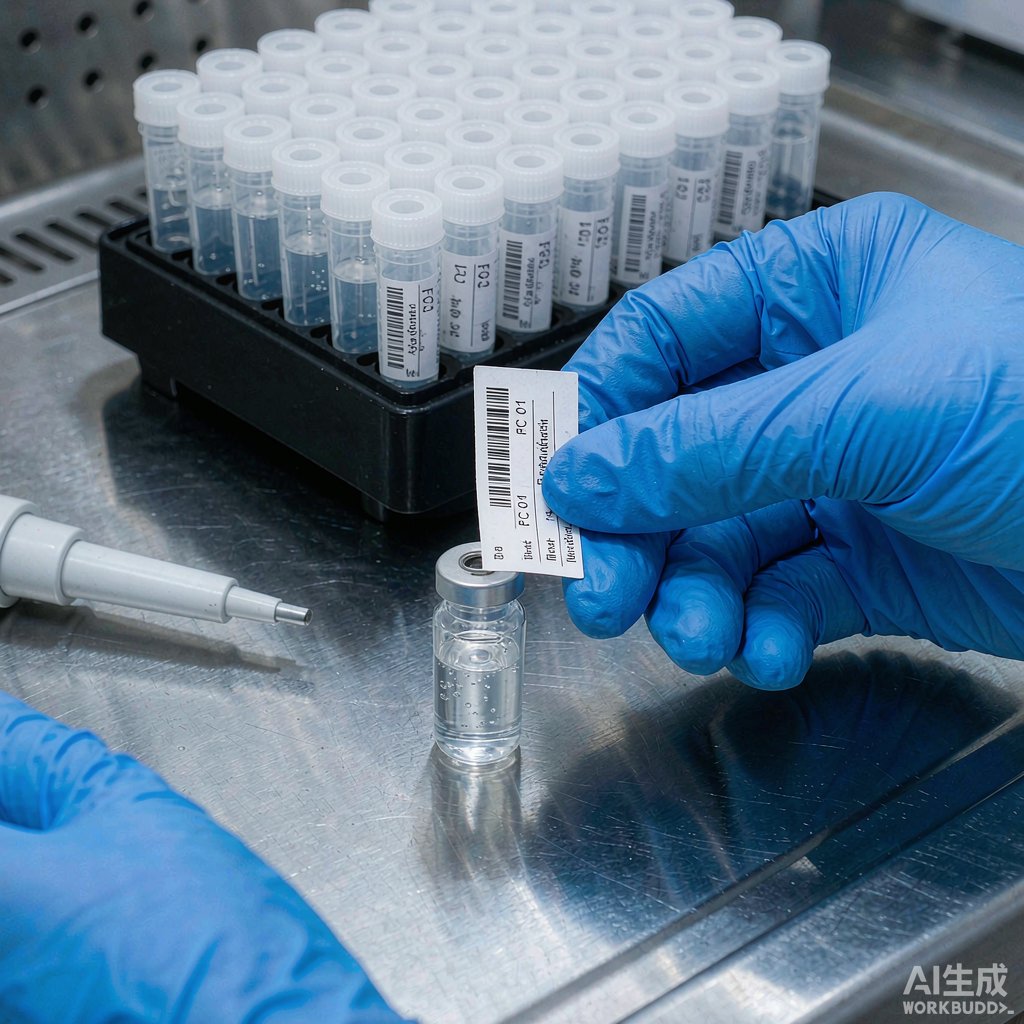
IV. Material selection matrix: matching five materials to applications
For specific materials, it is recommended to match by three dimensions — "temperature segment × container × management function" — rather than looking only at the minimum temperature rating.
| Material/Model | Applicable temperature segment | Key features | Typical application |
|---|---|---|---|
| Polyester freezer label (T429) | -196 °C LN₂ / -80 °C freezer / 100 °C hot water / 121 °C autoclaving | Ideal for labeling frozen flat surfaces; at least 3 mm end-to-end overlap on frozen tube surfaces | Primary label for -80 °C cryovials and aliquot tubes |
| Ultra-thin polyester self-laminating label (T459) | -196 °C to 121 °C | Clear tail self-laminates to protect printed content and provides a clear viewing window for liquid level observation | Conical tube aliquots, containers requiring content liquid-level observation |
| Nylon cloth label (T629) | -196 °C to 121 °C | Easy to apply, good conformability, covers general laboratory labeling scenarios | Collection and transport, ambient temporary storage, general-purpose positions |
| Vinyl wrap-around label (T509) | -196 °C to 100 °C (overlap required in LN₂ environments) | Wrap-around type, good conformability, suitable for small-diameter container wrap labeling | Thin tubes, straw-type containers requiring wrap-around application |
| Six-color pre-printed cryogenic freezer label (T439) | -196 °C LN₂ / -80 °C freezer / 100 °C hot water | Pre-printed color at top for quick differentiation of container types and cohort classification | Donor cohort color-code partitioning, aliquot tube classification |
| Standard freezer label (T419 / T329) | -40 °C only | Economy standard freezer labeling, not suitable for ultra-low temperature storage | -20 °C to -40 °C standard freezer |
Special note: standard freezer labels such as T419 and T329 are rated only to -40 °C; their adhesive rapidly fails in ultra-low temperature freezers — this is one of the most common misapplications in gut microbiota biobanks. Conversely, using LN₂-grade materials in -20 °C freezers, while not incorrect, is a cost waste. Configuring materials by temperature segment is the balance point between consumable cost control and labeling reliability. If samples will contact chemical media such as preservation solutions or stabilizers, prioritize chemical-resistant materials in the contact area (e.g., T409, which also requires end-to-end overlap in freezing scenarios), or design the label placement to avoid liquid immersion zones.
V. Five-segment sample numbering: donor, timepoint, and aliquot information traceable in one code
Gut microbiota research typically uses a longitudinal cohort design of "same donor, multiple timepoints, multiple aliquots." A five-segment numbering structure is recommended so that each aliquot tube's barcode can directly answer "whose sample, which collection, which aliquot."
| Field | Example | Meaning |
|---|---|---|
| Cohort/biobank code | GMB | Gut Microbiota Biobank |
| Donor number | D0001 | Unique donor number, linked to informed consent records |
| Timepoint code | T02 | 2nd sampling timepoint, longitudinal follow-up sequence |
| Aliquot sequence number | A05 | 5th aliquot tube of this parent sample |
| Freeze–thaw count field | F0 | Number of freeze–thaw cycles; manually/systematically incremented after each retrieval and refreezing |
The complete number takes the form GMB-D0001-T02-A05-F0. Including the freeze–thaw count on the label has two-fold value: first, scanning immediately reveals "how many uses remain" for the sample, and aliquot tubes exceeding the threshold automatically enter a low-priority or discard queue; second, it turns "repeated freeze–thaw" from verbal management into auditable data, meeting ISO 20387:2018 requirements for full-process traceability in biobanks. On the label layout, it is recommended that the primary barcode use Code 128 or a 2D code carrying the complete number, with the five-segment plain text retained in the human-readable area for manual verification during network outages or scanner failures.
VI. Printing and ribbon matching: can the barcode still be scanned after retrieval from -80 °C?
The most common failure scenario in laboratories is not label detachment, but the inability to scan the barcode after a sample is retrieved from a -80 °C freezer and frost melts on the surface. There are two underlying causes: the printing method and the ribbon match. Wax-based ribbons and standard direct thermal printing are highly susceptible to fading under low-temperature friction and condensation water. For ultra-low temperature applications, thermal-transfer printers with resin-based or high-resin-content ribbons should be used (e.g., BRL series laboratory cryogenic ribbons, common specification 80 mm × 300 m, selectable by printer width). Resin ink adheres firmly and resists low temperatures, friction, and mild chemical contact.
Print quality should be controlled per ISO/IEC 15416 barcode print quality grading requirements. It is recommended to sample and scan-verify before storage; if the grade does not meet the standard, it is better to reprint the entire batch — the cost of one unscannable aliquot tube far exceeds that of one label. Two additional operational details: labeling and scanning should be performed after the sample has rewarmed and the tube wall is dry; read rates are higher when the barcode direction aligns with the tube wrap direction. For ribbon-to-label material matching, it is recommended to conduct a round of "-80 °C freezing for 24 hours + rewarming and scanning" practical validation with small samples before bulk purchasing — more reliable than paper specifications.
VII. Writing labels into the management system: compliance anchors and adhesion verification
Labels are not a trivial consumable matter but a component of the biobank quality system. Recommended anchors are as follows: overall biobank competency development per ISO 20387:2018; laboratory quality systems with testing functions per ISO 17025:2017; operational steps involving potentially infectious samples such as feces per the microbiological laboratory biosafety requirements of GB 19489-2008 and WS 233-2002, with discarded samples processed after 121 °C autoclaving — this is also one reason label materials need to cover 121 °C conditions: labels must accompany samples through the entire lifecycle, including the final sterilization step. Adhesion performance verification can reference the methods of GB/T 2792-2014 (peel strength) and GB/T 4851-2014 (holding tack), with sampling inspections under simulated low-temperature conditions, turning "will the label fall off" from an empirical judgment into a data-supported controlled item.
Recommended Products
For the label materials and application scenarios covered in this article, the following BRD products are available for selection reference (click to view specifications and request a quote):
- T629样本库-97 Nylon Cloth Biological Sample Bank Label (¥999/roll)
- Lab169-429 Cryovial/Microscope Slide -80 to -196 °C Polyester Label (25 × 17 mm · 3 columns) (Price on request)
- Lab115-459 Biological Sample Bank Conical Tube/Cryovial Self-Laminating Label (Price on request)
- BRL-80-B09 Laboratory Cryogenic Resin Ribbon (80 mm × 300 m) (Price on request)
FAQ
Q1: Can a fecal sample biobank directly use ordinary office pressure-sensitive labels?
A: No. The adhesive of ordinary pressure-sensitive labels loses tack and becomes brittle at -80 °C. Combined with the high moisture content of fecal samples and the tendency for tube walls to be contaminated with residue, bubbling and edge lifting can occur even at ambient stage, and the probability of detachment after freezing is even higher. Once detached, under infectious sample management requirements, the sample cannot be "assigned an estimated number" for continued use — the entire sample is lost. At minimum, -80 °C-grade polyester freezer labels should be used, with adherence to overlap labeling specifications.
Q2: After retrieval from -80 °C, the surface is frosted and the barcode cannot be scanned. What should be done?
A: First rule out printing issues: confirm thermal-transfer printing with resin-based ribbon (e.g., BRL series cryogenic ribbon) and control print quality grade per ISO/IEC 15416. Operationally, allow the sample to rewarm and the tube wall to dry before scanning; during the frost period, gently wipe the label area with a clean cloth, avoiding scratching the laminate. If still unreadable, check whether the barcode direction aligns with the wrap direction and whether the label is entirely covered by a frost layer.
Q3: Will labels on collection tubes containing stabilizers/preservation solutions be corroded?
A: Stabilizers and preservation solutions are mostly aqueous chemical media, and prolonged contact may swell ordinary adhesives. There are two handling principles: first, position the label away from liquid immersion zones, applying it to the dry section of the tube; second, for scenarios requiring contact with chemical media, select chemical-resistant materials — for example, T409, known for excellent chemical resistance and abrasion resistance (end-to-end overlap required in freezing scenarios) — and include chemical compatibility in small-sample validation.
Q4: How many labels and numbers does one fecal sample actually need?
A: Recommended approach: "one code per tube, shared parent sample number." Each aliquot tube is independently labeled with a five-segment number (cohort-donor-timepoint-aliquot sequence-freeze–thaw count), e.g., GMB-D0001-T02-A05-F0. This ensures each tube is independently scannable and traceable while linking all aliquot tubes of the same sample through the parent sample number, making freeze–thaw count statistics at retrieval immediately clear.
Q5: Is LN₂ (-196 °C) backup necessary for gut microbiota samples? Can labels withstand it?
A: For long-term preservation of high-value donor cohorts or clinical research directions (such as samples related to fecal microbiota transplantation), many biobanks adopt a dual strategy of -80 °C primary storage plus LN₂ backup. Regarding labels, materials such as T429, T459, T629, and T509 are all rated for -196 °C LN₂; T459's clear tail also facilitates observation of sample liquid levels in LN₂ tanks; the wrap-around T509 also withstands LN₂ but requires end-to-end overlap when used in LN₂ environments. Backup biobank labels should be completely consistent with primary biobank numbers and annotated with a bank identifier code to avoid dual-bank confusion.