
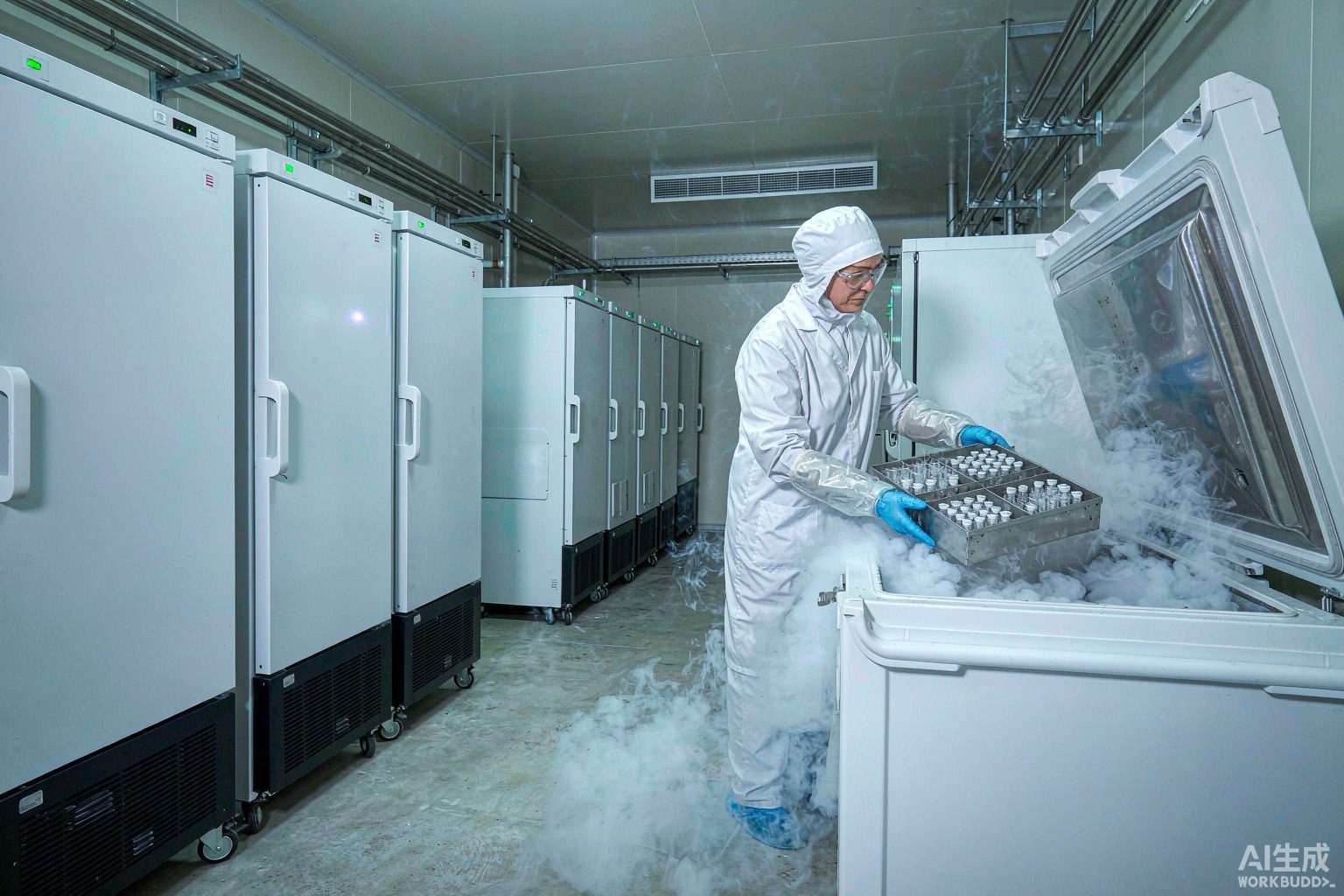
Bottom line first: When a biobank establishes an off-site backup repository, the primary criterion for label selection is not whether the label will stay adhered on the equipment at the off-site facility, but whether the ID and printed information remain readable, scannable, and reconcilable after the same cryovial completes the entire round-trip chain of "main repository -80 °C freezer or -196 °C LN₂ tank — dry ice transport — re-storage at off-site repository — later retrieval on demand." The sublimation point of dry ice is approximately -78.5 °C, only about 1.5 °C different from a -80 °C freezer. The real added threat is not the lower temperature limit, but condensate water inside the transfer box, vibration and friction, and the differing numbering conventions of the two repositories. This article follows a six-step path—"breakpoint identification — temperature chain — mirror coding — material tiering — printing and inventory — implementation SOP"—to provide an actionable selection path for dual-repository consistent identification. All materials and temperature tiers are cross-checked item by item against the official material guide table.
I. Why does an off-site backup repository need an independent identification strategy?
Off-site backup of critical samples is essentially converting "single point of failure" into "dual-point redundancy": hematopoietic stem cells, rare microbial strains, baseline serum from cohort studies, emergency outbreak strains—such samples are irreplaceable once lost to power failure, fire, or equipment malfunction. Therefore, mature biobanks aliquot the same sample into two or more copies, keeping the main repository in the home building and placing the backup repository in another campus or even another city. In ISO 20387:2018, which specifies competence and general requirements for biobanks, traceability across the sample lifecycle is a core clause—every transfer, every aliquot, every exchange of samples between the two repositories must be reconstructable into a complete chain through identification.
The problem is that most laboratories design their identification systems for a "single repository": the main repository's numbering rules, label materials, printing parameters, and scanning equipment all evolved around the home institution's workflow. Once an off-site backup repository is activated, it is equivalent to inserting a segment of "different people, different equipment, different software ledgers" into the chain out of thin air. If the identification layer is not aligned in advance, the two repositories operate independently, and reconciliation relies on manual conversion tables. The probability of misplacement, duplication, and loss during sample retrieval scales linearly with storage capacity. The independence of an off-site backup identification strategy is reflected in the fact that all four layers—coding, material, printing, and reading—must be specifically designed for "dual-repository round-trip," rather than simply duplicating single-repository labels twice.
II. Three typical breakpoints of dual-repository consistency failure
Reviewing multiple cases of off-site backup reconciliation failure, breakpoints concentrate in three areas, with a common feature: all single-repository tests pass, and problems only surface during dual-repository joint debugging. The table below breaks them down by "symptom—root cause—defense line," with each item elaborated in subsequent sections.
| Breakpoint | Typical symptom | Root cause | Defense line |
|---|---|---|---|
| Coding drift | The same sample has inconsistent IDs at the main and off-site repositories; reconciliation relies on manual conversion tables that grow increasingly chaotic | Each repository creates its own numbers without agreed mirror rules | Five-segment mirror coding with repository location as a separate segment (Section IV) |
| Labeling failure | Upon opening the transfer box for spot inspection, labels are found curled, detached, or with fogged print | Temperature shock combined with condensate water infiltration, or cold-labeling on frosted surfaces | Dual-stage resistant material + room-temperature dry labeling + overlap technique (Sections III, V) |
| Reconciliation chain break | Barcode scans instantly with the main repository's scanner but repeatedly fails on the same vial at the off-site repository | Printed ink layer not resistant to low-temperature condensation; generational differences in scanning equipment between the two repositories | Resin-based cryogenic ribbon + ISO/IEC 15416 grading acceptance + dual-repository first-article cross-check (Section VI) |
Among the three breakpoints, the third is most easily overlooked. Many laboratories treat "can it be scanned" as a scanner problem and simply swap the scanner. In reality, barcode reading failures are often seeded at the printing end—after the same label is infiltrated by dry ice condensate, the ink layer of a wax-based ribbon has already partially softened at the microscopic level. The main repository's high-power scanner may barely read it, but the older equipment at the off-site repository cannot read it at all. This is why dual-repository consistency must include graded acceptance at the printing stage, rather than troubleshooting only after reconciliation fails.
III. Temperature chain: three-stage challenge of main repository, dry ice transfer, and off-site repository
The complete temperature chain of off-site backup is three-stage: main repository residence, dry ice transport, and off-site repository re-storage. Broken down, each stage poses different challenges to labels.
| Chain segment | Temperature environment | Typical duration | Label challenge | Material baseline |
|---|---|---|---|---|
| Main repository residence | -80 °C freezer or -196 °C LN₂ tank | Months to years | Long-term low-temperature aging, repeated door opening with frost and thaw | Material suitable for both LN₂ and freezer tiers simultaneously |
| Dry ice transport | Dry ice environment approx. -78.5 °C | Hours to 48 hours | Condensate water infiltration, bumping and vibration friction, humidity fluctuations inside the box | Freezer-tier suitable + abrasion-resistant face stock + wrap-around technique |
| Off-site repository re-storage | -80 °C freezer or -196 °C LN₂ tank | Months to years | Temperature field differences of new equipment, secondary frosting, different operator habits | Same as main repository segment; same material recommended to reduce variables |
Here is a key conclusion: The dry ice segment does not introduce a new lower temperature limit. The sublimation point of dry ice at standard atmospheric pressure is approximately -78.5 °C, only about 1.5 °C higher than a -80 °C freezer—meaning that any material checked for the freezer -80 °C tier in the official material guide table inherently covers the dry ice transport segment on the temperature dimension. There is no need to purchase a separate so-called new material tier for "dry ice." The real incremental threat in the dry ice segment is at the mechanical and chemical level: dry ice sublimation inside the transfer box absorbs moisture, continuously producing liquid condensate on the box walls and vial surfaces. Combined with vibration-induced friction between labels and box walls during transport, this tests face stock abrasion resistance, ink adhesion, and labeling wrap-around technique far more severely than static freezing. If both the main and off-site repositories are LN₂ tanks, the labels must additionally withstand a temperature differential of approximately 116 °C from the -80 °C pre-freeze stage to the -196 °C LN₂ stage—not a single step of overlap and wrap-around technique can be omitted.

Another easily overlooked detail is labeling timing. Transfer orders for off-site backup are usually scheduled the day before loading. The correct approach is to complete labeling on room-temperature dry vial surfaces and let stand so the adhesive layer fully wets out, then pack into dry ice. Never "cold-label" on frosted or condensate-covered vial surfaces—the adhesive bonds to the water film rather than the polypropylene vial body. When the box is opened and warmed at the off-site repository, the water film sublimates or slips, and the entire label lifts. This type of failure is obvious during opening inspection, but the remediation window has already passed; samples can only be re-labeled and re-stored, instantly misaligning the ledger and physical inventory.
IV. Dual-repository mirror coding: five-segment structure and repository location segment
The skeleton of dual-repository consistency is coding. A five-segment structure is recommended, incorporating "repository" as an independent segment in the ID rather than hiding it in a remarks field:
| Segment | Example | Meaning | Information carrier |
|---|---|---|---|
| Segment 1: Repository location | A / B | A = main repository, B = off-site backup repository | First character of code + label pre-printed color |
| Segment 2: Equipment position | F02 / LN3 | -80 °C freezer number or LN₂ tank number | Second segment of code |
| Segment 3: Box position | B0147 | Cryobox serial number, consistent with the large label on the box | Box label |
| Segment 4: Vial position | R03C05 | Row 3, column 5 well position within the box | Second line of vial label |
| Segment 5: Sample serial | 20261104-018 | Storage date + daily serial number | Barcode/2D code data segment |
There is only one mirror rule: The sample serial segment of the off-site copy is identical to the main repository; only the repository location segment changes. That is, if the ID on the main repository vial is A-F02-B0147-R03C05-20261104-018, the aliquot copy at the off-site repository is B-F05-B0021-R01C02-20261104-018—the middle three segments can be rearranged according to the off-site repository's equipment and box positions, but the first and last segments (repository location + sample serial) pin both vials to the same sample. During reconciliation, only the sample serial segment and inventory quantity columns need to be compared; a reconciliation table of tens of thousands of vials across two repositories can be completed with a single VLOOKUP in a spreadsheet. During sample retrieval, the serial segment allows reverse lookup of positions in both repositories, and any label damage at any point can be traced level by level through the remaining segments.
The repository location segment can also be pushed down to the visual layer: use cryogenic freezer labels with pre-printed top colors such as T439 as inventory ownership color codes—the main repository uses one pre-printed color uniformly, and the off-site backup repository uses another. During box opening or inventory, it is immediately visible "which repository this vial belongs to," intercepting cross-repository mixing risk at the visual layer. Color codes do not replace barcodes; they simply add a zero-cost redundancy criterion to the barcode system.
V. Material tiering: matching tier by tier against the official material guide
The material requirements for dual-repository round-trip can be summarized in one sentence: Materials that remain at both the main and off-site repository segments must be checked for both the LN₂ and freezer tiers in the official guide table; the dry ice segment follows the freezer tier. The table below transcribes the official material guide table item by item; "—" indicates that the tier is not checked in the official table.
| Material code | Material and structure (official description) | LN₂ -196 °C | Freezer -80 °C | Hot water 100 °C | Autoclave 121 °C | Dual-repository chain positioning |
|---|---|---|---|---|---|---|
| T629 | Nylon cloth label, easy to apply, high/low temperature resistant, good conformability, for all laboratory labeling needs | √ | √ | √ | √ | Preferred general-purpose choice for dual repositories; checked for room temperature/microscope slides/cryovials/conical tubes, single material throughout reduces mixing |
| T429 | Ideal for labeling frozen surfaces; when applied to frozen vial surfaces, overlap at least 3 mm at both ends | √ | √ | √ | √ | Cryovial body flat-surface labeling; packaging labeling tier also checked, can simultaneously be used for transfer box outer labeling |
| T459 | Ultra-thin polyester label with transparent tail self-laminating design, protects printed content and provides a transparent window for liquid level observation | √ | √ | √ | √ | Preferred for LN₂ dual repositories when liquid level and vial position observation is needed without removing the cryo-rack |
| T439 | 6-color cryogenic label with pre-printed color at top for quick visual identification of container type classification | √ | √ | √ | — | Dedicated model for dual-repository color code management, using pre-printed colors to distinguish inventory ownership |
| T509 | Durable vinyl label, suitable for wrapping, good conformability; requires overlap when used in LN₂ environments | √ | √ | √ | — | Wrap-around coverage for thin tubes and general containers; good vibration and friction resistance in dry ice segment |
| T419 | Bright white PET material, for cryovials and microcentrifuge tubes, resistant to environments above -40 °C | — | — | — | — | Cannot cover -80 °C and LN₂ segments; limited to room-temperature ledgers and transfer stages |
| T329 | Matte white/PP adhesive, resistant to -40 °C low-temperature freezing | — | — | — | — | Cannot cover -80 °C and LN₂ segments; limited to room temperature and short-term refrigerated stages |
Four selection judgments. First, T629 is the most worry-free general solution in the dual-repository chain: nylon cloth substrate has good conformability, all four temperature tiers apply, and all four application categories—room temperature, microscope slides, cryovials, and conical tubes—are checked in the official table. From room-temperature aliquoting, main repository freezing, dry ice transfer, off-site repository re-storage, to eventual retrieval and checkout, a single material can be used throughout, removing the "material mixing error" variable directly from the process. Second, T429's 3 mm overlap is a hard process specification in the official table; the original text explicitly states "when applied to frozen vial surfaces, overlap at least 3 mm at both ends." The vibration and friction of the dry ice segment rely entirely on this ring of overlap for mechanical protection, and it should be treated as an incoming inspection item rather than a labeling suggestion. Its packaging labeling application tier is also checked, so the large labels on transfer box exteriors can use the same material as the vial bodies. Third, T459's self-laminating film plus transparent tail is a functional structure designed for LN₂ dual repositories: the laminate encases the printed content under film, so condensate water and friction cannot damage the ink layer; the transparent tail provides a window for liquid level observation, so the off-site repository can confirm LN₂ level without removing the entire rack of samples during replenishment. Fourth, T509 wrap-around vinyl label is the preferred choice for thin-tube containers in the dry ice segment; wrap-around coverage naturally resists vibration and friction, and requires overlap in LN₂ environments. Note that it is not checked for the autoclave tier in the official table—if your workflow includes a "sterilize before aliquoting and storage" step, the sterilization segment should use materials checked for all four tiers, such as T629 or T459.
Reverse exclusion is equally important: T419 and T329, the economy models officially rated for "-40 °C," cannot cover the -80 °C dual-repository segment, let alone the LN₂ segment. They are only suitable for room-temperature ledger cards, room-temperature transfer baskets, and paper document circulation. Applying such labels to cryovials entering an off-site backup repository is the most common source of batch rework—they look perfectly adhered at storage, but after one frost-thaw cycle the entire batch curls.
VI. Printing end: dual-repository print consistency and resin-based cryogenic ribbon
The most insidious pitfall in dual-repository joint debugging is at the printing end. The main and off-site repositories often have their own printing equipment. If ribbons and printing parameters are inconsistent, the barcodes printed on both sides—while appearing "roughly the same to the naked eye"—may differ by a full grade in actual density and edge contrast. The main repository's scanner reads smoothly, but the off-site repository's equipment may not. Three countermeasures:
First, unify the ribbon system: when both repositories print labels of the same coding system, uniformly use resin-based cryogenic ribbon, such as BRL-80-B09 Boerjie LAB laboratory-specific cryogenic ribbon (black, 80 mm × 300 m specification). Purchase the same batch and distribute to both repositories; set printing temperature and pressure parameters according to the same SOP. Wax-based and mixed-based ribbons are prone to ink layer softening and smearing under low-temperature condensate environments. Most cases of "this repository can scan but that one cannot" during dual-repository reconciliation ultimately trace back to the ribbon. Second, first-article cross-check: before each batch of labels is printed, the main and off-site repositories each print a first article and mail or photograph them for comparison. Grade and accept 1D barcode print quality according to ISO/IEC 15416 (2D codes per ISO/IEC 15415); batch printing is permitted only when both repositories' first-article grades match. Third, batch-to-batch adhesive performance comparison: conduct batch-to-batch sampling tests of label peel strength and holding tack per GB/T 2792-2014 and GB/T 4851-2014 to prevent adhesive layer performance drift between batches—the dual-repository round-trip tests the adhesive layer more severely than single-repository static storage, and batch-to-batch drift will first surface in the transfer segment.
VII. Inventory reconciliation: barcode primary, RFID supplementary
The recommended dual-repository inventory cadence is "monthly sampling, annual full count": monthly, each repository samples 10% by box position to recheck barcode readability and position consistency; annually, conduct a full reconciliation, cross-checking the set of main repository serial segments against the set of off-site repository serial segments, and immediately flag any serial number appearing on only one side for review. The acceptance benchmark for the barcode system follows the ISO/IEC 15416 grading in Section VI. Laboratory quality system context can align with ISO 17025:2017 requirements for record traceability; biosafety operational aspects should be managed per GB 19489-2008 general requirements for transfer handover. For cold chain transport segment temperature records and handover documentation management, the GSP management approach for refrigerated pharmaceutical transport—"full-process temperature traceability, immediate handling upon exceedance"—can be referenced, equipping dry ice transfer boxes with temperature data loggers so that upon arrival, temperature curves and barcode rechecks are performed together.
As sample volumes grow, the inventory cost of scanning barcodes vial by vial will prompt many biobanks to consider RFID. The value of RFID inventory is especially prominent at off-site repositories—remote facilities have fewer staff, and batch non-contact reading can significantly shorten the annual full inventory cycle. For air interface protocols, mature standards such as ISO 15693 (13.56 MHz high frequency) can be referenced. During selection, note the impact of low temperature and liquid environments on read rates: sample liquid inside cryovials and metal cryo-racks both attenuate RF signals. Be sure to validate read rates in actual low-temperature storage before batch deployment. The on-site TRUF low-temperature, solvent-resistant, liquid-resistant RFID labels (suitable for Petri dishes, microplates, and other containers) can serve as one starting point for such validation; contact the product manager for specific model and reading environment adaptation recommendations.
VIII. Six-step implementation SOP
Compress the above into an operation sheet that can be handed directly to warehouse staff:
Step 1: Dual-repository coding rules first: establish the five-segment structure; make the repository location segment (main repository A / off-site repository B) and the sample serial segment unique in both repositories' ledger systems; every vial must have an ID before storage.
Step 2: Select materials per the official matrix: vial body labels that remain at both the main and off-site repository segments must be selected from materials checked for both LN₂ and freezer tiers (T629 / T429 / T459 primarily); use T509 for thin-tube wrap positions; use T439 pre-printed colors for inventory ownership color codes.
Step 3: Room-temperature dry labeling + overlap: complete labeling the day before loading; the circumferential overlap on vial bodies must be no less than 3 mm; cold labeling on frosted surfaces is prohibited; use T429 or T629 for large box codes on transfer box exteriors.
Step 4: Dual-repository first-article print cross-check: unify resin-based cryogenic ribbon and printing parameters; batch print only after both repositories' first articles grade consistently per ISO/IEC 15416.
Step 5: Dry ice transfer and arrival re-inspection: equip transfer boxes with temperature data loggers; upon arrival, first verify the temperature curve, then open the box to spot-check label edges and barcode re-read rates; isolate and handle abnormal samples separately before storage.
Step 6: Periodic reconciliation closed loop: monthly sampling, annual full count, cross-check dual-repository serial segment intersection, flag discrepant samples for review, and record disposition conclusions in the ledger, forming a record chain referenceable under the ISO 17025:2017 system.
Recommended Products
For the label materials and application scenarios covered in this article, the following BRD products are available for selection reference (click to view specifications and request a quote):
- Lab112-629/35x25mm Biobank Cryovial EP Tube Microscope Slide -196 °C LN₂ Nylon Cloth Label (¥1490/PCS)
- Lab169-429/25X17mm-3-column Biobank Cryovial Microscope Slide -80~-196 °C Polyester Label (Price on request)
- Lab115-459/9.53+65x9.53 Biobank Conical Tube Cryogenic Cryovial PET Self-Laminating Label (Price on request)
- T439 Biobank LN₂ Color-Coded Cryogenic Label Stickers (pre-printed 6 colors) (Price on request)
- BRL-80-BK Boerjie LAB Laboratory-Specific Cryogenic Ribbon - Black Ribbon - 80MMX300m (Price on request)
FAQ
Q1: Must off-site backup repository labels be the same model as the main repository?
A: Coding and printing parameters must be consistent; materials are recommended to be consistent but may be tiered by position. Mirror coding and resin-based ribbon printing are hard prerequisites for dual-repository reconciliation. At the material level, as long as labels remaining at both the main and off-site repository segments are within the range checked for both LN₂ and freezer tiers in the official matrix (such as T629, T429, T459), using the same model minimizes variables to the greatest extent; switching to T509 for thin-tube wrap positions is a reasonable practice of tiering by position.
Q2: Can economy labels rated only for -40 °C be used in an off-site backup repository?
A: No. T419 and T329 are officially rated for environments above -40 °C and cannot cover the -80 °C dual-repository residence segment, let alone the -196 °C LN₂ segment. They are only suitable for room-temperature ledger cards, room-temperature transfer, and paper documents. Applying -40 °C tier labels to cryovials entering a backup repository may result in entire batches curling and requiring rework after just one frost-thaw cycle.
Q3: Do I need to purchase special "dry ice labels" for dry ice transport?
A: No separate temperature tier purchase is needed. The sublimation point of dry ice is approximately -78.5 °C, only about 1.5 °C different from a -80 °C freezer. Materials checked for the freezer tier in the official matrix inherently cover the dry ice segment on the temperature dimension. What truly needs to be added is mechanical protection—abrasion-resistant face stock, wrap-around coverage, and overlap of no less than 3 mm at both ends—to counter condensate water infiltration and bumping friction inside the transfer box.
Q4: Should dual-repository barcodes use 1D or 2D codes?
A: Both are acceptable, with different acceptance standards. 1D codes have smaller data capacity but the best scanning compatibility; grade print quality per ISO/IEC 15416. 2D codes have large capacity per unit area and can fit the entire five-segment code string onto small vial body labels; accept per ISO/IEC 15415. The key is that regardless of symbology, the mirror rule for data segments must be consistent: the off-site copy's sample serial segment is completely identical to the main repository; only the repository location segment changes.
Q5: Is handwritten numbering plus an Excel ledger acceptable?
A: Not recommended as the primary system. Handwritten content cannot undergo print quality grading acceptance; cryogenic markers smear easily under condensate; and manual transcription by two people introduces transcription errors. An Excel ledger has no machine-readable anchor bound to physical items, so reconciliation can only be done manually line by line. The traceability requirements of ISO 20387:2018 ultimately rely on "machine-readable physical identification + cross-checkable ledger records" for closure; thermal-transfer printing is the lowest-cost path to compliance.
Q6: What is the first thing to do upon arrival after dry ice transfer?
A: Verify first, then store. The sequence is: verify the temperature data logger curve to confirm no temperature exceedance throughout; open the box to spot-check label edges for curling and film surfaces for abrasion; randomly sample 5%–10% for barcode re-reading; only after all pass, scan and store on shelves. Any abnormal vial should first be isolated and flagged; determine whether it is transfer damage or a printing issue before deciding disposition—do not mix into normal batches for storage.
Q7: Is RFID inventory worth deploying for an off-site backup repository?
A: Benefits are significant when sample volumes are large, off-site staffing is limited, and the annual full inventory cycle is long. For protocol selection, mature air interface standards such as ISO 15693 can be referenced. Before deployment, be sure to validate read rates in actual low-temperature environments—sample liquid and metal cryo-racks both attenuate RF signals. If validation does not meet standards, fall back to the barcode system; do not adopt technology for technology's sake.