

Bottom line first: The primary criterion for cryogenic labels used in controlled-rate freezing containers is not whether the label can withstand -196 °C LN₂, but how many complete cycles the same batch of cryovials must undergo: "-80 °C controlled-rate cooling — isopropanol immersion — transfer to LN₂ within 24 hours — rewarming upon retrieval." Isopropanol has a melting point of approximately -89.5 °C and remains liquid inside a -80 °C freezer, continuously wetting the label edges and adhesive layer. When cryovials are transferred from -80 °C to -196 °C LN₂, the temperature differential reaches 116 °C, and any minor interfacial defect will be amplified during these two transitions into edge lifting, detachment, or unreadable barcodes. This article presents an actionable selection path in five steps: "stress decomposition — material tiering — labeling process — coding rules — printing and verification." All temperature tiers are cross-checked item by item against the official material guide table.
1. Why controlled-rate freezing containers reverse the selection sequence
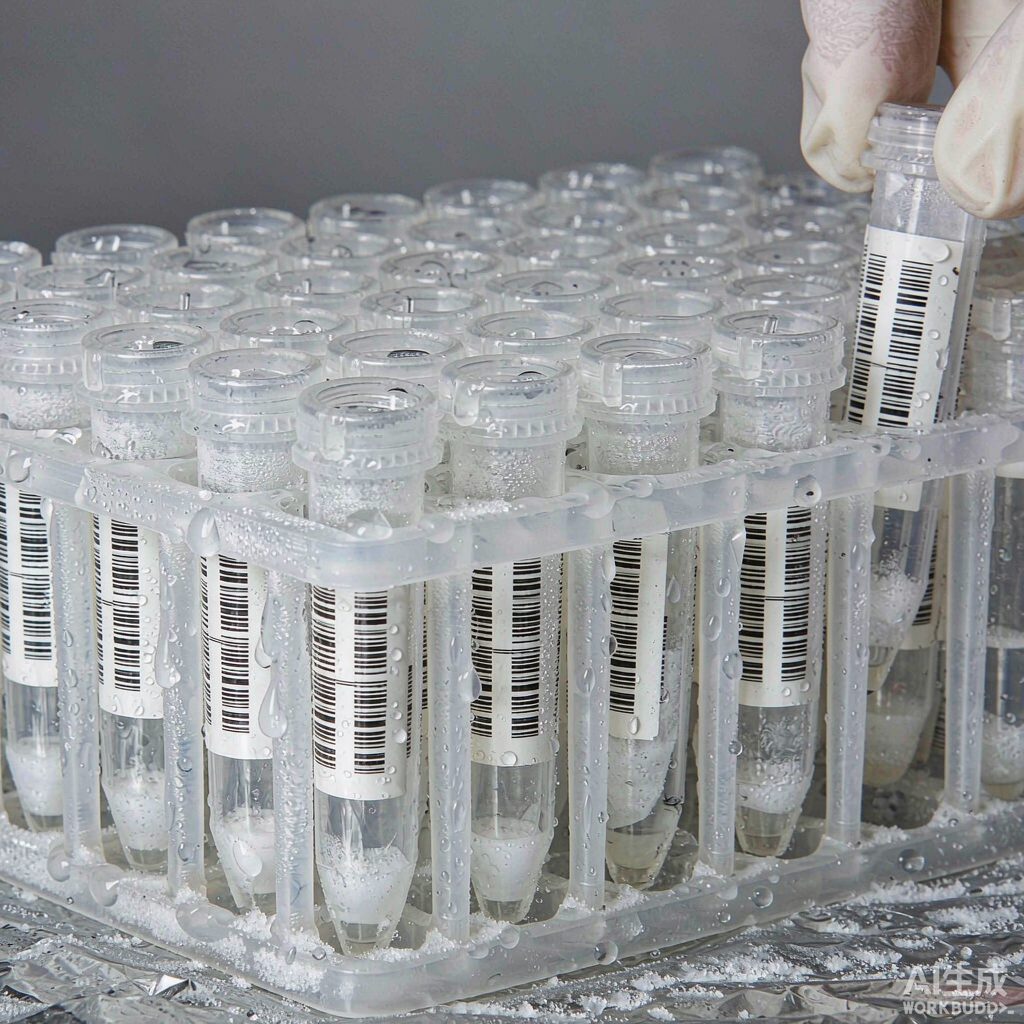
The conventional selection sequence in biobanks is "check the lowest temperature first": ask directly whether a label withstands -196 °C, then discuss everything else. But in controlled-rate freezing container (gradient cooling container) workflows, this sequence misses the real source of failure. A 2 mL cryovial undergoes three consecutive stages with completely different conditions during the controlled-rate freezing process: the cooling stage, from 4 °C down to -80 °C over several hours, during which the label and the polypropylene tube body contract synchronously at different shrinkage rates; the dwell stage, standing overnight in a -80 °C freezer for 12–24 hours, during which the lower half of the tube may be fully immersed in liquid isopropanol vapor and condensate; the transfer stage, direct transfer from -80 °C to -196 °C LN₂, where a Δ116 °C instantaneous thermal shock combines with rapid boiling heat transfer in LN₂. Across these three stages, the lowest temperature only determines the material floor for the third stage, while the highest failure probability often comes from chemical wetting in the second stage and shrinkage mismatch in the first stage.
This is also why the same "LN₂-resistant" label performs well in some laboratories but suffers batch edge lifting after three to five cycles in others — the difference lies not in temperature but in cycle count and isopropanol contact location. ISO 20387:2018 sets traceability requirements for biobank identification and process control, but the standard will not determine for you which stage is the weak link; decomposing the three stages of stress and matching materials item by item is the only reliable selection method in controlled-rate freezing workflows.
2. Where -1 °C/min comes from: the gradient cooling curve and label position
The design goal of a classic isopropanol controlled-rate freezing container is to cool the cryovials inside from 4 °C to -80 °C at approximately -1 °C/min. This rate derives from the classic balance of slow freezing: if cooling is too fast, intracellular water cannot exude in time and intracellular ice crystals directly rupture the cell membrane; if cooling is too slow, solutes continue to concentrate in the residual liquid phase, prolonging exposure to electrolyte toxicity. Approximately -1 °C/min is the compromise validated by numerous cell and strain cryopreservation protocols, and it is the entire purpose of the controlled-rate freezing container — using a plastic box filled with isopropanol to convert a -80 °C freezer, a device that cools freely, into an approximately linear cooling curve.
For labels, this curve means two things. First, time is extended: cooling from 4 °C to -80 °C typically takes more than 4 hours, and with overnight dwell, the label must work continuously for over 12 hours at an interface where low temperature and solvent coexist, far longer than in vitrification protocols involving direct immersion in LN₂. Second, position determines contact dose: tubes at the bottom layer of the container contact the most isopropanol, while upper layers are mainly exposed to vapor; label failure within the same container often starts from the bottom layer. When selecting, do not think in terms of "uniform for the whole container" but in terms of contact-dose stratification.
3. Isopropanol wetting: the chemical stress most selection checklists miss
Why is isopropanol still liquid at -80 °C? Because its melting point is approximately -89.5 °C, nearly 10 °C lower than -80 °C. This means the isopropanol in a controlled-rate freezing container exists as liquid or saturated vapor throughout the entire cooling process, continuously contacting the labels on the lower half of the cryovials. For labels, this brings three types of chemical stress: first, adhesive plasticization, where alcohol molecules penetrate the pressure-sensitive adhesive and reduce cohesive strength, manifesting as whitening and lifting of label edges when the container is opened; second, face stock swelling, where some coated papers and inferior film materials delaminate after prolonged alcohol immersion; third, ink layer dissolution, where the printed layer of wax-based ribbons is sensitive to organic solvents and may suffer rub-off ink loss upon alcohol contact, with barcodes smearing at a single wipe.
There are three corresponding selection actions. First, prioritize face stocks positioned as "chemical-resistant": T409 is positioned in the official guide table as having excellent chemical resistance and abrasion resistance, used for labeling frozen/cryogenic conditions with end-to-end overlap, making it the preferred face stock for direct isopropanol contact locations. Second, for any tube entering the LN₂ stage, the overlap process cannot be omitted: overlap essentially changes "adhesive resisting peel" into "face stock wrapping around itself to resist peel," and under -196 °C conditions where the adhesive vitrifies, mechanical wrapping is more reliable than adhesion. Third, the printed ink layer must be compatible with the solvent, which is elaborated in Section 7.
4. Taking tiers one by one from the official material matrix
The table below transcribes item by item the applicability of four temperature tiers according to the official material guide table; "—" indicates that the tier is not checked in the official table. The tier selection rule for controlled-rate freezing workflows is clear: for any endpoint involving -80 °C dwell and -196 °C LN₂ stages, materials must be selected from those checked for both LN₂ and freezer tiers; economy grades checked only for ambient temperature and cryovials with resistance above -40 °C cannot cover the -80 °C gradient cooling stage, let alone enter the LN₂ stage, and can only be used for ambient-temperature steps at either end of the process.
| Material code | Material and structure (official description) | LN₂ -196 °C | Freezer -80 °C | Hot water 100 °C | Autoclave 121 °C | Positioning in controlled-rate freezing workflow |
|---|---|---|---|---|---|---|
| T629 | Nylon cloth label, easy to apply, high and low temperature resistant, good conformability, for all laboratory labeling needs | √ | √ | √ | √ | Preferred general-purpose choice for the full workflow; checked for cryovials/conical tubes/microscope slides/ambient temperature |
| T459 | Ultra-thin polyester self-laminating label with transparent tail, protecting printed content while leaving a transparent window for observing liquid level | √ | √ | √ | √ | Preferred when visual observation of liquid level or tube position inside LN₂ tanks is required |
| T429 | Ideal choice for labeling frozen surfaces; at least 3 mm end-to-end overlap required when applied to frozen tube surfaces | √ | √ | √ | √ | Flat-surface labeling on cryovial bodies and packaging labels |
| T409 | Excellent chemical resistance and abrasion resistance; for labeling frozen/cryogenic (end-to-end overlap) or ambient-temperature bottles and test tubes | √ | √ | √ | — | Preferred face stock for direct isopropanol contact locations |
| T509 | Durable vinyl label, suitable for wrapping, good conformability; overlap required for LN₂ environments | √ | √ | √ | — | Wrap-around coverage for thin tubes/conical tubes |
| T419 | Bright white PET material, for cryovials and microcentrifuge tubes, resistant to environments above -40 °C | — | — | — | — | Ambient-temperature transfer steps only; cannot cover the -80 °C stage |
| T329 | Matte white/PP adhesive, -40 °C low-temperature freezer label | — | — | — | — | Ambient temperature/short-term refrigerated steps only |
Three supplementary judgments. First, T629 is the most worry-free general solution in controlled-rate freezing workflows: the nylon cloth substrate has good conformability, all four temperature tiers apply, and all four application categories — ambient temperature, microscope slides, cryovials, and conical tubes — are checked, so a single tube can use one material from ambient-temperature inoculation through gradient cooling, LN₂ storage, and post-recovery transfer to slides, reducing mixing errors. Second, the transparent tail of T459 is a functional element inside LN₂ tanks, not merely decorative: the self-laminating structure protects printed content while leaving a window for observing liquid level; for biobanks that need to confirm liquid level and tube position without removing cryoracks, this structure directly reduces one thawing risk. Third, the 3 mm overlap of T429 is a hard specification: the official table explicitly states "at least 3 mm end-to-end overlap when applied to frozen tube surfaces," which is not a recommended value but a process floor and should be used as an incoming inspection item.
Also note a common misjudgment: the wrap-around vinyl label T509 has excellent conformability and coverage, but its autoclave 121 °C tier is not checked in the official table — that is, if your cryovial workflow includes a "121 °C sterilization before aliquoting" step, the sterilization stage must switch to a material checked for all four tiers such as T629 or T459; T509 cannot cover the 121 °C tier. Likewise, T409 cannot cover the 121 °C autoclave tier (not checked in the official table), and the same applies to workflows with sterilization as a preceding step. Material tiering must be matched stage by stage according to the workflow and cannot be summarized in one sentence as "which one is most freeze-resistant."
5. Labeling process: overlap, wrap-around, and self-laminating windows
Once the material is selected, the process determines success. There are four typical labeling positions in controlled-rate freezing workflows, each with different geometry and stress:
| Labeling position | Geometry/conditions | Process key points | Material recommendation |
|---|---|---|---|
| Cryovial body circumference (1.8/2.0 mL) | Cylindrical curved surface with outer diameter approximately 12.5 mm; transferred to -196 °C after -80 °C dwell | Wrap-around coverage with end-to-end overlap of no less than 3 mm; printed side facing outward to prevent scraping when inserting the tube into container holes | T429 flat type or T509 wrap-around type |
| Lower half of conical cryovials/conical tubes | Tapered curved surface; highest isopropanol contact dose | Choose cloth-based or wrap-around film-based materials with good conformability; after application, roll along the tapered surface to remove bubbles | T509 wrap-around, T629 nylon cloth |
| Tube positions inside LN₂ tanks requiring liquid-level observation | Dim light and frost inside the tank | Place transparent tail window facing up; press the laminate firmly over the printed area | T459 self-laminating |
| Controlled-rate freezing container body and lid | Repeated opening and closing from ambient to -80 °C; isopropanol fill port residue | Apply large-format label with container number to the front of the container body; apply tube-position cross-reference table to the inside of the lid | T629 nylon cloth |
Two process details are easily overlooked. First, labeling timing: complete labeling on ambient-temperature dry tube surfaces before entering the cooling process whenever possible, avoiding "cold labeling" on frosted surfaces — the frost layer itself is an isolation interface, and the adhesive bonds to ice rather than polypropylene; upon rewarming, the ice sublimates and the entire label floats up. Second, isopropanol fill location: labels near the fill line inside the container receive the highest exposure dose; the fill volume specified in the controlled-rate freezing container instructions is based on just immersing the bottom, and overfilling will leave the bottom-layer labels soaked in liquid for extended periods; labels at this position should be selected under the dual criteria of "chemical resistance + overlap."
6. Container position coding: five-segment numbering and tube-position mapping
Controlled-rate freezing workflows naturally add a "container" layer management object: tubes are first queued in the container, then the container goes into the freezer, and within 24 hours the container must be transferred to the LN₂ rack. If the numbering system has no container layer, verification during transfer can only rely on manual tube-by-tube comparison. A five-segment code is recommended, with the "container number" as the physical carrier code:
| Segment | Example | Meaning | Information carrier |
|---|---|---|---|
| Segment 1: Storage zone | A / B | Main bank and backup bank (or main bank and working bank) | First character of code |
| Segment 2: Equipment | F02 / LN3 | -80 °C freezer number or LN₂ tank number | Second segment of code |
| Segment 3: Container number | B0147 | Controlled-rate freezing container serial number, consistent with the container body label | Large label on container body |
| Segment 4: Tube position | R03C05 | Well position at row 3, column 5 inside the container | Second line of tube label |
| Segment 5: Specimen serial | 20261103-018 | Accession date plus daily serial number | Barcode/2D code data segment |
The value of the five-segment code is realized at the moment of transfer: when retrieving container B0147 from the freezer, the transfer sheet only states "B0147 → LN3 rack, level 2," and the verification object is the container rather than individual tubes; after racking, spot-check verification is performed by tube-position segment. ISO 15189:2022 requires that medical laboratory specimen identification be "unique and maintained throughout the entire process"; the five-segment code ensures that tubes within containers and containers within racks each have unique coordinates at every layer, and any label damage at any step can be traced and located through the remaining segments.
7. Printing side: performance differences between resin-based and wax-based ribbons in isopropanol
Thermal-transfer printing is the mainstream solution for cryogenic labels, but wax-based and resin-based ribbons perform very differently in controlled-rate freezing workflows. Wax-based ribbons have a high wax proportion in the ink layer and weak solvent resistance; under isopropanol wetting plus low-temperature friction, the ink layer is prone to rub-off ink loss. Resin-based ribbons have significantly better chemical resistance and scratch resistance in the ink layer, making them the reliable choice for cryogenic scenarios. BradyLAB's BRL-80-B09 laboratory-specific cryogenic ribbon is an 80 mm width resin-based cryogenic ribbon positioned for this scenario, used in combination with Lab series cryogenic labels.
Print quality must be verified before labeling, not acknowledged after failure. Grade print quality according to ISO/IEC 15416 for 1D barcodes and ISO/IEC 15415 for 2D DataMatrix; a grade of no less than C is recommended, with the specific acceptance grade subject to the thresholds of downstream code-reading equipment and the bank management system. In practice, there are two print settings that improve cryogenic readability: first, appropriately increase the narrow bar width (X dimension) to compensate for the loss from limited scanning angles after curved-surface labeling; second, retain human-readable plain text below the 2D code, so that in frosted LN₂ tank environments where scanners occasionally fail, the human-readable text is the final fallback.
8. Six-step implementation SOP
Condense the preceding conclusions into an actionable checklist:
Step 1, map the process stages: divide your facility's cryopreservation workflow into "ambient-temperature labeling — gradient cooling — -80 °C dwell — transfer to LN₂ — long-term storage — retrieval and rewarming," and mark the temperature and contact medium for each stage. Step 2, select tiers stage by stage: against the matrix in Section 4, select for each stage a material officially checked to cover that tier; for workflows with sterilization as a preceding step, note that T509 and T409 cannot cover the 121 °C tier. Step 3, define the process: tube-body wrap-around overlap of no less than 3 mm; add chemical-resistant face stock at direct isopropanol contact locations; select self-laminating window types for LN₂ observation positions. Step 4, define coding: enter the five-segment code into the database, make the container number a large label on the container body, and apply the tube-position cross-reference table to the inside of the lid. Step 5, verify printing: verify grades according to ISO/IEC 15416 and ISO/IEC 15415, and retain batch samples of resin-based ribbons. Step 6, run cycle validation: for each new material and new process combination, run at least 3 complete "cooling — transfer — rewarming" cycles before full-scale rollout; validation items include edge lifting, ink layer rub-off, and barcode re-read rate.
9. Five types of failure phenomena and troubleshooting
| Failure phenomenon | High-probability root cause | Troubleshooting and countermeasures |
|---|---|---|
| Label edges overall whitening and lifting when removing from container | Adhesive plasticized by isopropanol, or frost on tube surface during labeling | Switch to chemical-resistant face stock and re-verify labeling environment humidity; labeling must be completed on ambient-temperature dry tube surfaces |
| Barcode unreadable after transfer to LN₂ | Shrinkage rate mismatch between face stock and tube body; barcode deformation out of tolerance | Re-verify print grade and curved-surface X dimension; appropriately increase overlap amount for wrap-around labels |
| Ink layer smears at a single wipe | Wax-based ribbon not alcohol-resistant | Switch to resin-based cryogenic ribbon; retain batch samples for re-verification |
| Bottom-layer labels fail while upper layers intact | Excessive isopropanol fill; contact dose stratification | Control fill volume according to the instruction fill line; switch bottom layer to chemical-resistant face stock such as T409 |
| Container number clear but tube positions do not match | Code lacks tube-position segment or lid lacks cross-reference table | Add the fourth segment of the five-segment code; apply tube-position cross-reference table to the inside of the lid |
10. Compliance records and system integration
Label selection itself must also be documented. ISO 20387:2018 sets system-level requirements for biobank identification uniqueness and process traceability; material selection rationale, process parameters, and validation records should all be incorporated into controlled documents. The technical record requirements in Clause 7.5 of ISO 17025:2017 also apply to material change records in cryopreservation workflows. For medical laboratories managing specimen identification according to ISO 15189:2022, label acceptance records for controlled-rate freezing workflows are recommended to be stored in the same file as specimen receipt records; for those involved in cell therapy products or device-related R&D, the purchasing and process control clauses of ISO 13485:2016 also bring label consumables into qualified supplier management. Methodological benchmarks for adhesive performance may reference the 180° peel strength in GB/T 2792-2014 and the holding tack test in GB/T 4851-2014 as unified criteria for batch-to-batch consistency comparison of incoming materials.
Finally, returning to the conclusion at the beginning: in controlled-rate freezing container workflows, the label's enemy is not the -80 °C freezer, nor the -196 °C LN₂, but the combination of "repeated cycling + continuous chemical wetting + two temperature transitions." Write cycle count and contact medium into the first line of selection criteria, and the subsequent material tiering, overlap process, and coding rules will have a foundation to stand on.
Recommended Products
For the label materials and application scenarios covered in this article, the following BradyLAB (BRD) products are available for selection reference (click to view specifications and request a quote):
- Lab112-629/35x25mm样本库冻存管EP管载玻片-196℃液氮尼龙布标签(¥1490/PCS)
- Lab014-629/50x30mm样本库冻存管EP管载玻片-196℃液氮尼龙布标签(¥1890/卷)
- Lab169-429/25X17mm-3列样本库冻存管载玻片-80~-196℃聚酯标签(询价)
- BRL-80-BK 博尔杰LAB实验室专用低温碳带-黑色碳带-80MMX300米(询价)
FAQ
Q1: Do labels in controlled-rate freezing container workflows need to be LN₂-resistant? Is -80 °C alone sufficient?
A: LN₂ resistance is required. Gradient cooling is only the middle stage of the workflow; within 24 hours after cooling is complete, the container is typically transferred to -196 °C LN₂ for long-term storage, and the label's dwell time in the LN₂ stage far exceeds that in the cooling stage. Materials must be selected from those checked for both LN₂ and freezer tiers in the official matrix; T419 and T329, which are only resistant above -40 °C, cannot cover the -80 °C gradient cooling stage, let alone enter the LN₂ stage.
Q2: Are economy grades at the -40 °C tier, such as T419 and T329, completely unusable in controlled-rate freezing workflows?
A: They are not completely unusable, but must be placed in the right position. They are checked only for ambient-temperature and cryovial ambient-temperature applications, resistant to environments above -40 °C, and can be used for ambient-temperature steps at either end of the process, such as ambient-temperature colony picking, temporary transfer, and packaging labels. However, they cannot cover the -80 °C dwell stage or the LN₂ stage; applying such labels into controlled-rate freezing containers is a common cause of batch failure.
Q3: Should labels be applied to the tube cap or the tube body?
A: The unique identifier must be on the tube body circumference. Cryovial caps may be unscrewed, swapped, or replaced during handling, so cap-top identification can only serve as an auxiliary color code; only wrap-around labels on the tube body combined with a process of end-to-end overlap of no less than 3 mm can ensure the identifier remains unique and inseparable throughout the entire handling chain.
Q4: Is handwriting acceptable? What about using a marker plus lamination?
A: Not recommended. Ink from cryogenic markers smears easily under isopropanol wetting, and manual lamination processes in cryogenic environments cannot guarantee a bubble-free interface; bubbles become stress concentration points at -196 °C. Thermal-transfer printing with resin-based cryogenic ribbons provides verifiable print layer density and solvent resistance, and can issue grade reports according to ISO/IEC 15416 and ISO/IEC 15415.
Q5: Is the 3 mm overlap a general requirement for all wrap-around labels?
A: The official guide table explicitly states for T429 "at least 3 mm end-to-end overlap when applied to frozen tube surfaces," and T509 requires overlap in LN₂ environments. Overlap is a general process requirement for ultra-low temperature scenarios; the specific overlap amount should be calculated based on tube diameter and label width — the smaller the tube diameter, the larger the wrap angle corresponding to the same overlap amount, and the more reliable the mechanical interlock at cryogenic temperatures.
Q6: How do you verify that a new label can be rolled out?
A: Run cycle validation. For each "material × process × printing" combination, complete at least 3 full "ambient-temperature labeling — gradient cooling — -80 °C dwell — transfer to LN₂ — rewarming" cycles, validating three items: edge lifting, ink layer rub-off, and barcode re-read rate; adhesive consistency can be compared batch-to-batch according to GB/T 2792-2014 and GB/T 4851-2014. Roll out in full only after all items pass.
Q7: How do you determine whether existing inventory of old labels can be used in controlled-rate freezing containers?
A: First check the material code, then check the tier. Refer to the matrix in Section 4: T629, T459, and T429, which are checked for all four tiers, can directly enter the controlled-rate freezing container workflow; T409 and T509 cover the hot water 100 °C tier, LN₂ tier, and freezer tier, and can be used for controlled-rate freezing containers and the LN₂ stage, but cannot cover the 121 °C sterilization stage; grades marked only -40 °C should remain in ambient-temperature steps. For batches you are unsure about, run one complete cycle with a sample tube before deciding; for more materials and specific applications, please contact the product manager for selection.