
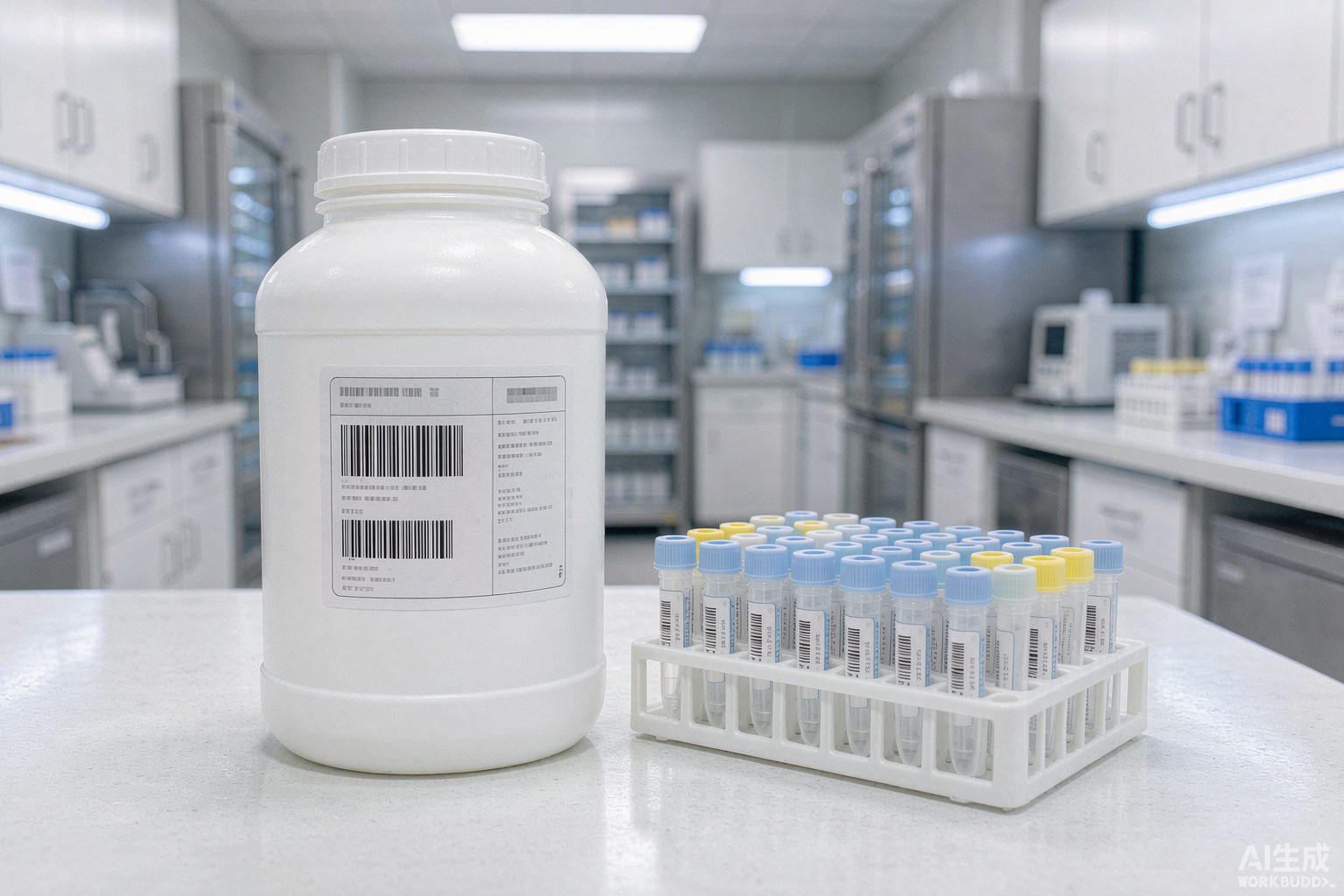
Bottom line first: For 24-hour urine and urine sediment specimen labeling, the first determining factor is not whether the barcode prints clearly, but whether the ID and printed information can remain readable, scannable, and traceable across the four carrier stages the same urine sample must pass through—preservative-containing 24-hour collection container—centrifuge sediment tube—microscopy smear and counting chamber—-80 °C retention tube. Most laboratories focus on the low-temperature stage, but the stage that fails first is often the collection stage: chemical attack on the label face stock and ink layer from preservative conditions such as concentrated hydrochloric acid acidification and toluene liquid sealing begins accumulating during the 24-hour collection; at the retention stage, -80 °C freezing and repeated freeze–thaw cycles add another layer of challenge. This article provides an actionable selection path following five steps: "preservative conditions—four-stage chain—material tiering—coding compliance—print acceptance." All materials and temperature tiers are checked item by item against the official material guide table, and this article complements the existing collection container article (container selection from urine cups to CSF tubes) by process level without overlapping coverage.
I. Why 24-hour urine labeling is a chemical problem before a low-temperature problem
Adult 24-hour urine volume is commonly about 1–2 liters, and collection containers are generally 2–3 L polypropylene (PP) or polyethylene (PE) buckets. To inhibit bacterial growth and chemical degradation, a considerable number of tests require preservatives to be added during or after collection: catecholamine and vanillylmandelic acid (VMA) assays commonly use concentrated hydrochloric acid acidification, and urine calcium and urine phosphorus tests also have acidification practices; in traditional practice, a toluene liquid seal isolates the surface layer from air, and thymol inhibits bacteria. Specific amounts used in each laboratory are subject to the institution's SOP. This means the label's service environment is "low-surface-energy plastic bucket surface + long-term coexistence with chemically active liquid," not the clean room-temperature environment many people assume.
Three failure paths are seeded at the collection stage. First, chemical attack: the low-pH environment of acidified urine causes paper labels and the ink layer of wax-based ribbons to gradually powder, while organic solvents such as toluene directly swell the adhesive layer, causing label edges to lift first and then the entire label to float up. Second, mechanical friction: during 24-hour collection, the bucket is moved, tipped, and mixed repeatedly, and the label rubs repeatedly against the bucket wall and work surfaces; face stocks with insufficient abrasion resistance develop surface haze, and barcode contrast degrades. Third, liquid contact: during pouring, aliquoting, or adding preservative, liquid runs down the bucket wall across the label, with condensation and wetting alternating. With these three factors combined, after one collection cycle the label's condition already determines whether the subsequent sediment aliquoting and retention freezing stages can still be scanned.
ISO 15189:2022 has clear requirements for the pre-examination process in medical laboratories: specimens must maintain unique identification during collection, transport, receipt, and processing, and unreadable identification information is deemed a loss of specimen integrity. 24-hour urine is precisely one of the specimens with the longest pre-examination process span—from discarding the first void and starting the timer, to completing the 24-hour collection, measuring total volume, mixing and sampling, and centrifuging sediment, the entire process spans more than a day. Every stage where identification fails along this chain breaks one link in traceability.
II. Four preservative conditions: threat tiering and face stock countermeasures
Breaking down common preservative conditions, the threats at the label level are not the same. The table below tiers by "common use—label threat—material countermeasure"; specific amounts and applicable tests are subject to each laboratory's SOP:
| Preservative | Common use (subject to each laboratory's SOP) | Threat at the label level | Material and process countermeasure |
|---|---|---|---|
| Concentrated hydrochloric acid (acidification) | Acidified 24-hour urine for tests of readily degradable analytes such as catecholamines and VMA | Long-term low-pH wetting; paper face stock and wax-based ink layer powder | Chemical-resistant face stock + resin-based ribbon; label high on the bucket body to avoid the liquid level |
| Toluene (liquid seal) | Forms an isolating film on the urine surface to inhibit aerobic degradation | Organic solvent swells the adhesive layer; edges lift and liquid seeps into the bonding interface | Solvent-resistant face stock + high-position labeling + edge compression |
| Thymol | Added as powder or crystals to inhibit bacterial growth | Crystals deposit on the label surface, obscuring barcodes and text | Gloss face stock can be wiped clean; reserve redundant barcode positions |
| Preservative-free refrigeration | Stored at 2–8 °C and tested within the time limit | Condensation water film on the bucket surface; interface condensation after removal to room temperature | Label on a dry room-temperature surface; avoid cold labeling; time-limit management replaces chemical protection |
Two practical judgments. First, label position stops loss sooner than material: regardless of preservative type, placing the label in the high zone above the designed liquid level line on the bucket body, avoiding the liquid flow path during pouring, can directly eliminate most chemical exposure—material countermeasures address the remaining exposure, not all of it. Second, "preservative-free refrigeration" does not mean zero threat: when a 2–8 °C refrigerated bucket is removed to room temperature, a condensation water film first forms on the bucket wall; applying or pressing a label onto the condensation surface bonds to the water film rather than the bucket body, and this type of failure erupts concentratedly at the sediment aliquoting stage.
III. Four-stage carrier chain: each stage has a different identification task
The complete chain of 24-hour urine from collection to retention is four-stage, and each stage differs in carrier form, temperature environment, and identification task; material tiering must be done segment by segment:
| Chain stage | Carrier | Temperature environment | Core identification task | Material baseline |
|---|---|---|---|---|
| ① Collection stage | 2–3 L PP/PE collection bucket | Room temperature, with preservative exposure | Patient dual identifiers + preservative type + start/end time | Room-temperature tier checked + chemical-resistant + abrasion-resistant |
| ② Sediment aliquoting stage | Conical-bottom centrifuge tube / conical tube | Room temperature after centrifugation, briefly 2–8 °C | Transfer correspondence between aliquot number and parent bucket number | Good conformity on curved surfaces; small size machine-readable |
| ③ Microscopy stage | Smear microscope slide / counting chamber | Room temperature | Smear number corresponds to tube number; closed-loop verification after microscopy | Microscope slide application tier checked |
| ④ Retention stage | Cryovial (metabolomics / microbiome retention) | -80 °C freezer, some tests at deep cryogenic temperatures | Retention number, freeze–thaw count, project library association | Official matrix freezer tier checked; upgrade as needed for deep cryogenic |
The first stage is "the stage with the highest information density": patient dual identifiers, preservative type, timing start/end, and total urine volume record position must all fit on one bucket-body label. It is recommended to use a large-size face stock + DataMatrix 2D code, with the human-readable area laid out with volume and preservative fields. The key to the second stage is number transfer: the number on the sediment tube must be able to trace back to the parent bucket barcode, establishing the parent-child correspondence with one scan rather than manual transcription. The third stage, microscopy smears, is the most prone to chain breaks—between smear completion and microscopy review there is often staining and queuing, and smear identification must maintain machine-readable correspondence with the tube number. The fourth stage, retention, is the entry point for 24-hour urine into clinical research and biobanks; -80 °C retention for metabolomics and microbiome analysis is increasing year by year, and identification must be built to biobank standards rather than merely internal laboratory circulation.
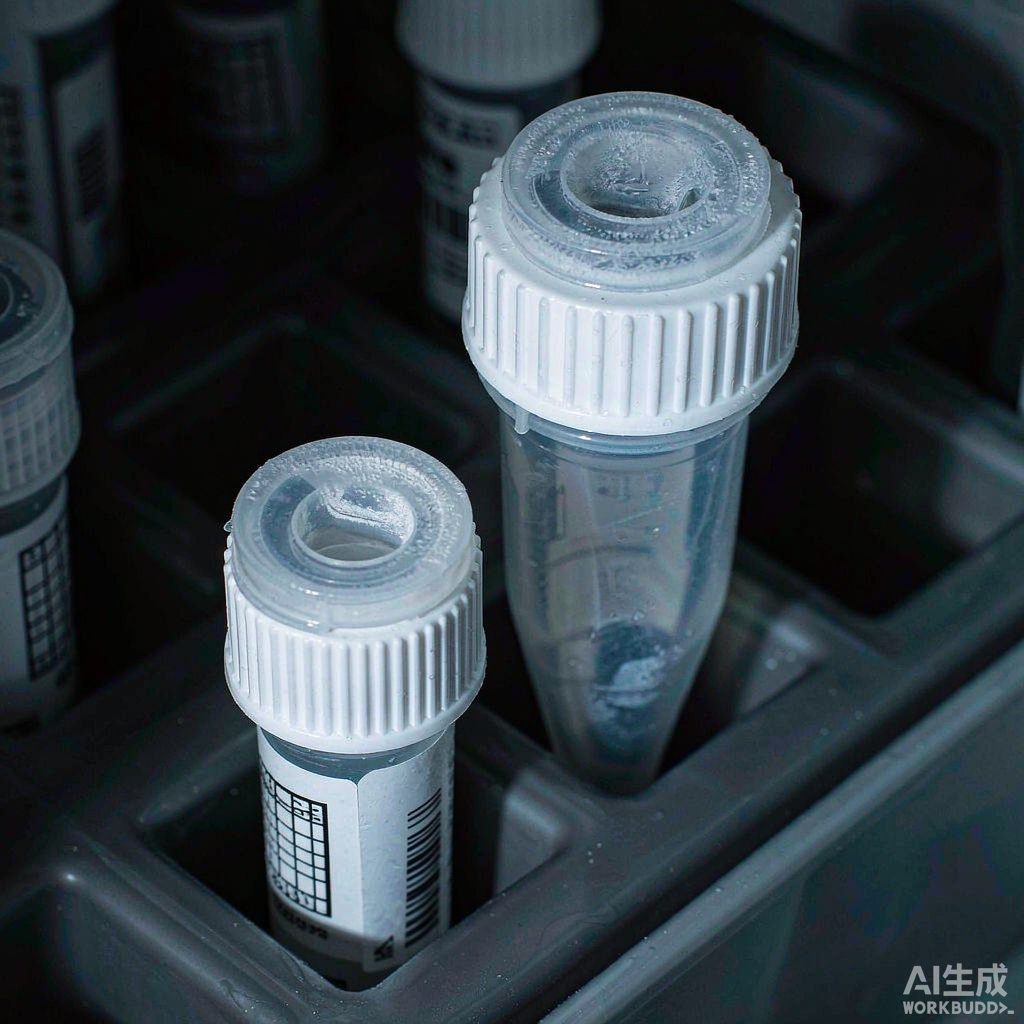
IV. Retention-stage material tiering: matching tier by tier against the official material guide
The material requirements for the retention and microscopy stages can be summarized in one sentence: for the retention stage, select from materials checked in the freezer -80 °C tier of the official guide table, upgrading to the liquid nitrogen tier for deep cryogenic scenarios; for the microscopy stage, prioritize materials checked in the microscope slide application tier. The table below transcribes the official material guide table item by item; "—" indicates the tier is not checked in the official table:
| Material code | Material and structure (official wording) | LN₂ | Freezer | Hot water | Autoclave | Room temperature | Microscope slide | Chain positioning |
|---|---|---|---|---|---|---|---|---|
| T629 | Nylon cloth label, easy to apply, high/low temperature resistance, good conformity, for all laboratory locations requiring identification | √ | √ | √ | √ | √ | √ | The most versatile solution across the four-stage chain; conforms to curved bucket bodies and small tubes |
| T429 | Ideal choice for labeling frozen flat surfaces; when applied to frozen tube surfaces, overlap at least 3 mm head-to-tail | √ | √ | √ | √ | — | — | Mainstay for flat tube-body labeling on retention tubes |
| T459 | Ultra-thin polyester label, self-laminating label with transparent tail, protects printed content and leaves a transparent window for observing liquid level | √ | √ | √ | √ | — | — | Preferred for sediment conical tubes and segments requiring liquid-level observation |
| T509 | Durable vinyl label, suitable for wrapping, good conformity; requires overlap when used in liquid nitrogen environments | √ | √ | √ | — | — | — | Wrap-around coverage position for thin tubes and lower edge of centrifuge tube caps |
| T419 | Bright white PET material, for cryovials and centrifuge tubes, resistant to environments above -40 °C | — | — | — | — | √ | — | Cannot cover the -80 °C retention stage; limited to room-temperature ledgers and transfer |
Four tier-selection judgments. First, T629 is the most broadly covering general solution across the four-stage chain: the nylon cloth substrate has good conformity, and the official table checks all four application categories—room temperature, microscope slide, cryovial/test tube, and conical tube—with all four temperature tiers applicable. The large-diameter curved surface of the collection bucket, the small curved surface of the sediment tube, and the microscope slide end face for smears can all use a single material throughout, removing the "mixed-material error" variable from the process; for large-curvature surfaces such as 2–3 L collection buckets, the flexibility and conformity advantage of the nylon cloth substrate is especially pronounced. Second, the 3 mm overlap of T429 is a hard process specification in the official table; the original text explicitly states "when applied to frozen tube surfaces, overlap at least 3 mm head-to-tail." When retention tubes enter the -80 °C freezer freeze–thaw cycles, this ring of overlap provides the structural mechanical coverage against edge lifting and should be treated as an incoming inspection item rather than a labeling suggestion. Third, the self-laminating plus transparent tail structure of T459 is particularly valuable for the sediment stage: the laminate encloses the printed content under the film, so the ink layer is unaffected when the centrifuge tube is inserted into an ice box and wetted by condensation, and the transparent tail window allows direct observation of the sediment liquid level in the tube; the official table checks it in both the cryovial/test tube and cell application tiers. Fourth, the wrap-around vinyl label T509 is the preferred coverage for thin-tube positions; wrap-around coverage is inherently abrasion-resistant, and the official table specifies that overlap is required when used in liquid nitrogen environments—if the retention stage is upgraded to deep cryogenic LN₂ tanks in the future, the overlap process for wrap positions should be固化 into the SOP in advance.
Two reverse exclusions. First, economy grades such as T419 with the official wording "resistant to above -40 °C" cannot cover the -80 °C retention stage, let alone the liquid nitrogen stage, and are only suitable for room-temperature ledger cards and room-temperature transfer baskets; applying a -40 °C tier label to a retention tube and putting it in the freezer may cause the entire batch to lift after one defrost cycle. Second, chemical-resistance requirements cannot be assumed to map to materials: in the official table, T409 has excellent chemical resistance and abrasion resistance, but its application positioning is bottles and test tubes at frozen/low temperature and room temperature, and the autoclave tier is not checked in the official table; moreover, solvent-resistant solutions for pathology staining scenarios (such as xylene-resistant materials) have a different chemical spectrum from body fluid preservative scenarios. For the adaptation of specific materials to preservative conditions, it is recommended to contact the product manager to select according to the actual chemical environment rather than applying something directly because "both are called chemical-resistant."
V. Three-field coding: write the preservative and timing window into the identification
For 24-hour urine identification coding, it is recommended to fix three fields in addition to the patient dual identifiers:
| Field | Example | Information carried | Carrier |
|---|---|---|---|
| Patient dual identifiers + barcode | Outpatient number + name + 1D code | Unique identity, linked to LIS | Bucket-body label human-readable area + machine-readable area |
| Preservative type code | H (hydrochloric acid) / T (toluene) / N (none) | Precondition for retention and testing, prevents mishandling | Explicit label field + optional pre-printed color |
| Timing window field | Start 07:30 — end 07:30 next day | 24-hour timing start/end, verified when measuring total volume | Label print field, written back to LIS together with total volume |
| Aliquot/retention serial | U20261105-041-R02 | Hierarchical correspondence of parent bucket number—sediment tube—retention tube | Barcode data segment of each stage's tube/slide label |
The preservative type code is the field most easily overlooked and most prone to incidents: acidified specimens and other specimens are not interchangeable in pre-test processing, and the receiving end knows the specimen's chemical precondition upon scanning, avoiding mistaken processing as an ordinary specimen. The timing window field directly supports time-limit compliance in the pre-examination process—24-hour urine total volume calculation depends on accurate start and end times; fixing these two time points on the label allows on-the-spot verification when measuring total volume, and out-of-window specimens can be rejected on the spot rather than traced back after abnormal results. The aliquot serial field establishes the four-level correspondence of "parent bucket—sediment tube—smear—retention tube," so that if any stage's label is damaged, it can be located level by level using the remaining stages; this is also the basic foundation for full traceability of body fluid specimens under WS 233-2002 for biosafety management of microbiological and biomedical laboratories.
VI. Printing end: resin-based cryogenic ribbon and barcode grading acceptance
Chemical attack at the collection stage acts not only on the face stock but even more on the ink layer. In acidified urine environments, the ink layer of wax-based ribbons is the first to fail—the text may still appear present on the surface, but the barcode's solid density and edge contrast have already degraded; if the bucket body scans but codes printed with the same parameters on small tubes after aliquoting cannot be scanned, the problem is most likely at the printing end. Three countermeasures:
First, standardize on resin-based cryogenic ribbon: use resin-based ribbon uniformly for the large bucket-body labels and all small labels across the 24-hour urine chain, such as BRL-80-B09 Boerjie LAB laboratory-specific cryogenic ribbon (black, 80 mm × 300 m specification), purchased in the same batch, with print temperature and pressure set according to the same SOP, ensuring consistent ink layer performance across bucket, tube, and slide labels. Second, print quality grading acceptance: perform a first-article check before each batch of labels is printed, grade 1D codes for print quality according to ISO/IEC 15416 (2D codes per ISO/IEC 15415), and do not release batches that fail grading. Third, batch-to-batch adhesive performance sampling: perform batch-to-batch sampling of peel strength and holding tack according to GB/T 2792-2014 and GB/T 4851-2014—the collection bucket surface is low-surface-energy plastic, and batch-to-batch adhesive drift will first show up in the high-position labeling zone on the bucket body; sampling can intercept it before batch edge lifting occurs.
VII. Five-step implementation SOP
Compress the above into an operation sheet that can be handed directly to the pre-examination processing team:
Step 1, coding rules first: enter the four fields—patient dual identifiers + preservative type code + timing window + aliquot serial—into LIS and the label template; the parent bucket must have a number before storage.
Step 2, select materials by stage: use wide-format nylon cloth labels matching room-temperature and chemical-resistance performance for collection buckets (T629 system), T459 or T429 for sediment conical tubes, T509 for wrap-around thin-tube positions, and for retention tubes always select from materials checked in the freezer tier of the official matrix, reserving an upgrade path to the liquid nitrogen tier for deep cryogenic use.
Step 3, high-position labeling + room-temperature dry operation: apply bucket-body labels above the designed liquid level line, avoiding the pour flow path; cold labeling on condensation-covered bucket surfaces is prohibited.
Step 4, unified ribbon and first-article grading: resin-based cryogenic ribbon across the entire chain; each batch's first article is graded and accepted per ISO/IEC 15416 before mass printing.
Step 5, segmented review closed loop: verify the timing window when measuring total volume, scan to establish parent-child correspondence during aliquoting, verify smear numbers during microscopy review, scan and archive upon retention storage; set one scan review at each of the four stages, and flag and isolate any stage with an abnormality.
Recommended Products
For the label materials and application scenarios covered in this article, the following BRD products are available for selection reference (click to view specifications and request a quote):
- Lab112-629/35x25mm Biobank Cryovial EP Tube Microscope Slide -196 °C Liquid Nitrogen Nylon Cloth Label (¥1490/PCS)
- Lab169-429/25X17mm-3-column Biobank Cryovial Microscope Slide -80~-196 °C Polyester Label (Price on request)
- Lab115-459/9.53+65x9.53 Biobank Conical Tube Cryogenic Cryovial PET Self-Laminating Label (Price on request)
- Lab167-509/40x25mm Wrap-Around Cryovial Color-Coded Classification Label Laboratory Thin Tube LN₂ Label (Price on request)
- BRL-80-BK Boerjie LAB Laboratory-Specific Cryogenic Ribbon - Black Ribbon - 80MMX300m (Price on request)
FAQ
Q1: Do 24-hour urine collection bucket labels absolutely require chemical-resistant material?
Answer: It depends on the preservative condition and label position. For preservative-free refrigerated specimens, room-temperature tier material plus high-position labeling is sufficient; for conditions such as concentrated hydrochloric acid acidification and toluene liquid sealing, chemical-resistant face stock with resin-based ribbon is the reliable solution. Two general rules: label in the high zone above the liquid level line to eliminate most chemical exposure; when unsure about the adaptation of a specific preservative to a material, contact the product manager to select according to the actual chemical environment.
Q2: How should the number on the sediment tube correspond to the parent bucket?
Answer: Use the aliquot serial field for hierarchical coding, e.g., "parent bucket number—sediment tube sequence number—retention tube sequence number," and establish the correspondence with one scan written to LIS during aliquoting. Manual transcription is prohibited—24-hour urine aliquoting often occurs in the high-intensity operation segment after measuring total volume and mixing, where manual transcription error rates rise with operation volume; scan-based correspondence is the only reliable transfer method.
Q3: For -80 °C retention freezing, how should labels be selected?
Answer: Select from materials checked in the freezer -80 °C tier of the official material guide table; the mainstay for flat tube bodies is T429 (head-to-tail overlap not less than 3 mm), the general solution is T629, T459 can be used for conical tube positions, and T509 for thin-tube wrap positions. Note that economy grades such as T419 and T329 with the official wording "resistant to -40 °C" cannot cover the -80 °C tier and must not be applied to retention tubes placed in the freezer.
Q4: If only routine testing is performed and no retention is needed, is such care still necessary?
Answer: Even without retention, the first three stages of the four-stage chain (collection bucket, sediment tube, smear) still exist, and preservative attack and number transfer issues remain unchanged; materials can be simplified, but coding fields cannot be omitted. Once -80 °C retention for metabolomics or microbiome analysis is involved, the fourth stage's low-temperature materials and freeze–thaw records must be completed to biobank standards.
Q5: How should urine sediment smears be labeled to avoid chain breaks?
Answer: Use materials checked in the microscope slide application tier for the smear end (such as microscope slide labels in the T629 system), and print smear numbers that are machine-readably corresponding to tube numbers; microscopy queuing and staining processes are long, and handwritten numbers on frosted ends are most easily worn during staining and washing—thermal-transfer printed machine-readable correspondence is the main defense against chain breaks.
Q6: Can 24-hour urine labels be printed with wax-based ribbon?
Answer: Not recommended. The ink layer of wax-based and mixed-based ribbons softens and smears easily under acidic wetting and friction; the problem of the bucket body scanning but aliquoted small tubes not scanning often originates here. Standardizing on resin-based cryogenic ribbon across the entire chain, combined with ISO/IEC 15416 first-article grading acceptance, is the lowest-cost consistency assurance.
Q7: For preservative-free refrigerated (2–8 °C) specimen buckets, are there special label considerations?
Answer: Mainly prevent condensation. When a bucket is removed from refrigeration to room temperature, condensation first forms on the bucket wall; applying or pressing a label onto the condensation surface bonds to the water film rather than the bucket body—the correct practice is to label in a dry room-temperature environment and let it stand so the adhesive layer fully wets out before refrigeration; when additional handling is needed after removal, wipe the bucket surface dry before touching the label edges.