
Key takeaway up front: The core of LN₂ tank specimen localization is not "sticking the label on firmly," but mapping the four-level spatial information—tank number–cane number–box number–grid position—onto the 2D barcode of every cryovial according to a unified coding rule, then integrating a barcode scanning system to locate specimens by the map. Following ISO 20387:2018 General requirements for biobanking and ISO/IEC 15416 barcode print quality assessment, this article breaks down the structural design of the four-level code, naming rules, label material selection, and scanning system integration, and presents a practical coding scheme from BradyLAB BRD for biobanks and cell therapy companies, helping laboratories turn "searching through cryoboxes" into "scan to locate."
Biobanks, cell therapy companies, CROs, and third-party testing organizations face the same problem every day: tens of thousands of cryovials are scattered across dozens of LN₂ tanks, and finding a specific specimen often requires opening multiple cryoboxes and scanning dozens of barcodes, all while subjecting specimens to the freeze–thaw risk of removal from LN₂. The root cause is not "too many vials," but that spatial positions are not digitized—the position of a given cryovial in an LN₂ tank exists only in the technician's "memory" or an Excel sheet, lacking a unified, scannable, auditable four-level coding system. While serving multiple provincial CDC biobanks and cell therapy GMP cleanrooms, BradyLAB BRD found that facilities with a complete four-level code reduced specimen localization time from an average of 8 minutes to under 30 seconds, and cut the number of LN₂ lid openings by more than 50%.
I. Structural Design of the Four-Level Localization Code
The spatial structure inside an LN₂ tank is naturally suited to hierarchical coding. A standard LN₂ tank is divided into four levels from outside in: tank—cane—box—grid position. Level 1 "tank" corresponds to individually numbered LN₂ tanks (typically 4–12 tanks per facility); Level 2 "cane" corresponds to the removable metal/plastic canes in each tank (4–6 canes per tank); Level 3 "box" corresponds to the cryoboxes in each cane (4–8 boxes per cane); Level 4 "grid position" corresponds to the specific well position in each cryobox (standard 81-well 9×9, 100-well 10×10, or 196-well 14×14 arrangements).
The core of the four-level code is "controllable length, globally unique, scannable." The coding structure recommended by BradyLAB BRD is "site—tank number—cane—box number—row—column," totaling 12–15 fixed-length characters, where rows (A–P) and columns (01–14) use uppercase letters plus digits to avoid ambiguity. The table below demonstrates the structure and examples of the four-level code.
| Level | Field | Value range | Code example | Corresponding physical location |
|---|---|---|---|---|
| Level 1 | Site code | 3 letters (site pinyin initials) | BJD / SHH / GZH | Beijing/Shanghai/Guangzhou site |
| Level 2 | LN₂ tank number | 2 digits | 01 - 12 | Individual LN₂ tank in the facility |
| Level 3 | Cane number | 1 letter + 1 digit | A1 - F4 | Removable cane in the tank |
| Level 4 | Box number | 2 digits | 01 - 08 | Cryobox in the cane |
| Level 5 | Row number | 1 letter | A - P | Row in the box |
| Level 6 | Column number | 2 digits | 01 - 14 | Column in the box |
Full code example: BJD-03-B2-05-H07 = Beijing site, LN₂ tank No. 03, cane B2, cryobox No. 05, row H, column 07. The code totals 17 characters and can be mapped directly to a DataMatrix 2D barcode (ECC200 error correction level), remaining reliably scannable even at -196 °C in LN₂. BradyLAB BRD recommends a unified numbering rule within the same site, automatically generated and validated by the site LIMS to avoid manual handwriting errors.
II. Naming Rules and Code Examples
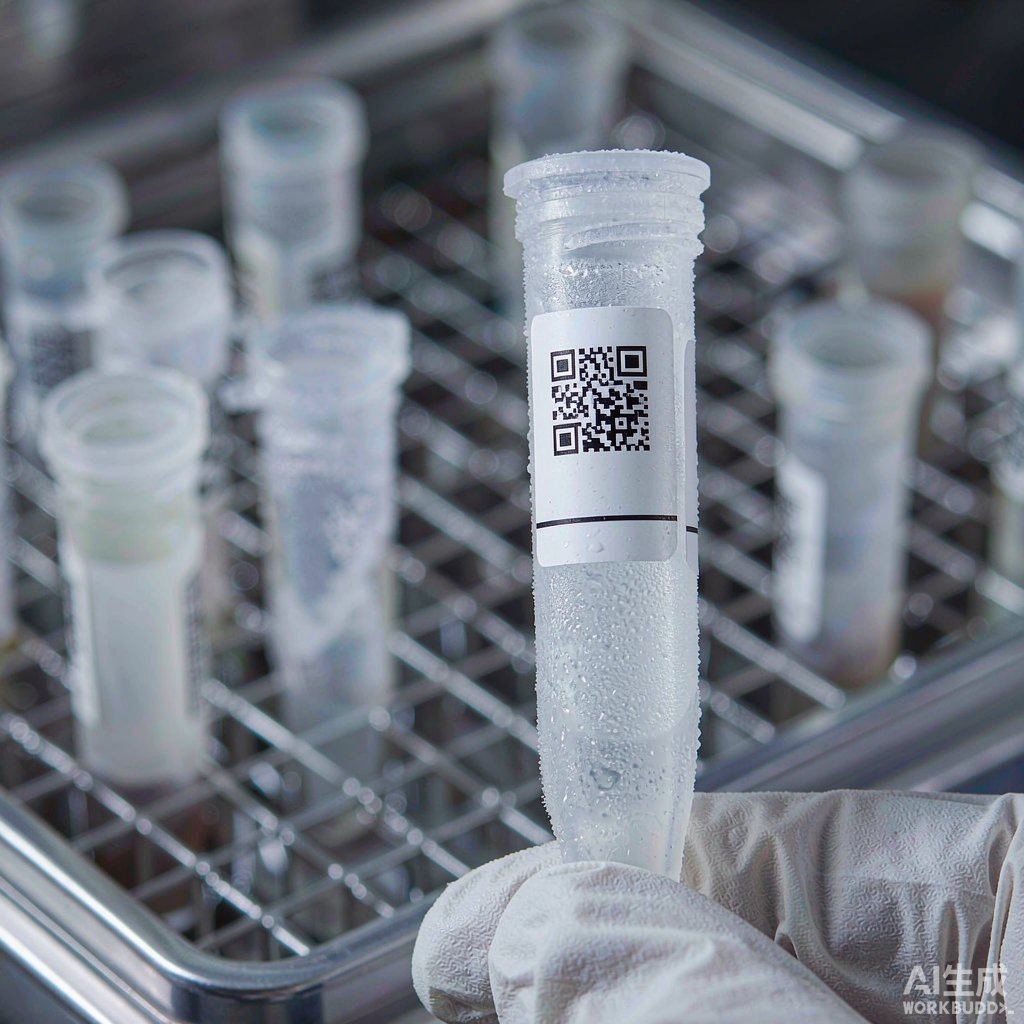
Four-level code naming must balance "machine-readable" and "human-readable." Labels on cryovials must not carry only a 2D barcode; they must have equally clear plain-text fields for emergency human reading when the scanner fails or frost prevents scanning. The label layout recommended by BradyLAB BRD is: human-readable fields on top (site + tank number + cane + box number + row + column, within 30 characters), the corresponding 2D barcode below, with ≥2 mm margins on both sides to prevent misreads from scanner light spots.
Naming rules should also reserve compatibility for "2D barcode + RFID." Biobanks may in the future upgrade to RFID batch inventory, so it is recommended to reserve a 4-digit check code (corresponding to specimen batch/year) beyond the four-level code, combining into a 21-character total length that can be stored in an EPC Gen2 RFID chip and printed as a DataMatrix 2D barcode, enabling dual-channel identification via "scanner + RFID reader." When implementing biobank projects for customers, BradyLAB BRD pre-allocates fields according to the 21-character code structure by default, so customers upgrading to RFID in the future need not re-label.
III. Label Design and Barcode Selection
The LN₂ environment is an extreme test of label materials: -196 °C LN₂ immersion, 75% ethanol wiping, repeated freeze–thaw cycles—ordinary thermal labels or coated paper labels fail after the first freeze–thaw. The LN₂ specimen localization label material combination recommended by BradyLAB BRD is "polyimide (PI) face stock + modified acrylic pressure-sensitive adhesive + resin-based thermal-transfer ribbon." PI face stock retains flexibility at -196 °C without embrittlement; the modified acrylic pressure-sensitive adhesive has a glass transition temperature (Tg) below -80 °C, ensuring the adhesive layer does not enter a glassy state as cryovials rewarm after removal from LN₂. Barcode printing follows the grade requirements of ISO/IEC 15416 (1D barcodes) and ISO/IEC 15415 (2D barcodes), with measured ≥Grade C required for acceptance.
The table below presents the correspondence between BradyLAB BRD laboratory cryogenic label product matrix and LN₂ scenarios, covering the full range from -196 °C LN₂ to ambient temperature:
| Series | Typical material | Temperature range | LN₂ scenario suitability | Typical specification |
|---|---|---|---|---|
| T629 nylon cloth | Nylon cloth substrate | -196 °C to +121 °C | ★★★ Preferred (long-term LN₂) | 15 × 30 mm cryovial roll format |
| T509 vinyl | Vinyl | -196 °C to +100 °C | ★★ (short-term LN₂ vapor phase) | 20 × 40 mm wrap-around conformable |
| T449 polypropylene (PP) | PP substrate | -80 °C to +120 °C | ★ (-80 °C freezer only) | 12 × 25 mm microcentrifuge tube |
| T249 polyolefin | Polyolefin | -40 °C to +80 °C | Not recommended for LN₂ | 15 × 30 mm refrigerated specimen |
For barcode type selection, LN₂ specimen localization labels should preferably use DataMatrix (ECC200) rather than QR codes. DataMatrix can encode 30+ characters within an extremely small area of 2.5 × 2.5 mm, and the ECC200 error correction level tolerates 30% local damage, giving significantly better scanning reliability than QR on curved cryovial surfaces, frost, and light scratches. BradyLAB BRD LN₂ localization labels use DataMatrix by default, with measured scan recognition rate ≥99% under frosted cryovial conditions and identification at a scanning distance of 50–100 mm.
Label adhesion reliability is verified per GB/T 2792-2014 Pressure-sensitive tape—180° peel strength test, and holding tack per GB/T 4851-2014. BradyLAB BRD LN₂ nylon cloth T629 labels have 180° peel strength ≥18 N/25 mm and holding tack ≥72 hours without displacement at -196 °C, fully meeting long-term LN₂ storage requirements.
IV. Scanning and Traceability System Integration
The "last mile" of implementing the four-level code is scanning system integration. The scanning traceability architecture recommended by BradyLAB BRD has three layers: front-end scanning layer (PDA/scanner)—middle transport layer (REST API)—back-end storage layer (LIMS/specimen management system). Front-end scanning devices should be industrial PDAs supporting DataMatrix (e.g., Zebra TC52, Honeywell CT60), capable of scanning level by level at the LN₂ tank mouth, cane surface, and cryobox surface with automatic level recognition; the middle transport layer writes scan events to the LIMS via OPC/RESTful API, with fields (scan time, operator, scan location GPS) stored alongside specimen master data; the back-end storage layer handles position change logs and historical traceback.
The core scenario of scanning system integration is "scan to locate." The user enters the specimen's unique ID at the front end (e.g., the donor-ID assigned at specimen accession), and the LIMS automatically returns the five-level position—tank number, cane, box number, row, column—where the specimen currently resides, with no need for the operator to search any records. When implementing for customers, BradyLAB BRD integrates by default with 5 types of LIMS (Watson LIMS, LabWare, Freezerworks, SampleNavigator, custom in-house systems), achieving sub-1-second response to scan events via standard REST API.
Another frequently overlooked compliance requirement is Clause 7.5 "location traceability" of ISO 20387:2018. This clause requires biobanks to be able to "locate the physical position of any specimen at any time" and to retain position change records for at least 3 years. The BradyLAB BRD scanning traceability system enables full logging of position changes by default; all "scan out of tank," "scan into tank," and "scan relocation" events are automatically written to the audit table, searchable within 3 years across three dimensions—time window/operator/specimen type—meeting all requirements of ISO 20387 on-site audits.
V. Typical Case Studies
Case 1: A provincial CDC biobank with 8 LN₂ tanks storing 120,000 cryovials previously relied on Excel for position records, taking an average of 8 minutes to locate a specimen with a 2.3% misidentification rate. After upgrading to the BradyLAB BRD four-level coding scheme in 2024, localization time was reduced to 25 seconds, the misidentification rate dropped to 0.05%, and the number of LN₂ lid openings decreased by 56%. The 2D barcode labels use the T629 nylon cloth series, with measured DataMatrix scan recognition rate still ≥99% after 12 months of LN₂ immersion.
Case 2: A cell therapy GMP cleanroom with 6 LN₂ tanks storing CAR-T cell cryobags and intermediate specimens needs to quickly locate specific batches by patient ID. Using the BradyLAB BRD "tank–cane–box–grid position" code, each 250 mL cryobag is fitted with an independent 21-character coded label; after scanning, the LIMS directly returns the tank number, cane, box number, and the shelf number of the cryobag within the box. Sampling time during GMP release was reduced from an average of 12 minutes to 2 minutes, fully meeting the traceability requirements of FDA 21 CFR Part 11 for cell therapy products.
Case 3: A tertiary hospital biobank needs to manage specimens grouped by disease category (oncology/cardiovascular/metabolic/rare disease). BradyLAB BRD adds a "project code" as a prefix to the four-level code (e.g., ONC–oncology, CVD–cardiovascular), with dual indexing by project code + four-level position on the LIMS side and automatic categorization in statistical reports. In the hospital's 2025 ISO 20387:2018 on-site audit, the four-level coding system passed in one go as the core traceability tool, with no observations.
Recommended Products
For the label materials and application scenarios covered in this article, the following BradyLAB (BRD) products are available for selection reference (click to view specifications and request a quote):
- Lab162-629/40x20 biobank cryovial -196 °C LN₂ nylon cryogenic label biobank 18015583218 (¥999/roll)
- Lab208-509/25.4x63.5 wrap-around cryovial biobank fine tube LN₂ classification label (Price on request)
- Lab127-449/60x30 biobank medical vessel identification gloss white PET biobank label (Price on request)
VI. FAQ: Common Questions on LN₂ Tank Specimen Localization Labeling
Q1: Must LN₂ cryovial labels use DataMatrix? Can QR codes be used instead?
A: QR codes can be used, but DataMatrix is superior on small curved surfaces. Cryovial curved surfaces are only 8–12 mm in diameter, leaving limited labeling area; DataMatrix can encode 30+ characters within an extremely small area of 2.5 × 2.5 mm, and ECC200 error correction tolerates 30% local damage, giving significantly better scanning reliability than QR under frost, light scratches, and low-temperature embrittlement. BradyLAB BRD LN₂ localization labels use DataMatrix by default, with measured scan recognition rate ≥99% under frosted cryovial conditions.
Q2: Is there a recommended total length for the four-level code?
A: BradyLAB BRD recommends 21 fixed-length characters: site code (3) + tank number (2) + cane number (2) + box number (2) + row (1) + column (2) + check code (4) + project code prefix (2) + future expansion (3). This length can be printed as a DataMatrix 2D barcode and stored in the EPC field of an EPC Gen2 RFID chip, so customers upgrading to RFID in the future need not re-label.
Q3: How often do LN₂ labels need to be replaced?
A: BradyLAB BRD LN₂ T629 nylon cloth labels have a print legibility retention of 2–4 years under standard LN₂ scenarios (depending on freeze–thaw cycle frequency and solvent exposure). A preventive re-scan every 2 years is recommended, with batch reprinting of blurred or detached labels. In daily use, if the scan recognition rate drops below 95%, the entire batch should be replaced immediately. BradyLAB BRD offers batch re-labeling services, reprinting labels with the original codes without modifying LIMS-side data.
Q4: Do LN₂ tanks themselves need labels?
A: Yes. It is recommended to affix a "tank-level" label on the side of each LN₂ tank, containing the tank number, capacity (L), current fill rate, last LN₂ refill date, and responsible person. Tank-level labels can use a larger size (50 × 80 mm) vinyl series (a BRD in-house product, resistant to -80 °C to +120 °C) with epoxy resin overlamination for protection. Tank-level labels are not part of the cryovial four-level code but are essential for full lifecycle management of LN₂ tanks.
Q5: What if the scanner fails or heavy frost prevents scanning?
A: One of the core values of the four-level code design is that it is human-readable. The plain-text fields on the cryovial label (site + tank number + cane + box number + row + column) carry the same information as the 2D barcode, allowing operators to locate directly via the plain text. BradyLAB BRD recommends a plain-text font size ≥6 pt on each cryovial, so that localization can be completed by visual identification even if the 2D barcode fails—an emergency measure compliant with Clause 7.5 "location traceability" of ISO 20387:2018.
Q6: How do BradyLAB BRD LN₂ localization labels differ from GA International's CryoSTUCK series?
A: BradyLAB BRD is the China partner of GA International. The LN₂ T629 nylon cloth series builds on GA International CryoSTUCK technology with three localizations for Chinese customer scenarios: ① the coding structure supports Clause 7.5 location traceability of ISO 20387:2018; ② the accompanying LIMS integration API supports mainstream domestic specimen management systems (Watson, LabWare Chinese version); ③ batch delivery time is shortened from GA International's overseas 4–6 weeks to BRD's domestic 5–10 working days. Both pass long-term -196 °C LN₂ immersion verification for low-temperature performance, with comparable 2–4 year print legibility retention.
BradyLAB BRD is a laboratory labeling brand under Suzhou BradyLAB New Material Technology Co., Ltd., with over twenty years of cooperation experience with international brands such as Brady, GA International, Zebra, CAB, and Merck. BRD's in-house Lab series cryogenic/LN₂ labels (T629 nylon cloth series, T509 vinyl, T449 PP series), BRL series resin ribbons, and accompanying barcode scanning devices provide full-process technical support from label selection and printer configuration (BBP12/i5100/i7100/MACH4S/ZD621) to four-level coding rule design, LIMS integration, and 2D barcode + RFID dual-channel solutions. The BRD engineering team provides on-site labeling training, scanning system commissioning, and annual re-scan services, assisting biobanks, cell therapy GMP cleanrooms, CROs, and third-party testing organizations in establishing ISO 20387:2018-compliant LN₂ specimen localization and traceability systems. Sales hotline: 18015583218, or visit bradylab.com.cn to request sample testing.
Related Compliance Standards
The standardized management of LN₂ tank specimen localization labeling is mainly based on ISO 20387:2018 General requirements for biobanking, Clause 7.5 "location traceability," which requires that specimen spatial positions be locatable; barcode print quality is assessed per ISO/IEC 15416 (1D barcodes) and ISO/IEC 15415 (2D barcodes), with measured ≥Grade C; label adhesion reliability is verified per GB/T 2792-2014 Pressure-sensitive tape—180° peel strength test, and holding tack per GB/T 4851-2014; overall medical laboratory management can align with Clause 6.4 of ISO 15189:2022 on identification and traceability; cell therapy GMP processes can align with the electronic records and electronic signatures requirements of FDA 21 CFR Part 11.