
Why microcentrifuge tube labels are completely different from ordinary labels
BradyLAB BRD cryogenic label product matrix quick reference
| Series | Typical material | Temperature range | Typical applications | Specifications / printing method |
|---|---|---|---|---|
| T629 | Nylon cloth | -196 °C to +121 °C | LN₂ cryovials, cell freezing bags, deep low-temperature specimens | Thermal-transfer printing / 6 mm–50 mm width |
| T509 | Vinyl | -196 °C to +100 °C | ULT freezer specimens, microplates, microscope slides | Thermal-transfer printing / wrap-around conformability |
| T449 | Polypropylene (PP) | -80 °C to +120 °C | Microcentrifuge tubes, cryovials, PCR plates | Thermal-transfer printing / roll format continuous feed |
| T249 | Polyolefin | -40 °C to +80 °C | Room-temperature/refrigerated specimens, 2D barcode traceability | Thermal transfer / laser printing |
| T189 | Synthetic paper | -20 °C to +60 °C | Reagent bottles, document and file management | Thermal transfer / inkjet printing |
| T109 | Vinyl | -20 °C to +80 °C | Equipment identification, instrument labeling | Thermal transfer / full-sheet A4 |
Data source: BradyLAB BRD laboratory cryogenic identification product specification sheet · Temperature ranges are typical laboratory test values; verify against actual application conditions.
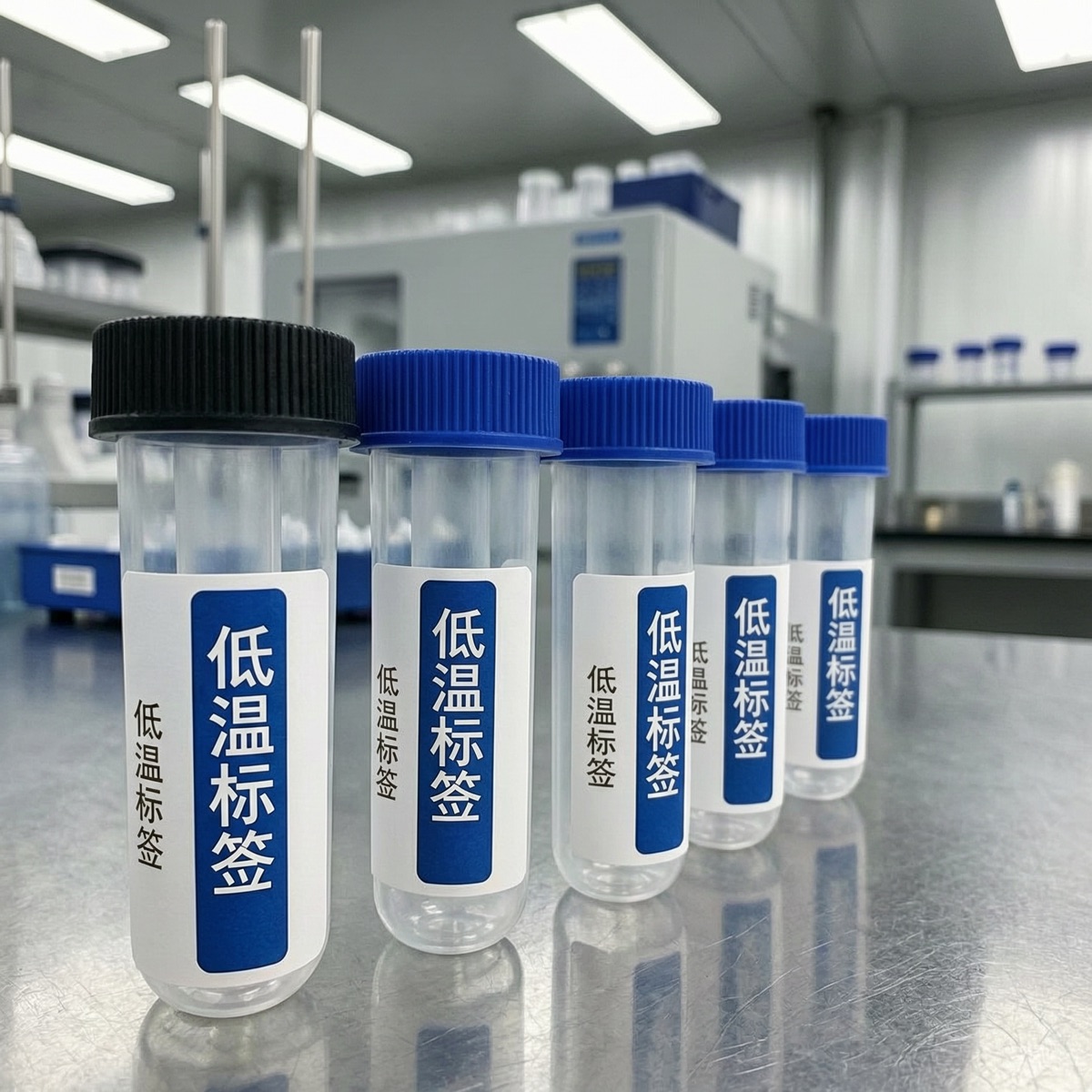
Microcentrifuge tube labels look much like ordinary pressure-sensitive labels, but their operating environment means ordinary materials are not good enough. Microcentrifuge tubes range from 0.5 mL microtubes to 50 mL large-capacity conical tubes (Falcon tubes), with diameters from about 8 mm to 30 mm, and labels must stay on curved surfaces for long periods without lifting or adhesive failure.
More importantly, there is temperature. Microcentrifuge tubes are routinely centrifuged at 4 °C, frozen at -20 °C to -80 °C, or even placed directly into LN₂ tanks (-196 °C). Ordinary paper labels deform and curl under repeated changes in ambient moisture and temperature, and eventually fall off. A problem BradyLAB BRD repeatedly encounters when serving biobanks is users applying ordinary labels to microcentrifuge tubes and losing an entire batch after one freeze cycle.
Therefore microcentrifuge tube labels should be selected according to cryogenic label technical standards, not general office label standards.
Low-temperature tolerance threshold is the core parameter of microcentrifuge tube labels
Cryogenic labels generally use environmentally friendly acrylic pressure-sensitive adhesive and a surface coating suitable for thermal-transfer printing. They withstand extreme temperatures down to below -196 °C while maintaining adhesion, without falling off, deforming or curling, and with clear, non-fading print. Such labels also stay adhered on cylindrical, spherical and other curved surfaces over long periods.
Based on common industry product parameters, cryogenic labels cover a wide temperature span, working stably from -196 °C (LN₂) to +100 °C or higher. For example, labels for deep-freeze applications are typically rated from -196 °C to +100 °C, suitable for both liquid-phase and vapor-phase LN₂ as well as water-bath thawing and boiling-water temperatures.
Requirements differ by scenario: -20 °C cold-chain transport can use standard cryogenic adhesive; -80 °C storage requires a dedicated adhesive; long-term LN₂ storage requires face stocks and adhesives that do not become brittle at -196 °C. BradyLAB BRD recommends first defining the lowest temperature the label will experience and the dwell time, then working backward to the required low-temperature grade.
Adhesive type directly determines whether the label falls off
Adhesives for microcentrifuge tube labels generally fall into three categories: permanent adhesive, removable adhesive, and dedicated freezer adhesive that remains tacky at low temperatures. Permanent adhesive suits long-term archived specimens; removable adhesive suits scenarios requiring frequent label changes and leaves no residue when peeled off.
The difficulty in low-temperature environments is that many ordinary adhesives harden and lose tack below -20 °C. Professional cryogenic adhesives are designed to bond firmly to containers at -20 °C, -40 °C, -80 °C or even in LN₂ vapor phase, while still peeling off easily at room temperature. Some products can be applied directly to already-frozen tube walls without prior thawing.
Another case is moist surfaces—for example, tubes just taken out of LN₂ develop frost. Whether a label can adhere directly to moist, frosted surfaces is an easily overlooked but critical selection criterion for microcentrifuge tube labels. BradyLAB BRD lists "can it label moist surfaces" and "does it require prior thawing" as mandatory questions during selection.
Face stock material determines chemical and scratch resistance
Common face stocks for microcentrifuge tube labels include synthetic paper, PET (polyester), nylon cloth and vinyl ester resin. Synthetic paper is flexible and suits curved surfaces, while PET offers high strength and tear resistance, suiting scenarios requiring long-term storage and high-durability identification.
In the laboratory, microcentrifuge tubes contact organic solvents such as xylene, dimethyl sulfoxide (DMSO), alcohol and anhydrous ethanol. Ordinary labels smear and their face stock dissolves under these solvents. Cryogenic labels must remain unchanged during long-term use in these solvent environments while also resisting scratching, tearing, abrasion, UV and chemical corrosion.
Print longevity is also a quantifiable reference metric. Industry data generally shows that cryogenic labels retain print for 5 to 10 years under normal low-temperature environments and 2 to 4 years under extreme low temperatures (such as LN₂). This longevity is directly related to the ribbon used, as explained in the printing compatibility section below.
Ribbon and printer compatibility cannot be ignored
The ribbons and printers used with cryogenic labels are special; ordinary label printers often cannot print them, or print quality is unsatisfactory. Microcentrifuge tube labels are usually printed by thermal transfer, and the ribbon must be resin-based or a dedicated cryogenic ribbon. Mixed-base and wax-based ribbons fall off and smear at low temperatures and are not suitable.
Ribbon grade directly affects print longevity. Cryogenic labels printed with ordinary resin-based ribbons generally retain print for 1 to 2 years; those printed with dedicated cryogenic ribbons retain print for more than 4 years. Medical LN₂ labels must use dedicated ribbons to withstand harsh conditions such as alcohol wiping and UV exposure.
So selecting microcentrifuge tube labels is not just buying labels—labels, ribbons and printers must be matched as a system. BradyLAB BRD solutions typically validate labels, ribbons and printers as a whole, preventing users from buying labels that are scrapped in full batches due to ribbon mismatch.
A complete selection sequence from tube type to storage environment
A practical selection sequence for microcentrifuge tube labels is: first determine tube type and diameter, then determine the lowest storage temperature and dwell time, third confirm whether organic solvents or alcohol wiping will be involved, fourth match the adhesive type, and finally match the appropriate ribbon and printer.
For example, for 15 mL or 50 mL conical tubes with short-term -20 °C storage and occasional alcohol wiping, a flexible synthetic paper face stock with cryogenic permanent adhesive can be selected; for microtubes requiring long-term LN₂ storage, a PET face stock with LN₂-grade dedicated adhesive and a dedicated cryogenic ribbon is required.
Many users skip validation and purchase in bulk directly, only to find on site that temperature or solvent compatibility does not match, with losses far exceeding procurement cost. BradyLAB BRD recommends small-batch sampling and validation first, confirming that labels adhere firmly and print remains clear under real storage conditions before scaling up.
BradyLAB BRD recommendations for microcentrifuge tube label selection
BradyLAB BRD is an authorized Brady partner serving biopharmaceutical laboratories, pathology departments and IVD reagent manufacturers over the long term. For microcentrifuge tube labels, BradyLAB BRD first learns the user's specimen type, tube specifications, storage temperature range and whether barcode scanning is required, then provides combined recommendations for labels, ribbons and printers.
Biobank and IVD production scenarios have high traceability requirements for labels, which often must carry 1D or 2D barcodes—placing additional demands on face stock flatness, print resolution and ribbon adhesion. BradyLAB BRD incorporates these requirements into the selection assessment to avoid later batch rework.
If users are unsure what grade their labels require, BradyLAB BRD recommends a small-sample test under real conditions first, validating low-temperature resistance, solvent resistance and barcode scanning performance under actual storage conditions before deciding on a procurement plan.
Featured Products
For the label materials and application scenarios covered in this article, the following BradyLAB (BRD) products are available for selection reference (click to view specifications and request a quote):
- Lab162-629/40x20 biobank cryovial -196 °C LN₂ nylon cryogenic label biobank 18015583218(¥999/roll)
- Lab208-509/25.4x63.5 wrap-around cryovial biobank thin tube LN₂ classification label(Price on request)
- Lab127-449/60x30 biobank medical device identification gloss white PET biobank label(Price on request)
Microcentrifuge tube label FAQ
Q: Can ordinary labels replace microcentrifuge tube labels? A: Not recommended. Microcentrifuge tubes are often in low-temperature storage or LN₂ environments; ordinary labels become brittle and fall off at low temperatures, and print smears, causing loss of specimen information.
Q: Are the requirements the same for -80 °C and LN₂ environments? A: No. LN₂ (-196 °C) places higher low-temperature grade requirements on adhesives and face stocks, requiring dedicated LN₂-grade labels, whereas -80 °C can use standard freezer labels.
Q: Why does the label adhere firmly but the print is blurry? A: Usually a ribbon mismatch. Cryogenic labels require resin-based or dedicated cryogenic ribbons; mixed-base and wax-based ribbons smear and fall off at low temperatures.
Q: Can labels be applied directly to frosted microcentrifuge tubes? A: It depends on the adhesive type. Some professional cryogenic labels support direct labeling on moist, frosted surfaces; confirm this with the supplier during selection.
Q: How long does print on LN₂ labels last? A: Industry data is generally 2 to 4 years, depending on face stock and ribbon grade; dedicated cryogenic ribbons last longer than ordinary resin-based ribbons.
Related compliance standards
For microcentrifuge tube label technical parameters, adhesive reliability is verified per GB/T 2792-2014, barcode quality per ISO/IEC 15416, and specimen identification meets ISO 20387:2018 requirements.