
Why pathology labels must be discussed in terms of "standards," not "usability"
BradyLAB BRD Cryogenic Label Product Matrix Quick Reference
| Series | Typical Material | Temperature Range | Typical Applications | Specifications / Printing Method |
|---|---|---|---|---|
| T629 | Nylon cloth | -196 °C to +121 °C | LN₂ cryovials, cell cryopreservation bags, deep cryogenic specimens | Thermal-transfer printing / 6 mm–50 mm width |
| T509 | Vinyl | -196 °C to +100 °C | ULT freezer specimens, microplates, microscope slides | Thermal-transfer printing / wrap-around |
| T449 | Polypropylene (PP) | -80 °C to +120 °C | Microcentrifuge tubes, cryovials, PCR plates | Thermal-transfer printing / roll continuous feed |
| T249 | Polyolefin | -40 °C to +80 °C | Room-temperature/refrigerated specimens, QR code traceability | Thermal-transfer / laser printing |
| T189 | Synthetic paper | -20 °C to +60 °C | Reagent bottles, document and archive management | Thermal-transfer / inkjet printing |
| T109 | Vinyl | -20 °C to +80 °C | Equipment identification, instrument labeling | Thermal-transfer / full-sheet A4 |
Data source: BradyLAB BRD laboratory cryogenic identification product specifications · Temperature ranges are typical laboratory test values; please verify according to specific application scenarios.
In the daily work of a pathology department, labels are the most easily overlooked item on the consumables list. Turning to Appendix A of CNAS-GL048:2021 "Guidance on Accreditation in the Field of Medical Laboratory Histopathology Examination," one finds that "correct labeling" is listed as an independent scoring item in the HE pathology slide quality assessment, worth as much as 10 points. Intact section 10 points, no wrinkles 10 points, no overflow and correct labeling 10 points—labeling issues can directly determine whether a slide meets the standard.
The logic behind this is not complicated: from excision, grossing, and slide preparation to diagnostic archiving, tissue specimens rely throughout on a unique pathology number for traceability. Clause 5.4.6 of CNAS-GL048 explicitly requires that "the pathology number shall always be used as the unique identifier of the original specimen, grossed specimen (embedding cassette), wax block, or slide." As long as a label becomes blurred, detaches, or has incomplete information, the entire traceability chain is broken. This means labels are not ordinary consumables where "usable is good enough," but a critical node in the compliance system.
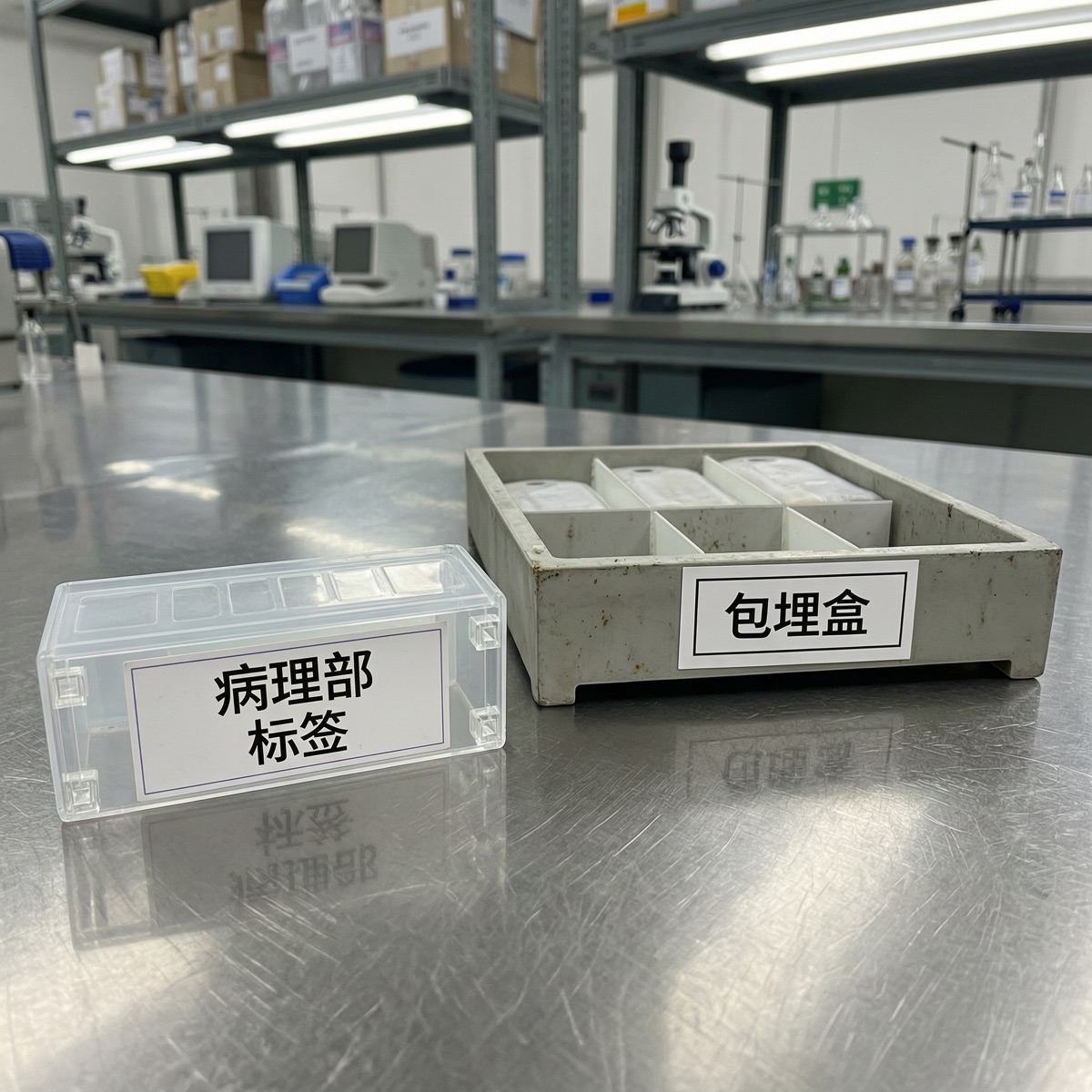
Three labels, three completely different chemical environments
Label applications in pathology laboratories concentrate on three core stages, each with vastly different levels of chemical exposure. The first is specimen container labels: after excision, tissue is placed into specimen containers or transport bags and must withstand prolonged immersion in 10% neutral buffered formalin (NBF). Per CNAS-GL048 requirements, the fixative volume must be at least 10 times the specimen volume, with fixation times ranging from several hours to 24 hours; the face stock must resist formaldehyde attack, and the adhesive must maintain tack in humid environments.
The second is embedding cassette/dehydration cassette labels, the stage with the most intensive chemical exposure across the entire workflow. Tissue blocks together with embedding cassettes pass sequentially through 75% to 100% graded alcohol, xylene clearing, and immersion in molten paraffin at 55 to 60 °C. Labels must not lift at the edges, must not fade, and must not be dissolved by xylene throughout this process. The third is microscope slide labels; sections must remain fully labeled through oven baking at 60 °C, xylene deparaffinization, graded alcohol dehydration, HE staining, and other multiple steps.
Hard specifications for chemical resistance: when selecting face stock, look first at xylene and formalin
The most commonly overlooked point in selection is that solvent resistance needs to be "actually tested" rather than "read from the label datasheet." In accreditation practice, embedding cassette labels lifting and detaching after xylene immersion is one of the most common deduction points, typically rooted in face stock or adhesive solvent resistance falling short. In the standard paraffin sectioning workflow, tissue is immersed in xylene I and xylene II for 5 to 10 minutes each (small specimens) to over 1 hour (large specimens), and labels must retain margin beyond this duration.
The common engineering approach is to use polyester face stock combined with cross-linked acrylic adhesive. After full-process simulation testing through graded alcohol, xylene, and paraffin, this combination can still maintain barcode readability at ISO/IEC 15416 Grade C or above. BradyLAB BRD chemical-resistant labels use medical-grade polyester substrate; after 72-hour immersion testing in 10% neutral buffered formalin and xylene environments, label information remains clearly readable, leaving ample margin for laboratory accreditation.
Key control points for microscope slide labels: slide size compatibility and full staining process
The challenges for microscope slide labels are no less than those for embedding cassettes—sections must undergo oven baking at 60 °C, xylene deparaffinization, hematoxylin-eosin staining, and multiple other steps. In the slide quality assessment of CNAS-GL048 Appendix A, "correct labeling" accounts for 10 points; once a microscope slide label detaches or becomes blurred, it directly lowers the slide excellence rate. Therefore, microscope slide labels must "adhere to the frosted end without exceeding the slide edge" to avoid jamming in the slide racks of automated stainers.
Size compatibility is another easily overlooked pitfall. The standard pathology microscope slide specification is 25 mm × 75 mm, and the label width should match the frosted end of the slide. BradyLAB BRD microscope slide labels are designed specifically for this size; labels do not exceed the slide edge and can withstand the full HE and IHC staining process. For thermal-transfer solutions, full-resin ribbons paired with polyester labels are recommended; the resin component fuses with the face stock at high temperature, and the resulting printed layer has significantly better solvent resistance than wax-based ribbons.
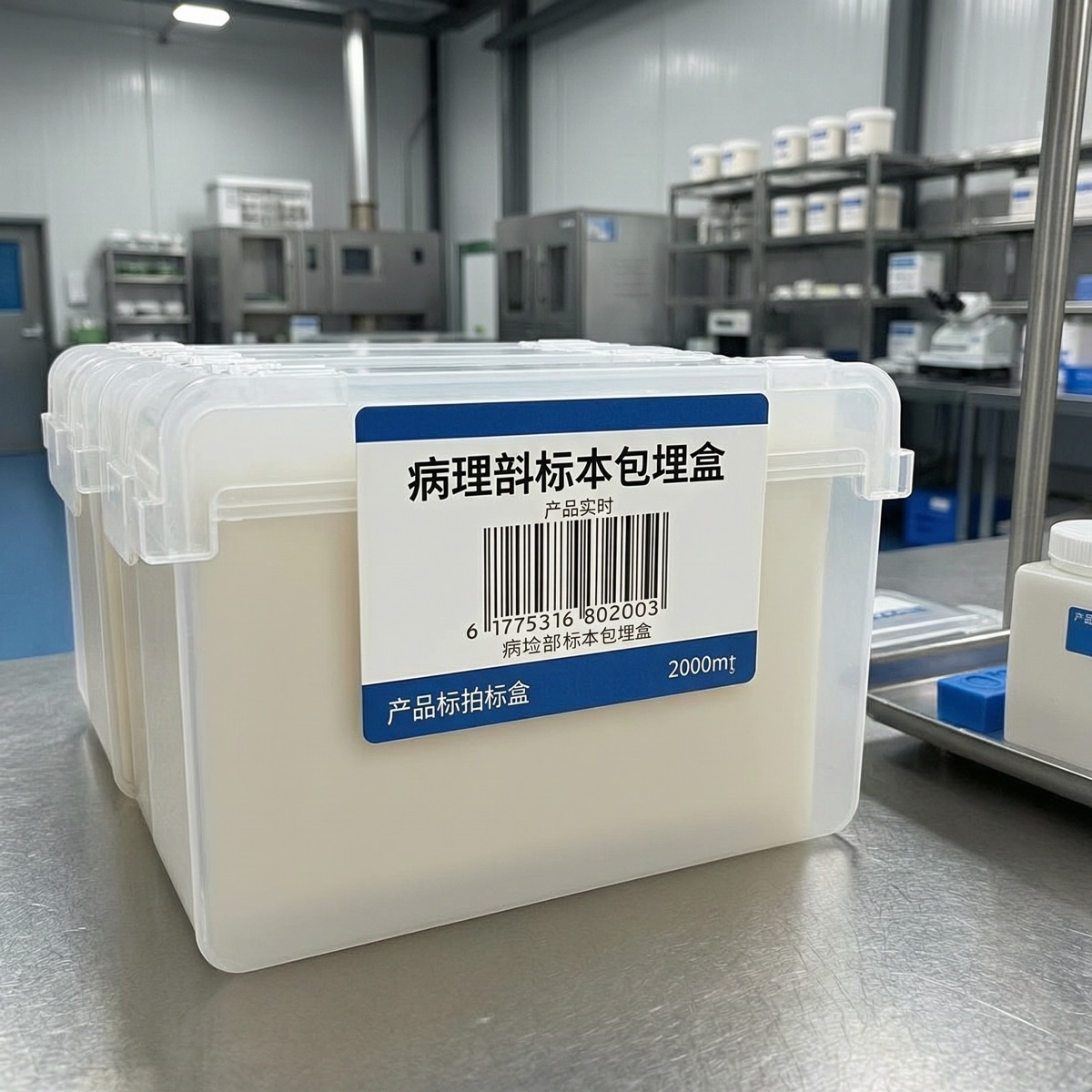
Barcode grade and printer dpi: a commonly overlooked combined issue
Whether a label can be reliably recognized by a scanner after printing depends on barcode grade, not merely on being "legible." When microscope slide label information becomes blurred after HE staining, it is often caused by partial dissolution of wax-based ribbon during oven baking and deparaffinization, leading to a drop in barcode grade. Laboratories should use a barcode verifier during self-inspection to verify that 1D codes achieve at least ISO/IEC 15416 Grade C and 2D codes achieve ISO/IEC 15415 Grade C.
Printer resolution must also match content density. For the conventional combination of pathology number plus 1D barcode, a 300 dpi thermal-transfer printer is sufficient; if Data Matrix or QR codes are needed to store multi-dimensional information such as patient ID and specimen type, 600 dpi is recommended to ensure readability of small code areas. BradyLAB BRD can provide matching full-resin ribbon solutions for corresponding dpi specifications, supporting minimum code areas of 3 mm × 3 mm.
High-frequency deduction points in CNAS assessments and corresponding self-inspection methods
Based on practical cases of CNAS-GL048 in accreditation assessments, deduction points in identification management at pathology laboratories concentrate in three areas. First, embedding cassette labels lifting and detaching after xylene immersion; second, microscope slide label information becoming blurred after HE staining; third, incomplete label information at specimen receipt. The first two are mismatches in face stock, adhesive, and ribbon selection; the third is a front-end process management issue that propagates all the way to the completeness of diagnostic reports.
Laboratories can safeguard through three self-inspection checkpoints. First, perform a xylene immersion test when labels are received; after 30 minutes of immersion, check for edge lifting, fading, and barcode readability. Second, sample-check barcode quality after each print batch, using a barcode verifier to confirm grade compliance. Third, after staining is complete, inspect the status of each microscope slide label, record the abnormality rate, and incorporate it into CNAS quality indicator monitoring. This approach can expose most identification risks before accreditation.
BradyLAB BRD pathology label solutions: from standards to implementation
As a biomedical laboratory label identification service provider, BradyLAB BRD has built a product matrix covering the entire pathology workflow around the identification compliance requirements of CNAS-GL048 and ISO 15189: embedding cassette solvent-resistant labels (compatible with standard embedding cassette sizes, resistant to the full xylene, alcohol, and paraffin process), microscope slide labels (compatible with the frosted end of 25 mm × 75 mm slides, resistant to the full HE and IHC staining process), and specimen container labels (resistant to long-term immersion in 10% NBF fixative). Face stock thickness is controlled within the 50 to 75 micrometer range, balancing chemical resistance and equipment sensor compatibility.
In batch scenarios, BradyLAB BRD embedding cassette labels support pre-printed batch pathology numbers and are compatible with automated cassette printers, achieving identification throughput of over 15 units per minute. Printer compatibility covers 300 dpi and 600 dpi thermal-transfer models; combined with full-resin ribbons, high-density Data Matrix codes printed on embedding cassette and microscope slide surfaces also maintain stable readability.
Featured Products
For the label materials and application scenarios covered in this article, the following BradyLAB (BRD) products are available for selection reference (click to view specifications and request a quote):
- Lab296-629 biobank cryovial microscope slide -196 °C liquid nitrogen nylon cryogenic label (¥999/roll)
- Lab167-509/40x25mm wrap-around cryovial color-coded classification label laboratory microtube LN₂ label (Price on request)
- Lab127-449/60x30 biobank medical vessel identification gloss white PET biobank label (Price on request)
FAQ
Q1: What are the specific label inspection methods during CNAS assessment?
Assessors will inspect the label status of HE-stained slides and immunohistochemistry slides during on-site experiments according to the assessment requirements of CNAS-GL048 Appendix A. Assessment criterion item 4 is "no overflow, correct labeling" (10 points), focusing on whether labels are affixed squarely, whether information is clear, and whether there is adhesive overflow or lifting at the edges.
Q2: How long can embedding cassette labels withstand xylene?
In the standard paraffin sectioning workflow, tissue immersion in xylene ranges from 5 to 10 minutes to over 1 hour. BradyLAB BRD embedding cassette solvent-resistant labels remain barcode-readable after 4 hours of xylene immersion, far exceeding routine workflow requirements; choosing polyester face stock with cross-linked acrylic adhesive is key to ensuring xylene resistance.
Q3: What dpi printer is suitable for microscope slide labels?
For conventional pathology number plus 1D barcode, 300 dpi thermal-transfer is sufficient; when Data Matrix or QR codes are needed to store multi-dimensional information, 600 dpi is recommended to ensure readability of small code areas. BradyLAB BRD can provide matching full-resin ribbon solutions for corresponding dpi.
Q4: How compatible are BradyLAB BRD labels with common pathology equipment?
BradyLAB BRD pathology labels cover standard embedding cassette and standard microscope slide sizes and are compatible with mainstream cassette printers, slide printers, and automated stainers. Face stock thickness is controlled at 50 to 75 micrometers, ensuring chemical resistance without causing equipment jams or sensor misreads due to excessive thickness.
Q5: How can laboratories self-inspect whether labels meet CNAS compliance requirements?
It is recommended to establish three checkpoints: perform a xylene immersion test when labels are received; sample-check barcode grades after each print batch, with 1D codes/2D codes achieving ISO/IEC 15416 and 15415 Grade C respectively; after staining is complete, inspect the status of each microscope slide label and record the abnormality rate, incorporating it into CNAS quality indicator monitoring.