
Why PCR plate labels are the "last mile" that cannot be ignored
BradyLAB BRD cryogenic label product matrix quick reference
| Series | Typical material | Temperature range | Typical applications | Specifications / printing method |
|---|---|---|---|---|
| T629 | Nylon cloth | -196 °C to +121 °C | LN₂ cryovials, cell freezing bags, deep cryogenic specimens | Thermal-transfer printing / 6 mm–50 mm width |
| T509 | Vinyl | -196 °C to +100 °C | ULT freezer specimens, microplates, microscope slides | Thermal-transfer printing / wrap-around conformability |
| T449 | Polypropylene (PP) | -80 °C to +120 °C | Microcentrifuge tubes, cryovials, PCR plates | Thermal-transfer printing / roll format continuous feed |
| T249 | Polyolefin | -40 °C to +80 °C | Room-temperature/refrigerated specimens, 2D barcode traceability | Thermal-transfer / laser printing |
| T189 | Synthetic paper | -20 °C to +60 °C | Reagent bottles, document and file management | Thermal-transfer / inkjet printing |
| T109 | Vinyl | -20 °C to +80 °C | Equipment identification, instrument labeling | Thermal-transfer / full-sheet A4 |
Data source: BradyLAB BRD laboratory cryogenic identification product specifications · Temperature ranges are typical laboratory test values; verify against your specific application.
Once a PCR amplification run starts, every piece of identity information for the specimen depends on a small label. If a label on the plate lifts, falls off, or the print becomes illegible midway, all the prior work of loading, sealing, and running the instrument is wasted.
The problem is that PCR plates are made of polypropylene (PP), a material with a surface energy of only about 29–31 mN/m—a classic low-surface-energy plastic. Ordinary adhesives naturally adhere weakly to PP surfaces, which is the root cause of many general-purpose labels curling at the edges shortly after being applied to PCR plates.
In working with numerous molecular diagnostics laboratories, BradyLAB BRD has found that PCR plate label selection errors overwhelmingly cluster in three areas: skirt structure mismatch, insufficient adhesive temperature resistance, and unverified barcode readability. Each is broken down below.
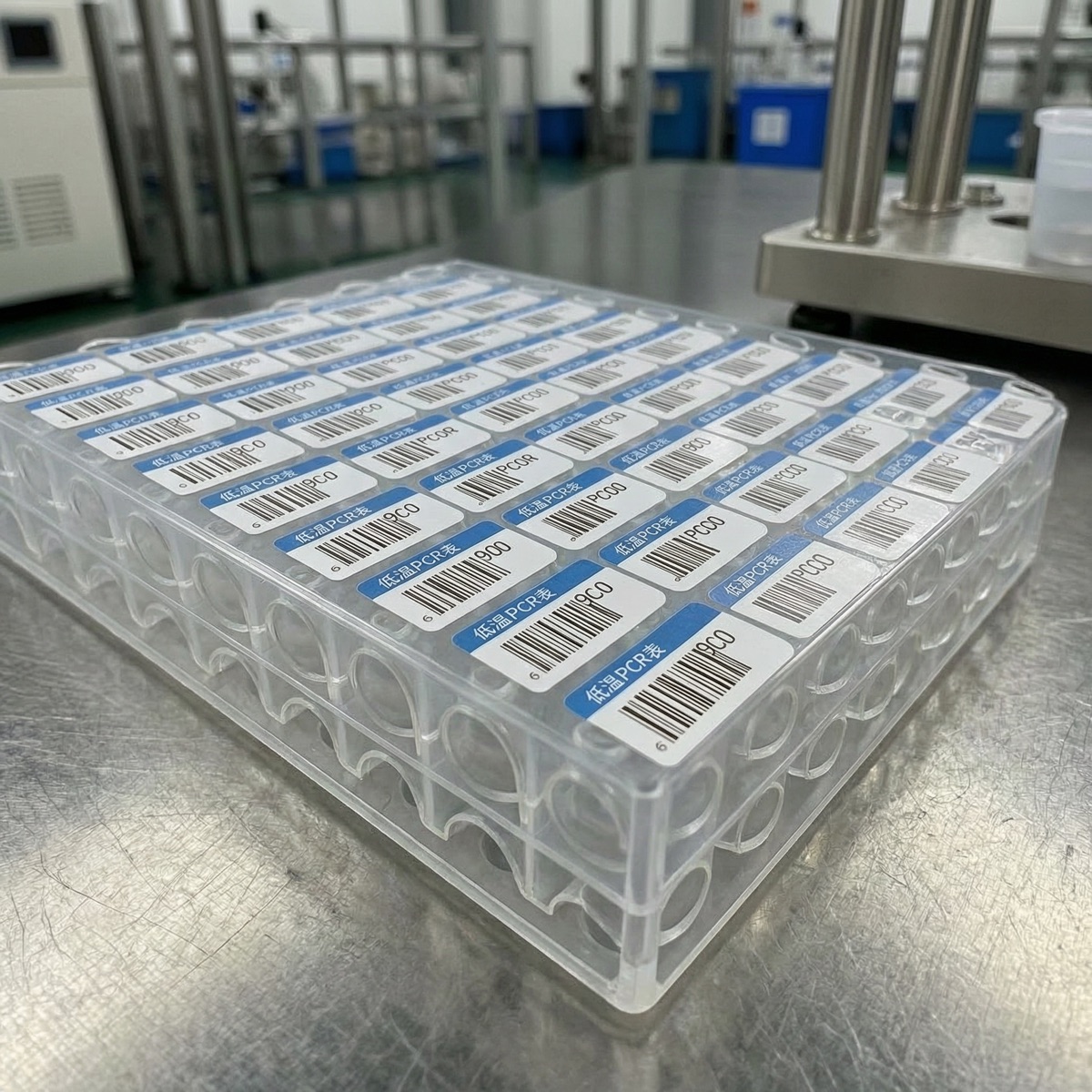
Step 1: First determine well count and plate surface specifications
The first step in PCR plate labeling is not choosing an adhesive but confirming the plate's surface dimensions. Mainstream 96-well plates come in 0.1 mL and 0.2 mL capacities; 384-well plates have smaller wells, typically only about 0.04 mL. Different well counts leave different amounts of space for labels on the plate surface.
96-well plates have relatively generous labeling areas on the sides and can take barcode labels directly; 384-well plates have tighter well spacing, compressing the available labeling space, so narrower label strips or labels applied to the plate corners are often required. Before purchasing, measure the actual labelable area with calipers and work backward to the label specification—this avoids the awkwardness of buying labels that do not fit.
Step 2: Skirt structure determines where the label goes
PCR plates are classified by skirt as skirtless, semi-skirted, and full-skirted. Skirtless plates have no surrounding frame and a thin body, so labels can often only be applied to the accompanying plate holder—once the plate and holder are separated, the numbers no longer correspond. This is the most error-prone scenario in high-volume clinical sample handling.
Semi-skirted and full-skirted plates have flat surrounding edges on the sides that can take adhesive labels or printed 2D barcodes directly, allowing each plate to be marked independently so identification does not detach during transport or storage. This is also why ANSI/SBS-compliant plate formats reliably accommodate automated robotic gripper handling.
BradyLAB BRD recommends: for any laboratory involving automated pipetting or long-term specimen archiving, prioritize semi-skirted or full-skirted plates with independent labels; skirtless plates with holder labeling are suitable only for short-workflow temporary marking.
Step 3: Material and adhesive must pass the temperature test
PCR label face stocks must maintain dimensional stability across roughly 20 °C to 95 °C or higher to withstand repeated thermal cycling. If the face stock's coefficient of thermal expansion is too high, a few heat-up/cool-down cycles will cause shrinkage and edge lifting, and the barcode is ruined along with it.
More critical is the adhesive's temperature boundary. Taking common PCR cryogenic labels as an example, some specifications are rated -80 °C to +110 °C, covering long-term storage in -80 °C freezers and dry ice transport while withstanding the transient high temperatures of thermal cycling; labels for more demanding LN₂ environments can achieve -196 °C to +150 °C. When selecting labels, always check the label's temperature range against the actual temperatures across the entire experimental workflow—do not look only at adhesion at room temperature.
Step 4: Low-surface-energy PP is a hard threshold for adhesives
Polypropylene PP has low surface energy, and ordinary water-based and rubber adhesives show clearly insufficient adhesion on it. For low-surface-energy substrates like PP, labels typically require specially modified adhesives to form sufficiently strong initial tack.
This also explains why the same "cryogenic label" adheres firmly to glass cryovials but easily falls off PP PCR plates. When purchasing, laboratories should explicitly tell suppliers that the substrate is a PP plate, rather than vaguely saying "I need a low-temperature-resistant label." BradyLAB BRD first clarifies three pieces of information during selection—substrate, operating temperature, and whether LN₂ immersion is involved—then matches the corresponding face stock and adhesive system.
Step 5: Barcode readability must be verified in advance
No matter how firmly a label adheres, if it cannot be scanned it is as good as not applied. After labels are printed, a round of spot checks should be performed with the scanning equipment actually used in the laboratory to confirm that barcode density and contrast remain reliably readable after thermal cycling and cryogenic storage.
A practical approach: apply 3 to 5 labels to real PCR plates, run through a complete amplification and cryogenic storage workflow, then scan them and simultaneously check for edge lifting, adhesive residue, and print blurring. BradyLAB BRD recommends writing this procedure into the laboratory's consumables acceptance SOP to avoid leaving verification to be done ad hoc during formal experiments.
Step 6: The labeling environment cannot be ignored either
No matter how good the label itself is, the ambient temperature during labeling also affects the final bonding result. According to technical materials from the Tag and Label Manufacturers Institute (TLMI), the suitable labeling temperature for most pressure-sensitive labels is between 18 °C and 25 °C. Environments below 10 °C reduce adhesive flow, while above 30 °C may cause adhesive oozing.
If labeling happens to be performed in a cold room or near an oven, adhesion will be significantly reduced. It is recommended to set up the labeling station on a bench with stable room temperature, let labels rest briefly after application before moving them into low- or high-temperature steps, giving the adhesive time to complete initial bonding.
Recommended Products
For the label materials and application scenarios covered in this article, the following BradyLAB (BRD) products are available for selection reference (click to view specifications and request a quote):
- Lab296-629 biobank cryovial microscope slide -196 °C LN₂ nylon cryogenic label(¥999/roll)
- Lab167-509/40x25mm wrap-around cryovial color-coded classification label laboratory thin-tube LN₂ label(Price on request)
- Lab127-449/60x30 biological sample bank medical vessel identification gloss white PET biobank label(Price on request)
FAQ
Below are answers to the questions laboratories ask most frequently.
Do PCR plate labels have to be cryogenic labels?
Not necessarily—it depends on whether cryogenic storage is involved. For specimens undergoing only room-temperature amplification without long-term cryogenic storage, standard heat-resistant labels are sufficient; but any involvement of -20 °C or -80 °C long-term storage requires dedicated cryogenic labels, otherwise labels become brittle and peel off at low temperatures.
If the label lifts, is it the adhesive or the plate?
In most cases it is a substrate mismatch. PP PCR plates have low surface energy and naturally weak adhesion to ordinary adhesives, requiring modified adhesives. When troubleshooting, first confirm whether the label is designed for PP substrates, then check the labeling environment and temperature range.
What if the barcode cannot be scanned clearly after cryogenic storage?
First confirm the dimensional stability of the label face stock at low temperatures and the ribbon-to-face-stock match at printing. Blurring after cryogenic storage is usually caused by face stock shrinkage or poor ribbon transfer; BradyLAB BRD recommends switching to a matching cryogenic ribbon and performing pre-verification of scanning after cryogenic storage.
Can edge lifting be remedied after application?
Labels that have already lifted are not recommended for secondary repair with glue—adhesive residue and repair marks will instead affect scanning and cleanliness. The correct approach is to peel off and reapply a new label, while returning to the selection stage to investigate the three variables of substrate, adhesive, and labeling temperature.
Can BradyLAB BRD customize labels by plate format?
Yes. BradyLAB BRD supports customizing label dimensions and barcode formats for 96-well and 384-well plates with different skirt structures, along with matching cryogenic ribbons and printing solutions. Laboratories only need to provide three pieces of information—plate format, operating temperature, and whether LN₂ immersion is involved—to evaluate a matching model.
Related compliance standards
For PCR plate label selection, microplate dimensions reference the ANSI/SLAS 1-2004 standard, and barcode quality is implemented per ISO/IEC 15416 and ISO/IEC 15415.
Avoiding the "three pitfalls" of PCR plate labels
| Pitfall | How to avoid |
|---|---|
| Label edge lifting and detachment | Choose low-temperature-resistant adhesive, clean before application, press firmly |
| Barcode unreadable | ≥300 dpi printing, sufficient quiet zone, resin ribbon |
| Failure after thermal cycling | Choose temperature-cycling-resistant material, test cryogenic storage and thermal cycling |
Verify by actual testing to avoid pitfalls
The key to avoiding the "three pitfalls" of PCR plate labels is actual testing: after small-batch proofing, perform cryogenic storage and thermal cycling tests to verify edge lifting, readability, and durability. Once standards are met, proceed to bulk purchasing—this avoids the specimen traceability risks and duplicated work caused by "labels applied in vain."