
Microplate Standardization Framework: Why ANSI/SLAS Is the Starting Point for Label Selection
BRD Cryogenic Label Product Matrix Quick Reference
| Series | Typical Material | Temperature Range | Typical Applications | Specifications / Printing Method |
|---|---|---|---|---|
| T629 | Nylon cloth | -196 °C to +121 °C | LN₂ cryovials, cell freezing bags, deep cryogenic specimens | Thermal-transfer printing / 6 mm–50 mm width |
| T509 | Vinyl | -196 °C to +100 °C | ULT freezer specimens, microplates, microscope slides | Thermal-transfer printing / wrap-around conformability |
| T449 | Polypropylene (PP) | -80 °C to +120 °C | Microcentrifuge tubes, cryovials, PCR plates | Thermal-transfer printing / roll continuous feed |
| T249 | Polyolefin | -40 °C to +80 °C | Room-temperature/refrigerated specimens, 2D barcode traceability | Thermal-transfer / laser printing |
| T189 | Synthetic paper | -20 °C to +60 °C | Reagent bottles, document and archive management | Thermal-transfer / inkjet printing |
| T109 | Vinyl | -20 °C to +80 °C | Equipment identification, instrument labeling | Thermal-transfer / full-sheet A4 |
Data source: BRD laboratory cryogenic identification product specifications · Temperature ranges are typical laboratory test values; verify against actual application conditions.
Since the microplate was invented in 1951 by Hungarian microbiologist Gyula Takátsy, it has undergone a complete evolution from a hand-assembled 8 × 12 well array to injection-molded industrial production. In 2003, the American National Standards Institute (ANSI) first published the microplate footprint standard, specifying a rectangular plate body of 127.76 mm × 85.48 mm. In 2010, the Society for Biomolecular Screening (SBS) and the Association for Laboratory Automation (ALA) merged into the Society for Laboratory Automation and Screening (SLAS), and the standard system was formally unified as the ANSI/SLAS standard.
The significance of standardization lies in this: whether it is Agilent's BenchCel workstation, Analytik Jena's CyBio QuadPrint labeler, or Tecan's liquid handling platform, all automated equipment relies on the consistency of the microplate footprint. If label dimensions do not match the plate geometry—for example, exceeding the side height, obscuring the well identification area, or covering the stacking alignment notch—the consequences range from scan failures to the entire plate jamming or even dropping during robotic arm transfer.
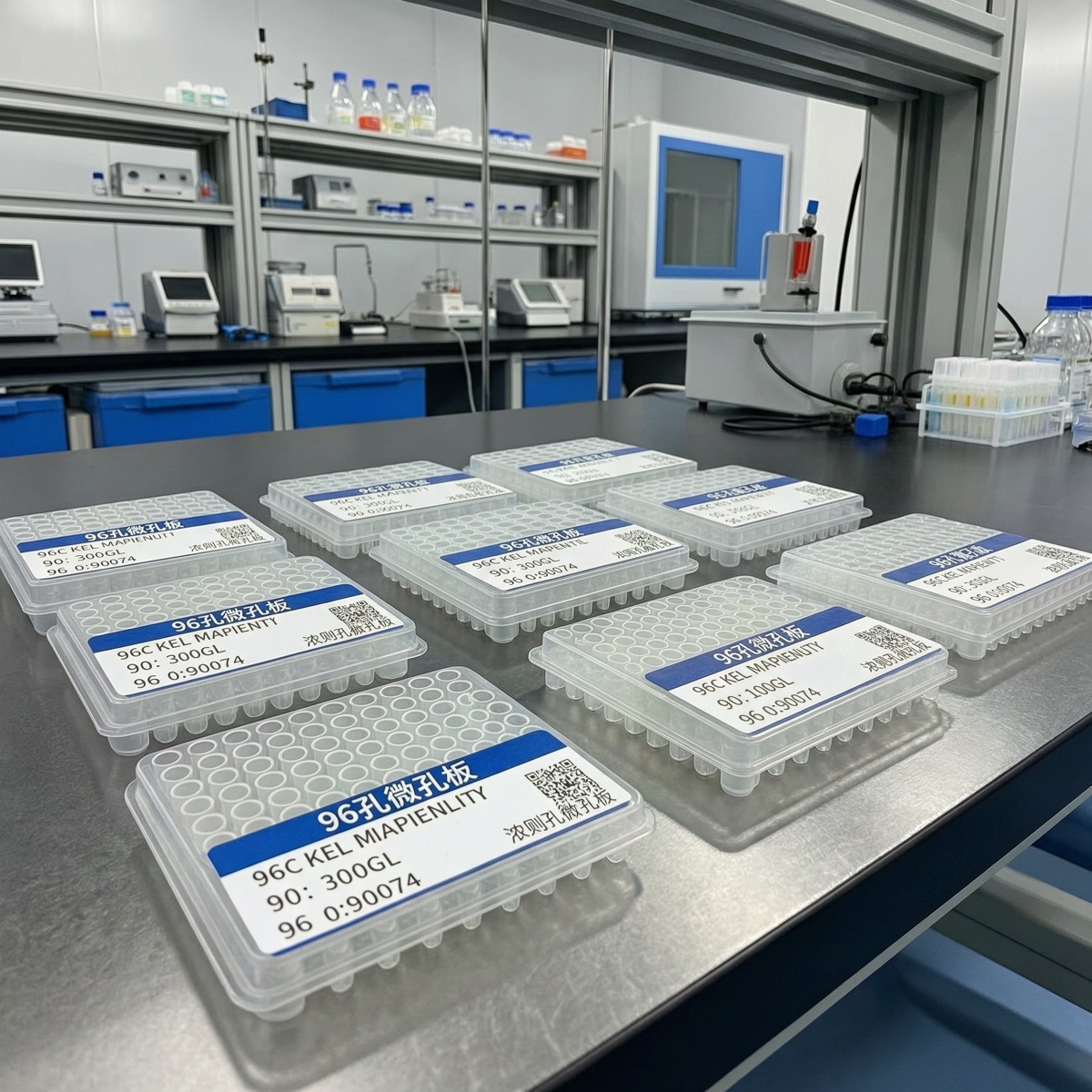
Current mainstream microplate formats cover 6-well, 12-well, 24-well, 48-well, 96-well, 384-well, 1536-well, and a small number of 3456-well ultra-high-throughput formats. Among these, 96-well plates are the most widely used, with a maximum volume of approximately 300 μL per well; 384-well plates are commonly used for high-throughput drug screening, at approximately 100 μL per well. Different well densities correspond to different available labeling areas on the plate surface. When selecting, engineers must first confirm the skirt structure of the target plate type (no skirt / half skirt / full skirt) and the available side height.
Substrate Selection for Microplate Labels: Performance Comparison of Cryo-PET, Polyimide, and Polypropylene
The substrate of a microplate label determines its performance under cryogenic storage, solvent exposure, and repeated freeze–thaw conditions. The three mainstream substrates each have distinct characteristics: Cryo-PET (cryogenic polyester) is the most widely used material in laboratory labels, maintaining dimensional stability from -80 °C to +100 °C and offering good chemical resistance, compatible with common laboratory solvents such as DMSO, ethanol, and isopropanol. BRD's microplate label solutions generally use Cryo-PET as the standard substrate.
Polyimide (PI) film targets the extreme -196 °C liquid nitrogen environment, with an extremely low coefficient of thermal expansion and no microcracking or delamination during repeated freeze–thaw cycles. When label thickness increases from the standard 50 μm to 75 μm, tear strength improves by approximately 40%, making it suitable for biobank applications requiring long-term storage in LN₂ dewars. Polypropylene (PP) labels are mostly used for deep-well plates and short-term room-temperature storage; they are lower in cost but have an upper temperature limit of only 121 °C, and their resistance to certain organic solvents is inferior to PET.
One empirical data point from industry applications: in 10 cycles of LN₂ immersion–room-temperature rewarming testing, Cryo-PET labels retained approximately 85%–90% legibility, whereas ordinary polyester labels fell below 60% and became unreadable. The root cause of the difference lies in the freezing–relaxation behavior of the substrate's molecular chain segments at low temperatures—materials with a lower Tg (glass transition temperature) are less prone to embrittlement in deep cryogenic environments.
Adhesive Selection and Tg Value: The Technical Key to Preventing Microplate Label Lifting
Adhesive is the most common source of microplate label failure. At low temperatures, the adhesive hardens and loses tack, causing labels to lift from the plate surface or detach completely—a situation particularly common in -80 °C freezers and -196 °C liquid nitrogen environments. The core technical indicator for selection is the glass transition temperature (Tg) of the adhesive: the lower the Tg, the greater the adhesive's flexibility in deep cryogenic environments.
For refrigerated applications from -20 °C to 4 °C, standard acrylic adhesives (Tg approximately -20 °C) are sufficient. However, for -80 °C ULT freezer scenarios, modified acrylic adhesives with a Tg below -40 °C are required to ensure labels do not develop stress concentration at plate surface curvatures. For -196 °C liquid nitrogen storage, silicone adhesives or specially formulated cryogenic acrylic systems are recommended, with Tg values as low as -70 °C or lower.
Another easily overlooked factor is the microplate material. Polystyrene (PS) microplates have lower surface energy, so label adhesion is inherently weaker than on polypropylene (PP) plate surfaces. For PS 96-well plates, BRD's technical solution adjusts the adhesive coating thickness from the standard 18 μm to 22 μm to compensate for the surface energy difference, ensuring peel strength of no less than 12 N/25 mm at -80 °C.
Thermal-Transfer Printing Parameter Optimization: 600 DPI and Resin Ribbon Matching Strategy
The barcodes and text information on microplate labels are the sole basis for specimen traceability. On high-density 96-well and 384-well plate formats, label dimensions are typically only 66 mm × 5.5 mm or 50.5 mm × 5.5 mm. Printing readable 1D barcodes and 2D DataMatrix codes on such a narrow format makes print resolution critical. Industry standards recommend no less than 400 DPI, with 600 DPI preferred.
Ribbon selection directly affects print durability: wax ribbons are low-cost but not solvent-resistant, wax/resin hybrid ribbons provide moderate scratch resistance, and full resin ribbons offer optimal chemical resistance and cryogenic performance. For microplate labels that need to be wiped with 70% ethanol or isopropanol for disinfection, full resin ribbons must be used. BRD's standard solution uniformly uses full resin ribbons with 600 DPI thermal-transfer printers, ensuring that 2.5 mm-high Code 128 barcodes can be reliably read by mainstream barcode scanners.
A practical printing parameter is the balance between print speed and darkness. When print speed is reduced from 4 ips to 2 ips, the ribbon's dwell time on the label doubles, toner transfer is more complete, and text durability after -80 °C freezing can improve by approximately 30%. For biobank microplates requiring long-term archiving, a combination of 2 ips speed and high darkness settings is recommended—although printing time increases, it delivers barcode readability after 5+ years of freeze–thaw.
Automated Labeling and SBS Standard Compatibility: Adaptation Requirements for Microplate Labels in Robotic Systems
In modern biobanks and drug screening platforms, microplate labels are not applied by hand—automated labeling equipment such as the Agilent Microplate Barcode Labeler and Analytik Jena CyBio QuadPrint can apply labels to all four sides of a microplate within 3 to 4 seconds, with labeling accuracy controlled to ±0.5 mm. This imposes stringent requirements on label release liner peel force, label roll format, and gap precision.
Label compatibility with microplates is also reflected in height parameters. ANSI/SLAS 2-2004 defines the standard microplate height dimension range; labels applied to the plate sides must not exceed the upper height limit, otherwise they will affect plate stacker and robotic arm gripping. Label thickness (including substrate + adhesive + ribbon residue) is generally controlled at 80–120 μm; too thick increases stacking gaps, while too thin may result in labels being scraped off during gripping.
For automated workflows requiring LIMS (Laboratory Information Management System) integration, labels typically need to be printed with a 1D barcode containing a check digit and a 2D DataMatrix code. BRD's label solutions are compatible with mainstream symbologies including Code 128, Code 39, DataMatrix, and QR codes, support ASCII character sets and independent block printing, and can interface with labeling software such as Agilent PlateTag and CyBio PrintStudio for data flow integration.
Chemical Resistance Validation: Label Performance Under DMSO, Ethanol, and Autoclaving Conditions
Microplates frequently come into contact with DMSO (dimethyl sulfoxide) during high-throughput screening—this universal solvent can carry small-molecule compounds across cell membranes, but it also dissolves substandard label coatings. Agilent's published microplate label resistance data explicitly states: DMSO resistance tested, applicable temperature range -80 °C to +100 °C. This means that a qualified microplate label must maintain legible text and non-dissolved adhesive after 24 hours of DMSO immersion.
In addition to DMSO, commonly used laboratory disinfectants such as 70% ethanol, isopropanol, and sodium hypochlorite solution can also damage labels. BRD's microplate labels must pass standardized chemical immersion testing before shipment: 24-hour immersion at 25 °C in DMSO, 70% ethanol, and 10% bleach respectively, with text legibility retention of no less than 98% and adhesive peel strength degradation of no more than 15%.
Autoclaving (121 °C, 20 minutes) is another challenge dimension. Polypropylene microplates themselves can withstand autoclaving, but whether labels delaminate, discolor, or detach under these conditions depends on the heat-resistant combination of substrate and adhesive. BRD's high-temperature-resistant label solution uses a PI substrate + silicone adhesive, which can be used normally after 121 °C autoclaving, suitable for cell culture and microbiology experiments requiring aseptic operations.
BRD Microplate Label Solutions: Full-Specification Coverage from 96-Well to 1536-Well
As a biomedical laboratory label identification service provider, BRD has been deeply engaged in the laboratory cryogenic label field for over twenty years and has built a full-specification label matrix covering 96-well, 384-well, and 1536-well standard microplates. From drug screening to biobanking, from ELISA testing to high-throughput compound library management, BRD's microplate label solutions provide standardized products that seamlessly integrate with automated labeling equipment and LIMS systems.
At the specific product level, BRD offers three product lines: Cryo-PET standard cryogenic labels (suitable for -80 °C to +100 °C), polyimide deep cryogenic labels (suitable for -196 °C liquid nitrogen), and chemical-resistant labels (suitable for DMSO/ethanol immersion). Each product line offers three standard sizes—66.0 × 5.5 mm, 66.0 × 7.0 mm, and 50.5 × 5.5 mm—supplied in roll format (from 5000 labels/roll), compatible with mainstream Brady, Zebra, and CAB thermal-transfer printers.
In terms of quality control, every batch of BRD microplate labels undergoes 10 cycles of LN₂ immersion–room-temperature rewarming validation, peel strength testing, barcode grade verification (ANSI X3.182 standard, minimum Grade B), and 24-hour DMSO immersion testing, with batch test reports provided. For customers with special requirements, BRD also offers custom sizes, pre-printed barcode serialization, and color label services.
Featured Products
For the label materials and application scenarios covered in this article, the following BRD products are available for selection reference (click to view specifications and request a quote):
- Lab162-629/40x20 Biobank Cryovial -196 °C LN₂ Nylon Cryogenic Labels Biobank 18015583218 (¥999/roll)
- Lab208-509/25.4x63.5 Wrap-Around Cryovial Biobank Microtube LN₂ Classification Labels (Price on request)
- Lab127-449/60x30 Biobank Medical Vessel Identification Gloss White PET Biobank Labels (Price on request)
FAQ: Frequently Asked Questions on Microplate Label Selection
Are label dimensions different for 96-well and 384-well plates?
The footprint of 96-well and 384-well plates is identical (both follow the ANSI/SLAS 127.76 mm × 85.48 mm standard), so label dimensions are interchangeable. However, the skirt structure of 384-well plates may differ from that of 96-well plates, and the labeling position must avoid mechanical alignment notches. BRD recommends performing a fit test with samples on the target plate type before bulk purchasing.
How long after labeling must microplate labels be inspected during cryogenic storage?
It is recommended to let labels rest for 24 hours after application (allowing the adhesive to fully cure at room temperature), then place them in a -80 °C freezer. During the first week of cryogenic storage, a sampling inspection should be performed—randomly select 5–10 plates and visually check for bubbling, edge lifting, or blurred text. Thereafter, a routine spot check once per quarter is sufficient. BRD cryogenic labels, under adequately cured conditions, maintain stable adhesion and barcode readability after 3+ years of storage at -80 °C.
How do I troubleshoot barcode scan failures after cryogenic storage?
Scan failures typically have three causes: first, insufficient ribbon darkness during printing, causing barcode module distortion from toner shrinkage at low temperatures—increase the print darkness setting or reduce print speed; second, frost on the label surface—gently wipe the barcode area with a lint-free cloth before scanning; third, adhesive failure causing partial label detachment from the plate surface and barcode distortion—in this case, switch to a cryogenic adhesive model with a lower Tg.
Can microplate labels be laminated? Do they need extra protection?
For routine -80 °C freezer storage, BRD Cryo-PET labels do not require additional lamination—their surface coating already provides scratch and solvent resistance. However, for long-term liquid nitrogen storage or frequent handling scenarios, self-laminating labels are recommended; the printed area is automatically covered by a transparent film after printing, providing a physical protective layer over the text. BRD self-laminating microplate labels can withstand more than 50 LN₂ freeze–thaw cycles.
What are the precautions for manual labeling?
Manual labeling is suitable for small batches or laboratories without automated equipment. Key points: before labeling, wipe the microplate labeling area with 70% ethanol to remove mold release agent residue; apply pressure starting from one end of the label and gradually work toward the other end to expel air bubbles; do not place in the freezer immediately after labeling—let rest at room temperature for at least 2 hours to allow the adhesive to initially cure. If labels repeatedly lift at low temperatures, check whether the labeling surface is clean and whether the adhesive model matches the ambient temperature. BRD can provide positioning templates for manual labeling users to help control labeling consistency.