
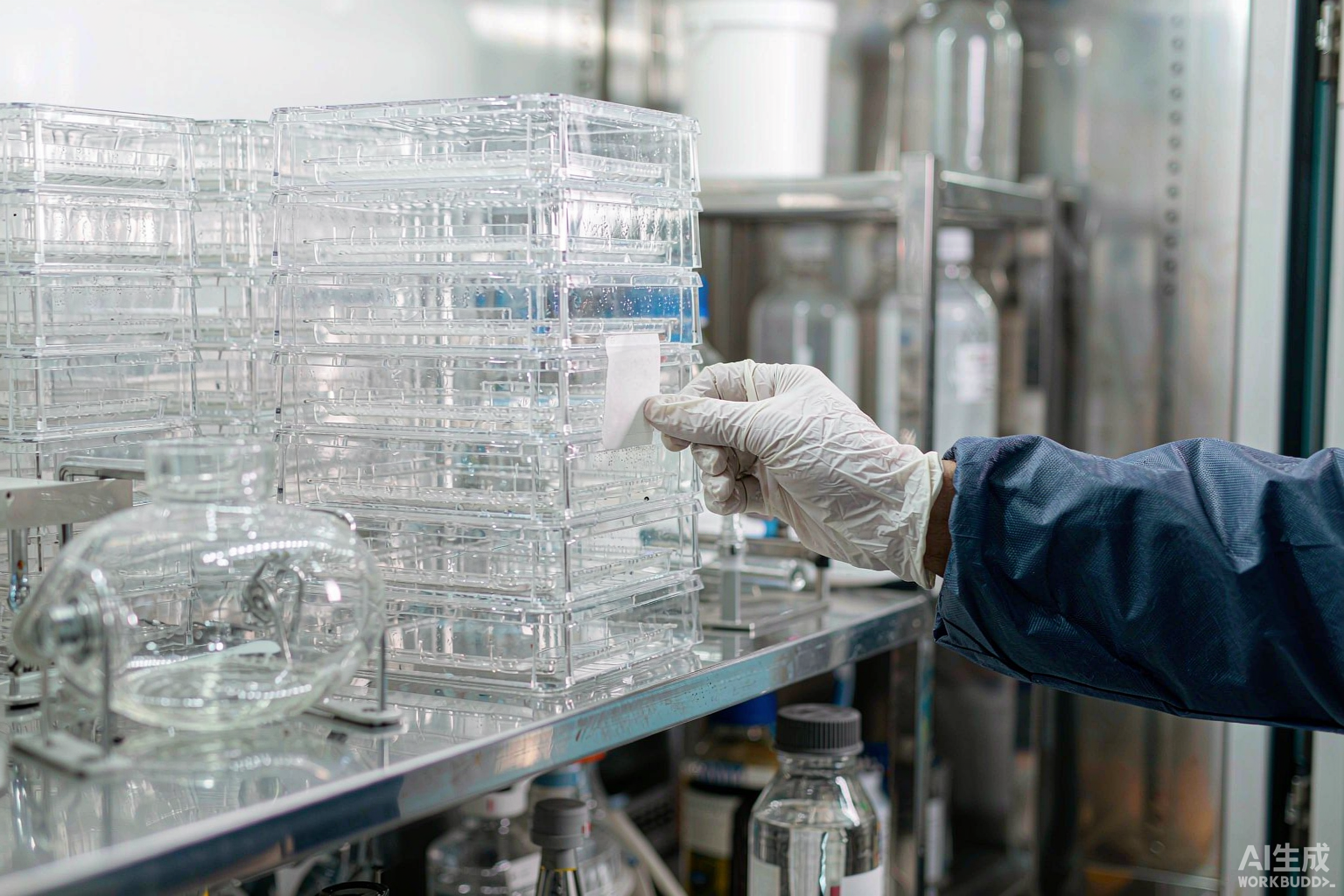

In the context of biobanks, cryogenic label selection has become almost a fixed formula: look at the lowest temperature endpoint first, then work backward to the material. This formula holds perfectly for cryovials, cryoboxes, and LN₂ dewars, but it fails immediately when applied to the site of large-scale cell culture—multilayer cell culture vessels (commonly known in the industry as "cell factories"), roller bottles, spinner flasks, and small stirred tanks. The reason is that labels on these containers almost never need to withstand -196 °C: their actual service environment is inside a CO₂ incubator at 37 °C with relative humidity typically no lower than 95%, and they must remain there continuously for 5 to 14 days. The conclusion of this article is: for label selection on large-scale culture vessels, the first determining criterion is not the minimum temperature, but the cumulative load formed by "moist heat, motion, and duration"; only when the label follows the harvest to -80 °C post-hoc retention samples, or enters the -196 °C LN₂ working cell bank, does the cryogenic specification return to first place.
I. Conclusion First: Reordering the Priority of Three-Layer Criteria
Replace "look at the lowest temperature first" with a three-layer determination, and the order cannot be reversed.
Layer one: Is it in-line? Does the label need to go into the incubator with the entire vessel and follow the full culture cycle until harvest? If so, the first hurdle it must pass is long-term moist heat aging at 37 °C and saturated humidity, not low temperature.
Layer two: Sterilization pathway. Is this vessel a single-use irradiation-sterilized consumable, or a reusable item requiring repeated moist heat sterilization? The answer directly determines whether to pay a premium for 121 °C.
Layer three: Cryogenic endpoint. Only last does it matter where the harvest goes: -80 °C post-hoc retention samples, or -196 °C LN₂ vapor-phase or liquid-phase storage.
The reason the three-layer determination must follow this order is that the first two layers are veto items: if the label lifts, molds, or falls off inside the incubator, all subsequent cryogenic design considerations become moot. Conversely, if you select a material based on -196 °C from the start, you can easily end up buying a solution that concentrates cost on low-temperature performance but performs poorly at 37 °C and saturated humidity.
II. Why the Biobank Cryogenic Formula Fails in the Production Segment
Multilayer culture vessels, roller bottles, and stirred tanks are production-end containers, and they are completely opposite to storage-end containers in four dimensions.
| Comparison Dimension | Storage End (cryovials, cryoboxes) | Production End (multilayer culture vessels, roller bottles) |
|---|---|---|
| Primary temperature | -80 °C or -196 °C | 37 °C (inside incubator) |
| Humidity | Dry, condensation only briefly during defrost or handling | Relative humidity typically no lower than 95%, long-term saturation |
| Motion state | Static | Roller bottles rotate continuously, repeatedly passing through the culture liquid surface |
| Service duration | Months to years | 5 to 14 days, but high load intensity |
Once this table is understood, the translation of conventional cryovial solutions to the production segment becomes problematic: adhesive systems optimized for cryogenic conditions may undergo hydrolysis and plasticizer migration under prolonged moist heat, with edges lifting first. And a lifted edge in a GMP cleanroom is not a cosmetic issue—it becomes a crevice harboring microorganisms, directly touching the requirements of GB 19489-2008 "Laboratories—General Requirements for Biosafety" and WS 233-2002 regarding facility surfaces being cleanable and free of dust-accumulating structures.
A boundary must first be drawn here: the label affixed to the outer wall of the culture vessel has no direct contact with the culture system, so "leachables entering the culture medium" is not the primary risk pathway. The real risk is physical—edge lifting, curling, shedding, and the resulting cleaning and cross-contamination hazards.
III. The Overlooked Hidden Variable: Cumulative Count of Wet–Dry Alternations
Single-use multilayer culture vessels placed statically on shelves encounter steady-state moist heat; roller bottles rotate, and the label undergoes one "liquid immersion, emergence, drying" cycle per revolution. This cycle count can be calculated.
| Rotation speed | Cycles per hour | Cycles per day | 14-day cumulative | Practical implication for the label |
|---|---|---|---|---|
| 0.5 r/min | 30 | 720 | ~10,000 | Low frequency but continuous; tests adhesive layer hydrolysis resistance |
| 1 r/min | 60 | 1,440 | ~20,000 | Standard operating condition; requires wrap-around structure |
| 2 r/min | 120 | 2,880 | ~40,000 | Significant edge shear; overlap and conformability become primary variables |
A typical roller bottle has an effective adherent surface area of approximately 850 cm², and working liquid generally occupies 10% to 20% of the bottle volume, so the proportion of time the label is actually submerged in liquid per revolution is not high, but the frequency is extremely high. This is why this article reverses the conclusion: roller bottle labels should be selected by "wrapping, overlap, and conformability," not by temperature resistance. If temperature resistance is treated as the primary criterion during selection, it is easy to pick a rigid square label that will lift at the edges after a few thousand revolutions.
IV. Sterilization Pathway Divergence: The Watershed Between Single-Use Irradiated Consumables and Reusable Glass
Commercially available single-use multilayer culture vessels are mostly made of polystyrene, irradiation-sterilized at the factory, and typically not subjected to 121 °C moist heat sterilization by the user; glass roller bottles and glass spinner flasks are reusable items that often undergo 121 °C autoclaving before entering the incubator. This difference turns "whether to buy 121 °C-resistant material" from a technical preference into a determinable choice.
Single-use plastic multilayer culture vessels: no need to pay for 121 °C; allocate budget to conformability and print durability.
Reusable glass roller bottles and spinner flasks: labels must survive the full 121 °C cycle, otherwise they must be re-applied after each sterilization, and re-application means the batch of vessels loses process traceability.
Any item requiring moist heat washing before reuse: same as above.
For scenarios constrained by ISO 13485:2016 and GMP documentation systems, such as cell therapy and antibody pilot production, the cost of the second point is particularly high: re-labeling after sterilization means the batch number on the original label is no longer continuous, and an unexplained numbering gap appears in the batch record. This is also why ISO 20387:2018 repeatedly emphasizes that samples and their identification information must be bound for life.
V. The "Cell" Application Column in the Official Material Guide: Only Three Hits
The BradyLAB (BRD) Lab&HC laboratory medical cryogenic, ultra-low temperature, and solvent-resistant label material guide provides four temperature tiers (LN₂ -196 °C, freezer -80 °C, hot water 100 °C, autoclave 121 °C) and seven application columns (ambient, microscope slides, cryovials and test tubes, conical tubes, cells, general purpose, packaging identification). Pulling out the "cells" column, only three entries match.
| Material Code | Key Official Description | LN₂ -196 °C | Freezer -80 °C | Hot water 100 °C | 121 °C autoclave | Application Recommendation |
|---|---|---|---|---|---|---|
| T629 | Nylon cloth label, easy to apply, high/low temperature resistant, good conformability | Yes | Yes | Yes | Yes | Reusable glassware, or scenarios requiring full temperature range coverage |
| T459 | Ultra-thin polyester label with self-laminating structure and clear tail, protecting printed content while leaving a viewing window | Yes | Yes | Yes | Yes | Single-use plastic culture vessels, or applications involving narrow elongated tubes |
| T409 | Excellent chemical resistance and abrasion resistance; requires end-to-end overlap for freezer and low-temperature applications | Yes | Yes | Yes | — | Where chemical and abrasion resistance are prioritized and 121 °C is not involved |
Among the three, only T629 satisfies both the "cell application plus 121 °C autoclave tier" requirements: it is the only nylon cloth material in the entire table checked for all four temperature tiers and the "cells" application. This table also incidentally rules out two common misuses: T419 (gloss white PET, officially positioned for environments above -40 °C) and T329 (matte white PP adhesive, -40 °C class freezer label) are checked only for the ambient tier in the guide; they cannot cover the -80 °C and LN₂ tiers and therefore are not suitable for any bridging position where the final destination is -196 °C.
If the container body only needs a general-purpose or packaging-level identification (e.g., shelf tags, transport outer box labels), another entry in the guide—T509—is the correct choice: a durable vinyl label designed specifically for wrapping with good conformability, with official guidance to overlap when used in LN₂ environments.

VI. Geometry and Forces: Large Flat Surfaces, Cylindrical Wrap-Around, and Cap Surfaces
Although all involve labeling, the forces at the three types of locations are completely different.
The side wall of a multilayer culture vessel is a nearly ideal large flat surface; a large-format rectangular label is preferred, fitting barcode, batch number, and layer position information in one go, while avoiding fill ports, vent ports, and shelf contact surfaces.
Roller bottles and spinner flasks are cylindrical surfaces in continuous rotation. The stable approach for curved-surface adhesion is circumferential wrapping with end-to-end overlap, rather than applying a rigid square label, which will most likely lift at the edges after a few thousand revolutions.
Cap and top surfaces only need to be identified during opening operations; they are suitable as temporary status layers, not for permanent encoding: caps are removed, swapped, or even soaked for disinfection.
Geometry also determines whether the barcode symbol fits. On the large flat side wall of a culture vessel, width is not an issue, and both 1D and 2D codes can be used; but in narrow elongated areas such as the roller bottle circumference, a 1D code requires sufficient width and quiet zone, whereas a Data Matrix with a module size of approximately 0.50 mm more easily fits batch number and serial number into a small area. Therefore, it is recommended to proceed in the order of "define the symbol first, then define the label size," not the reverse.
VII. Encoding Field Design: Batch, Layer Position, Passage, and Date
The real difficulty in large-scale culture is not adhesion but "traceability of each individual layer within a multi-layer culture vessel." The following field structure is recommended.
| Field | Recommended digits | Example | Notes |
|---|---|---|---|
| Project or line code | 2 to 3 digits | CF2 | Distinguishes different product pipelines |
| Batch number | 6 digits | 261031 | Generated by receipt date for easy sorting |
| Layer position or vessel serial number | 2 digits | 07 | Must cover maximum layer count, hence two digits reserved |
| Passage and harvest status | 2 digits | P4 | Passage number and pre-harvest status |
| Destination marker | 1 digit | N | N = LN₂, 8 = -80 °C, R = ambient retention only |
The five fields concatenated total approximately 13 to 15 characters, which falls right in the Data Matrix comfort zone. For scenarios requiring rapid color sorting, a six-color pre-printed cryogenic label such as T439 can be overlaid at a fixed position—officially described as "pre-printed color at the top of the label for quick identification and classification of experimental container types," which is designed precisely for multi-point parallel experiments.
VIII. Printing and Acceptance: Thermal-Transfer Ribbon and Barcode Grading
Labels at large-scale sites almost always use thermal transfer. The reason is that thermal transfer uses resin-based or mixed-based ribbons to transfer the image onto the face stock, providing significantly better abrasion and rub resistance than direct thermal printing, whose print rapidly grays out or even disappears entirely in high-humidity environments. For specific consumables, refer to cryogenic-specific black ribbons such as BRL-80-B09 on this site; before production, trial printing at various print speeds and darkness settings should be performed, and the parameters then fixed into the work instruction.
| Acceptance Item | Method and Basis | Judgment Recommendation |
|---|---|---|
| Peel strength | GB/T 2792-2014 Pressure-sensitive adhesive tape—180° peel strength test method | Use the incoming batch initial value as baseline; retest after moist heat cycling; include degradation in change control |
| Holding tack | GB/T 4851-2014 Pressure-sensitive adhesive tape—Holding tack test method | Record displacement and failure time under specified load and archive |
| 1D barcode quality | ISO/IEC 15416 Linear barcode print quality evaluation | Use grading result as receiving and release threshold |
| 2D barcode quality | ISO/IEC 15415 2D barcode print quality evaluation | Modulation ratio and grid damage can be graded A or B under the grading system |
| Key field readability | ISO/IEC 15415, ISO/IEC 15416 verification | Must be readable on first scan after sterilization and moist heat cycling |
The ISO/IEC 15415 and ISO/IEC 15416 grading systems range from grade 4 to grade 0 in 0.5 steps, with common receiving thresholds at grade 3 or grade 2 and above. A key point to add here: barcode grading must be retested after moist heat cycling, not just at incoming inspection—a high grade at the time of printing does not mean it will still be readable on day 14.
IX. Implementation Checklist: Layout Example for a Multi-Layer Culture Vessel
Estimating by the industry-standard specification of 600 to 650 cm² per layer, a 40-layer culture vessel has a total adherent surface area of approximately 25,000 cm² (about 2.5 m²), equivalent to more than 140 175 cm² culture flasks; adherent cell confluence density is typically on the order of 1 to 2 × 10⁵ per cm², giving a single-batch harvest of approximately 2.5 × 10⁹ to 5 × 10⁹ cells. For such a harvest, label placement should follow at least four points.
1. Place the main label on the lower side wall in a flat area avoiding tubing and openings, with a size no smaller than the window that allows the Data Matrix module to reach 0.50 mm.
2. Leave a clear zone of no less than 20 mm above the fill port and harvest port to avoid repeated glove rubbing during operation.
3. Record the layer position number and batch number from each layer's side wall into the batch record simultaneously; the physical label on the container and the paper ledger serve as mutual backups.
4. When harvesting and aliquoting into centrifuge bottles or well plates, copy the complete source vessel number once more onto each daughter container—ISO 20387:2018 and ISO 17025:2017 both require continuous identification of test or preservation objects, and this step is the most easily broken link in the chain.
X. Correction Checklist for Common Misuses
1. Do not ask "is it -196 °C resistant?" first. Most in-line containers sit statically exposed to moist heat; cryogenic conditions come after harvest.
2. Do not temporarily use ordinary paper or direct thermal labels on culture flasks to save money; no problem is visible on day one, but edge curling begins on day three.
3. Do not write the unique number on the cap. Caps are removed, mixed up, and soaked for disinfection.
4. Do not share one container number across shelf positions. The same culture vessel can easily run two batches in parallel.
5. Do not treat 121 °C as a default requirement, nor as never required. The determining basis is the sterilization pathway, not habit.
6. Do not release based solely on barcode grading at ambient temperature; retesting after moist heat cycling is the real threshold.
Recommended Products
For the label materials and application scenarios covered in this article, the following BradyLAB (BRD) products are available for selection reference (click to view specifications and request a quote):
- Lab096-629/80x60mm nylon cloth label (T629 material, full temperature range coverage) (¥999/roll)
- Lab208-509/25.4x63.5mm wrap-around vinyl label (preferred for roller bottle circumference) (Price on request)
- Lab115-459/9.53+65x9.53mm ultra-thin polyester self-laminating label (Price on request)
- Lab084-439/30x15mm six-color pre-printed cryogenic classification label (Price on request)
FAQ
Q1: Must multilayer cell culture vessels use -196 °C-resistant labels?
A: In the vast majority of cases, no. Their service environment is inside an incubator at 37 °C with relative humidity no lower than 95%, and the first hurdle for the label is moist heat aging, not cryogenic conditions. What truly requires cryogenic capability is the aliquot tubes after harvest. Follow the three-layer determination in this article when selecting materials: first determine whether it is in-line, then the sterilization pathway, and finally the cryogenic endpoint.
Q2: Can single-use plastic culture vessels use 121 °C-resistant labels?
A: Yes, but it is usually unnecessary to pay for this performance. Single-use multilayer culture vessels are mostly irradiation-sterilized at the factory and are not subjected to moist heat sterilization by the user; only when the item is a reusable glass roller bottle or spinner flask, or when the process requires the label to follow the 121 °C cycle, must a material be selected that is checked for both the autoclave tier and the cell application in the guide.
Q3: Why is wrapping recommended for roller bottle labels rather than square application?
A: Roller bottles rotate continuously, and the label undergoes one immersion and emergence per revolution. At a typical 1 r/min, that is approximately 1,440 cycles per day and approximately 20,000 over 14 days. Under such conditions, a rigid square label will lift at the edges, whereas a circumferential wrap with end-to-end overlap can hide the edges within the overlap zone. The wrap-around vinyl material designed for this purpose in the guide is officially noted to require overlap when used in LN₂ environments.
Q4: Should the barcode symbol be 1D or 2D?
A: If space is sufficient—for example, on the large flat side wall of a culture vessel—a 1D code is lower cost and compatible with existing scanners; but in narrow elongated areas such as the roller bottle circumference, a Data Matrix can carry significantly more characters in a small area and has built-in error correction. Whichever is chosen, it should be graded per ISO/IEC 15415 or ISO/IEC 15416 and retested once after moist heat cycling.
Q5: Can -40 °C class ordinary freezer labels be used on archive tubes for cell culture?
A: Not recommended. According to the official guide, T419 and T329 are checked only for the ambient tier and officially positioned for environments above -40 °C; they cannot cover the -80 °C and LN₂ tiers. Archive tubes should use materials checked for the corresponding temperature tier; otherwise, if they fall off, the complete source information of that batch of cells is lost with them.
Q6: Should roller bottle and multilayer culture vessel labels be made to a unified specification?
A: Field content and encoding rules can be unified, but it is not recommended to unify the physical dimensions. The geometries are completely different: one is a large flat surface, the other a rotating cylindrical surface. The recommended approach is "unified rules, separate specifications"—the same set of fields maps to the appropriate size and symbol density for each container type.
Q7: How should the retest judgment after moist heat cycling be defined?
A: The most robust approach is to use the incoming batch initial value as baseline, measure peel strength and holding tack once before and once after moist heat cycling per GB/T 2792-2014 and GB/T 4851-2014, and retest barcode grading per ISO/IEC 15415 and ISO/IEC 15416 after cycling, writing the difference rather than the absolute value into the work instruction. This ensures a consistent comparison basis each time the material source is changed.