
Bottom line up front: The selection sequence for cleanroom environmental monitoring sampling labels is the opposite of that for biobank labels. Biobanking is "temperature first"—decide -196 °C or -80 °C first, then everything else; cleanroom environmental monitoring is "location first"—the first constraint is the unique code and monitoring type of the sampling point, the second is the geometry of the carrier (settling plate φ90 mm × 15 mm, contact plate φ55 mm, swab sampling tube), and only the third is the temperature tier. The reason is that the credibility of environmental monitoring data rests entirely on "which point, which time period, which sample type"; once the location code is mismatched, all subsequent CFU counts lose traceability. The implementation sequence should be: define the code → define the geometry → define the temperature zone → define the face stock and ribbon → define the symbology. What BRD 博锐迪 provides in environmental monitoring scenarios is the physical-world carrier for this coding system.
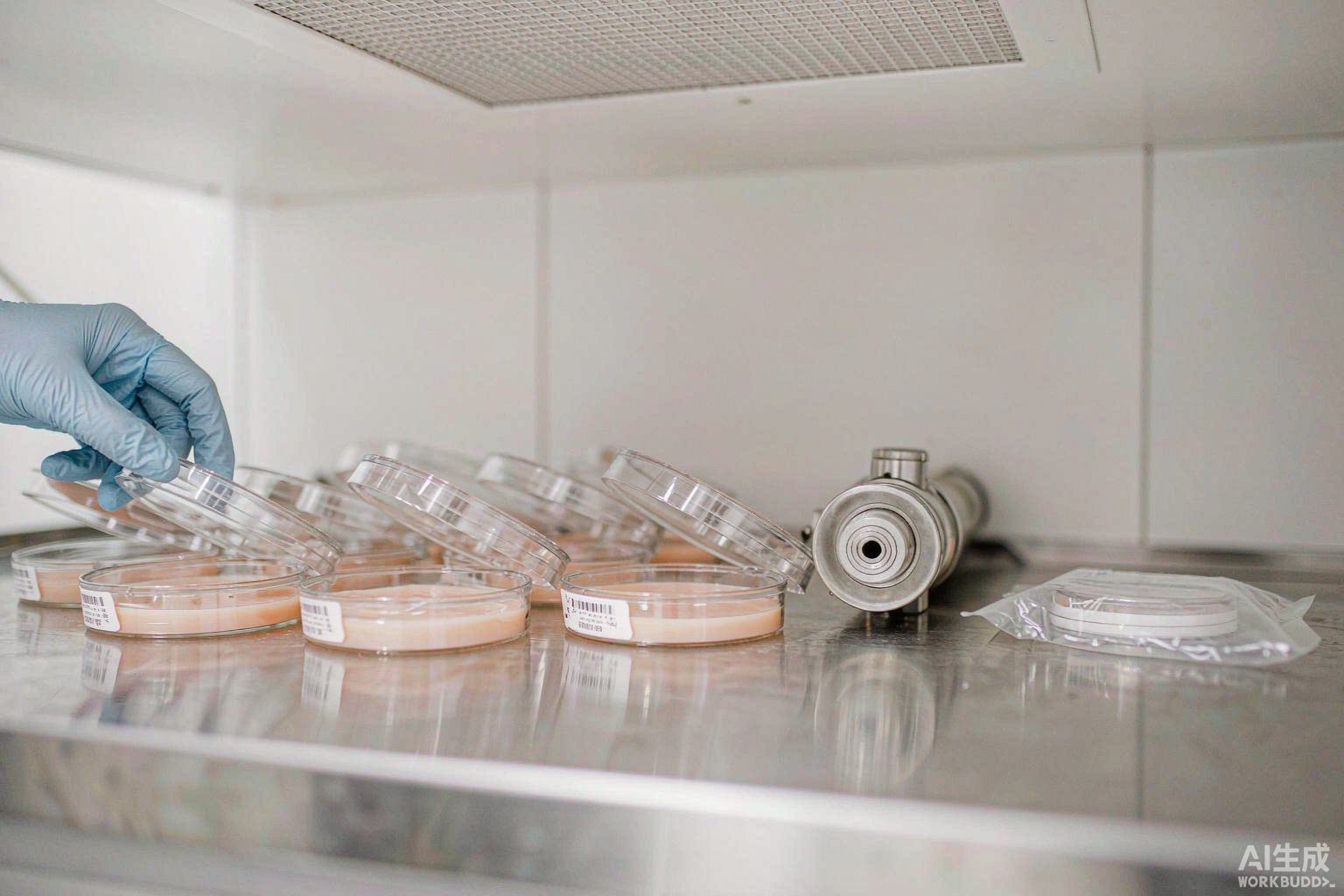
1. Why the first constraint is the sampling point code, not temperature
For cleanroom environmental monitoring data to be accepted in an audit, three questions must be answered: which point this number came from, which time period was sampled, and which type of monitoring sample it belongs to. Temperature ranks only third in the chain—because the vast majority of steps (2–8 °C refrigerated storage, 18–26 °C sampling, 20–35 °C incubation) are far below the lower limit of any cryogenic label. The only genuine material thresholds are the 121 °C waste sterilization after plate reading, and the transition where isolated strains are transferred to -80 °C or -196 °C preservation.
Article 3.2.1 of GB 50457-2019, Design Standard for Pharmaceutical Industry Clean Rooms, requires that the air cleanliness level classification of pharmaceutical cleanrooms comply with Table 3.2.1, and Article 3.2.2 requires that the dynamic standards for environmental microbial monitoring comply with Table 3.2.2. Both are mandatory provisions, effective from December 1, 2019, superseding GB 50457-2008. Annex 1 Sterile Products of the Good Manufacturing Practice for Drugs (2010 Revision), Chapter 3, sets out the dynamic standards for airborne particles and microorganisms at cleanroom grades A/B/C/D. These two documents establish that a "sampling point" is a controlled object with a unique number, subject to controlled revision as the facility changes—not a temporary mark that can be altered at will.
The layout and number of sampling points follow a defined algorithm. The minimum number of sampling points is calculated as NL=√A, where A is the area of the cleanroom or controlled clean zone in square meters. For any small cleanroom (zone) or localized air purification area, the number of sampling points shall be no fewer than 2, and the total number of sampling events no fewer than 5; each sampling point may be sampled more than once, and different sampling points may have different sampling counts. When there are more than 5 sampling points, they may be arranged in layers within the zone 0.8 m–1.5 m above the floor, with no fewer than 5 points per layer. Sampling points in the working area are positioned approximately 0.8 m–1.5 m above the floor; sampling points at supply air outlets are positioned approximately 30 cm from the supply air face; the layout should be as uniform as possible, avoiding overly sparse areas in any localized zone.
Sampling point numbers for different cleanliness levels within the same room must not be duplicated—this is the most common and most critical failure point in environmental monitoring labeling. For example, in a Grade B background zone containing a Grade A unidirectional airflow protected area, the two must be assigned to different number sequences. Engineering practice typically uses a structure of "monitoring type abbreviation + room number + two-digit point number"; two points in the same room receive two independent numbers. Translated to labels, this requires that the code carried on the label be unique within the same room and distinguish cleanliness levels.
2. Geometric windows of the four carrier types
The objects labeled in environmental monitoring are not cryovials; their geometries differ greatly, directly determining the available labeling area and symbology.
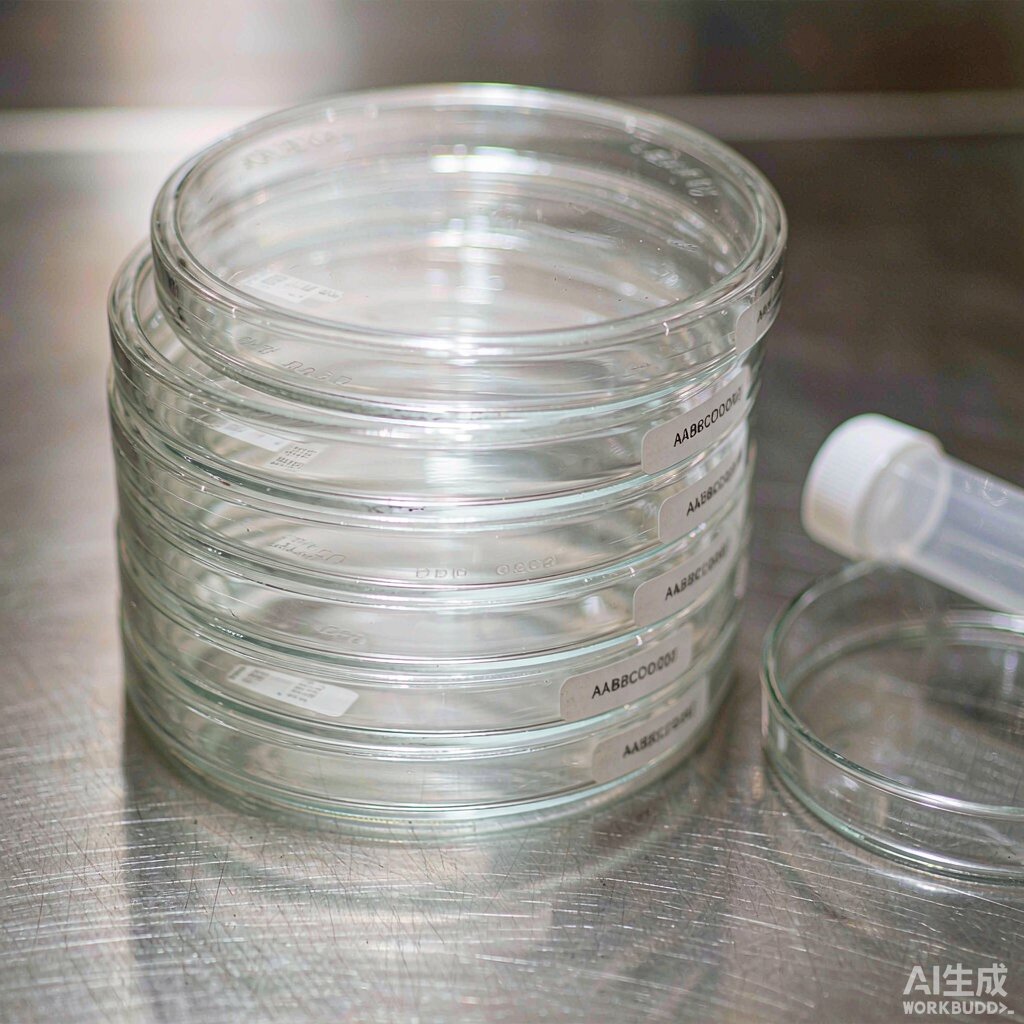
| Carrier | Typical specification | Labeling window | Main constraint |
|---|---|---|---|
| Settling plate | φ90 mm × 15 mm, glass or polystyrene | Side wall height 15 mm, usable height after edge margin approx. 13 mm; side wall circumference approx. 283 mm; base φ90 mm, annular band usable after reserving a φ30 mm central viewing window | Incubated inverted; label must not obscure the viewing surface or interfere with lid opening/closing |
| Surface microbial contact plate | φ55 mm (RODAC type) | Side wall circumference approx. 173 mm; usable height approx. 12–15 mm | Bottom is a raised agar surface; absolutely must not be labeled |
| Petri dish for airborne microbial sampler | Typically φ90 mm × 15 mm or instrument-specific strip agar | Same as settling plate; instrument body is a metal housing requiring a separate equipment location label | Sampling head rotates; label thickness affects loading/unloading |
| Surface wipe swab sampling tube | Commonly 10–15 mL screw-cap tube, OD approx. 15–17 mm | Circumference approx. 47–53 mm; maximum flat-label width approx. 12–13 mm | Narrow diameter; 1D barcode length easily exceeds limit |
| Five-finger glove print contact plate | φ90 mm or φ55 mm | Same as corresponding contact plate specification | Must distinguish operator identity and workstation |
The significance of the geometric window is that it constrains the symbology, not the material. The side wall circumference of a φ55 mm contact plate is only about 173 mm; a Code 128 symbol would likely wrap nearly one-third of the way around the plate and cross the handling position, cutting off the scan window. On narrow-diameter swab tubes, a 1D barcode will almost certainly exceed the limit. This is the fundamental reason environmental monitoring scenarios have broadly shifted to 2D symbols.
3. The temperature chain is four transitions, not a single low temperature
Environmental monitoring samples undergo four temperature state changes within a week, completely different from the biobank model of "one-time storage, long-term constant temperature."
The first stage is refrigerated storage: prepared agar plates are typically stored at 2–8 °C for several days to several weeks, to inhibit agar dehydration and growth of contaminants. The second stage is sampling exposure: cleanroom (zone) temperature should be 18–26 °C with relative humidity 45%–65% (absent special requirements); exposure time for settling plates is no less than 30 min in static testing and no more than 4 h in dynamic testing; multiple settling plates may be used at the same location for continuous monitoring and cumulative counting. The third stage is incubation: plates prepared with soybean casein digest agar (TSA) are incubated inverted at 30–35 °C for no less than 2 d after sampling; plates prepared with Sabouraud dextrose agar (SDA) are incubated at 20–25 °C for no less than 5 d. The fourth stage is waste disposal: after plate reading, plates must undergo moist heat sterilization at 121 °C for no less than 30 min before disposal as medical waste; the label travels with the plate.
Of the four stages, only the fourth—121 °C saturated steam—constitutes a hard material threshold. The first three (2–8 °C, 18–26 °C, 20–35 °C) all fall within conventional ranges that any cryogenic material can cover. There is no need to default to the liquid nitrogen tier "for safety"—that only adds unnecessary cost.
4. Selecting tiers stage by stage against the official material guide table
For selection, align the four operating conditions with the four columns of the official material guide table (liquid nitrogen -196 °C, freezer -80 °C, hot water 100 °C, autoclave 121 °C).
| Monitoring step | Temperature condition | Corresponding tier in official table | Recommended material | Key constraint |
|---|---|---|---|---|
| A Agar plate refrigerated storage | 2–8 °C, several days to several weeks | Conventional range; covered by freezer -80 °C tier and below | T439 top pre-printed 6-color cryogenic label | Use top color to distinguish monitoring type, avoiding lid-opening identification |
| B Sampling exposure | 18–26 °C, 45%–65%RH, static ≥30 min / dynamic ≤4 h | Conventional range | T439 or T629 nylon cloth label | Label must not fall in the lid opening/closing path |
| C1 Bacterial incubation | 30–35 °C, ≥2 d, inverted | Hot water 100 °C tier | T439 or T629 | High humidity + prolonged constant temperature; adhesive must not flow |
| C2 Fungal incubation | 20–25 °C, ≥5 d, inverted | Hot water 100 °C tier | T439 or T629 | Longer incubation; printed content must be abrasion-resistant |
| D Post-reading waste sterilization | 121 °C moist heat, ≥30 min | Autoclave 121 °C tier | T629 (listed for this tier in the guide table) | T439 is not listed for the 121 °C tier; must be removed beforehand or switched to T629 |
| E Isolated strain preservation transition | -80 °C or -196 °C | Freezer -80 °C tier / liquid nitrogen -196 °C tier | T629 (listed for both tiers); T509 wrap-around type (overlap required in LN₂ environments) | Narrow tubes require end-to-end overlap of no less than 3 mm |
T629 is the only material in the guide table checked in all four columns—room temperature, microscope slides, cryovials and test tubes, and conical tubes—and the only nylon cloth label covering all four tiers: liquid nitrogen -196 °C, freezer -80 °C, hot water 100 °C, and autoclave 121 °C. It is easy to apply and conforms well. In environmental monitoring scenarios it serves two roles: first, as a fixed sampling point number plate (wall, equipment location, below supply air outlets), applied for long-term room-temperature adhesion and replaced entirely when points are adjusted; second, as a petri dish identity label that must accompany the plate through the full 121 °C waste sterilization process.
T439's differentiated value lies in color coding rather than temperature. In the guide table it covers three tiers—liquid nitrogen -196 °C, freezer -80 °C, and hot water 100 °C—and features 6 pre-printed colors at the top of the label for rapid differentiation of container categories. Environmental monitoring happens to involve five sample types requiring visual differentiation—settling bacteria, airborne bacteria, surface contact plates, five-finger glove prints, and negative controls—and the top color code allows operators to sort without opening lids or turning plates over, which is particularly practical under the restriction that no more than 2 personnel may be present in a static test room.
T429 is the conventional choice for frozen flat surfaces, applicable across all four tiers in the guide table; when applied to cryovial surfaces, overlap at least 3 mm end to end. In environmental monitoring it is mainly used for small-diameter containers after isolated strains are transferred to low-temperature preservation. T509 is a wrap-around vinyl label with good conformability; it requires overlap in liquid nitrogen environments and is suitable for narrow-diameter round tubes such as swab sampling tubes.
5. Disinfectant chemical exposure determines face stock and ribbon
The cleanroom where environmental monitoring sampling points are located undergoes periodic cleaning and disinfection. Common disinfection methods include 75% ethanol wiping, chlorine-based disinfectants, quaternary ammonium compounds, hydrogen peroxide fogging, peracetic acid, and ozone and UV irradiation. Labels affixed to walls, equipment locations, or sampler bodies are repeatedly wiped or even fog-fumigated along with the surfaces.
This determines two things: first, thermal transfer printing must be used rather than direct thermal—direct thermal paper fades rapidly under alcohols and oxidants, and if the code is unreadable at the plate-reading stage, the entire batch of data is invalidated; second, the ribbon must be resin-based—wax and wax/resin ribbons lack sufficient abrasion resistance under disinfectant wiping. BRD 博锐迪's laboratory-specific cryogenic ribbon is designed for this operating condition.
One point requires clarification: the official material guide table does not provide a tolerance list for specific disinfectant types, so articles should not promise that a given material "withstands X wipes of a certain disinfectant." The correct approach is to determine candidates using the material tiers in this article, then conduct compatibility testing with the actual disinfectant types and wiping frequencies used, or contact the product manager for selection confirmation. This boundary is both responsible to the customer and avoids writing unverified figures into quality system documents.
6. Coding rules and symbology selection
Sampling point codes are recommended to use a segmented structure of "monitoring type—room number—cleanliness level—point number—sampling date—sequence number," with total length kept within 20 characters. Example: SET-B203-A07-20261005-01 denotes the settling bacteria sample from point 07 in the Grade A zone of room B203, first sampling on October 5, 2026. The advantage of the segmented structure is human readability—even if scanning fails, the operator can still locate the point from the code.
Symbology selection is determined by the geometric window. Taking a 20-character alphanumeric code as an example: the symbol width of Code 128 is approximately (11n+55)×X, where n is the number of characters and X is the narrow module width. With n=20 and X=0.19 mm, the symbol width is approximately 52 mm; with X=0.25 mm, approximately 90.8 mm. On the side wall of a φ55 mm contact plate, 52 mm already wraps nearly one-third of the way around the plate, and after crossing the handling position the scan window is cut off; 90.8 mm is even less feasible.
| Comparison item | Code 128 (1D) | DataMatrix (2D) |
|---|---|---|
| 20-character symbol size | Approx. 52 mm wide at 0.19 mm narrow module | Approx. 7.2 mm side length at 24×24 modules, X=0.30 mm |
| φ90 mm settling plate side wall | Fits, but occupies nearly 1/5 of circumference | Fits, with viewing window preserved |
| φ55 mm contact plate side wall | Wraps nearly 1/3 of plate, crosses handling position | Fits completely |
| φ15–17 mm swab sampling tube | Flat application almost certainly exceeds limit | Usable at 7.2 mm side length (tube circumference approx. 47–53 mm) |
| Quality evaluation standard | ISO/IEC 15416 | ISO/IEC 15415 |
| Symbol specification | — | ISO/IEC 16022 |
The conclusion: φ90 mm settling plates may continue to use 1D as appropriate; φ55 mm contact plates and narrow-diameter swab sampling tubes should always use DataMatrix. Symbol quality is evaluated per ISO/IEC 15416 (linear) and ISO/IEC 15415 (2D); the 2D symbol specification is given in ISO/IEC 16022. For batch plate-reading scenarios, UHF RFID petri dish labels can be further introduced to enable contactless reading of entire racks of plates—a path consistent with the batch inventory logic of biobanks.
7. Six-step implementation SOP
Step 1: Freeze the sampling point layout drawing and generate numbers. The quality department determines sampling point locations and quantities based on risk assessment, calculates the minimum per NL=√A, with no fewer than 2 points for small cleanrooms and no fewer than 5 total sampling events, producing a controlled layout drawing and numbering table.
Step 2: Produce fixed sampling point number plates. Point plates on walls, equipment locations, and below supply air outlets use room-temperature long-term adhesive material; numbers must match the layout drawing character for character; when points are adjusted, the entire plate is replaced and the layout drawing revised accordingly.
Step 3: Assign color codes by monitoring type. Assign one pre-printed top color each to settling bacteria, airborne bacteria, surface contact plates, five-finger glove prints, and negative controls, and document this in work instructions to prevent misreading caused by color changes between batches.
Step 4: Generate sample labels and print. Label content must include at least the sampling point number, monitoring type, sampling date and start/end times, and operator code; use thermal transfer + resin-based ribbon, and perform symbol quality spot checks immediately after printing.
Step 5: Apply according to the geometric window. For settling plates, apply to the side wall or the base annular band, avoiding the viewing window and lid-opening path; for contact plates, apply to the side wall only; for swab sampling tubes, use wrap-around application with end-to-end overlap of no less than 3 mm.
Step 6: Close the loop on plate reading and waste disposal. After plate reading, record CFU counts and associate them with the code; sterilize plates with moist heat at 121 °C for no less than 30 min before disposal as medical waste; strains requiring archival transfer to -80 °C or -196 °C preservation, with labels switched to the material for that temperature zone.
8. Five failure types and troubleshooting
| Failure symptom | Most common root cause | Troubleshooting and corrective action |
|---|---|---|
| Code unreadable after incubation | Direct thermal printing or wax/wax-resin ribbon; fading under disinfectant wiping and 30–35 °C high humidity | Switch to thermal transfer + resin-based ribbon; assess whether data from completed batches can be salvaged |
| Duplicate numbers in the same room | Grade B background zone and internal Grade A zone not assigned to separate number sequences | Assign separate sequences by cleanliness level; revise layout drawing and replace point plates |
| Contact plate label cannot be scanned | 1D symbol wraps more than 1/3 of plate, crossing the handling position | Switch to DataMatrix with side length controlled at 7–8 mm |
| Label lifting or detaching after incubation | Disinfectant or moisture residue on application surface; not pressed out after application | Wipe dry with a lint-free cloth before application and allow surface to dry; press out and firm along the labeling direction after application |
| Label carbonized or detached after sterilization | Material does not cover the autoclave 121 °C tier | Switch to a material covering that tier, or remove the label before sterilization and transcribe the code |
9. Compliance boundary: labeling does not replace system documents
One boundary must be made clear: the sampling point layout drawing, numbering rules, monitoring frequency, and acceptance limits for cleanroom environmental monitoring are enterprise quality system documents, based on GB 50457-2019, Annex 1 of the Good Manufacturing Practice for Drugs (2010 Revision), and other standards, under controlled management by the quality department. Labels are merely the physical-world carrier for this numbering system, binding "points on paper" to "actual petri dish and wall locations"; they neither generate limits nor replace layout drawings, validation reports, or deviation investigation records.
Similarly, biological indicators, chemical indicator cards, and culture medium suitability checks used in environmental monitoring are independent compliance actions with their own regulatory requirements; labels neither intervene in nor cover them. Clarifying the boundary actually makes the labeling scheme defensible in audits—what the auditor sees is not "a label was applied" but "the numbering system, physical carrier, and data records correspond one-to-one."
10. Interface with biobanking
Environmental monitoring is not the endpoint. When a strain requiring further identification is isolated on a settling or airborne bacteria plate, the sample transitions from the "environmental monitoring chain" to the "biological sample preservation chain," and labeling requirements change accordingly.
Labels on the environmental monitoring side need only cover the 2–8 °C to 35 °C range; after transfer to preservation, strains are typically held at -80 °C as glycerol stocks or at -196 °C in liquid nitrogen vapor/liquid phase, at which point materials must be switched to the -80 °C or -196 °C tier. If this transition is overlooked, the same strain has one number in environmental monitoring records and another in the preservation library, and the traceability chain is broken. Recommended practice: use the environmental monitoring sampling point number as a prefix on the preservation tube label, followed by the strain sequence number, with both segments linked by the same primary key in the LIMS or ledger.
For biobanks, ISO 20387:2018 sets explicit requirements for traceability of the preservation process; for testing laboratories, ISO/IEC 17025:2017 and ISO 15189:2022 constrain record integrity from the perspectives of testing competence and medical laboratory quality respectively; laboratories handling bacterial (viral) strains must also comply with GB 19489-2008 and WS 233-2002. Using a unified code prefix for environmental monitoring labels and preservation labels is the lowest-cost approach to satisfying all of these requirements simultaneously.
11. Records and retention periods
| Record item | Recommended medium | Relationship to labels |
|---|---|---|
| Sampling point layout drawing and numbering table | Controlled quality system document (with version number) | Label numbers must match the current version character for character |
| Sampling raw records (point, start/end times, sampling volume) | Paper record book or LIMS | Retrieved using the label code as primary key |
| Incubation condition records (medium lot number, incubation temperature, duration) | Incubator records + ledger | Blank control plates (3) require separate numbering |
| Count results and determination | LIMS or spreadsheet | Associated with code; out-of-limit triggers deviation |
| Strain preservation transition records | Preservation library ledger | Use sampling point number as prefix |
Each batch of culture medium should include a blank control to verify whether the medium itself is contaminated; typically 3 plates per batch are selected for control incubation—these three plates also require independent codes, otherwise the control results cannot be attributed. This detail is most often overlooked on site, yet it is precisely a mandatory audit item.
Recommended Products
For the label materials and application scenarios covered in this article, the following 博锐迪 (BRD) products are available for selection reference (click to view specifications and request a quote):
- Lab096-690 (T629 nylon cloth, 80 × 60 mm, covers all four tiers -196 °C/-80 °C/100 °C/121 °C, ¥999)
- Lab084-454 (T439 six-color pre-printed cryogenic label, 30 × 15 mm, price on request)
- TRUF-32916 (UHF RFID petri dish/microplate label, low-temperature and solvent-resistant, price on request)
- BRL-110-13 (laboratory-specific cryogenic ribbon, 110 mm × 300 m, price on request)
For wrap-around selection for narrow-diameter sampling tubes, refer to Lab208-542; for small-diameter low-temperature containers, refer to Lab038-442. For more materials and specific applications, please contact the product manager for selection.
FAQ
Q1: Should the settling plate label go on the lid or the base?
Recommended on the base annular band or side wall, not on the lid. During sampling the lid must be opened and set aside separately; when multiple plates are handled simultaneously, lids are easily mixed up, whereas the base remains with the medium at all times, so the number cannot be misplaced. If applied to the base, reserve a central viewing window of approximately φ30 mm to avoid obstructing transmitted-light observation during colony counting. For the side wall option, note that label height must not exceed 13 mm, otherwise it will interfere with lid closure.
Q2: Incubation temperature is only 30–35 °C—is cryogenic material really unnecessary?
Looking at incubation temperature alone, indeed not. But the value of an environmental monitoring label is "one label through the entire process"—from 2–8 °C storage, 18–26 °C sampling, 30–35 °C or 20–25 °C incubation, all the way to 121 °C waste sterilization. If a label change is required mid-process due to material intolerance, the code must be transcribed once, and transcription is the primary source of number mix-ups. Therefore material selection should be based on the highest temperature tier in the entire process (121 °C), not on the incubation temperature.
Q3: Why can't a 1D barcode be used on a φ55 mm contact plate?
Geometry. The side wall circumference of a φ55 mm contact plate is approximately 173 mm; a 20-character Code 128 symbol at 0.19 mm narrow module is approximately 52 mm wide, already wrapping nearly one-third of the way around the plate and necessarily crossing the handling position—the scan window is cut off by fingers or handling motion, and on-site scan success rates are very low. Switching to a 24×24 module DataMatrix with X=0.30 mm gives a side length of only approximately 7.2 mm, which fits entirely at a single point on the side wall.
Q4: Do sampling point number plates also need to be placed below cleanroom supply air outlets?
Yes. The sampling point layout requirements of GB/T 16293-2010 specify that sampling points at supply air outlets are positioned approximately 30 cm from the supply air face; such points typically have no equipment to attach to, so fixed number plates must be placed on walls or ceiling suspension positions—otherwise each sampling event relies on memory for positioning, and after personnel rotation the position easily drifts. Number plates are applied for long-term room-temperature adhesion; when points are adjusted, the entire plate is replaced and the layout drawing revised accordingly.
Q5: Do blank control plates require separate numbering?
Absolutely. Each batch of culture medium should include a control to verify whether the medium itself is contaminated; typically 3 plates per batch are selected for control incubation. If these three plates are not included in the coding system, the control results cannot be attributed to a specific batch; and if a control turns positive, the range of affected sampling batches cannot be quickly defined. It is recommended to assign a separate type code to control plates, parallel to sample types such as settling bacteria and airborne bacteria.
Q6: If the label code fades after disinfection, can completed monitoring data still be used?
It depends on when the fading occurred. If fading occurred after plate reading and counting were completed, and the count records were already associated with the code at that time and archived, the data can usually be preserved through ledger traceability, but a deviation must be recorded and explained. If the code was unreadable before plate reading, the plate cannot be attributed to a point, the data cannot be accepted, and resampling should be performed. The fundamental corrective action is to switch to thermal transfer + resin-based ribbon and move symbol quality spot checks upstream to the printing step.
Q7: After strains isolated from environmental monitoring are transferred to preservation, should the number be changed?
No—use prefix inheritance. The preservation tube label uses the environmental monitoring sampling point number as a prefix, followed by the strain sequence number, with both segments linked by the same primary key in the ledger. If a completely new number is assigned, the connection key between environmental monitoring records and preservation records is lost, and subsequent trend analysis or deviation traceability requires manual comparison—costly and error-prone.
Q8: Can one label set cover both Grade A and Grade B points?
The number cannot; the material can. Sampling point numbers for different cleanliness levels within the same room must not be duplicated; Grade A and Grade B must be assigned to different number sequences—this is a hard requirement at the numbering rule level. But there is no material difference between the two—the temperature conditions are the same, the chemical exposure is the same, and the same material can be used; the only difference is the code content printed on the label.