
Bottom line first: The label selection sequence for laboratory pure water and ultrapure water systems is the opposite of that for biological sample cryogenic labels. The first constraint for cryogenic sample labels is the "lowest temperature across the entire process," whereas the first constraint for pure water systems is the combination of "water grade × time-based degradation × disinfection chemical exposure." The reason is that the system itself operates year-round in the ambient temperature range; what truly determines the viability of face stocks and ribbons is periodic disinfection—pasteurization with 80–85 °C hot water circulation, 0.5%–3% hydrogen peroxide, 0.1%–0.5% peracetic acid, 50–200 mg/L sodium hypochlorite—as well as the minute-by-minute water quality degradation after ultrapure water leaves the piping. Therefore, the selection path should be: first determine the water grade and point-of-use classification → then determine the time-sensitive fields → then determine the temperature and chemical resistance tier according to the disinfection method → finally determine the geometry and symbology. Note: The BradyLAB (BRD) material guide table does not list a "pure water system housing / piping" application column. The following uniformly uses temperature tier and chemical resistance as the basis for selection; specific suitability is subject to the product specification sheet and actual compatibility testing. You may contact the product manager for selection assistance.
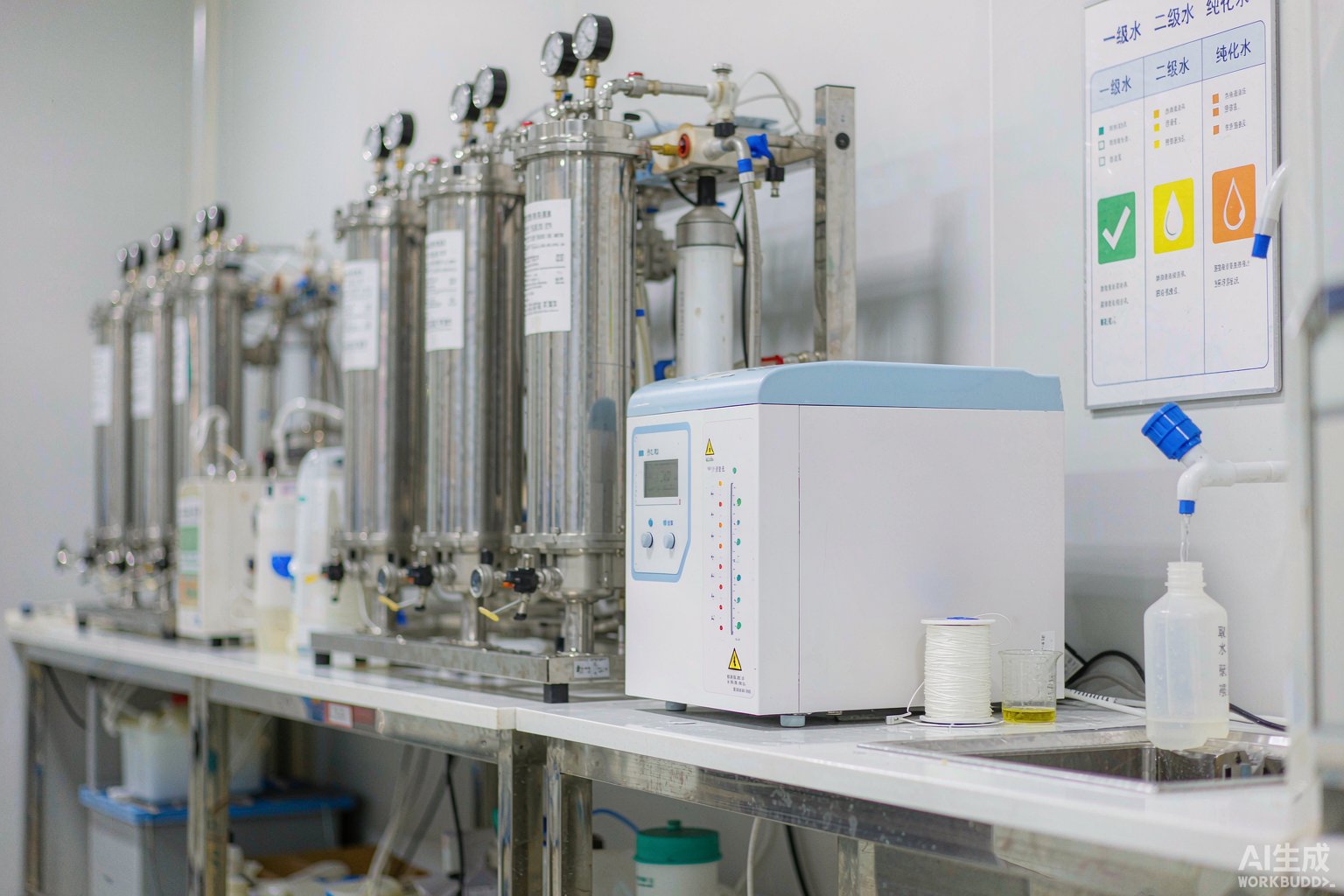
I. Why the selection sequence for pure water systems is the opposite of cryogenic sample labels
The selection logic for biological sample cryogenic labels is dominated by a single variable: find the lowest temperature across the entire process, then find the material corresponding to that tier. Pure water systems are completely different—their temperature variable is nearly constant. The ambient temperature of equipment rooms and water intake rooms is typically controlled at 10–30 °C with humidity below 60%, falling within the ambient temperature range; extreme conditions such as liquid nitrogen and ultra-low temperature freezers simply do not exist in this scenario.
The two new variables that take their place are chemical exposure and time-based degradation. Chemical exposure comes from the system's periodic disinfection: to inhibit biofilm, distribution piping and storage tanks require weekly or monthly pasteurization or chemical disinfection. If labels are applied near the disinfection section, they must withstand the dual stress of high temperature and oxidizing agents. Time-based degradation comes from the physical and chemical characteristics of ultrapure water itself: once it leaves the closed piping and contacts air, resistivity drops significantly within tens of minutes. Therefore, the "time of collection" must become a mandatory field on the label.
After ranking the three variables, the selection sequence becomes clear: the first constraint is water grade (determining the point-of-use and container classification labeling), the second constraint is time-based degradation (determining which time fields the label must contain and how often it must be replaced), and the third constraint is the disinfection method and temperature tier (determining the face stock and ribbon). This sequence is exactly the opposite of the "temperature first" approach for cryogenic samples, and it is the starting point for all conclusions in this article.
II. First determine water grade: the eight quantitative indicators for Grade 3 water in GB/T 6682-2008
GB/T 6682-2008 "Water for analytical laboratory use—Specification and test methods" classifies analytical laboratory water into three grades and is the most direct basis for point-of-use classification labeling. The technical content of this standard is essentially consistent with ISO 3696 "Water for analytical laboratory use—Specification and test methods"; the main difference lies in the determination temperature for evaporation residue: GB/T 6682-2008 uses 105 °C ± 2 °C, while ISO 3696 uses 110 °C.
| Indicator | Grade 1 water | Grade 2 water | Grade 3 water |
|---|---|---|---|
| Conductivity (25 °C) / (mS/m) | ≤0.01 | ≤0.10 | ≤0.50 |
| Conductivity (25 °C) / (μS/cm) | ≤0.1 | ≤1.0 | ≤5.0 |
| Corresponding resistivity (25 °C) / (MΩ·cm) | ≥10 (practically up to 18.2) | ≥1.0 | ≥0.2 |
| pH range (25 °C) | Not specified | Not specified | 5.0–7.5 |
| Oxidizable matter content (as O) / (mg/L) | Not specified | ≤0.08 | ≤0.4 |
| Absorbance (254 nm, 1 cm path length) | ≤0.001 | ≤0.01 | Not specified |
| Evaporation residue (105 °C ± 2 °C) / (mg/L) | Not specified | ≤1.0 | ≤2.0 |
| Soluble silicon (as SiO₂) / (mg/L) | ≤0.01 | ≤0.02 | Not specified |
The unit conversion is 1 mS/m = 10 μS/cm. The reason pH is not specified for Grade 1 and Grade 2 water is that at these two purity levels, true pH is already difficult to measure; similarly, the limits for oxidizable matter and evaporation residue in Grade 1 water are not specified, and quality is instead ensured by the preparation method.
The use allocation of Grade 3 water determines the classification approach for point-of-use labeling: Grade 1 water is used for analytical tests with stringent requirements, including high-performance liquid chromatography, gas chromatography, atomic absorption spectroscopy, inductively coupled plasma mass spectrometry, ion chromatography, and other precision instrumental analyses, as well as trace analysis, cell culture, and molecular biology experiments. It is prepared by distilling Grade 2 water using quartz equipment or treating it with a mixed-bed ion exchange, followed by filtration through a 0.2 μm microporous membrane; it must not be stored and must be prepared and used immediately. Grade 2 water is used for tests such as inorganic trace analysis, e.g., water for atomic absorption spectroscopy, and can be obtained by multiple distillation or ion exchange. Grade 3 water is used for general chemical analysis tests. Writing this grade into the point-of-use label is the first line of defense against incorrect water collection.
III. 18.2 MΩ·cm is a physical limit, not a pass threshold: time-based degradation is the second constraint
At 25 °C, water self-ionizes to produce H⁺ and OH⁻ at approximately 10⁻⁷ mol/L each. These two "inherent" ions cannot be removed by any purification technology. Calculated from ion concentration and mobility, the minimum conductivity determined by water self-ionization is 0.055 μS/cm, and its reciprocal 1 ÷ 0.055 ≈ 18.18, i.e., approximately 18.2 MΩ·cm. Therefore, 18.2 MΩ·cm is not an artificially set pass threshold but the theoretical limit of water at 25 °C; no pure water with higher resistivity exists.
This value has two strict qualifying conditions. The first is temperature: resistivity is extremely sensitive to temperature. Near 25 °C, resistivity decreases by approximately 0.84 MΩ·cm for every 1 °C increase, so the value displayed on a pure water system screen is temperature-compensated to 25 °C, not the actual value at the current water temperature. The second is online measurement: GB/T 6682-2008 specifies that the conductivity of Grade 1 water must be measured online, because once ultrapure water leaves the piping and contacts air, resistivity drops rapidly.
The mechanism of decline is the dissolution of carbon dioxide. The CO₂ concentration in air is approximately 0.038% (380 ppm); once dissolved, it forms carbonic acid and dissociates into H⁺ and HCO₃⁻. Since ultrapure water contains no dominant strong acid, strong base, or conjugate acid-base pair, carbonic acid becomes the sole source of H⁺. Measured results show that within 1 hour of air exposure, conductivity can rise from 0.055 μS/cm to above 0.25 μS/cm, corresponding to a resistivity drop below 4 MΩ·cm and an increase in total ion concentration by more than 4.5 times. There are also two additional degradation pathways: total organic carbon (TOC) must be controlled below 5 ppb (μg/L), microbial limits are typically required to be below 1 CFU/mL, and particles (larger than 0.2 μm) must be fewer than 1 per mL. Container materials can also cause reverse contamination; glass containers slowly release silicates, so PTFE or PP containers with low leaching rates are recommended.
This leads directly to the labeling requirement: the time of collection must become a mandatory field on the label and must be printed together with the container number and grade code. For water-quality-sensitive uses such as trace element analysis, ion chromatography, and liquid chromatography mobile phase preparation, water should be used immediately after collection. Before collection, flush the water accumulated in the piping, wait until resistivity stabilizes back to 18.2 MΩ·cm before collecting, and minimize contact time with air.
IV. Third constraint: the disinfection method determines the face stock and ribbon
Biofilm is the primary contamination source in pure water systems, and periodic disinfection is unavoidable. Different disinfection methods impose very different stresses on labels, so the disinfection protocol used by the system must be confirmed before selection.
| Disinfection method | Key parameters | Applicable locations | Stress on labeling |
|---|---|---|---|
| Pasteurization (heat) disinfection | 80–85 °C circulation for 30–90 min; timing starts after the farthest point reaches temperature | 316L stainless steel storage tanks and circulation piping | Alternating high temperature + condensation; risk of adhesive hydrolysis |
| Hydrogen peroxide | 0.5%–3%, circulation or immersion for 30–60 min | Distribution system; decomposition products are water and oxygen | Strong oxidizing; attacks printed layer |
| Peracetic acid | 0.1%–0.5%, circulation for 30–60 min, immersion for 2–4 h, rinse until residue is below 0.1 ppm | Strong biocidal efficacy; effective against biofilm and spores | Corrosive to stainless steel; requires thorough rinsing |
| Sodium hypochlorite | 50–200 mg/L, contact for 30–60 min | Only for piping sections resistant to chlorine | RO membrane and EDI sections must never contact residual chlorine |
| Ozone | 0.1–0.5 ppm, circulation for 15–30 min | PVDF, PP piping and storage tanks | Strong oxidation; residual must be decomposed by 254 nm UV after disinfection |
| Ultraviolet | 254 nm biocidal dose not less than 40 mJ/cm²; 185 nm also degrades TOC | Tank outlet and main circulation piping; online auxiliary means | Long-term UV irradiation; lamps replaced at 8000–9000 hours or 6–12 months |
Operating mode also affects label service life: the system should maintain 24-hour continuous circulation, with circulation flow velocity generally not less than 1.5 m/s, avoiding stagnant sections and dead legs; for shutdowns exceeding 48 hours, drain the system or fill with 0.5%–1% sodium bisulfite protective solution, and perform complete flushing and water quality testing before restarting. After disinfection, rinse until no residue remains and monitor continuously for more than 24 hours to confirm no rebound before putting back into use.
There are two layers of direct conclusions for labels. The first layer is the temperature tier: as long as the label is located on piping or tanks in the pasteurization loop, it must meet the hot water 100 °C tier; ambient-temperature materials will fail at 80–85 °C. The second layer is the printing method: oxidizing agents attack direct thermal printed layers, so pure water system labeling must use thermal transfer with resin-based ribbons; wax-based and wax-resin ribbons will lose print under periodic chemical disinfection.
V. Purification cartridges and filters: write the "replacement basis" into the label
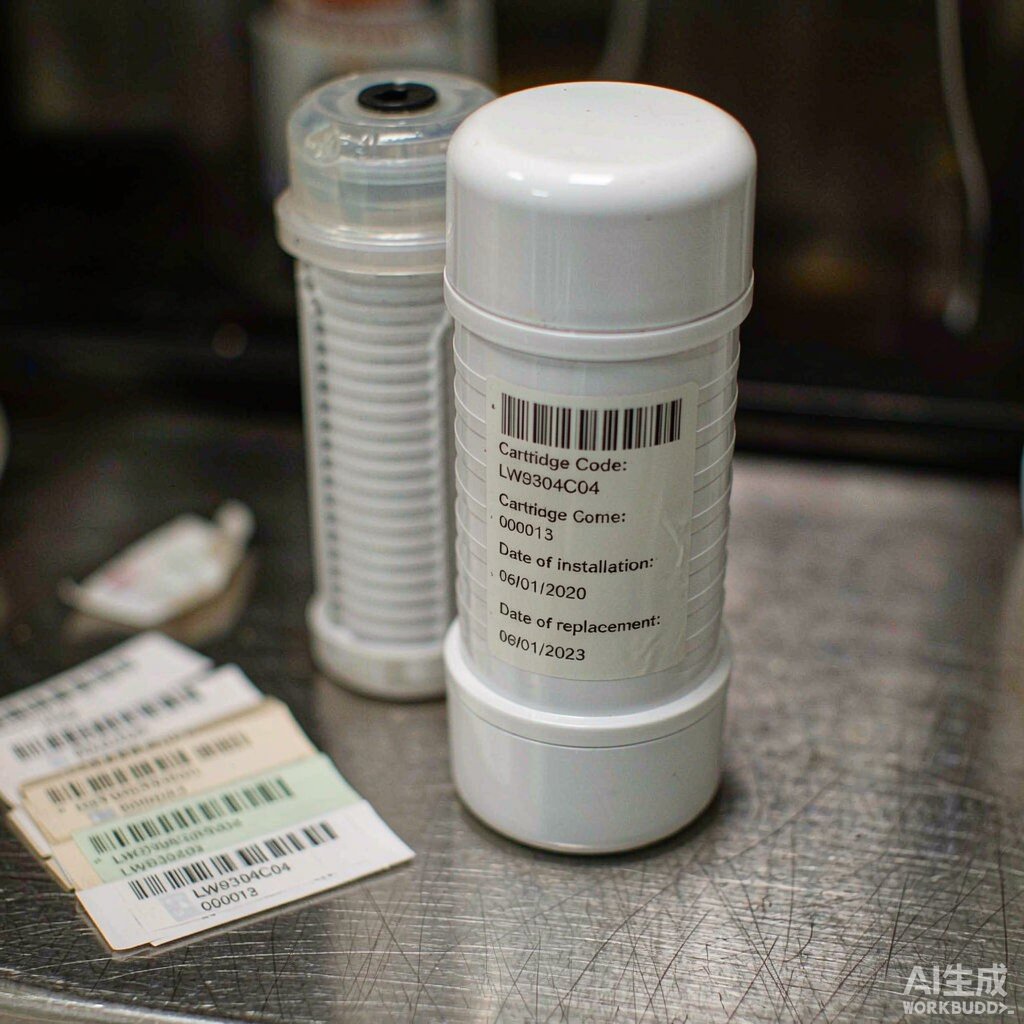
Pure water systems are consumable-driven equipment, and the second category of labeling objects is the purification cartridges, filter elements, and filters themselves. The value of such labels lies not in long-term durability but in making the "replacement threshold" explicit—so that any operator can tell at a glance whether replacement is due.
| Consumable | Reference replacement interval | Quantitative judgment basis |
|---|---|---|
| PP sediment filter | 3–6 months (1–2 months for high turbidity or high usage) | Use the upper limit when raw water turbidity is below 1 NTU and daily water use is less than 50 L; use the lower limit when daily use exceeds 100 L or sand content is high; replace if visibly yellowed or blackened |
| Pre-carbon filter | 3–6 months | Shorten to 3 months when raw water residual chlorine exceeds 0.5 mg/L; after carbon exhaustion, residual chlorine will irreversibly breach the RO membrane |
| Softening resin | 6–12 months | After regeneration, rinse until effluent hardness is not higher than 0.01 mmol/L |
| RO reverse osmosis membrane | 1–2 years | Salt rejection not less than 98%; perform chemical cleaning or replace early when standardized permeate flow decreases by 10% or pressure differential increases by 15% |
| Ultrapurification cartridge | 6–12 months | Replace when product water resistivity drops below 10 MΩ·cm, or when TDS rises from an initial value below 1 μg/mL to above 5 μg/mL; after replacement, rinse for 30 min before use; replacement recommended after shutdown exceeding 1 month |
| Terminal sterilizing filter (0.22 μm) | 3–6 months | 3 months recommended for biological experiments |
| UV lamp | 8000–9000 hours or 6–12 months | Replace when radiation intensity has decayed by more than 30%; replace when energy at 254 nm is below 30 mJ/cm² |
The recommended label fields should be fixed at five items: consumable number, installation date, replacement threshold (choose one of resistivity, water production, or cumulative operating hours), next verification date, and responsible person. Printing these five items on the cartridge label and combining with barcode scanning for inventory entry can transform "replace cartridges based on experience" into "replace cartridges based on thresholds."
Since purification cartridges and filter elements are consumables that are discarded with the equipment upon expiry, the labels do not require removability; ambient-temperature economical face stocks are sufficient. What truly requires removable, residue-free material is the status labeling applied to cabinets and equipment bodies that needs repeated updating.
VI. Point-of-use classification and distribution containers: the combination of color coding + self-laminating
Points of use are the locations with the highest labeling density and the greatest potential for error. A two-layer design of "color coding + protected printed content" is recommended. The color-coding layer uses labels with pre-printed colors at the top to quickly distinguish grade and type, preventing operators from misreading text when busy; the printed layer carries the grade code, piping number, most recent disinfection date, and next verification date.
Point-of-use valves and faucets are repeatedly wiped and disinfected during daily operation, and printed content is easily rubbed off. This leads to the second choice in face stock: labels with a self-laminating structure can cover the printed content with a protective film, at the cost of requiring sufficient overlap length. According to the application requirements in the BradyLAB material guide table, when applied to cryovial surfaces, the ends must overlap by at least 3 mm; this rule also applies to cylindrical filter housings and terminal filters.
Distribution containers (buckets and bottles transported from the pure water room to various laboratories) are time-sensitive objects. Labels on such containers must include the time of collection and the recommended use time limit, and glass containers should be avoided as much as possible because glass slowly leaches silicates, which in turn lowers the soluble silicon indicator of the water. PTFE or PP containers with low leaching rates combined with externally applied labels are a more reliable combination.
VII. Temperature tiers and material matrix
The following table is transcribed verbatim from the BradyLAB official material guide table, with check marks following the official original table. As stated above, the official table does not include a "pure water system housing / piping" application column; therefore, this table uses temperature tier as the basis for selection and does not constitute a statement of suitability for specific application locations.
| Material No. | Official description | Ambient | Hot water 100 °C | Freezer -80 °C | LN₂ -196 °C | Autoclave 121 °C | Corresponding working conditions in this article |
|---|---|---|---|---|---|---|---|
| T629 | Nylon cloth label; easy to apply, resistant to high and low temperatures, good conformability | √ | √ | √ | √ | √ | Purification cartridge housings, storage tanks, disinfection section piping |
| T429 | Ideal choice for labeling frozen surfaces; when applied to cryovial surfaces, overlap ends by at least 3 mm | Not applicable | √ | √ | √ | √ | Points of use and terminal filters requiring protection of printed content |
| T439 | 6-color cryogenic label; pre-printed color at the top of the label facilitates rapid identification and classification of laboratory container types | Not applicable | √ | √ | √ | Not applicable | Type color coding for distribution buckets and sampling containers |
| T509 | Durable vinyl label, suitable for wrapping, good conformability; requires overlap when used in liquid nitrogen environments | Not applicable | √ | √ | √ | Not applicable | Wrap-around labeling for round tubes, fittings, and valves |
| T329 | Matte white/PP adhesive, resistant to -40 °C cryogenic label | √ | Not applicable | Not applicable | Not applicable | Not applicable | Cabinet number plates and status labeling in non-disinfection areas |
The most important use of this matrix is the process of elimination. The 80–85 °C of the pasteurization section falls within the hot water 100 °C tier; only materials checked for that tier can be used. Ambient-temperature materials, although lower in cost, will exhibit edge curling, adhesive failure, and printed layer detachment in the disinfection section. Conversely, cabinet number plates and status labeling in non-disinfection areas do not require the high-temperature tier at all; ambient-temperature materials are sufficient to control costs.
VIII. Geometry and symbology: from filter housings to terminal filters
The objects being labeled in pure water systems span a wide size range, from filter housings tens of millimeters in diameter to terminal filters and fittings only a dozen or so millimeters wide. Size determines the choice of symbology.
The module count for 1D Code 128 barcodes can be estimated as "11 modules per character + 13 modules for the stop character + quiet zones on both sides." Encoding 20 digits requires approximately 255 modules; with a narrow module width of 0.19 mm plus quiet zones, the total length is approximately 52.3 mm. This length is fine on filter housings and storage tanks but cannot fit on the narrow surface of a terminal filter. The advantage of 2D DataMatrix lies in area efficiency: with 24×24 modules and a cell size of 0.37 mm, the side length is only approximately 9.62 mm, and it can accommodate far more than 20 digits of fields.
Wrap-around labels must also account for overlap length: the wrap length should be no less than the circumference of the labeled object plus a 3 mm overlap, and the overlap area should avoid the barcode and key text. When applied flat to a cylindrical surface, the upper width limit is determined by the central angle; the arc length corresponding to a central angle of 90° is approximately one quarter of the circumference.
Barcode quality is assessed according to ISO/IEC 15416 (1D) and ISO/IEC 15415 (2D). It is recommended to perform a grade comparison before and after each disinfection cycle and record the scan grade in the maintenance record as an objective basis for determining whether a label should be replaced early.
IX. Printing and ribbons: thermal transfer is the only choice
In environments with periodic chemical disinfection, direct thermal printing is not feasible—oxidizing agents directly attack the thermal coating, and 80–85 °C hot water circulation will cause the entire label to blacken. Thermal transfer with resin-based ribbons is the only reliable solution; BradyLAB's BRL series laboratory-specific cryogenic ribbons are designed for this type of application.
Key printing parameter settings include: increasing print darkness to ensure full ribbon transfer, reducing print speed to ensure sharp graphic edges, and performing a rub resistance test after printing (reciprocating wiping with a 75% ethanol pad followed by both visual and scan confirmation). Adhesive performance may reference the methodologies of GB/T 2792-2014 (peel strength) and GB/T 4851-2014 (holding tack) as the basis for incoming acceptance and periodic re-verification.
Surface pretreatment of the labeled object is equally critical. Stainless steel housings, PP, and PVC surfaces differ greatly in surface energy; PP is a low-surface-energy material (approximately 29–31 mN/m). Before labeling, clean and degrease the surface, sand if necessary, and after application, apply sufficient pressure and allow to stand for 24 hours so the adhesive layer fully wets out before entering the disinfection cycle.
X. Six-step implementation SOP
Step 1: List the labeling objects. Cover at least eight categories: purification cartridges, pretreatment filters, RO membrane housings, storage tanks, circulation piping, point-of-use valves, terminal sterilizing filters, and distribution containers.
Step 2: Zone by disinfection method. Divide objects into disinfection sections and non-disinfection sections. Disinfection sections must use hot water 100 °C tier materials; non-disinfection sections may use ambient-temperature tier materials.
Step 3: Define field sets by replacement interval. Consumables use a fixed set of five fields (number, installation date, replacement threshold, next verification date, responsible person); points of use use a fixed set of four fields (grade, piping number, most recent disinfection date, next verification date); distribution containers additionally include the time of collection.
Step 4: Determine size and symbology by geometry. Use Code 128 when the labelable area is greater than 50 mm; use DataMatrix when less than 15 mm; for cylindrical wrap-around, use circumference plus 3 mm overlap.
Step 5: Determine face stock and ribbon by material combination. Select face stock from the temperature tier matrix; use resin-based ribbons uniformly; after printing, perform dual verification of rub resistance and scan grade.
Step 6: Establish a closed-loop ledger. Incorporate the four states of installation, verification, replacement, and validation into the same ledger, with each state corresponding to one scan action, forming a traceable maintenance chain.
XI. Six types of failure phenomena and troubleshooting
| Failure phenomenon | Most likely cause | Corrective action |
|---|---|---|
| Label curling and adhesive failure after pasteurization | Ambient-temperature tier material mistakenly used in the 80–85 °C disinfection section | Switch to a material checked for the hot water 100 °C tier, and verify that the labeled surface is clean and degreased |
| Printed content rubbed off by disinfectant | Direct thermal or wax-based, wax-resin ribbon used | Switch to thermal transfer with resin-based ribbon, increase print darkness, and perform rub resistance verification |
| Wrap-around label edges lifting | Insufficient 3 mm overlap, or overlap area covers the barcode | Recalculate wrap length as circumference plus 3 mm; keep overlap area away from barcode and key text |
| Adhesive residue when replacing consumables | Non-removable face stock mistakenly used for equipment body labeling | Switch equipment body and cabinet labeling to repositionable, removable, residue-free vinyl cloth labels |
| Confusion between Grade 1 and Grade 2 water points of use | No color-code tiering, or color codes do not correspond to the legend | Switch to six-color labels with pre-printed colors at the top, and post a fixed color-code legend next to the point of use |
| Barcode unscannable after disinfection | Surface hazing or module size too small | Increase cell size or switch to DataMatrix; re-evaluate grade according to ISO/IEC 15416 and ISO/IEC 15415 |
XII. Compliance and traceability: connecting water quality records with equipment labeling
Labeling of pure water systems is not an isolated consumable management action; it must be integrated into the laboratory's existing quality system. Clause 6.4 of ISO/IEC 17025:2017 requires laboratories to have the equipment needed for correct sampling and measurement, and clause 6.5 requires the establishment of metrological traceability—online conductivity meters and TOC analyzers are monitoring equipment requiring periodic calibration, and their calibration status labeling should share the same numbering rules as point-of-use labeling. ISO 15189:2022 sets requirements for equipment and reagent management in the pre-examination and examination processes of medical laboratories; the grade and timeliness of water used for reagent preparation are also part of pre-examination variables.
For biobanks, ISO 20387:2018 requires control over supporting processes. As a supporting link for reagent preparation and vessel cleaning, the pure water system's consumable replacement records and water quality monitoring records should be within the same traceability framework as sample processing records. Matching the numbers on purification cartridge replacement labels one-to-one with water quality records is precisely how this requirement is implemented at the labeling level.
The retention period for maintenance records is recommended to align with the equipment lifecycle, covering at least one complete consumable replacement cycle plus one verification cycle, to facilitate retrospective investigation of the actual grade of water used for a given batch of reagent preparation during deviation investigations.
Recommended Products
For the label materials and application scenarios covered in this article, the following BradyLAB (BRD) products are available for selection reference (click to view specifications and request a quote):
- Lab096-629/80x60mm Biobank cryovial EP tube microscope slide -196 °C LN₂ nylon cloth label (¥999)
- Lab038-429/25.4X9.53+Φ9.53mm Biobank EP cryovial -80 °C matte white PET label (Request a quote)
- Lab084-439/30x15mm Biobank cryovial polyester label cryogenic biological sample bank classification label (Request a quote)
- Lab208-509/25.4x63.5 Wrap-around cryovial biological sample bank thin tube LN₂ classification label (Request a quote)
- Lab361-329-500C/60x60mm Biobank cryovial conical tube centrifuge tube + cap label (¥769)
- BRL-110-BK Borjer LAB laboratory-specific cryogenic ribbon 110 mm × 300 m (Request a quote)
FAQ
Q1: Why can't the cheapest ambient-temperature labels be used directly on pure water system housings and piping?
Because the disinfection section periodically undergoes 80–85 °C hot water circulation. Ambient-temperature materials will exhibit adhesive softening, face stock curling, and printed layer detachment at 80–85 °C. The judgment method is simple: first confirm whether the location is in the disinfection loop; if so, hot water 100 °C tier material must be used. Only for cabinets, number plates in non-disinfection areas, and status labeling is ambient-temperature tier a reasonable choice.
Q2: Why must the time of collection be written on ultrapure water labels?
Because the resistivity of ultrapure water drops rapidly over time. The theoretical limit resistivity of water at 25 °C is 18.2 MΩ·cm; within 1 hour of air exposure, conductivity can rise from 0.055 μS/cm to above 0.25 μS/cm, corresponding to a resistivity drop below 4 MΩ·cm and an increase in total ion concentration by more than 4.5 times. For uses such as trace analysis, ion chromatography, and liquid chromatography mobile phases, the time of collection is a critical quality attribute and must be labeled together with the container.
Q3: Is the resistivity of Grade 1 water in GB/T 6682-2008 18.2 MΩ·cm?
The standard specifies an upper conductivity limit of 0.01 mS/m for Grade 1 water, which corresponds to a resistivity of not less than 10 MΩ·cm. 18.2 MΩ·cm is the theoretical limit of water at 25 °C; actual equipment can achieve it, but it is not the pass threshold specified by the standard. When marking the grade on labels, the conductivity upper limit specified by the standard should be used as the basis, to avoid mistaking the equipment display value for a compliance criterion.
Q4: What face stock should be selected for labels in the disinfection section?
According to the temperature tier matrix, any material checked for the hot water 100 °C tier can be used in this section. Among them, nylon cloth labels are suitable for curved surfaces such as filter housings and storage tanks due to their good conformability and resistance to high and low temperatures; labels with a self-laminating structure are suitable for points of use requiring protection of printed content; vinyl wrap-around types are suitable for round tubes, fittings, and valves, and the overlap length must be ensured during wrapping.
Q5: What fields should be written on purification cartridge replacement labels?
Five items are recommended: consumable number, installation date, replacement threshold (choose one of resistivity, water production, or cumulative operating hours), next verification date, and responsible person. The replacement threshold is the most valuable; for example, an ultrapurification cartridge can be labeled "Replace when product water resistivity drops below 10 MΩ·cm," transforming experiential judgment into an executable numerical criterion.
Q6: Terminal filters and thin fittings are too small for 1D barcodes—what should be done?
Switch to 2D DataMatrix. With 24×24 modules and a cell size of 0.37 mm, the side length is only approximately 9.62 mm, which can accommodate far more than 20 digits of fields; whereas Code 128 encoding 20 digits with a narrow module of 0.19 mm has a total length of approximately 52.3 mm including quiet zones, which cannot fit on small labeled surfaces. Quality grades are assessed according to ISO/IEC 15415.
Q7: Can direct thermal printing be used?
Not recommended. Oxidizing disinfectants such as hydrogen peroxide,