
I. Conclusion First: The Selection Sequence for Reagent Open-Vial Expiry Labels Is the Reverse of That for Specimen Labels
For laboratory reagents, reference materials, and certified reference standards, the selection sequence for "open-vial expiry labels" is exactly the opposite of that for cryovial specimen labels: the first priority for specimen labels is the temperature tier, while the first priority for reagent open-vial labels is the field set and replacement frequency. The reason is that the two solve different problems—specimen labels must follow the specimen into the LN₂ tank and remain unchanged over the long term, whereas reagent open-vial labels must follow a bottle of reagent as it circulates repeatedly among ambient-temperature reagent cabinets, 2–8 °C refrigerators, fume hoods, and analytical instruments, and each opening may trigger a recalculation of the expiry and a label replacement.
The conclusion is four steps: ① First determine the value rule for "post-opening shelf life" by reagent category—standard volumetric solutions follow the opening clauses of GB/T 601-2016 Chemical Reagents—Preparation of Standard Volumetric Solutions; reference materials and certified reference standards follow the certificate provisions and the "out-only, no return" principle; mobile phases, test solutions, and culture media follow laboratory-defined and documented periods; ② Then select the material tier by storage temperature zone—ambient, 2–8 °C refrigerated, and -20 °C frozen fall within the "above -40 °C" tier, while reference materials, enzyme preparations, and antibodies stored in -80 °C freezers require a deeper tier; ③ Determine label size and adhesive system by bottle geometry and surface energy; ④ Determine face stock and ribbon by chemical exposure and printing method. There is one non-negotiable red line throughout: the original chemical safety label on the reagent bottle is a statutory layer and must not be covered by the self-applied layer.
II. Why "Post-Opening Shelf Life" Is an Independent Selection Dimension
Directly carrying over the unopened shelf life as the post-opening shelf life is the most common and most dangerous error in reagent management. The expiry date marked on a reference material certificate refers to the storage period in the unopened state; once opened, the storage method, ambient temperature and humidity, cap-open duration, and cleanliness of dispensing utensils all become uncontrollable variables, and the producing organization typically no longer assumes responsibility for the value. In the instructions for use of national pharmaceutical reference standards, a common statement is "This product is volatile; it is recommended to use it all at once after opening," with packaging in brown ampoules and storage protected from light at 2–8 °C; once such items are opened, the expiry field on the label is not "how much time remains" but "use up this time."
Therefore, an open-vial expiry label must have three capabilities that specimen labels do not need: first, it must be writable with the opener and opening date, assigning responsibility to a person; second, it must calculate and prominently indicate the post-opening expiry date, rather than carrying over the manufacturer's expiry; third, it must be repeatedly replaceable without leaving adhesive residue, because a bottle of reagent may be reopened, relabeled, and aliquoted multiple times over its life cycle. These three points determine that its orientation in material and adhesive system is markedly different from that of low-temperature specimen labels.
III. First Layer: The Statutory Layer Must Not Be Covered—Boundaries of GB 15258 and GB 30000
On the packaging of hazardous chemicals and general chemical reagents, the chemical safety label affixed, hung, or spray-printed by the manufacturer before leaving the factory is a statutory information carrier. According to GB 15258-2009 Rules for the Compilation of Chemical Safety Labels, a label shall contain seven types of elements: chemical identification, pictogram, signal word, hazard statement, precautionary statement, supplier identification, and emergency contact telephone number; pictograms use a white background, black symbols, and a red border, totaling nine types, corresponding respectively to explosiveness, flammability, oxidizing properties, corrosiveness, toxicity, health hazards, and environmental hazards; signal words have only two levels, "Danger" and "Warning"; the label edge shall have a border, and a margin of not less than 3 mm shall be left outside the border; the printing materials and adhesive materials used shall be durable and waterproof. For drum-shaped and bottle-shaped packaging, the label position is specified on the side body. The classification basis comes from the GB 30000 series.
The same standard also stipulates: safety labels are affixed by the manufacturer before the goods leave the factory; if the packaging is changed, they shall be re-affixed by the unit that changed the packaging; containers or packaging holding hazardous chemicals may have their labels removed only after treatment and confirmation that the hazard has been completely eliminated. These two clauses set clear boundaries for the self-applied layer—when a laboratory applies an open-vial expiry label to a reagent bottle, it may only occupy the area of the bottle body not occupied by the statutory label, and must not cover the pictogram, signal word, hazard statement, precautionary statement, or emergency telephone number; still less may it tear off the original manufacturer's safety label on the grounds that "the label is too old" and replace it with a self-applied label.
A feasible approach is zoning: divide the bottle body into the front and back of the side body, retain the statutory layer on the front, and apply the self-applied open-vial expiry label on the back or the blank area of the bottle shoulder; for small-size packaging (where the manufacturer has already used a simplified label), the self-applied layer should preferably be changed to a bottle-neck hang tag or a bottle-cap top label, while keeping the original label intact. If a bottle of reagent is aliquoted by the laboratory into a new container, the safety label on the new container shall be re-made by the aliquoting unit (i.e., the laboratory); in this case, the statutory elements and the open-vial expiry fields should be satisfied on the same label, or divided between two adjacent labels.
IV. Second Layer: Which Five Fields the Dynamic Self-Applied Layer Must Clearly State
Making the dynamic layer into a fixed field set is the prerequisite for making expiry management auditable. Referring to common practice in reagent and reference material management in testing laboratories, a complete open-vial expiry label should contain at least:
- Reagent name and lot number: corresponding one-to-one with procurement acceptance records and certificates, used to trace back which other reports the same lot of reagent was used in when a failure occurs.
- Opening date: accurate to the day, uniformly formatted as four-digit year, two-digit month, two-digit day, avoiding ambiguous cross-regional formats such as "9/10."
- Opener: assigning responsibility to a person is a core requirement of the "externally provided products and services" and technical records clauses of ISO/IEC 17025:2017, and is also the starting point for relabeling and deviation investigation.
- Post-opening shelf life (or relabeling date): this is the dividing field between the dynamic layer and the static layer, and must be on a separate line with a prominent font size, not mixed into remarks.
- Storage conditions: ambient / 2–8 °C / -20 °C / -80 °C / protected from light / desiccator, directly determining the material tier and adhesive system.
According to CNAS-CL01 Accreditation Criteria for the Competence of Testing and Calibration Laboratories (identically adopting ISO/IEC 17025:2017) 6.6.1, laboratories shall conduct conformity checks or verification of consumables—including culture media, reference materials, chemical reagents, kits, and glassware—with respect to name, specification, grade, production date, shelf life, composition, packaging, storage, quantity, and certificate of conformity. When this requirement is applied to labels, it means the above fields must be visible, legible, and non-erasable. In medical laboratory settings, ISO 15189:2022 has similar requirements for the acceptance, storage, and expiry monitoring of reagents and consumables, and the field set can be directly reused.
V. How to Determine Post-Opening Shelf Life: Value Rules for Four Categories of Reagents
Post-opening shelf life is not a number that a laboratory can freely set; the order of priority is: national standards → producing organization's certificate and instructions → test method provisions → laboratory-defined and documented. The table below gives the basis for determining values in four common situations.
| Reagent category | Basis for value | Typical period (after opening) | Key label fields |
|---|---|---|---|
| Standard volumetric solutions | GB/T 601-2016 storage clause: sealed storage at 10–30 °C generally not exceeding 6 months; after opening and use generally not exceeding 2 months (cap tightly immediately after pouring out) | 2 months; iodine and potassium hydroxide-ethanol not exceeding 1 month; sodium nitrite (0.1 mol/L) not exceeding 15 d; perchloric acid used on the day of opening | Opening date + relabeling date + relabeler |
| Reference materials / certified reference standards | Certificate and instructions; shelf life refers to the unopened state; once an ampoule is opened it should be used immediately and must not be resealed | Principle of single use to completion; working standards opened no more than 20 times and used for no more than 1 month | Opening date + opener + remaining quantity + "out-only, no return" reminder |
| Mobile phases / test solutions / buffers | Laboratory SOP and method provisions, must be documented | Commonly 3–30 days; aqueous mobile phases shorter | Preparation date + preparer + preparation basis + expiry date |
| Culture media | Laboratory SOP; post-sterilization shelf life and open-vial expiry calculated separately | Labeled separately by preparation batch and sterilization batch | Sterilized / unsterilized + preparer + shelf life |
The most easily overlooked rule in the second column of the table above is GB/T 601-2016's requirement for containers: the material of containers storing standard volumetric solutions shall not react physically or chemically with the solution, and the thinnest wall thickness shall not be less than 0.5 mm. The implication for labels is that for containers with very thin walls or special materials, the choice of label face stock and adhesive system will be constrained by the container itself; in such cases, a product manager should be consulted first for compatibility confirmation, rather than selecting a "general-purpose" material based on experience.
VI. Bottle Geometry: GL45 Reagent Bottle Outer Diameter and Label Width Upper Limit
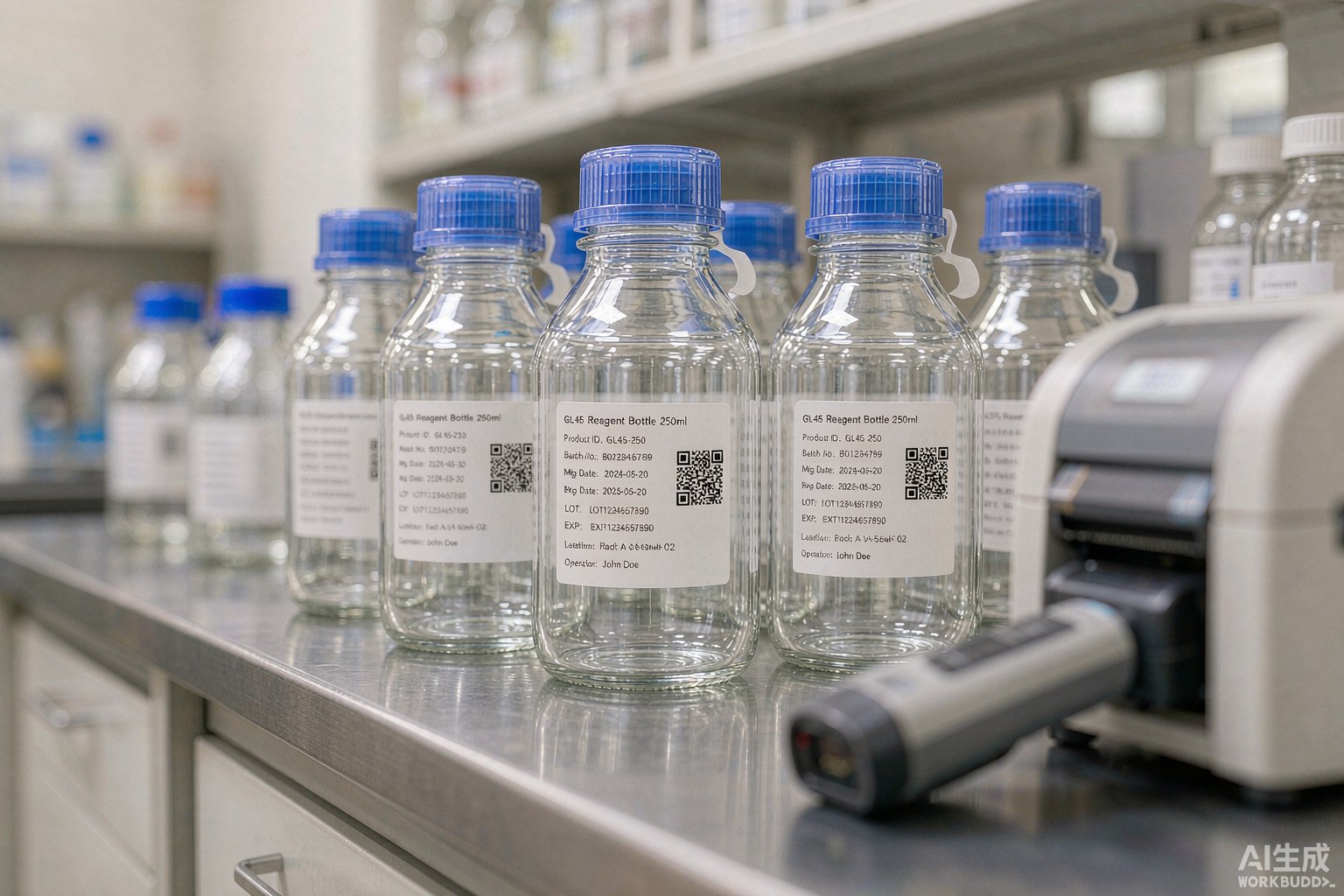
The most common screw-thread reagent bottle in laboratories is the GL45 borosilicate glass bottle. According to DURAN official ordering data, the outer diameters of round GL45 bottles are: approximately 56 mm for 100 mL, 70 mm for 250 mL, 86 mm for 500 mL, 101 mm for 1000 mL, and 136 mm for 2000 mL; the corresponding bottle heights are approximately 105 mm, 143 mm, 181 mm, 230 mm, and 265 mm, respectively. From these, the labeling window can be calculated directly.
| Specification | Outer diameter (mm) | Bottle body circumference (mm) | Flat-application width upper limit (mm) | Wrap length lower limit (mm) |
|---|---|---|---|---|
| 100 mL | 56 | 175.9 | 39.6 | 178.9 |
| 250 mL | 70 | 219.9 | 49.5 | 222.9 |
| 500 mL | 86 | 270.2 | 60.8 | 273.2 |
| 1000 mL | 101 | 317.3 | 71.4 | 320.3 |
The "flat-application width upper limit" in the table is calculated based on the label covering a central angle of 90° of the bottle body, i.e., the chord length equals the outer diameter multiplied by sin45° (approximately 0.7071); beyond this width, the two ends of the label will lift due to surface curvature, and the edges will quickly debond after liquid ingress. The "wrap length lower limit" is calculated as the bottle body circumference plus an overlap of not less than 3 mm at the head and tail—this 3 mm is a general application requirement for cryogenic labels and also applies to wrap-around labels that need to go around the bottle once.
The practical significance of this geometric constraint is: an 80 mm wide large-size label is not suitable for direct flat application on a 100 mL reagent bottle (upper limit only 39.6 mm); it is more suitable for 500 mL and 1000 mL large bottles, or for flat carriers such as refrigerator doors, reagent cabinet shelves, and turnover boxes. Conversely, a small label of about 25 mm applied to a 1000 mL bottle will result in insufficient information, and the five necessary fields will not fit. Therefore, the first step for reagent bottle labels is not to select the material, but to fix the label size according to the bottle diameter.
VII. Chemical Exposure: Face Stock and Ribbon Matching for Solvents, Acids/Bases, and Oxidizers
The chemical exposure encountered by reagent bottle labels is completely different from that of biological specimen labels: specimen labels mainly face water, LN₂, and culture media, while reagent bottle labels face organic solvent splashes, acid/base vapors, oxidizer dust, and UV irradiation. When dispensing reagents, residual liquid at the bottle mouth running down the bottle wall is the most typical failure path.
| Exposure type | Typical reagents | Failure manifestation | Face stock and printing countermeasure |
|---|---|---|---|
| Organic solvents | Methanol, acetonitrile, acetone, ethyl acetate, dichloromethane | Ink smearing, face stock swelling, edge lifting | Thermal transfer + resin-based ribbon; avoid thermal paper and inkjet |
| Strong acids and bases | Concentrated sulfuric acid, hydrochloric acid, sodium hydroxide solution | Face stock embrittlement, print corrosion and detachment | Polyester face stock + resin ribbon; add transparent laminate layer if necessary |
| Oxidizers | Potassium permanganate, hydrogen peroxide, potassium dichromate | Bleaching and fading, adhesive layer oxidation | Dark face stock + resin ribbon; avoid light-colored thermal |
| Light-sensitive and light-protected | Silver nitrate, iodine, some reference standards | Label itself discolors and becomes difficult to identify | Brown bottle + opaque face stock; apply label on bottle shoulder separately |
| Cleaning and wiping | 75% ethanol, chlorine-containing disinfectants | Print wiped off, adhesive layer displaced by solvent | Thermal transfer + laboratory-specific cryogenic ribbon |
The printing method plays a decisive role here: in any scenario involving solvents and wiping, thermal transfer must be used rather than thermal, with a laboratory-specific resin-based ribbon. Thermal labels turn black on contact with ethanol and develop on heating, so the opening date will be wiped off during the first bench cleaning—and the opening date is precisely the field that must not be lost from the entire label. The print quality of barcodes and text can be accepted separately for one-dimensional and two-dimensional symbols according to ISO/IEC 15416 and ISO/IEC 15415, and the acceptance grade should be written into the SOP rather than passed by visual inspection.
VIII. Temperature Tiers: How to Select Materials for Ambient, 2–8 °C, -20 °C, and -80 °C
The second hard constraint for reagent bottle labels is the storage temperature zone. Unlike cryovials, the vast majority of reagents fall within the ambient and refrigerated ranges, but reference materials, enzyme preparations, antibodies, and some standard solutions will enter -20 °C or even -80 °C. According to the official material guide table, the four tiers are selected as follows.
| Storage temperature zone | Typical objects | Optional materials | Application points |
|---|---|---|---|
| Ambient (10–30 °C) | Inorganic salts, solid reagents, conventional solvents | T419, T329, T629, T625 | Apply after bottle body is dry and oil-free; put into use after 24 h |
| 2–8 °C refrigerated | Reference standards, standard solutions, kit components | T419, T329, T629 | Wipe off condensation before labeling; write after rewarming |
| -20 °C frozen | Enzyme preparations, some standard solutions | T419, T329, T629 | Pre-cool after labeling before storage to avoid water film at the interface from sudden cooling |
| -80 °C and deeper | Long-term stored reference standards and biological reagents | T629, T429 | Flat application requires pressing out air; wrap-around head-to-tail overlap not less than 3 mm |
The key distinction in this section is: reference standards, enzyme preparations, and biological reagents stored in colder tiers should be switched to T629 nylon cloth labels or T429 self-laminating labels—the former is applicable to all four tiers of LN₂, freezer, hot water, and autoclaving in the official material guide table, and is also a general cloth label checked for all four items of ambient, microscope slides, cryovials, and conical tubes. Ambient cabinets, 2–8 °C refrigeration, and -20 °C freezing fall within the "above -40 °C" tier; for conventional reagents, T329 matte white PP self-adhesive and T419 gloss white PET offer the best cost-effectiveness, and there is no need to blindly upgrade to a deeper tier.
There are two frequently overlooked scenarios: first, frequent replacement—near-expiry warning hang tags, titration solutions relabeled monthly, and mobile phases that change with batch; such labels must be torn off and re-applied each time they are replaced. T625 vinyl cloth labels are repositionable, removable, leave no residue, and can be re-applied, precisely for such turnover scenarios, effectively avoiding adhesive buildup on the bottle body that affects the next bonding. Second, small-diameter containers—ampoules, narrow-neck bottles, and small-size aliquot bottles have insufficient flat-application windows; T509 wrap-around vinyl labels have good conformability and can be applied by wrapping around the bottle once with head-to-tail overlap; when the liquid level needs to be observed, T459 with a transparent viewing window can be used. When color-code management by quarter or batch is required, the six-color band pre-printed on the top of T439 can directly serve this function.
IX. Aliquot Labeling and the "Out-Only, No Return" Principle
Reference materials and expensive reagents are often aliquoted into small portions for use; this doubles the labeling workload and is also the most error-prone. There are two iron rules for aliquoting: material already taken out must not be poured back into the original bottle (out-only, no return), and aliquot containers must be labeled independently rather than reusing the parent bottle's label number.
The field set for aliquot labels adds three items to the five open-vial fields: parent bottle lot number, aliquoting date, and aliquot portion number (e.g., 1/10). In this way, if an abnormality occurs in a certain aliquot portion, it can be traced back to the parent bottle lot and the locations of other aliquot portions from the same batch can be quickly identified. The shelf life of the aliquot portion inherits the post-opening shelf life of the parent bottle but does not restart—this is the item most easily written incorrectly on aliquot labels. If frozen storage is required after aliquoting, the aliquot container should be made of low-temperature-resistant material, and the storage temperature should be re-marked on the label; the ambient-temperature wording must not be carried over by default.
X. Coding and Barcodes: How the Field Set Becomes a Scannable Code
Open-vial expiry labels must satisfy both human reading and machine reading. The human-readable part uses a large font to arrange two lines: "Opening date" and "Post-opening expiry date"; the machine-readable part uses a barcode to carry the complete fields. The coding recommendation is a four-segment format: category code - lot number - opening date - serial number, for example "RM-171356-20260930-01," with length controlled within 20 characters.
The choice of symbology depends on the available width: according to the flat-application width upper limits above, a 100 mL bottle has only 39.6 mm and a 250 mL bottle 49.5 mm. Code 128 encoding 20 characters requires 255 modules plus quiet zones; with a narrow module of 0.19 mm, the total width is about 52 mm, which will not fit even on a 250 mL bottle. Switching to a DataMatrix two-dimensional symbol, a 26×26 module at a 0.25 mm cell is only about 6.5 mm, and can accommodate more fields with error correction. Therefore, small-diameter reagent bottles should prioritize DataMatrix and be accepted according to ISO/IEC 15415, while large bottles and flat carriers can use Code 128 and be accepted according to ISO/IEC 15416. Scanner selection should cover both symbologies to avoid rework after go-live where "one-dimensional codes scan but two-dimensional codes do not."
XI. Six-Step Implementation SOP
Solidifying the above judgments into a process is the only way to truly avoid "everyone writing it differently":
- Step 1 · Build a ledger: assign a unique internal number to each bottle of reagent, bound to the procurement acceptance record and certificate number.
- Step 2 · Set rules: according to the priority order in Section V, specify in the SOP the post-opening shelf life and relabeling method for each category of reagent; anything without a provision must be documented, and verbal agreements are not allowed.
- Step 3 · Measure bottle diameter: measure the outer diameter of commonly used specifications, calculate the flat-application width upper limit and wrap length according to the formulas in Sections III and VI, and lock in 2–3 label sizes accordingly; do not select temporarily each time.
- Step 4 · Configure printing: thermal transfer printer with laboratory-specific resin-based ribbon; barcode grade accepted once according to ISO/IEC 15416 and ISO/IEC 15415, and parameters recorded.
- Step 5 · Set position: specify in the SOP that the self-applied layer is applied to the back of the bottle body or the bottle shoulder, and the statutory layer is retained on the front without being covered; aliquot containers follow the same rule.
- Step 6 · Set up inspection: conduct a monthly inventory, using the "post-opening expiry date" field as the sole sorting key, with a warning 30 days before expiry; near-expiry reagents are stored in a separate zone with warning tags.
XII. Troubleshooting Six Types of Failures
| Phenomenon | Most likely cause | Action |
|---|---|---|
| Edge lifting 48 h after labeling | Residual solvent or fingerprint grease on bottle wall; ambient temperature below bonding temperature | Wipe with ethanol and dry before applying; put into storage 24 h after application |
| Print wipes off immediately | Thermal label used instead of thermal transfer | Switch entirely to thermal transfer + resin-based ribbon |
| Label falls off after removal from refrigeration | Condensation forms an interfacial water film in the adhesive layer | Rewarm, dry, and re-apply; switch to a high initial tack adhesive system |
| Opening date field left blank | Label template does not set this field as mandatory | Fix the five fields in the template; do not release printing if a field is missing |
| Aliquot portion cannot be traced to parent lot | Aliquot label reuses parent bottle number without portion number | Add the two segments "parent lot number + aliquot portion number" |
| Adhesive residue on bottle body after removing old label | Non-removable adhesive system used | Switch to removable, residue-free material; treat residue with a dedicated cleaner |
Recommended Products
For the label materials and application scenarios covered in this article, the following BRD products are available for selection reference (click to view specifications and request a quote):
- Lab096-629/80x60mm Sample bank cryovial EP tube microscope slide -196 °C LN₂ nylon cloth label (¥999/roll)
- Lab361-329-500C/60x60mm Sample bank cryovial conical tube microcentrifuge tube + cap label (¥769/roll)
- Lab277-329/80x80mm Sample bank cryovial conical tube microcentrifuge tube + cap label (¥1298/roll)
- Lab127-429/60x30mm Matte white PET polyester cryogenic freezable hand-writable sample bank label (Price on request)
- BRL-110-BK Borjer LAB laboratory-specific cryogenic ribbon, black, 110 mm × 300 m (Price on request)
FAQ
Q1: The original safety label on the reagent bottle is too old to read clearly. Can it be torn off and replaced with a new one?
It cannot be torn off by the laboratory itself. According to GB 15258-2009, safety labels are affixed by the manufacturer before leaving the factory, and when packaging is changed, they shall be re-affixed by the unit that changed the packaging; containers or packaging holding hazardous chemicals may have their labels removed only after treatment and confirmation that the hazard has been completely eliminated. The correct approach when the original label is illegible is: contact the supplier or re-make a compliant label according to the SDS and the GB 30000 series, have the laboratory re-affix it as the "packaging-changing unit," and keep a replacement record; the open-vial expiry information still goes on the self-applied layer and is not merged with or covered by the original label.
Q2: How long should the post-opening shelf life actually be written? Can it be uniformly written as half a year?
It cannot be written uniformly. The order of determination is national standards, producing organization's certificate and instructions, test method provisions, and laboratory documented provisions. Standard volumetric solutions have explicit opening clauses (generally not exceeding 2 months; iodine and potassium hydroxide-ethanol not exceeding 1 month; 0.1 mol/L sodium nitrite not exceeding 15 d; perchloric acid used on the day of opening); reference materials are subject to the certificate, and once an ampoule is opened it should be used immediately; mobile phases and test solutions follow the laboratory SOP. Uniformly writing half a year will cause the shortest-period items to expire, which is a problem that can directly lead to a nonconformity during assessment.
Q3: Why can't the certificate shelf life of a reference material be used as the post-opening shelf life?
Because the certificate shelf life describes the unopened state. After opening, the storage method, temperature and humidity, cap-open duration, and dispensing utensils all become uncontrollable variables, and the producing organization generally no longer assumes responsibility for the value. Therefore, the industry's common practice is "out-only, no return," use the ampoule immediately once opened, and open working standards no more than 20 times with a use period of no more than 1 month. The label should clearly state this judgment rather than carrying over the manufacturer's date.
Q4: Can the same label be used on 100 mL and 1000 mL reagent bottles?
No. Calculated from the measured outer diameters of GL45 bottles, the flat-application width upper limit for a 100 mL bottle (outer diameter 56 mm) is about 39.6 mm, and for a 1000 mL bottle (outer diameter 101 mm) about 71.4 mm—nearly double the difference. An 80 mm wide label applied to a 100 mL bottle will inevitably lift at the edges, while a 25 mm small label applied to a 1000 mL bottle will not fit the five mandatory fields. The correct approach is to lock in 2–3 sizes according to bottle diameter, with small bottles prioritizing two-dimensional symbols.
Q5: Must reagent bottle labels use thermal transfer? Thermal labels are much cheaper.
In any scenario involving solvent splashes and cleaning wipes, thermal transfer must be used. When dispensing reagents, residual liquid at the bottle mouth will run down the bottle wall, and wiping with 75% ethanol will turn the entire thermal label black and make the print disappear—and the opening date is precisely the field that must not be lost. Thermal transfer should be paired with a resin-based ribbon, and barcode quality should be accepted according to ISO/IEC 15416 (one-dimensional) and ISO/IEC 15415 (two-dimensional) and written into the SOP.
Q6: If a bottle of reagent is aliquoted into ten portions, is the shelf life of the aliquot portions recalculated?
It does not restart. The aliquot portions inherit the post-opening shelf life of the parent bottle, but three items need to be added to the label: "parent bottle lot number + aliquoting date + aliquot portion number," for example 1/10, so that other aliquot portions from the same batch can be quickly identified in the event of an abnormality. Material already taken out must not be poured back into the original bottle (out-only, no return), and aliquot containers should also use low-temperature-resistant materials with the storage temperature re-marked.
Q7: Can the material tiers for refrigerated and ambient reagents be merged?
They can be merged into the "above -40 °C" tier, but attention must be paid to application differences: refrigerated bottles form condensation on the surface after removal, and direct labeling will form an interfacial water film in the adhesive layer; they should be rewarmed and dried before application, and a high initial tack adhesive system should be selected; ambient cabinets mainly require protection against solvents and UV. When managed together, use the same set of materials but two sets of labeling work instructions.
Q8: By which date should inventory be sorted?
Sort by the "post-opening expiry date" field, not the manufacturer's expiry. Conduct a monthly inventory with a warning 30 days before expiry; near-expiry reagents are stored in a separate zone with warning tags; warning tags should preferably use removable, residue-free materials to avoid leaving adhesive residue on the bottle body after removal that affects the next bonding.