
Bottom line up front: For labeling clinical body-fluid specimen containers—urine cups, stool containers, sputum containers, and CSF and pleural/ascites tubes—the selection criteria are not "can it print legibly," but three things: First, can the face stock and adhesive bond to low-surface-energy polypropylene (PP) containers; second, after the container is taken out of 2–8 °C refrigeration, will the interfacial condensation water film lift the adhesive layer; third, can a single label carry three types of information at once—dual patient identifiers, specimen-type color code, and machine-readable barcode. The BRD 博锐迪 Lab&HC laboratory medical label series, per the official material guide, offers a complete range of grades from ambient, hot water 100 °C, and autoclaving 121 °C to freezer -80 °C and liquid nitrogen -196 °C. This article provides material, application method, and compliance points item by item for the real-world conditions of four container types.
I. Why clinical body-fluid specimen containers are the "hardest to label" substrate category
1.1 The physical boundaries of the four container types differ greatly
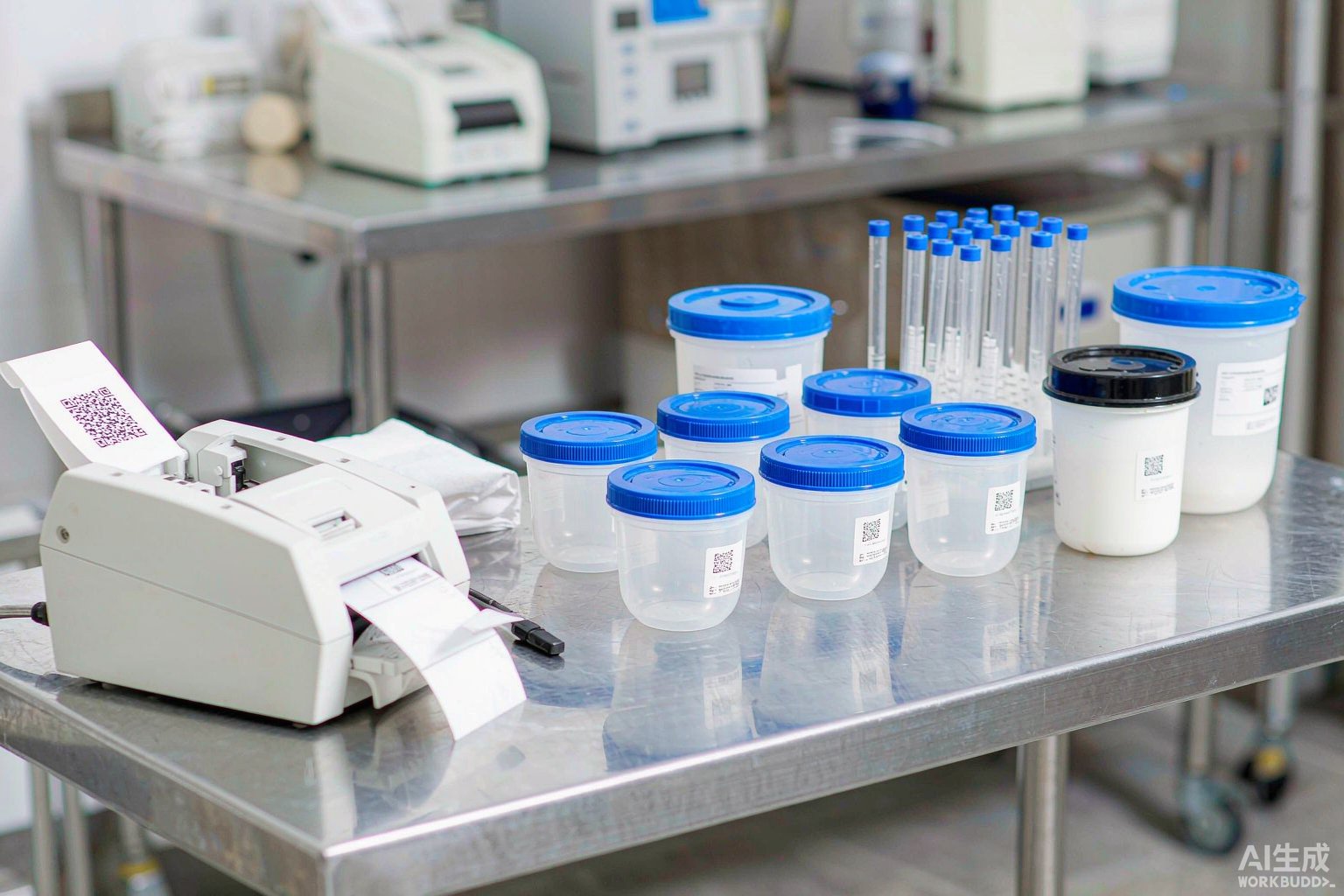
Clinical body-fluid specimens do not share a single container type. Urine cups are typically injection-molded polypropylene (PP) or polyethylene (PE), with a 50–70 mm opening and 30–100 mL capacity; the outer cup wall has a slight draft angle and parting line. Stool containers are mostly PP injection-molded, with a threaded lid and sampling spoon, and often have a textured surface. Sputum containers are also PP but must withstand 95 kPa differential pressure sealing and transport vibration. CSF, pleural/ascites fluid, and drainage fluid are mostly collected in 12 mm × 75 mm or 13 mm × 75 mm test tubes with an outer diameter of about 12–13 mm, a typical small-diameter curved surface. The four differ completely in curvature, surface roughness, surface energy, and downstream conditions; using a single label for all will almost inevitably fail on one container type.
| Container type | Common material | Key geometry | Immediate conditions | Downstream conditions |
|---|---|---|---|---|
| Urine cup | PP / PE injection-molded | 50–70 mm opening, with draft angle | Ambient collection, 2–8 °C refrigeration | Aliquoting, centrifugation 1500–3000 rpm |
| Stool container | PP injection-molded with threaded lid | Flat side section 25–40 mm | Ambient, some contain transport medium | 2–8 °C refrigeration; chemical resistance required after fixative added |
| Sputum container | PP injection-molded, sealed lid | Flat side section 20–35 mm | Ambient, biohazard risk | Transport vibration, 95 kPa differential pressure |
| CSF / pleural-ascites tube | PP or PS test tube | Outer diameter 12–13 mm, arc length about 38–41 mm | Ambient collection, sterility required | 2–8 °C refrigeration; backup cryopreservation -20 °C / -80 °C |
1.2 Low surface energy: the root cause of poor adhesion on PP containers
A label adheres by the adhesive layer wetting the substrate. The thermodynamic condition for wetting is that the adhesive's surface tension is lower than the substrate's surface energy. Steel and glass have surface energies on the order of 200–500 mN/m, and almost any pressure-sensitive adhesive can spread on them; untreated polypropylene has a surface energy of only 29–31 mN/m, and polyethylene about 31 mN/m—typical low-surface-energy substrates. The gap means a conventional acrylic adhesive layer has a larger contact angle on PP, the actual contact area is far smaller than the nominal area, and initial tack (loop tack) may be only one-third to one-half of that on glass.
The consequence is delayed failure: it looks flat when applied, but after 24–72 hours the edges begin to lift, accelerating after refrigeration. A dyne pen can quickly determine this on site—a 38 mN/m dyne pen will shrink into beads on a PP cup wall, indicating surface energy below 38; if even 34 mN/m shrinks, an adhesive formulation with high initial tack and high shear strength must be selected, and sufficient roller pressure applied during labeling.
The second often-overlooked variable is substrate temperature at labeling. Many specimen collection points are next to cold rooms, and the container itself may be only 4–8 °C; at this temperature the adhesive layer's viscosity rises sharply and flow decreases, making wetting nearly impossible. Standard practice is to let the container return to 20–25 °C room temperature before labeling, or in a 2–8 °C environment use a face stock with a low-temperature adhesive formulation, and let it sit at least 24 hours after labeling before refrigeration or cryopreservation.
1.3 Condensation: the interfacial water film after removal from refrigeration
When urine cups and sputum containers are removed from 2–8 °C refrigeration, if the ambient dew point is above the container surface temperature, a continuous condensation water film forms on the cup wall within 30–120 seconds. This water film penetrates along the adhesive interface, gradually lifting the already-established effective contact area. The common laboratory complaint "it stuck fine yesterday, but today it falls off at a touch" is mostly not adhesive aging but interfacial displacement by the condensation water film.
The response has three layers: wipe dry with a lint-free cloth before labeling and let the surface return to temperature; choose a face stock with good conformability that can deform with the container curvature, reducing edge stress concentration; for containers that must undergo repeated hot-cold cycles, prioritize an overlap structure so the label forms a mechanical lock rather than relying solely on the adhesive layer.
II. Temperature grades and the official material matrix
2.1 Determine the grade first, then select the material
For clinical body-fluid specimen labeling, the temperature grade must be set by the lowest and highest temperatures likely encountered throughout the entire process, not by the temperature at the moment of collection. Routine test specimens go through 2–8 °C; backups requiring long-term retention go into -20 °C or -80 °C; CSF and serum sent out for research use may enter liquid nitrogen vapor phase or -196 °C environments; reusable containers and some instruments must withstand 121 °C autoclaving. If the grade is wrong, no matter how expensive the material, it will fail.
| Temperature grade | Applicable materials (official material guide) | Typical clinical scenario | Key application requirements |
|---|---|---|---|
| Ambient | T419 (gloss white PET material, withstands environments above -40 °C), T329 (matte white/PP pressure-sensitive, withstands -40 °C low-temperature freezing), T625 (vinyl cloth label, repositionable, removable, no residue), T629 (nylon cloth label) | Urinalysis and stool routine completed same shift after outpatient collection | Label after container returns to room temperature, roll to expel air |
| Liquid nitrogen -196 °C / freezer -80 °C / hot water 100 °C | T629 (nylon cloth label, high-low temperature resistance, good conformability), T439 (6-color cryogenic label), T429 (freezer flat-surface identification), T459 (ultra-thin polyester self-laminating, with transparent window), T409 (excellent chemical and abrasion resistance) | Cryopreservation of CSF and pleural/ascites research backups | At least 3 mm overlap at head and tail |
| Including 121 °C autoclaving | T629, T459, T429 | Reusable instruments and containers requiring sterilization | Complete labeling and let sit 24 hours before sterilization |
| Curved-surface wrap-around / general purpose | T509 (durable vinyl label, suitable for wrapping, good conformability; requires overlap when used in liquid nitrogen environments) | High-curvature containers such as urine cups and sputum containers | Overlap head and tail when wrapping, avoid parting line |
| -40 °C grade | T419, T329 | -20 °C short-term retention | Lower-temperature conditions require a higher-grade model |
2.2 Item-by-item comparison with the official material guide
To avoid selection errors based on impression, the following lists the models relevant to this scenario item by item per the official material guide; material descriptions and temperature tolerance ranges follow the official table:
- T629: Nylon cloth label, easy to apply, high-low temperature resistance, good conformability. The official table checks all four grades—liquid nitrogen -196 °C, freezer -80 °C, hot water 100 °C, autoclaving 121 °C—and also checks all five application categories: ambient, microscope slides, cryovials/test tubes, conical tubes, and cells, making it the only model in the Lab&HC series with full-scenario coverage. For clinical body-fluid specimens requiring refrigeration, cryopreservation, and sterilization, prioritize this.
- T459: Ultra-thin polyester label, self-laminating with a transparent tail, protecting printed content while leaving a transparent window for observing liquid level. All four temperature grades checked; suitable for cryovials/test tubes and cells. When CSF and pleural/ascites tubes require liquid-level observation, the transparent window prevents the label from obscuring graduations and liquid-level judgment.
- T429: Ideal choice for identifying frozen flat surfaces; the official guide explicitly requires at least 3 mm overlap at head and tail when applied to cryovial surfaces. All four temperature grades checked; application range includes cryovials/test tubes and packaging identification. For 12–13 mm small-diameter test tubes, overlap is essential to prevent low-temperature shrinkage detachment.
- T439: 6-color cryogenic label; the pre-printed color at the top of the label facilitates rapid visual identification and classification of container types. The official table checks liquid nitrogen -196 °C, freezer -80 °C, and hot water 100 °C, and includes general-purpose application. When managing clinical specimens by color—urine, stool, sputum, CSF—this is the most direct implementation.
- T409: Excellent chemical and abrasion resistance; used for identifying frozen/low-temperature (overlap at head and tail) or ambient bottles and test tubes (nylon overlap). The official table checks liquid nitrogen -196 °C, freezer -80 °C, and hot water 100 °C. After stool specimens are mixed with fixative or transport medium, the face stock must withstand chemical attack; this model is suitable.
- T625: Vinyl cloth label, repositionable, removable, no residue, reusable. Suitable for scenarios requiring label replacement during aliquoting, tube transfer, or specimen pooling; after removal, no adhesive residue remains on the container surface, not affecting subsequent testing.
- T419: Gloss white PET material, for cryovials and microcentrifuge tubes; the official guide explicitly states "withstands environments above -40 °C." T419 and T329 are only suitable for environments above -40 °C; lower-temperature conditions require selecting liquid nitrogen and freezer grade models; the two must not be conflated.
- T329: Matte white/PP pressure-sensitive, -40 °C low-temperature freezer label; same positioning as T419, an economical routine freezing option.
Note at the end of the table: Lab&HC laboratory medical freezer/ultra-low temperature/solvent-resistant label material guide; for more materials and specific applications, please contact the product manager for selection.
III. Dual patient identifiers and barcode closed loop
3.1 ISO 15189:2022 identification requirements for the pre-examination process
ISO 15189:2022 "Medical laboratories—Requirements for quality and competence" divides the total testing process into pre-examination, examination, and post-examination phases, with the pre-examination process covering request, collection, identification, transport, and receipt. The core requirement for the identification step is that the specimen remains traceable throughout the entire workflow and can be uniquely matched to the patient. Translated to labels, this means dual patient identifiers—at least two independent identifiers (e.g., name + medical record number, or name + unique specimen number)—not merely variable information such as bed number or room number.
ISO 17025:2017 also sets unique identification requirements for sample handling and identification in testing laboratories. When CDC systems and third-party testing institutions operate both systems in parallel, the label field design should satisfy both: unique number + collection time + specimen type + responsible step signature or employee ID.
3.2 Geometric constraints of barcode types
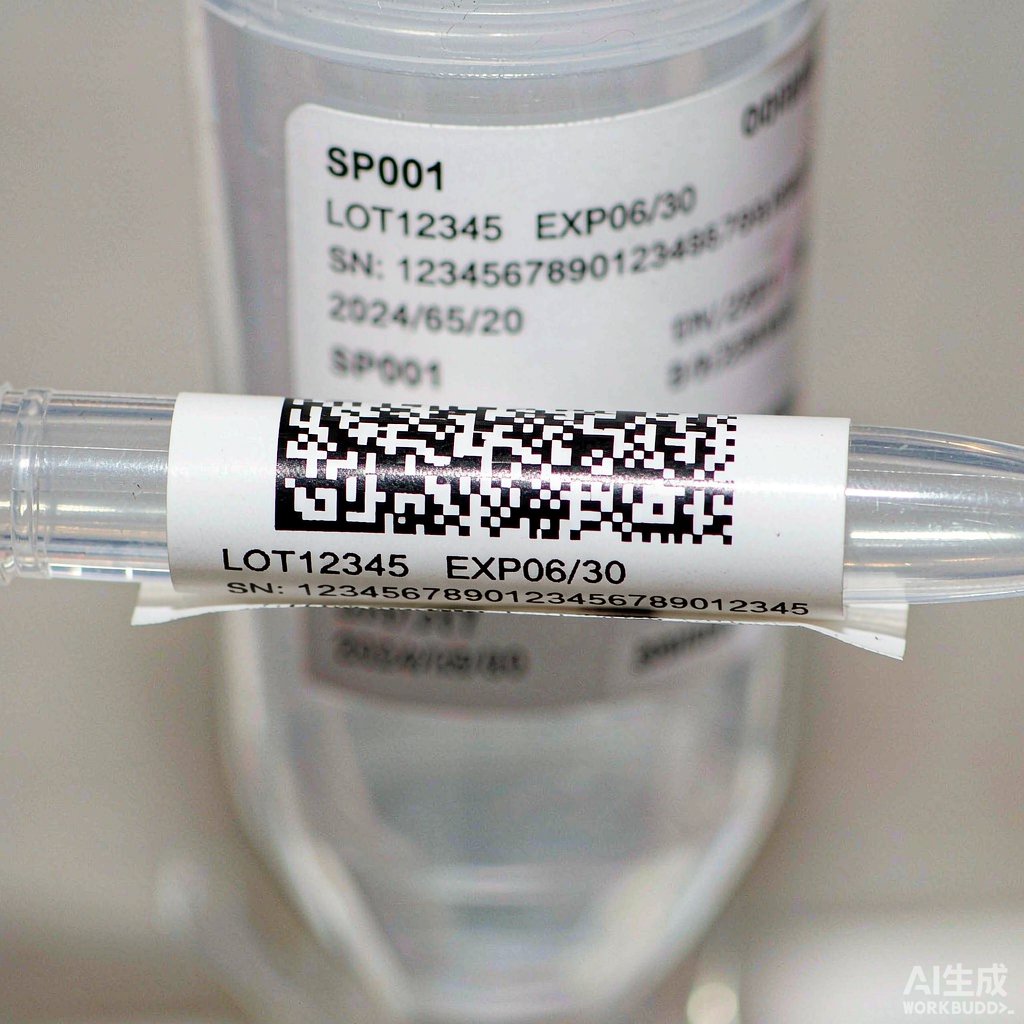
The labelable area on body-fluid specimen containers varies greatly, so the barcode type must be selected by available arc length, not by what the scanner supports. For a 12–13 mm outer diameter test tube, the full circumference arc length is about 38–41 mm, and the actual labelable window is usually no more than 30 mm; the flat side section of a urine cup is also only 25–40 mm.
| Symbology | Minimum printable size (reference) | Quiet zone requirement | Compatible containers | Quality standard |
|---|---|---|---|---|
| Code 128 (1D) | Module width 0.25 mm, 20 characters about 25–30 mm | 10× module width on each side, about 2.5 mm | Urine cups, stool containers, sputum containers | ISO/IEC 15416 |
| DataMatrix (2D) | 10×10 modules, 0.3 mm module about 3 mm square | 1× module width on all four sides | CSF tubes, small-diameter test tubes | ISO/IEC 15415 |
| QR Code (2D) | From 21×21 modules, 0.4 mm module about 8.4 mm square | 4× module width on all four sides | Outer packaging, transfer boxes | ISO/IEC 15415 |
The conclusion is straightforward: on small-diameter test tubes, Code 128 plus quiet zones on both sides often exceeds the available window, while DataMatrix can occupy as little as one-tenth the area for the same information content, making it the de facto standard for 12–13 mm tubes; on containers with a flat section of 25 mm or more, such as urine cups and stool containers, Code 128 offers higher readability redundancy and is easier for manual verification.
3.3 Barcode quality grades and readability re-verification
ISO/IEC 15416 assigns an A–F overall grade for 1D codes, and ISO/IEC 15415 assigns a 0–4 (corresponding to A–F) grade for 2D codes. For clinical scenarios, a minimum acceptance threshold of Grade C / 2.0 or above is recommended. The main parameters affecting the grade are symbol contrast (SC), modulation ratio (MOD), defects (DEF), and decodability (DECOD).
In thermal-transfer printing, resin-based ribbons achieve higher symbol contrast and more stable edge sharpness on polyester and nylon cloth face stocks; wax-based ribbons are lower cost but have poor abrasion resistance, and after refrigeration-rewarming cycles on PP curved containers they tend to show edge spread, reducing decodability. Sputum containers and stool containers rub against each other in transport boxes, and wax-based printed information areas commonly show abrasion whitening; resin-based ribbons are recommended uniformly.
IV. Biohazard and biosafety labeling
4.1 Labeling obligations under GB 19489-2008 and WS 233-2002
Urine, stool, sputum, CSF, and pleural/ascites fluid are all potentially infectious substances. GB 19489-2008 "Laboratories—General Requirements for Biosafety" requires laboratories to clearly label infectious substances, waste, and related containers with hazard warnings; WS 233-2002 "General Biosafety Guidelines for Microbiology and Biomedical Laboratories" also sets requirements for labeling, packaging, and transport. The specific implication for labels is: in addition to patient and specimen information, the container surface must reserve a biohazard warning area, which must not be obscured or removed before the specimen leaves the laboratory.
4.2 Placement of the ISO 7010 W009 biohazard symbol
ISO 7010 W009 is the internationally recognized biohazard symbol. Practical application on body-fluid specimen containers has three points: the minimum visible size of the symbol should be no less than a reasonable proportion of the container's visible face—for sputum and stool containers, no less than 10 mm is recommended; the symbol should be placed on the main viewing face, not the bottom or lid top, to avoid mutual obscuring when stacked; the symbol and text information should be arranged in separate zones, not covering each other, ensuring the barcode quiet zone is not encroached upon.
ISO 20387:2018 "Biobanking—General Requirements" provides a framework for the establishment and operation of biobanks, including requirements for specimen identification, traceability, and documented information. For specimens such as CSF and pleural/ascites fluid entering long-term biobank storage, label information should be consistent with records in the biobank management system and remain readable throughout the storage period.
V. Color-code management: using pre-printed colors to reduce sorting errors
A clinical laboratory may process hundreds of body-fluid specimens in a single shift; distinguishing specimen types by text alone causes sorting error rates to rise with workload. Encoding specimen type as color is a cost-effective error-defense measure: one color for urine, one for stool, one for sputum, one each for CSF and pleural/ascites fluid—grouping by color at sampling and centrifugation without reading text item by item.
In terms of implementation, the T439 top pre-printed 6-color structure is the simplest—the color is pre-printed at the factory, does not consume printhead capacity, and will not produce color shift due to ribbon differences. For outpatient specimens not requiring low temperature, color coding can also be achieved by color printing on ambient-compatible face stock, but the adhesion match between color ribbon and face stock must be confirmed, and color fastness after refrigeration re-verified.
Once the color-code scheme is determined, it should be written into the department's operating documents with a fixed color-to-type mapping to avoid different teams acting independently. Colors should also satisfy color-blind identifiability principles—do not rely on red-green distinction alone; pair with text abbreviations (UR / ST / SP / CSF) for dual-channel presentation.
VI. Three application methods and geometric calculations for curved containers
6.1 Wrap-around overlap
Wrap-around means wrapping the label around the container circumference with head and tail overlapping; the overlap zone forms face-stock-to-face-stock adhesion independent of container surface energy, giving the highest reliability on low-surface-energy PP substrates. The official material guide explicitly states: T429 requires at least 3 mm overlap at head and tail when applied to cryovial surfaces; T409 requires head-to-tail overlap in freezer/low-temperature scenarios; T509 requires overlap when used in liquid nitrogen environments. More overlap is not better—beyond about 6 mm, the step in overlap thickness becomes a stress concentration point during outer packaging friction. Engineering practice suggests 3–5 mm.
The label length required for wrap-around is calculated as full circumference plus overlap: for a 13 mm outer diameter test tube, circumference is about 40.8 mm; adding 4 mm overlap gives a label length of 45 mm; for urine cups, cup wall circumference plus 5 mm overlap. Label height should not exceed 70% of the container's labelable height to avoid crossing the shoulder arc.
6.2 Flat application with rounded corners
Stool containers and sputum containers with a sufficient flat section (≥25 mm) can be flat-applied. The key is to eliminate corner stress: changing the four corners to 1.5–2 mm rounded corners significantly reduces lifting probability. Before flat application, wipe the surface with a lint-free cloth moistened with isopropanol (PP has good isopropanol resistance), and apply after complete evaporation to remove mold-release agent residue.
6.3 Self-laminating protection
For specimens requiring refrigeration or rubbing against each other in transport boxes, a face stock with a self-laminating structure can be selected: after printing, fold the transparent tail over the information area to form the face stock's own protective layer. T459's ultra-thin polyester self-lamination also leaves a transparent window for observing liquid level in the tube, avoiding obstruction of graduation reading; T429's self-lamination focuses on protecting printed content on frozen flat surfaces. Self-lamination adds a process step, but in high-friction transport scenarios the improvement in barcode readability is very pronounced.
VII. Ribbons and print parameters
The three elements of thermal transfer are face stock, ribbon, and print parameters. In the Lab&HC series, polyester face stocks require resin-based ribbons to achieve chemical and abrasion resistance; nylon cloth face stocks have a woven texture and require appropriately increased print energy and pressure to ensure full ribbon transfer. Printhead energy should be determined by step testing: start from the device default, increase or decrease by 2–3 per step, and take the lowest energy at which the ISO/IEC 15416 grade reaches C or above, avoiding excessive energy causing dot spread and reduced decodability.
Print speed also affects quality: the higher the speed, the shorter the contact time between ribbon and face stock, and the lower the transfer rate. It is recommended to use a medium-low speed setting while meeting throughput requirements, especially for small-size DataMatrix, where module edge sharpness is more speed-sensitive.
VIII. Six-step implementation SOP
| Step | Action | Acceptance criteria | Responsible party |
|---|---|---|---|
| 1 | Determine the full-process temperature grade (ambient / -40 °C / -80 °C / -196 °C / 121 °C) | Take the grade corresponding to the highest and lowest temperatures throughout the process | Laboratory/biobank manager |
| 2 | Measure the container's labelable window and curvature | Record flat section length or full circumference | Labeling administrator |
| 3 | Lock the face stock by grade and curvature | Compare item by item with the official material guide | Labeling administrator |
| 4 | Select symbology and determine module size | Code 128 or DataMatrix, including quiet zones, within window | LIS administrator |
| 5 | Test print and re-verify barcode grade | ISO/IEC 15416 / 15415 Grade C / 2.0 or above | QC position |
| 6 | Re-scan and re-verify after hot-cold cycling | 2–8 °C refrigeration 24 hours + rewarming, grade does not degrade | QC position |
IX. Failure phenomena and troubleshooting
| Phenomenon | Common cause | Troubleshooting method | Remedy |
|---|---|---|---|
| Edges lifting 24–72 hours after application | Insufficient wetting of low-surface-energy PP; labeling temperature too low | Measure surface energy with dyne pen; record container temperature at labeling | Rewarm to 20–25 °C before labeling; switch to high-initial-tack adhesive face stock |
| Whole label detaching after removal from refrigeration | Interfacial displacement by condensation water film | Observe whether a continuous water film is present | Wipe dry, rewarm, and reapply; switch to overlap structure |
| Label brittle cracking after low-temperature cryopreservation | Wrong grade selected; -40 °C grade face stock used | Verify actual cryopreservation temperature against official grades | Switch to -80 °C/-196 °C grade model |
| Barcode cannot be scanned | Module size too small or quiet zone encroached | Re-test grade per ISO/IEC 15416 | Enlarge module or switch to DataMatrix |
| Information area abraded white after transport | Insufficient ribbon abrasion resistance | Re-scan after friction test | Switch to resin-based ribbon; switch to self-laminating structure |
| Residue after tube transfer affecting testing | Non-removable face stock used | Visual inspection of container surface | Switch to removable, residue-free model |
Recommended Products
For the label materials and application scenarios covered in this article, the following 博锐迪 (BRD) products are available for selection reference (click to view specifications and request a quote):
- T629样本库-196℃尼龙布耐低温试管生物样本库签化验采样液氮标签(¥999/卷)
- Lab307-419/32x18样本库冻存管载玻片亮面白色生物样本库低温标签BRD博锐迪(询价)
- Lab164-329-3/φ9.53mm样本库冻存管锥管离心管瓶盖-80℃低温标签BRD博锐迪(询价)
- T439样本库-80℃度液氮聚酯PET冷冻低温液氮彩色标签贴纸化验采样(询价)
X. FAQ
Q1: Why does the urine cup label lift after one day of use?
Mostly due to two combined causes: first, PP surface energy is only 29–31 mN/m, and conventional adhesive layers wet insufficiently; second, container temperature at labeling is low (4–8 °C is common), and adhesive flow is insufficient. It is recommended to rewarm the container to 20–25 °C before labeling, confirm surface energy with a dyne pen, roll to expel air after application, and let sit 24 hours before refrigeration.
Q2: The CSF tube diameter is only about 12 mm—can a 1D barcode still be used?
Not recommended. A 12–13 mm outer diameter test tube has a full circumference arc length of about 38–41 mm, and the actual labelable window is usually less than 30 mm; Code 128 carrying 20 characters plus quiet zones on both sides easily exceeds the window. DataMatrix occupies only about one-tenth the area for the same information content, making it the preferred choice for small-diameter test tubes, with quality grade determined per ISO/IEC 15415.
Q3: Stool specimens with fixative added—what should be noted for labels?
Fixatives and transport media attack conventional face stocks and wax-based ribbon print layers. Select a model with explicit chemical resistance and pair it with a resin-based ribbon. If low-temperature storage is also required, select by liquid nitrogen -196 °C/freezer -80 °C/hot water 100 °C grade; if the specimen also enters fixation and staining processes, separately confirm the face stock's resistance to xylene and staining solutions.
Q4: When specimens need to be aliquoted from collection tubes into cryovials, how should labels be handled?
After aliquoting, the original identification becomes invalid and new containers require re-labeling; at this point, select a repositionable, removable, residue-free face stock to avoid residue after removal affecting subsequent testing or reading. Aliquoting records should be updated synchronously in the LIS/biobank system to ensure the unique correspondence required by ISO 15189:2022 pre-examination procedures is not broken.
Q5: Must the biohazard symbol be affixed to the container?
GB 19489-2008 and WS 233-2002 both set requirements for labeling infectious substance containers and packaging. In practice, containers directly holding potentially infectious substances—sputum containers, stool containers, urine cups—should have the ISO 7010 W009 biohazard symbol affixed to the main viewing face, arranged in a separate zone from the barcode quiet zone to avoid mutual encroachment.
Q6: For a batch of specimens going to both routine testing and cryopreservation backup, how should labels be selected?
Set the grade by the lowest temperature likely encountered throughout the process, not by the collection temperature. Routine testing goes through 2–8 °C; if backups go into -80 °C, a -80 °C grade model must be selected; if backups ultimately enter liquid nitrogen vapor phase, a -196 °C grade must be selected. In the official material guide, T629 checks all four grades—liquid nitrogen -196 °C, freezer -80 °C, hot water 100 °C, autoclaving 121 °C—making it a reliable choice for cross-grade scenarios.
Q7: How can I verify that a label will hold up under real-world conditions?
Perform hot-cold cycle re-scanning: after labeling and letting sit 24 hours, refrigerate at 2–8 °C for 24 hours, remove and rewarm to room temperature, then re-test barcode grade per ISO/IEC 15416 / 15415, requiring Grade C / 2.0 or above; also check that edges are not lifted and no interfacial water film remains. If cryopreservation is involved, add a -80 °C 24-hour cycle. Only after passing can it be put into batch use.
The BRD 博锐迪 Lab&HC laboratory medical label series covers the complete range of grades—ambient, liquid nitrogen -196 °C, freezer -80 °C, hot water 100 °C, and autoclaving 121 °C—and, paired with resin-based ribbons and thermal-transfer printers, can provide a full-process labeling solution for clinical body-fluid specimen containers from collection, refrigeration, and aliquoting to long-term cryopreservation. For more materials and specific applications, please contact the product manager for selection.