
Bottom line up front: A 2 mL vial has a body OD of only about 11.6 mm, giving a labelable arc length of about 36 mm. At the same time it sits under three overlapping conditions—organic solvent splatter + 4 °C autosampler tray condensation + autosampler barcode scanning—so the selection logic differs from that for cryovials. You must choose face stock and ribbon by solvent type, choose wrap-around or overlap application by vial circumference, and choose symbology and X-dimension by barcode readable area. Within the BRD Lab&HC series: for ambient-temperature solvent-resistant scenarios, prioritize T409 and T424; for small vial diameters requiring conformable wrap-around, choose T509; for -80 °C freezer storage, choose T629 or T439; for single-use transfer vials, choose removable T625. The following five sections—geometry, solvent, barcode, temperature, and compliance—provide selection tables and SOPs you can apply directly.
1. Why vial labeling is a separate selection problem
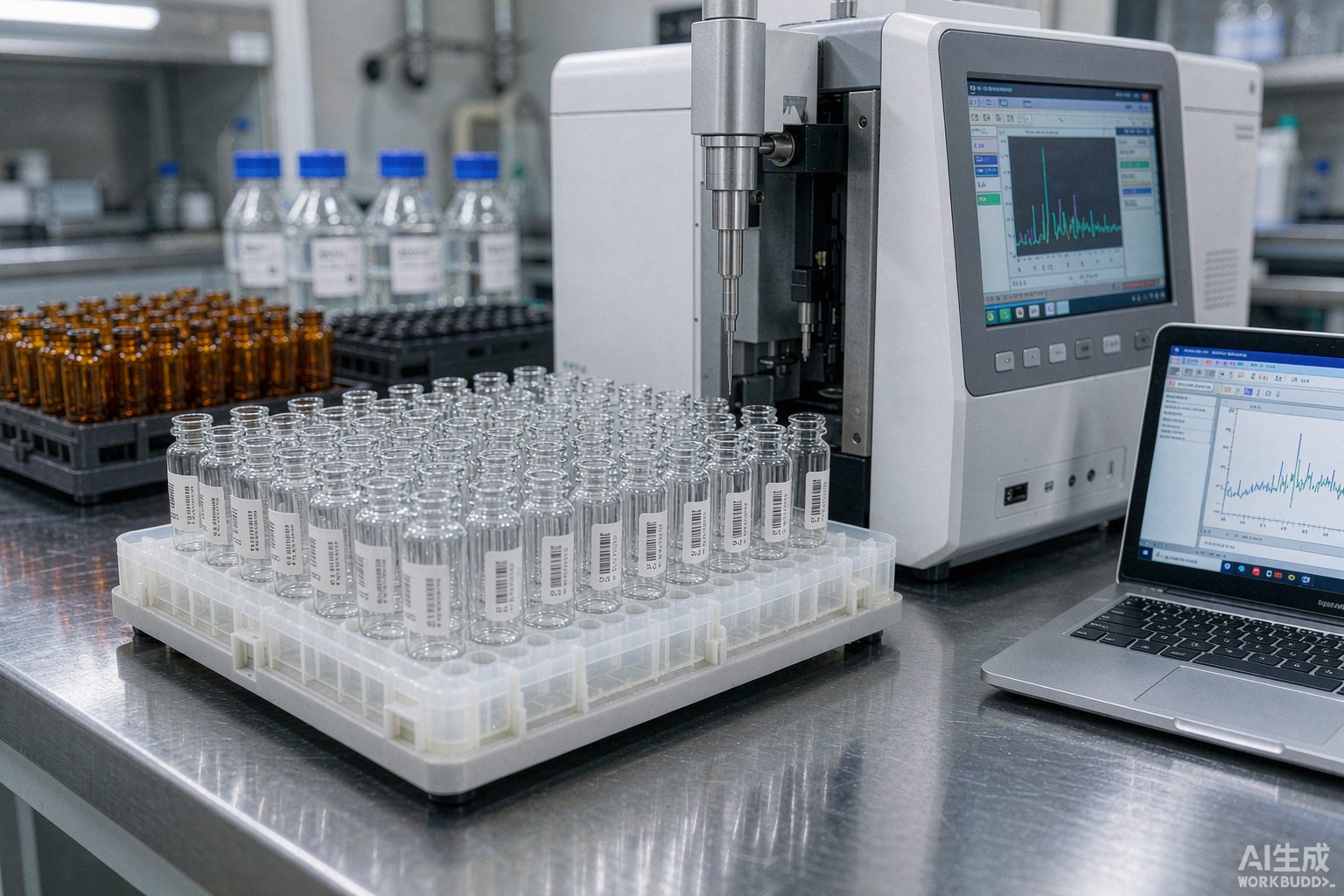
In laboratory identification systems, cryovials, microcentrifuge tubes, and microplates all have mature selection methods—yet chromatography vials (sample vials) have long been treated as "just stick any label on." The reason is easy to understand: vials are low-cost, high-volume, and fast-cycling, and a vial of sample often goes through only one injection run. But from an identification-engineering perspective, it is precisely one of the most constrained types of adherend.
The first constraint is geometry. Take the most common 2 mL screw-thread vial: standard dimensions are 12 mm × 32 mm, where 12 mm is the nominal body OD, and most brands measure around 11.6 mm. Using the circumference formula, the usable arc length for one full turn is about 3.1416 × 11.6 ≈ 36.4 mm. Considering the mold parting line, the printed graduation area, and the liquid-level viewing window on the vial body, the continuous curved surface that can actually be fully covered is usually only 25 mm to 28 mm. This number determines the upper limit of label width: exceed it, and the two ends of the label collide on the back of the vial and form wrinkles.
The second constraint is surface curvature. A cylindrical surface with a radius of about 5.8 mm imposes considerable bending stress on rigid face stocks. Common polyester film thicknesses range from 50 μm to 75 μm; when applied to a 5.8 mm radius surface, the outer-layer tensile strain of the face stock is approximately thickness divided by twice the radius, i.e., 50 μm ÷ 11.6 mm ≈ 0.43%. The value looks small, but creep relaxation of the adhesive continuously releases this stress over hours to days, manifesting as slow lifting of the label ends—this is the physical origin of "it looked fine when applied, but lifted the next day" for vial labels.
The third constraint is the chemical environment. The liquid in a vial is not water but organic solvents such as methanol, acetonitrile, isopropanol, acetone, ethyl acetate, dichloromethane, n-hexane, and toluene, with pH spanning from below 2 for strong-acid mobile phases to above 8 for ion-pair reagents. During cap opening/closing, pipetting, and ultrasonic degassing, solvents contact the label edges in three ways: splatter, evaporative condensation, and trace leakage. Among these, splatter is point-to-point impact, evaporative condensation is prolonged soaking, and leakage creeps along the vial threads to the back of the label—the third is often the most fatal because it directly attacks the interface between the adhesive layer and the vial wall.
2. Vial specification range and adherend geometric parameters
To select, first clarify the adherend specifications. The table below lists the most common types of chromatography sample containers in laboratories and their labelable geometric parameters, which are the basis for all subsequent calculations.
| Vial type | Nominal dimensions (mm) | Body OD (mm) | Full-circle arc length (mm) | Recommended label width (mm) | Typical volume | Main application |
|---|---|---|---|---|---|---|
| 2 mL screw-thread vial (9 mm opening) | 12 × 32 | 11.6 | approx. 36.4 | 20—25 | 2 mL (insert 250—300 μL) | Routine LC injection |
| 2 mL crimp vial (11 mm crimp) | 12 × 32 | 11.6 | approx. 36.4 | 20—25 | 2 mL | GC/headspace matching, high sealing requirements |
| Amber screw-thread vial (light-protected) | 12 × 32 | 11.6 | approx. 36.4 | 20—25 | 2 mL | Light-sensitive substances (vitamin A/D, catecholamines, nitroglycerin types) |
| 10 mL headspace vial | 22.5 × 46 | 22.5 | approx. 70.7 | 40—55 | 10 mL (5 mL fill) | Headspace GC, residual solvent determination |
| 20 mL headspace vial | 22.5 × 75 | 22.5 | approx. 70.7 | 40—55 | 20 mL (10 mL fill) | Headspace GC, packaging material residues |
| 4 mL sample vial (screw-thread) | 15 × 45 | 14.7 | approx. 46.2 | 28—35 | 4 mL | Large-volume samples for environmental/food testing |
| Cryogenic sample vial (external screw cap) | Depends on specification | 12—17 | 37—53 | 22—32 | 1—5 mL | Samples requiring long-term -80 °C storage |
The table reveals a key dividing line: 12 mm-class small vials and 22.5 mm-class headspace vials belong to two completely different orders of magnitude. The usable arc length of a 2 mL vial is only about half that of a headspace vial, so simply scaling down a flat label that works on headspace vials and applying it to 2 mL vials will almost inevitably cause edge lifting. This is also why laboratories often see "the same label works fine on headspace vials but falls off every time on injection vials."
3. Three pathways by which organic solvents destroy labels
Solvent damage to labels is not a single mechanism but three parallel pathways. Understanding these three pathways is essential to understanding why "low-temperature resistant" does not equal "solvent resistant."
Pathway 1: Face stock swelling and stress cracking. Solvent molecules penetrate between polymer chains, increasing segment spacing, which macroscopically manifests as face stock thickening, softening, and loss of transparency. Polyester face stocks resist alcohols and nitriles well but swell under prolonged contact with halogenated hydrocarbons (dichloromethane, chloroform); polypropylene face stocks are stable against polar solvents but are easily attacked by aromatics and halogenated hydrocarbons. After swelling, if the solvent evaporates rapidly, the face stock develops microcracks during shrinkage, blurring the bar-space boundaries of the barcode and directly downgrading the ISO/IEC 15416 symbol grade.
Pathway 2: Adhesive extraction and plasticizer migration. Pressure-sensitive adhesives are typically acrylic or rubber-based formulations, both containing plasticizers and tackifying resins. Organic solvents have a strong extraction capacity for such small-molecule components; once extracted, the adhesive hardens and loses initial tack and holding power. The label may appear intact, but a very small peel force causes the entire piece to fall off. The peel strength test specified in GB/T 2792-2014 and the holding tack test specified in GB/T 4851-2014 are precisely used to quantify this failure—if laboratory vials remain in solvent environments for more than 24 hours, it is recommended to request solvent-immersion peel strength retention data from the supplier rather than looking only at ambient-temperature initial values.
Pathway 3: Printed image dissolution or migration. The resin-based thermal-transfer ribbon image itself has good solvent resistance, but the interface between the image and the face stock, as well as the pigment dispersion system within the image, can still be attacked by strong solvents. This manifests as decreased barcode black-white contrast and reduced "reflectance" and "modulation" parameters in ISO/IEC 15416. This is also why solvent-resistant scenarios must specify resin-based ribbons and cannot use wax-based or mixed-based ribbons—the latter two may show significant fading within 10 methanol wipes.
4. Geometric constraints of small vial diameters: wrap-around vs. overlap
On a vial with an 11.6 mm OD, only two reliable application methods exist.
Wrap-around labeling: The label wraps completely around the vial circumference, with the two ends overlapping somewhere on the body. Advantages are maximum contact area and uniform distribution of curved-surface stress; disadvantages are a thickness step at the overlap and the inability to print barcodes in the overlap area. For 2 mL vials, the recommended overlap length is no less than 3 mm—consistent with the official application requirement for T429 in the Lab&HC series, which requires at least 3 mm end-to-end overlap on frozen tube surfaces—same order of curvature, same order of overlap. The overlap area should avoid the barcode symbol area and quiet zone, typically placed on the back of the vial.
Flat application with pressure: The label does not wrap around but is applied only to a segment of the vial's curved surface, with width controlled at 20—25 mm, combined with a high-initial-tack adhesive layer and thorough rolling. Advantages are an intact barcode area and large readable area; disadvantages are that both ends are free boundaries, which are starting points for edge lifting. Flat application must be combined with rounded corner design (corner radius no less than 2 mm), because the stress concentration factor at square corners is significantly higher than at rounded corners.
In actual selection, if vials need long-term storage in a -80 °C freezer and then rewarming for injection, wrap-around is the only reliable method, because flat labels will progressively lift at the ends under temperature cycling; if vials are prepared and tested at room temperature, flat application with rounded corners can trade for a larger barcode area. Note that vial bodies often have a small printed graduation or writing area that should be avoided before labeling; otherwise the label will adhere to the ink layer and fall off with it.
5. Barcodes and automated sampling: the arithmetic of readable area
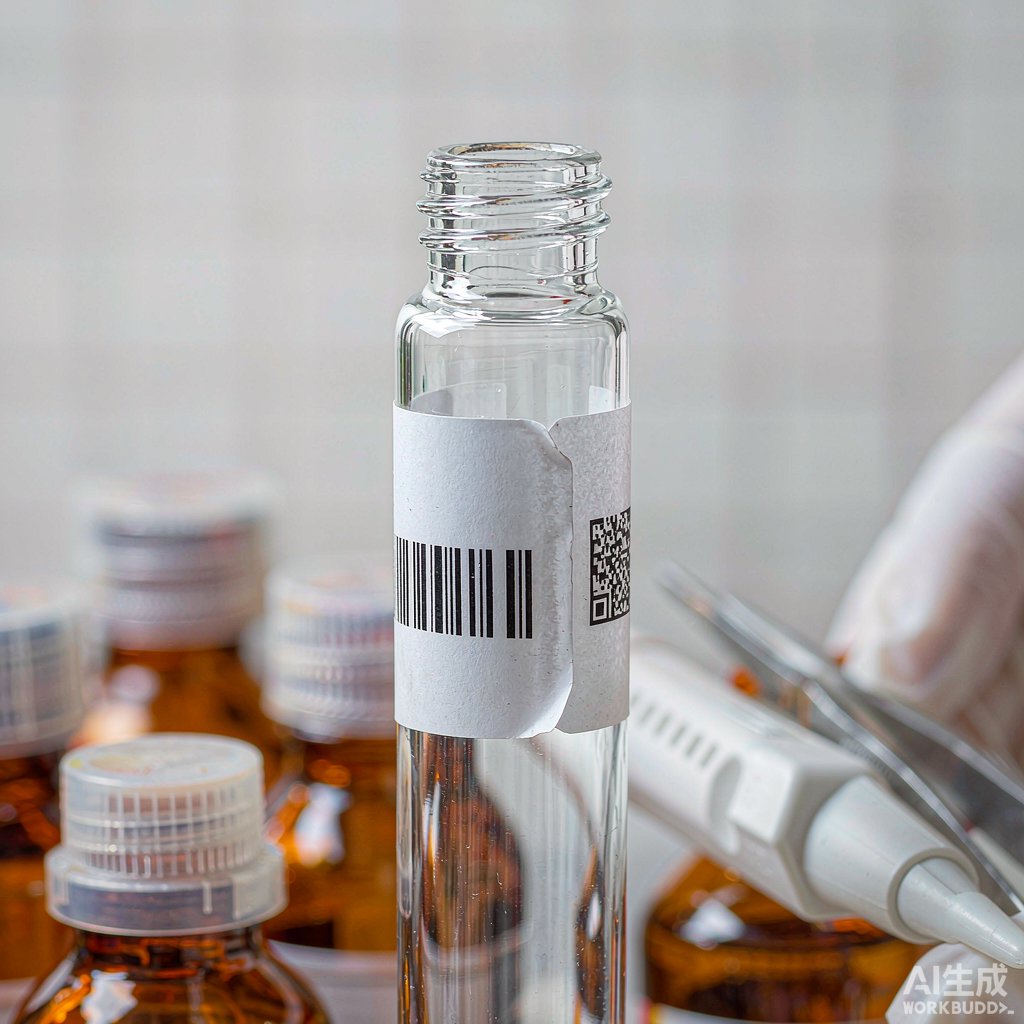
Barcode scanning associated with autosamplers typically occurs at two stages: first, manual handheld scanning during sample registration; second, automatic scanning at the vial position by high-end autosamplers equipped with barcode reading. Either way, the readable area is extremely limited.
Take Code 128 as an example: with an X-dimension (narrowest bar width) of 0.25 mm, encoding 12 characters requires a symbol width of approximately 30 mm to 35 mm, plus quiet zones of 10× X-dimension on each side (5 mm total), bringing the total requirement close to 40 mm—already exceeding the 36.4 mm full-circle arc length of a 2 mL vial. This is the fundamental reason why 1D barcodes are not recommended for injection vials.
Switching to a DataMatrix 2D symbol, the same 12 characters require only about 3 mm × 3 mm of symbol area at a 10 × 10 module specification, and only 5 mm × 5 mm including quiet zones—fully accommodable on a 25 mm wide label with room left for a human-readable text area. Therefore, symbology selection for injection vials is almost one-sided: prioritize DataMatrix, then QR Code; 1D barcodes are only for containers with arc lengths exceeding 70 mm, such as 20 mL headspace vials.
Regarding barcode quality grades, 1D symbols are evaluated per ISO/IEC 15416 with grades from 0 to 4 (corresponding to A to F); laboratory scenarios typically require no less than 1.5 (Grade D), and critical traceability scenarios require 2.5 (Grade C) or above; 2D symbols are evaluated per ISO/IEC 15415 for overall DataMatrix and QR grades. Curved surfaces introduce two typical defects: first, symbol contrast decreases due to uneven reflection on the curved surface; second, the Edge Determination parameter degrades due to curvature distortion. The mitigation is to place the symbol area where curvature effects are minimal—i.e., orient the symbol's horizontal direction parallel to the vial axis and keep symbol height no more than 6 mm, so the symbol spans a central angle of less than 30 degrees and distortion is controllable.
Scanning wavelength is also worth mentioning. Most handheld scanners use 660 nm red light or 630 nm red light, and some image-based scanners use white LEDs. The black image of resin-based thermal-transfer ribbons typically has reflectance below 15% at 660 nm, meeting the minimum contrast requirement of ISO/IEC 15416; however, if blue or green label substrates are used, reflectance under red light rises significantly and symbol contrast decreases. Therefore, vial label backgrounds should preferably be white or light yellow, avoiding colored substrates with 1D barcodes.
6. Temperature tiers: 4 °C autosampler tray, -80 °C storage, and "no need for 121 °C"
The temperature conditions of injection vials differ fundamentally from those of cryovials—this is the most common source of mis-selection. Most injection vials are prepared at ambient temperature and then placed in the autosampler's sample tray, where tray temperature control is typically set to 4 °C (some methods use 10 °C or room temperature); samples requiring next-day retesting or retention are transferred to -20 °C or -80 °C freezers. In other words, the lower temperature limit of an injection vial depends on whether the sample is frozen for storage, not on the injection itself.
Another important difference is that injection vials generally do not undergo 121 °C autoclaving. Chromatography vials are mostly single-use inert glass consumables, clean at manufacture, and do not enter pressure steam sterilizers during experimental workflows. Therefore, the 121 °C tier is usually not a mandatory option in injection vial scenarios, and you need not pay a premium for it during selection. Only two special cases require the 121 °C tier: first, methods requiring moist heat sterilization of the vial body together with its contents (e.g., pretreatment of microbial metabolism samples); second, vials being reused and laboratory SOPs mandating sterilization.
The table below provides the official applicability whitelist of the Lab&HC series by temperature tier—these are the official calibrated values for this series' materials and should be used as the basis for selection:
| Temperature tier | Typical conditions | Models officially calibrated as suitable | Not suitable |
|---|---|---|---|
| Freezer -80 °C | Samples retained in -80 °C ULT freezers | T629, T509, T459, T429, T409, T439 | T419, T329, T625, T424 |
| Liquid nitrogen -196 °C | Samples for long-term storage in gas-phase LN₂ | T629, T509, T459, T429, T409, T439, T424 | T419, T329, T625 |
| Hot water 100 °C | Water bath, boiling, hot solvent conditions | T629, T509, T459, T429, T409, T439, T424 | T419, T329, T625 |
| Autoclave 121 °C | Pressure steam sterilization cycles | T629, T459, T429 | T509, T409, T439, T424, T419, T329, T625 |
| -40 °C and above | Routine -40 °C freezing and all ambient-temperature scenarios | T419, T329 (officially calibrated for above -40 °C) | Scenarios below -40 °C |
| Ambient | Room-temperature autosampler tray, reagent rack | T629, T419, T329, T625, T424 | — |
One easily overlooked conclusion from this table: although T424 has official calibration for both the liquid nitrogen tier and the hot water tier, it does not cover the ULT freezer tier. Therefore it suits combined conditions of "chemical resistance + extreme low temperature + high temperature" but cannot be used as a general-purpose cryogenic label. If a laboratory needs both solvent resistance and ULT storage, choose T409 or T629 rather than T424.
7. Material selection matrix: matching by solvent type and vial type
Combining solvent resistance and vial geometry, the table below provides the selection cross-reference for the Lab&HC series. Material descriptions and applicable temperatures are official calibrated values; models without specific chemical resistance grades are not annotated with specific parameters in this table—please contact the product manager for confirmation in actual selection.
| Model | Official material and structure description | Injection vial scenario suitability | Application notes |
|---|---|---|---|
| T409 | Excellent chemical resistance and abrasion resistance | First choice for ambient-temperature solvent scenarios; also suitable for -80 °C and -196 °C storage; covers bottles, test tubes, and cell culture vessels | Requires end-to-end overlap for freezing and low-temperature scenarios; nylon overlap can be used for room-temperature bottles and test tubes |
| T424 | Excellent chemical resistance, withstands xylene and H&E staining processes | Strong solvent (halogenated hydrocarbons, aromatics) splatter scenarios; microscope slides and ambient-temperature containers; suitable for liquid nitrogen and hot water tiers | Must be printed with BRS series ribbons; does not cover the -80 °C tier |
| T629 | Nylon cloth label, easy to apply, high/low temperature resistant, good conformability | All laboratory locations requiring identification; full coverage of all four temperature tiers; suitable for ambient temperature, microscope slides, cryovials, and conical tubes | Cloth base offers good conformability, suitable for small-diameter curved surfaces; no additional overlap required |
| T459 | Ultra-thin polyester label with transparent tail self-laminating structure, protecting printed content while leaving a transparent viewing window for liquid level observation | Sample vials requiring observation of liquid level; cryovials and test tubes; cell culture vessels | Self-laminating structure protects the image and prevents solvents from directly washing the printed surface |
| T429 | Ideal choice for labeling frozen surfaces | Sample vials frozen for storage then rewarmed for injection; flat sections of vial body | At least 3 mm end-to-end overlap when applied to frozen tube surfaces |
| T439 | 6-color cryogenic labels with pre-printed color at the top for quick visual identification and classification of container types | Color-coded management by solvent type, batch, or method | Pre-printed color band should be outside the barcode area to avoid affecting symbol contrast |
| T419 | Bright white PET material for cryovials and microcentrifuge tubes, officially calibrated for environments above -40 °C | Ambient-temperature autosampler trays and routine -40 °C freezing; packaging identification and general containers | Not for -80 °C and lower; white substrate benefits red-light scanning |
| T329 | Matte white PP self-adhesive, officially calibrated as a -40 °C low-temperature freezer label | Cost-sensitive ambient and -40 °C scenarios; general products and packaging identification | Not for -80 °C and lower |
| T625 | Vinyl cloth label, repositionable, removable, no residue, reusable | Sample vials and secondary containers requiring transfer and reuse; ambient and test tube scenarios | Check adhesive surface for contamination before reuse; no-residue feature facilitates bottle recycling and cleaning |
| T509 | Durable vinyl label, suitable for wrap-around, good conformability | Workhorse for small-diameter wrap-around scenarios; suitable for liquid nitrogen, freezer, and hot water tiers | Requires overlap when used in liquid nitrogen environments; vinyl's high flexibility suits 5.8 mm radius curved surfaces |
Please note during selection: models not listed in this table with specific materials and temperature ranges should not be assumed to have parameters by experience. For more materials and specific applications, please contact the product manager for selection.
8. Ribbons and printing parameters: the last line of defense for solvent-resistant images
Even with the correct face stock, the wrong ribbon will undo everything. Thermal-transfer ribbons are classified by formulation into wax-based, mixed-based, and resin-based, with solvent resistance increasing in that order.
Wax-based ribbons have low melting points and low transfer temperatures; their images dissolve noticeably when wiped with methanol or isopropanol, making them suitable only for dry ambient environments. Mixed-based ribbons outperform wax-based in abrasion resistance but still do not resist polar organic solvents. Resin-based ribbons bond strongly to polyester and polypropylene face stocks and have high image crosslink density, making them the only choice for solvent-resistant scenarios. For materials like T424 that officially require BRS series ribbons, the ribbon model should not be substituted—the official resistance conclusions were obtained under the specified ribbon combination.
For printing parameters, it is recommended to set the print darkness (Darkness) in the upper-middle range of the printer driver's recommended range, and print speed should not exceed 100 mm/s. Excessive speed shortens thermal transfer time, resulting in insufficient transfer of resin ribbons and creating the illusion of "looks clear but wipes right off." After printing, a quick adhesion screening can be performed with 3M 610 tape: apply and quickly peel off; the image should not transfer in whole blocks. For formal solvent resistance verification, it is recommended to set up an immersion test per the method—immerse in the target solvent for 24 hours, remove, wipe 10 times with a lint-free cloth, then re-read with a scanner; a grade drop of no more than one level per ISO/IEC 15415 is considered acceptable.
9. Compliance and traceability: closing the loop from vial to chromatogram file
The value of injection vial identification ultimately manifests in the traceability chain. An audit-proof chain must contain at least five nodes: sample number, vial position number, injection sequence, acquisition method file, and chromatogram raw data file. If any node is broken, the data cannot be reproduced.
Regarding standards: sample identification and handling requirements for testing and calibration laboratories are found in ISO/IEC 17025:2017, which explicitly requires laboratories to maintain uniqueness and traceability of identification throughout sample receipt, handling, protection, storage, retention, and disposal; medical laboratory sample identification requirements are found in ISO 15189:2022, where sample identification and patient information association in the pre-examination process are among its core clauses; for long-term preservation of biological samples, refer to ISO 20387:2018 for management requirements of samples and associated information. General laboratory requirements related to biosafety are found in GB 19489-2008; classification and labeling of solvents themselves should follow the GB 30000 series and GB 15258 drafting regulations, and solvent bottle labels within the laboratory must also be consistent with Safety Data Sheets (SDS). Cold chain and retention sample requirements in drug testing and distribution refer to relevant GSP requirements.
Physical and chemical verification of labels can reference GB/T 2792-2014 (peel strength) and GB/T 4851-2014 (holding tack) as supplier data comparison benchmarks; barcode print quality is evaluated per ISO/IEC 15416 (1D) and ISO/IEC 15415 (2D). Writing these items into procurement technical agreements is the most effective means of ensuring label batch consistency.
10. Implementation SOP: eleven steps from vial selection to scanning
Step 1: Confirm vial type and OD, measure with calipers rather than relying on nominal values, and record OD and usable arc length. Step 2: Determine face stock by sample solvent type: for alcohols and nitriles, choose T409 or T629; for halogenated hydrocarbons and aromatics, choose T424 (with BRS ribbon); for strongly polar mixed solvents, conduct a 24-hour immersion verification first. Step 3: Determine temperature tier by whether frozen storage is required: once samples need to enter a ULT freezer for retention, switch to T409, T629, or T439; for use only at ambient temperature or above -40 °C, T419 or T329 may be selected. Step 4: Determine application method by vial diameter: for OD less than 14 mm, always wrap around with overlap no less than 3 mm; for OD greater than 20 mm, flat application is acceptable with corner radius no less than 2 mm. Step 5: Determine symbology: use DataMatrix for 2 mL vials with symbol height no more than 6 mm; Code 128 may be used for headspace vials. Step 6: Select resin-based ribbon and set printing parameters with print speed no more than 100 mm/s. Step 7: Clean the vial body, wipe with anhydrous ethanol or isopropanol, and air-dry for no less than 30 seconds, avoiding the printed graduation area and mold parting line. Step 8: Apply the label, rolling from one side to the other with pressure no less than 2 kgf and no fewer than 3 passes. Step 9: Apply supplemental pressure at the ends, especially at the wrap-around overlap and both ends of flat applications. Step 10: Allow to stand at ambient temperature for no less than 24 hours for full adhesive wet-out before contact with solvents; for low-temperature scenarios, allow an additional 4 hours at the target temperature. Step 11: Scan to verify and archive records, recording scanner model, wavelength, and ISO/IEC 15415 grade; labels with grades below 1.5 are rejected and re-labeled.
11. Failure troubleshooting cross-reference table
| Symptom | Most likely physical cause | Troubleshooting action | Corrective measure |
|---|---|---|---|
| Edge lifting within 24 hours of application | Face stock bending stress release, insufficient adhesive wet-out | Measure actual vial OD, check whether label width exceeds 80% of usable arc length | Switch to wrap-around method, reduce label width, increase rolling passes |
| Entire label falls off after solvent contact | Adhesive plasticizer extracted, adhesive hardened and lost tack | Verify solvent type against face stock resistance; perform 24-hour immersion peel test | Change to chemical-resistant face stock; switch to resin-based ribbon; shorten label-solvent contact time |
| Image fading, scanning failure | Image dissolution or migration, symbol contrast decreased | Re-test grade per ISO/IEC 15415, compare with pre-labeling baseline | Switch to resin-based ribbon, reduce print speed, increase print darkness |
| Barcode readable but grade low | Curvature distortion degrading edge determination, or insufficient quiet zone | Check whether symbol spans more than 30 degrees central angle, whether quiet zone reaches 10× X-dimension | Reduce symbol height, switch to DataMatrix, enlarge quiet zone |
| Label brittle cracking after removal from -80 °C | Face stock glass transition temperature higher than use temperature | Verify whether selected model covers the -80 °C tier | Replace T419, T329, T625, T424 in this scenario with T409, T629, or T439, which are officially calibrated to cover the ULT freezer tier |
| Bubbles under label on vial body | Air trapped during labeling, or cleaning liquid residue on vial body | Check whether air-dry time after vial cleaning reaches 30 seconds | Extend drying time, roll from center outward to expel air |
| Adhesive residue from old labels on reused vials | Non-removable adhesive type used | Check whether vials enter the reuse workflow | Switch to removable, no-residue T625 |
Recommended Products
For the label materials and application scenarios covered in this article, the following BRD products are available for selection reference (click to view specifications and request a quote):
- Lab208-509/25.4x63.5 wrap-around cryovial biobank thin-tube LN₂ classification label (Request a Quote)
- Lab296-629 biobank cryovial microscope slide -196 °C LN₂ nylon low-temperature label (¥999/roll)
- Lab032-429/30X20mm biobank cryovial microscope slide PET polyester label low-temperature adhesive (Request a Quote)
- Lab115-459/9.53+65x9.53 biobank conical tube low-temperature cryovial PET self-laminating label (Request a Quote)
12. FAQ
Q1: Can I use cryovial labels on injection vials?
Not recommended for direct substitution. Cryovial labels are designed for low-temperature curved surfaces, emphasizing -196 °C adhesion retention, and may not cover the organic solvent resistance dimension. The core conflict for injection vials is solvent plus small vial diameter; prioritize chemical resistance and wrap-around compatibility, then verify the temperature tier. If the same batch of samples requires both -80 °C storage and solvent contact, T409 and T629 are more balanced choices.
Q2: Should 2 mL injection vials use 1D or 2D barcodes?
Prioritize DataMatrix. The full-circle arc length of a 2 mL vial is about 36.4 mm; Code 128 encoding 12 characters plus quiet zones often exceeds 40 mm and physically will not fit; DataMatrix at 10 × 10 modules requires only about 5 mm × 5 mm including quiet zones and still leaves room for a human-readable area. Only containers with arc lengths exceeding 70 mm, such as 20 mL headspace vials, are suitable for Code 128.
Q3: What special requirements apply to labels for amber light-protected vials?
Contents in amber vials are generally light-sensitive, and labels must not cover the entire vial body; otherwise visual inspection of liquid level and precipitate is impossible. It is recommended to keep label width within 60% of the usable arc length, or choose a self-laminating structure with a transparent viewing window (T459) to protect the image while retaining an observation window.
Q4: Do injection vials need 121 °C sterilization?
Usually not. Chromatography vials are mostly single-use inert glass consumables and do not enter pressure steam sterilizers during the workflow. Only when the method explicitly requires moist heat sterilization of the vial body, or when vials are reused and SOPs mandate sterilization, is the 121 °C tier (T629, T459, T429) required.
Q5: Why does the label adhere firmly when applied but lift the next day?
This is a typical manifestation of curved-surface stress release. A vial with an 11.6 mm OD has a radius of about 5.8 mm; the face stock experiences continuous bending strain on the curved surface, and adhesive creep gradually releases it as edge lifting. Solutions are to reduce label width, switch to wrap-around method, increase rolling pressure, and ensure 24-hour wet-out time.
Q6: Are thicker solvent-resistant labels always better?
No. Thicker face stocks experience greater outer-layer tensile strain on curved surfaces, increasing