
Bottom line up front: Selecting labels for steam sterilization packs is essentially about holding four lines simultaneously under the combined action of 121 °C saturated steam, 100% relative humidity, approximately 0.21 MPa gauge pressure, and negative-pressure pulses during the drying phase: "sticks, prints clearly, reads reliably, traces back." Selection takes only three steps: first filter materials by the 121 °C moist heat rating, then determine by application column whether the label is for the outside of the pack, inside the pack, or the instrument itself, and finally verify peel strength and barcode grade with a three-cycle test. According to the official material guide table, only three models are explicitly checked for the 121 °C autoclave rating—T629 nylon cloth label, T459 self-laminating ultra-thin polyester label with transparent tail, and T429 self-laminating label for frozen flat surfaces; all other models are not checked for the 121 °C rating and cannot be substituted based on a vague impression of "heat resistance." External pack labeling handles batch and expiry, internal chemical indicators handle process interpretation, and instrument-body labeling handles individual-item traceability—these three roles cannot replace one another. The printing side must use resin-based thermal-transfer ribbon, and barcodes must be graded per ISO/IEC 15416 with records retained, to support the traceability loop required by ISO 13485:2016 and ISO 15189:2022.
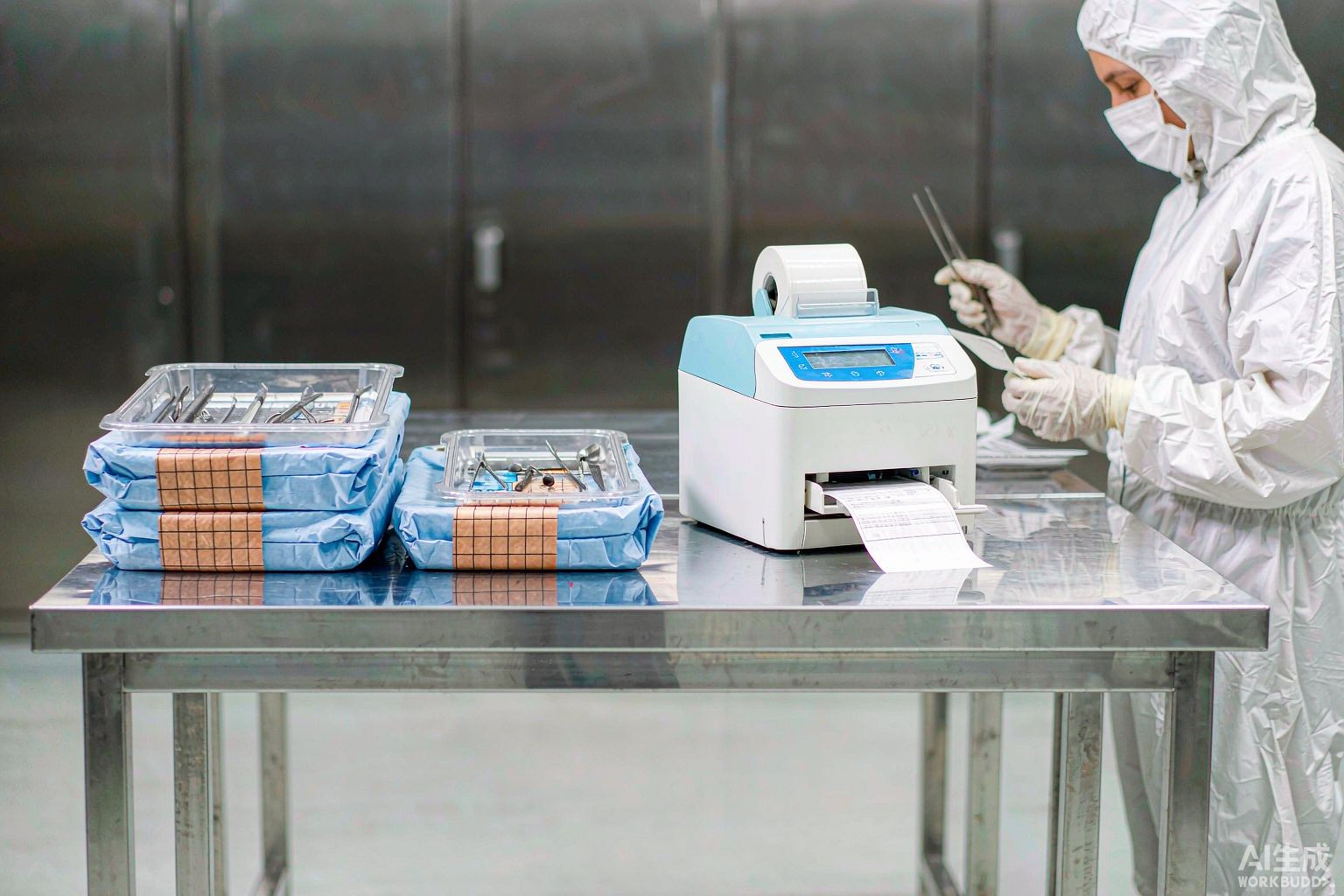
1. Moist heat sterilization conditions: labels face four combined stresses—heat + moisture + pressure + rapid change
Many laboratories and hospital central sterile services departments (CSSD) habitually treat "121 °C heat resistance" as the sole criterion during selection, yet actual failures mostly occur at the adhesive layer and interface, not in the face stock itself. A complete steam sterilization cycle includes at least four stages: preheating and vacuum removal of cold air, heating to sterilization temperature and holding, exhaust drying, and back-pressure cooling. Each stage exerts a different force on the label.
The first stress is temperature. Holding at 121 °C for 20–30 min is a common parameter for gravity-displacement sterilizers; pre-vacuum (pulsating vacuum) sterilizers mostly complete sterilization at 134 °C for 3–4 min. Rising temperature simultaneously reduces the cohesive strength of pressure-sensitive adhesive and increases the thermal shrinkage of the face stock; if the coefficients of thermal expansion of the face stock and adhesive layer differ too much, edges will lift or the entire label will curl.
The second stress is humidity. During the holding stage, the sterilization chamber is a saturated steam environment with relative humidity approaching 100%. Water molecules penetrate along the label edges into the adhesive interface, forming a microscopic water film—this is the main cause of peel strength decay after moist heat. By contrast, dry heat at 160–180 °C, though at a higher temperature, involves no liquid water and is actually less damaging to the adhesive interface—which is why "dry heat resistance" cannot be directly equated with "moist heat resistance."
The third stress is pressure. The saturated steam pressure at 121 °C is approximately 0.21 MPa (gauge pressure approximately 0.1 MPa), and pre-vacuum programs can drop to near -0.08 MPa during the evacuation stage. Alternating positive and negative pressure creates mechanical tearing at label edges and blister defects; locations with poor overlap or residual air bubbles during application are most prone to lifting first.
The fourth stress is rapid change and condensation. If the drying stage at the end of sterilization is insufficient, condensate remains on the outside of the pack, forming a "wet pack"; the label remains in a moist environment long-term, paper-based face stocks absorb water and deform, and the adhesive layer continuously hydrolyzes, typically showing visible failure only after 2–3 cycles. Therefore, the label's condition itself is a low-cost early warning signal for wet packs: if external labels on the same batch of packs generally curl at the edges, prioritize investigating the drying program and loading method rather than suspecting label quality first.
2. 121 °C material whitelist: three options, the rest not applicable
The first step in selection is not comparing prices but performing "temperature rating filtering." The official material guide table clearly divides environments into four ratings: liquid nitrogen -196 °C, freezer -80 °C, hot water 100 °C, and autoclave 121 °C. These four ratings are parallel rather than progressive—a material that withstands -196 °C may not withstand 121 °C moist heat. This is most easily confused: low temperature tests embrittlement below the glass transition temperature and low-temperature adhesive failure, while moist heat tests adhesive hydrolysis and interfacial water films—completely different mechanisms.
Checking column by column against the official table, only the following three models are checked for the 121 °C autoclave rating, and their application columns differ, determining whether they suit the outside of the pack, inside the pack, or the instrument body:
| Model | Structure & material | Official temperature ratings (LN₂ / freezer / hot water / autoclave) | Official application column | Positioning in sterilization scenarios |
|---|---|---|---|---|
| T629 | Nylon cloth, easy to apply, resistant to high and low temperatures, good conformability | √ / √ / √ / √ | Room temperature, microscope slides, cryovials · test tubes, conical tubes | General first choice for instrument trays, stainless steel utensils, and external pack labeling; cloth base resists tearing and conforms to fabric wrap |
| T459 | Ultra-thin polyester, self-laminating structure with transparent tail, protects printed content and provides a transparent window for observing liquid level | √ / √ / √ / √ | Cryovials · test tubes, cells | Internal instrument labeling requiring long-term retention; self-laminating layer isolates printed content from condensate |
| T429 | Self-laminating structure; when applied to frozen tube surfaces, head and tail must overlap by at least 3 mm | √ / √ / √ / √ | Cryovials · test tubes, packaging labeling | Reusable containers covering both low-temperature cryopreservation and moist heat sterilization; overlap requirement is the official application specification |
It must be clearly stated that models checked for the hot water 100 °C rating but not for the 121 °C rating in the official table cannot be used for sterilization pack labeling. Common misjudgments of this "one rating short" type include: T409 (chemical-resistant and abrasion-resistant, for frozen or room-temperature bottles and test tubes), T439 (6-color pre-printed top for color-coding container types), and T424 (resistant to xylene and H&E staining processes, must be used with BRS series ribbon). Another type is T509, which is suitable for wrapping and has good conformability; the official notes require overlap when used in liquid nitrogen environments, but it is likewise not checked for the 121 °C moist heat rating. These models perform well in low-temperature scenarios, but the official table does not endorse them for moist heat. When uncertain during selection, the correct approach is not to extrapolate from experience but to rely on the product specification sheet and contact the product manager for confirmation.
There is another easily overlooked boundary: T419 (gloss white PET material) and T329 (matte white PP adhesive) are marked in the official table with a tolerance range above -40 °C; they are conventional freezer labels, neither in the ultra-low temperature rating nor the moist heat rating, and should certainly not appear on sterilization packs. There is also T625, officially positioned as a repositionable, removable, residue-free vinyl cloth label; its design goal is repeated application rather than long-term resistance to moist heat cycles, and it is likewise unsuitable for sterilization pack labeling.
For quick cross-reference, the table below lists the official check status of each model across the four temperature ratings; during selection, check this table first, then verify the application column:
| Model | Material & structure highlights | LN₂ -196 °C | Freezer -80 °C | Hot water 100 °C | Autoclave 121 °C |
|---|---|---|---|---|---|
| T629 | Nylon cloth, good conformability | √ | √ | √ | √ |
| T459 | Ultra-thin polyester, self-laminating with transparent tail | √ | √ | √ | √ |
| T429 | Self-laminating; frozen tube surfaces require 3 mm head-to-tail overlap | √ | √ | √ | √ |
| T419 | Gloss white PET, for cryovials and microcentrifuge tubes | Only suitable for environments above -40 °C; not in low-temperature or moist heat ratings | |||
| T329 | Matte white PP adhesive, conventional freezer label | Only suitable for environments above -40 °C; not in low-temperature or moist heat ratings | |||
| T625 | Vinyl cloth label, repositionable, removable | Positioned for repeated application, not long-term moist heat cycling scenarios | |||
| T409 | Chemical-resistant, abrasion-resistant, requires head-to-tail overlap | √ | √ | √ | Not checked |
| T439 | 6-color pre-printed cryogenic freezer label | √ | √ | √ | Not checked |
| T424 | Resistant to xylene and H&E staining, used with BRS series ribbon | √ | Not checked | √ | Not checked |
| T509 | Vinyl material, suitable for wrapping, requires overlap in LN₂ environments | √ | √ | √ | Not checked |
3. Adhesive failure mechanisms: let peel strength and holding power speak
Passing face stock does not mean passing label. The most common problems after moist heat cycles are "the whole label falls off" or "edges lift, center bulges"; these correspond to different mechanical metrics and different test standards.
| Failure phenomenon | Corresponding mechanical metric | Applicable test standard | Typical interpretation method | Engineering countermeasure after moist heat |
|---|---|---|---|---|
| Whole label detaches, easily peeled off | 180° peel strength | GB/T 2792-2014 | Record in N/25 mm; measure one set before and after moist heat cycling and calculate decay rate | Increase adhesive coat weight or switch to cross-linked pressure-sensitive adhesive; degrease with isopropanol and press firmly before application |
| Edges lift, slow creep | Holding power (shear retention) | GB/T 4851-2014 | Record displacement or detachment time under specified load | Increase overlap length; avoid applying at locations with a radius of curvature smaller than the label width |
| Printed content fades, barcode unreadable | Print layer rub/water resistance | ISO/IEC 15416 | Grade barcode once before and after cycling; take the lower value as the acceptance value | Switch to resin-based ribbon; or use a self-laminating structure to protect the printed surface |
| Face stock whitens, blisters | Face stock water absorption and breathability | — | Visual inspection + cycle count comparison | Choose cloth-based or ultra-thin polyester face stock; avoid applying external labels over wrap seams |
A practical approach is to establish a "three-cycle verification": before officially deploying a batch of labels, run 3 complete sterilization cycles consecutively, measuring peel strength and barcode grade after each cycle. Empirically, if peel strength decay after the 1st cycle does not exceed 20%, more than 60% of the initial value is retained after the 3rd cycle, and the barcode grade is not lower than C, the combination can enter routine use; if edge lifting occurs after the 1st cycle, there is no need to continue testing—switch the adhesive system directly.
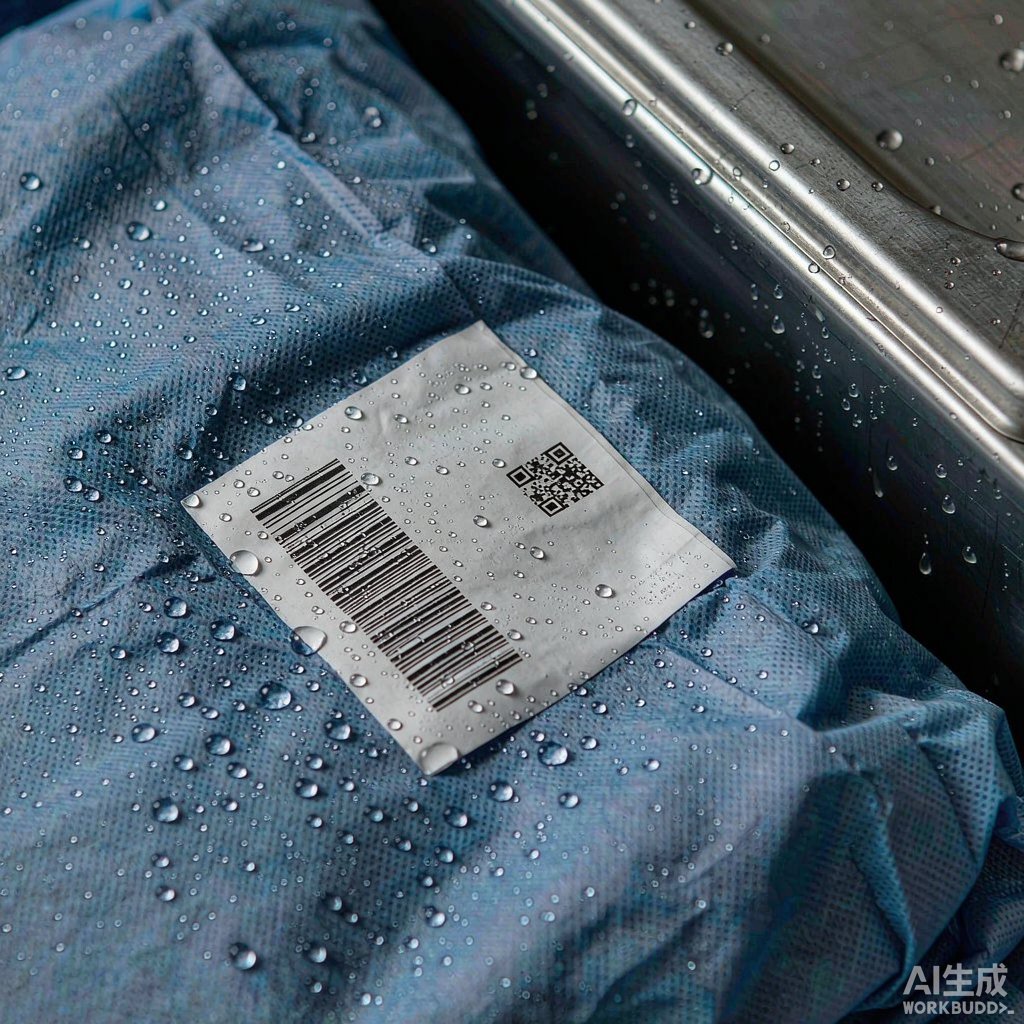
4. External pack, internal pack, instrument body: division of responsibilities across three labeling layers
A sterilization pack is not a single labeling object but a three-layer structure. Conflating the three layers' responsibilities is the main cause of broken traceability chains: if the external label falls off, batch information is lost; if no internal indicator is placed, sterilization conformity cannot be interpreted; if the instrument body has no unique code, a specific pair of forceps cannot be located once a problem arises.
| Layer | Labeling carrier | Required information | Condition requirements | Common errors |
|---|---|---|---|---|
| External pack | Moist-heat-resistant label (cloth-based or self-laminating structure) | Item name, sterilizer number (load number), sterilization batch (cycle number), sterilization date, expiry date, packer and checker | 121 °C moist heat, friction, handling abrasion | Using ordinary adhesive or handwritten paper tags that fall off or smear after cycling |
| Internal pack | Chemical indicator card/indicator (with label) | Sterilization process interpretation result, placement position identification | 121 °C moist heat, steam penetration | Indicator pressed by instruments or placed in non-breathable locations, causing distorted interpretation |
| Instrument body | Self-laminating or cloth-based individual-item label | Instrument unique number, associated pack cycle, maintenance and scrapping records | 121 °C moist heat + cleaning chemicals + friction | Substituting low-temperature freezer labels, which curl and fall off after moist heat |
The codes across the three layers must be linkable: the external pack batch number should be a common prefix for the internal indicator lot number and the instrument number, so that during traceability a single number can reverse-look-up the entire chain. When BRD 博锐迪 performs selection for hospitals and CDC clients, it typically recommends designing the external pack batch number as a fixed-digit structure of "date + load number + cycle number," for example 8-digit date plus 2-digit load number plus 2-digit cycle number, 12 digits total, facilitating one-pass parsing by scanning equipment and manual verification.
5. Printing side: why moist heat scenarios require resin-based ribbon + thermal transfer
A label withstanding 121 °C does not mean the content printed on it can withstand it. Direct thermal printing develops color via a thermal coating and darkens overall when heated, making it unusable in sterilization scenarios; inkjet and laser printing toner layers smear easily when soaked in condensate. Thermal transfer with resin-based ribbon is currently the reliable solution for moist heat scenarios: resin-based ribbons have higher melting points and adhesion than wax-based and wax-resin ribbons, and the printed image layer formed on polyester or cloth-based face stock withstands repeated moist heat and friction.
There are several directly actionable quantitative requirements for printing parameters: the barcode narrow bar width (X dimension) is recommended to be no less than 0.25 mm to ensure sufficient contrast after cycling; the quiet zone on both sides of the barcode should be no less than 10 times the X dimension; print darkness should be back-calculated from barcode grading results, not judged by visual "black enough." Grade 1D barcodes per ISO/IEC 15416 and 2D barcodes per ISO/IEC 15415; it is recommended to set the acceptance threshold at C grade (corresponding grade value 1.5) or above, and retain a grading report on file each time a batch of labels is deployed.
One detail also deserves attention: some chemical-resistant models explicitly require use with a designated ribbon series in the official table (for example, pathology labels resistant to xylene and H&E staining require BRS series ribbon), indicating that "face stock—ribbon" is a paired relationship rather than free combination. Although sterilization scenarios do not specify a particular ribbon series, the same logic holds: when changing face stock, re-verify ribbon matching rather than reusing the old combination.
6. Field design: how to write load number, cycle number, sterilization date, and expiry date
The value of labeling content depends on whether fields can be parsed by machines. It is recommended to divide the external pack label into two sections: a "human-readable zone" and a "machine-readable zone." The human-readable zone uses large-font Chinese and numerals to carry item name, date, and expiry date for quick verification within 1 meter; the machine-readable zone uses a 1D or 2D barcode to carry the complete batch string for scan-based receiving and traceability.
Expiry date calculation must be based on packaging material and storage conditions, not a fixed number of days. A common industry practice is: sterile items in textile packaging typically have a validity of 7–14 days under storage conditions meeting temperature and humidity requirements, while paper-plastic packaging and rigid containers can extend to several months or even half a year; the specific number of days should be based on the institution's CSSD policies and verification results, and the label should only print the result specified by policy, not the intermediate calculation process.
The recommended fixed field order is: item name → load number and cycle number → sterilization date → expiry date → packer → checker. The benefit of a fixed order is that manual verification develops muscle memory, and missing items are visible at a glance. For items requiring cross-department circulation, an additional 2–3 digit department code can be added to avoid confusion between items with the same name across departments.
7. Wet packs and labels: treat label condition as the first warning
Wet packs are a high-frequency nonconformity in sterilization quality, judged by visible moisture, water droplets, or water stains on the outside or inside of the pack. The label happens to be located at the most easily observed position on the outside of the pack, so it can serve as a low-cost early warning carrier: if multiple packs in the same cycle show label edge lifting, whitening, or curling, it can almost certainly be concluded that the drying stage is inadequate or loading is too dense.
The engineering handling order should be: first check the sterilization program (drying time, vacuum level, steam moisture content), then check loading (whether gaps remain between packs, whether metal instruments are placed on the upper layer causing condensate to drip down), and only then evaluate the label itself. Reversing the order easily leads to the cycle of "changing batch after batch of labels while the wet pack problem persists."
8. Traceability loop: from sterilization batch to usage records
The ultimate purpose of labeling is to form an auditable loop. Per ISO 13485:2016 requirements for medical device quality management systems, process parameters and product identification should remain traceable; per ISO 15189:2022 requirements for medical laboratory quality and competence, laboratories should be able to trace key processes affecting results. The medical laboratory competence system ISO 17025:2017 likewise emphasizes record integrity for equipment and processes. Biobank scenarios can refer to ISO 20387:2018 requirements for specimen and associated data management.
The minimum viable loop structure has four segments: sterilization records (load number, cycle number, program, parameters, indicator results) → external pack labeling (batch number string) → storage and distribution records (receiving time, storage location, recipient) → usage records (using department, subject of use, time of use). The four segments are linked by the same batch number; missing any segment creates a breakpoint. It is recommended to randomly select 3–5 used batches during monthly inventory for reverse traceability drills, tracing back from usage records to sterilization parameters; completing the entire process within 10 minutes is considered acceptable.
At the biosafety management level, the General Requirements for Laboratory Biosafety GB 19489-2008 and the General Guidelines for Biosafety in Microbiological and Biomedical Laboratories WS 233-2002 have clear requirements for zoning, labeling, and flow direction of contaminated and clean items. The pre-sterilization contaminated item area should use a unified biohazard symbol, which may reference ISO 7010 W009, forming a clear distinction in color and graphic from post-sterilization clean area labeling to prevent reverse flow due to unclear labeling.
9. Implementation SOP: nine-step checklist
Step one, filter materials by temperature rating: confirm whether the target model is checked in the 121 °C column of the official table; exclude any that are not checked. Step two, confirm the application column: for external pack, prioritize models checked for packaging labeling or general columns; for instrument body, prioritize self-laminating or cloth-based structures. Step three, perform three-cycle verification, recording peel strength and barcode grade decay. Step four, determine the ribbon and complete matching verification. Step five, design a fixed-digit, fixed-order batch number structure. Step six, print the first article and retain barcode grading on file. Step seven, specify application positions: flat surfaces on the outside of the pack, avoiding seams and folded corners; on instrument bodies, avoid movable joints. Step eight, press firmly: use a roller or fingertip to expel air from center to edge; cloth-based labels especially require firm pressure. Step nine, establish monthly reverse traceability drills and a label failure log.
10. Common failures—causes—countermeasures
| Failure mode | Direct cause | Root cause | Countermeasure | Verification method |
|---|---|---|---|---|
| Whole label detaches after cycling | Adhesive hydrolysis, interfacial water film | Used a model not checked for the 121 °C rating | Switch to a cloth-based or self-laminating structure within the official 121 °C rating | Three-cycle peel strength decay ≤40% |
| Edges lift | Pressure alternation + application bubbles | Not pressed firmly, no overlap | Press from center to edge to expel air; overlap on curved surfaces no less than 3 mm | No visible edge lifting after the 3rd cycle |
| Barcode unreadable | Insufficient ribbon moist heat resistance | Using wax-based or wax-resin ribbon | Switch to resin-based ribbon and increase print darkness | ISO/IEC 15416 grade ≥C |
| Print smears | Ink layer not water-resistant | Direct thermal or non-thermal-transfer printing | Convert all to thermal transfer | Visual + scan dual verification after cycling |
| Label whitens and blisters | Face stock water absorption | Paper-based or low-temperature-specific face stock | Switch to cloth-based or ultra-thin polyester | Three-cycle visual inspection |
| Batch cannot be reverse-looked-up | Three-layer codes not linked | No unified prefix in field design | Unify batch number structure and lock the template | Monthly reverse traceability ≤10 min |
Recommended Products
For the label materials and application scenarios covered in this article, the following 博锐迪 (BRD) products are available for selection reference (click to view specifications and request a quote):
- Lab296-629 Biobank cryovial microscope slide -196 °C liquid nitrogen nylon low-temperature label (¥999/roll)
- Lab115-459/9.53+65x9.53 Biobank conical tube low-temperature cryovial PET self-laminating label (Price on request)
- Lab032-429/30X20mm Biobank cryovial microscope slide PET polyester label low-temperature adhesive (Price on request)
- Lab208-509/25.4x63.5 wrap-around cryovial biobank fine tube liquid nitrogen classification label (Price on request)
11. FAQ
Q1: Does a label that withstands -196 °C liquid nitrogen necessarily withstand 121 °C moist heat?
No. The mechanisms differ: low temperature tests material embrittlement and low-temperature adhesive failure, while moist heat tests adhesive hydrolysis and interfacial water films. The official material guide table lists liquid nitrogen and autoclave as parallel columns; some models are checked in the liquid nitrogen column but not in the 121 °C column, and such models cannot be used for sterilization packs.
Q2: Must the expiry date be printed on external sterilization pack labels?
Recommended. The expiry date depends on packaging material and storage environment; in common industry practice, textile packaging is typically 7–14 days, while paper-plastic and rigid containers can reach several months. The specific value should be based on the institution's policies and verification results. The label should only print the conclusion value specified by policy, facilitating at-a-glance determination during distribution.
Q3: Should barcodes be 1D or 2D?
If the total field length does not exceed 20 digits and only the batch number needs to be read, a 1D barcode is sufficient and low-cost; if it needs to simultaneously carry item name, department code, packer, and checker, a 2D barcode graded per ISO/IEC 15415 is recommended. Either way, a human-readable zone should be retained as a fallback when scanning fails.
Q4: Can removable labels be used for sterilization pack labeling?
Not recommended. Removable designs aim for residue-free, repeated application, and their holding power is typically lower than permanent adhesive systems, with higher risk of detachment under moist heat and handling friction. Removable characteristics are better suited to turnover boxes, temporary storage locations, and other scenarios requiring repeated replacement.
Q5: Is label selection for 134 °C pre-vacuum programs the same as for 121 °C?
The judgment principles are the same, but verification conditions must follow the actual program. If both programs are used, three-cycle verification should be performed under the more stringent 134 °C program, and only after passing should it be released to 121 °C scenarios.
Q6: What causes labels to become brittle and snap when folded after sterilization?
Mostly due to face stock selection being too thin or excessive adhesive cross-linking. For instrument body positions that need to flex with the instrument, a cloth-based structure is recommended; for flat external pack surfaces, ultra-thin polyester can be used, but avoid applying over folded corners of the wrap.
Q7: What to do when uncertain about model specifications?
Do not extrapolate from experience or reuse wording from old documents. For models not included in the official material guide table, the specific material and temperature range should be based on the product specification sheet, and contact the product manager for selection confirmation.
Summary
Selecting labels for steam sterilization packs can be condensed into one sentence: first filter materials by the 121 °C rating, then determine the layer by application column, then verify the adhesive and barcode with three cycles, and finally link sterilization records, storage/distribution, and usage records into a closed loop using a fixed-structure batch number. BRD 博锐迪's laboratory and medical label system covers nylon cloth, self-laminating ultra-thin polyester, frozen flat-surface self-laminating, and other structures, meeting the reusable requirements of both low-temperature cryopreservation and moist heat sterilization; for more materials and specific applications, please contact the product manager for selection.