
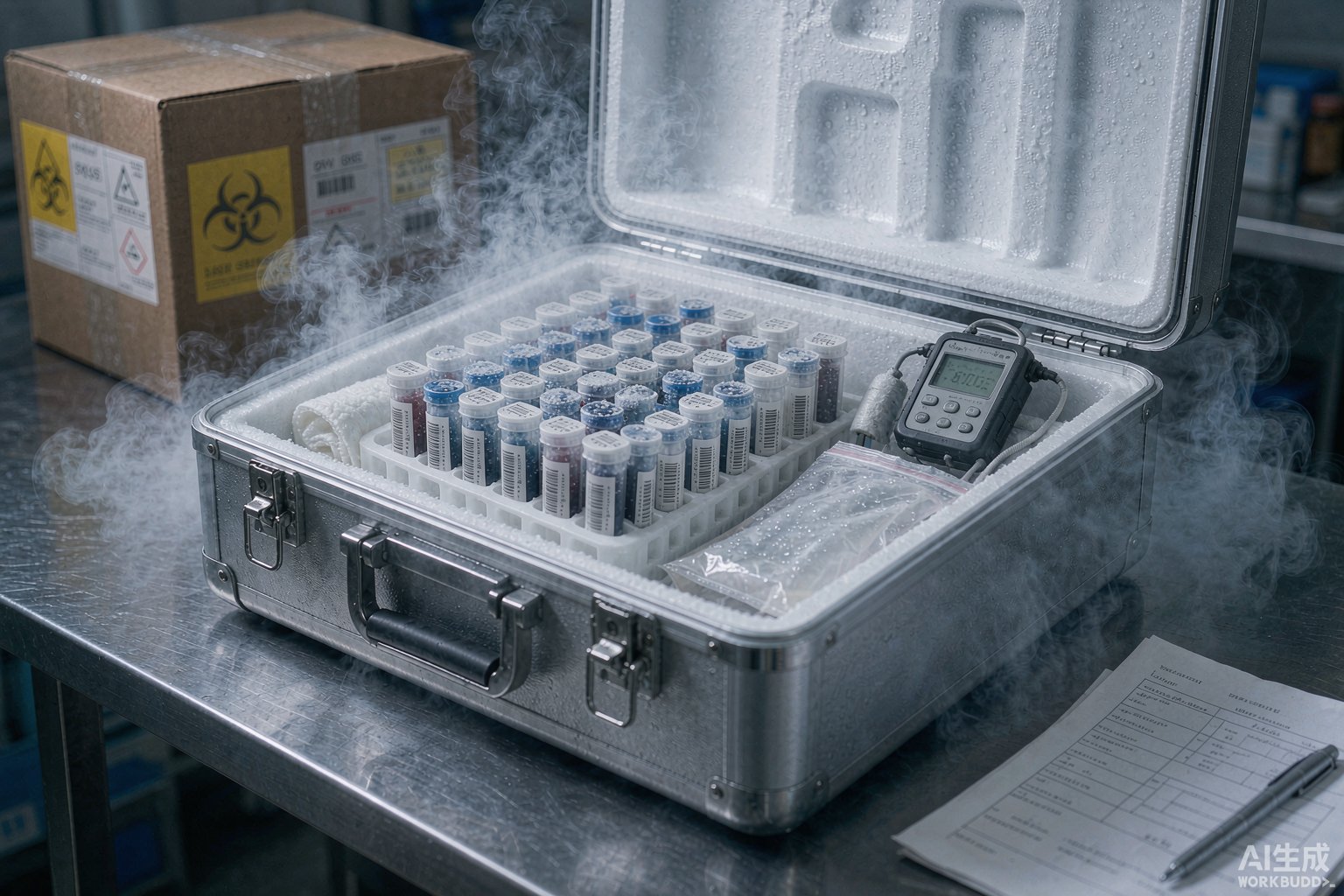
The moment a biological specimen leaves the freezer or LN₂ dewar, its labeling faces operating conditions entirely different from static storage: temperature swings across tens or even hundreds of degrees within hours, packaging layers opened and closed repeatedly, condensation and sublimation frost alternately appearing on the label surface, and a barcode that must scan correctly on the first attempt in the recipient's hands. This article provides directly actionable selection criteria: first lock the face stock by the lower temperature limit of the transport mode, then determine wrap-around or flat-label application by container diameter, and finally assign label tiers and numbering rules by the three-layer packaging structure. The BRD BradyLAB Lab & HC laboratory medical label series classifies materials by four temperature tolerance tiers: LN₂ -196 °C, freezer -80 °C, hot water 100 °C, and autoclave 121 °C. All model parameters in this article are taken from that material guide table; no specific values are given for models not listed.
I. Conclusions First: Three Decision Lines for Cryogenic Transport Labeling
If the entire article were compressed into three sentences, they would be the following. They determine the order of all subsequent selection decisions and also determine which materials should never enter the candidate list at all.
Line one: use the lowest temperature across the entire transport journey as the sole threshold, not the destination temperature. The sublimation temperature of dry ice at atmospheric pressure is -78.5 °C, meaning the interior of the box remains near -78.5 °C for extended periods. Any material rated only "tolerant to -40 °C and above" cannot be used for the primary container. Specimens stored in a -80 °C freezer before shipment and switched to dry ice in transit are at similar but not identical conditions—the dry ice box contains gaseous CO₂ and severe frost formation, whereas the freezer interior is a relatively stable air environment.
Line two: label failure almost always occurs at the interface, not in the face stock itself. At low temperatures the face stock contracts, the adhesive modulus rises, and the adherend surface frosts or condenses; the combination of these three causes edge lifting and detachment. Therefore, when selecting, the weight given to the adhesive and application process (surface preparation, overlap length, post-application dwell time) is no less than that given to the face stock temperature rating.
Line three: the three-layer packaging represents three independent labeling tiers, each requiring a different label strategy. The primary container carries specimen identity, the secondary container carries absorption and sealing, and the outer packaging carries transport and compliance information. All three share one numbering system, but their materials, dimensions, and removability differ completely; mixing them creates traceability breakpoints.
II. Temperature Windows and Label Boundaries of Three Cryogenic Transport Modes
Cryogenic transport commonly seen in laboratories and biobanks falls into three modes, with clear differences in lower temperature limit, typical duration, and labeling requirements—the first step in selection.
| Transport mode | Typical internal temperature | Common duration | Cold source characteristics | Primary container label temperature threshold | Typical specimens |
|---|---|---|---|---|---|
| Dry ice transport | -78.5 °C (atmospheric sublimation point) | 24–72 h | Solid CO₂ sublimates directly, no liquid residue; typical daily loss 5%–10% (depending on box insulation performance) | Must cover the -80 °C tier | Tissue, nucleic acid, cell pellet, vaccine intermediate |
| LN₂ vapor-phase transport (dry shipper) | Below -150 °C | 5–14 days | LN₂ adsorbed in the dewar's absorbent material, vapor-phase transport, no free liquid | Must cover the -196 °C tier | Cell lines, embryos, microbial strains, CAR-T cell products |
| Phase-change cold pack / refrigerated transport | 2–8 °C or 15–25 °C | 12–48 h | Phase-change material absorbs heat at its transition point, stable internal temperature | Ambient tier sufficient | Whole blood, serum, reagents, quality control materials |
It should be noted specifically: the reason the dry ice transport temperature threshold is set at the -80 °C tier rather than -78.5 °C itself is that the box experiences temperature spikes and frost layer melting during dry ice replenishment, opening for access, and mid-route transfers—actual conditions are more demanding than the nominal temperature. Similarly, the rated holding time of LN₂ vapor-phase dry shippers is based on static conditions; vibration and lid opening during actual transport shorten this time, so labels must be selected at the -196 °C LN₂ tier rather than compromised to the actual vapor-phase temperature.
III. Where Labels Go in the Three-Layer Packaging
Specimen outbound transport generally uses a primary container–secondary container–outer packaging three-layer structure. Each layer has different labeling objectives, and many traceability breakpoints are actually caused by "a layer not being labeled" rather than label detachment.
| Tier | Function | Required labeling elements | Recommended material direction | Common oversight |
|---|---|---|---|---|
| Primary container (cryovial / microcentrifuge tube / specimen bottle) | Unique specimen identity | Specimen number, DataMatrix or Code 128 barcode, project code, collection date | Wrap-around or self-laminating material rated -80 °C and below | Number written only on outer packaging; individual tubes cannot be independently identified after opening |
| Secondary container (seal bag / absorbent material / inner box) | Leak prevention and absorption | Batch number, tube count, primary container number range, sealing date | Cryogenic-rated material + transparent viewing structure | No labeling on secondary container; entire batch loses attribution if outer packaging is damaged |
| Outer packaging (carton / reusable crate / transport dewar jacket) | Transport and handover | Sender and recipient, waybill number, box number, biohazard symbol, orientation arrows, temperature requirements | Ambient removable material, box reusable | Reusing the previous batch's box number label; scanner reads old data |
The biohazard symbol in outer packaging labeling follows the graphical specification of ISO 7010 W009; classification, marking, and packaging requirements for infectious substances are governed by current transport regulations and the specific carrier's rules—this article discusses only how the label carrier itself fits into this structure. Specific limits such as the minimum dimension of any side of the outer packaging and the maximum volume of the primary container are likewise governed by current regulations. The design principle for labeling is: outer packaging labels must be readable without opening the box, and primary container labels must be independently identifiable after unboxing without reference to any documents.
IV. Four Typical Failure Modes in Dry Ice Environments
Dry ice transport is more prone to problems than freezer storage because it simultaneously introduces low temperature, gaseous CO₂, frost, and severe temperature cycling. The following four failure types appear most frequently in field reviews.
| Failure type | Mechanism | Field manifestation | Countermeasure |
|---|---|---|---|
| Interfacial frost causing initial adhesion failure | Frost forms in air after removal from -80 °C freezer; frost layer acts as a release layer | Appears adhered during labeling; entire label lifts after return to low temperature | Label in a low-temperature environment, or pre-cool with dry ice before labeling; remove frost from the labeling surface with a lint-free cloth first |
| Adhesive modulus rise at low temperature | Adhesive loses wetting capability below its glass transition range | Label edges lift first, then progressively detach entirely | Select a cryogenic adhesive system rated -80 °C and below; do not use ambient-temperature labels |
| Face stock contraction from temperature cycling | Cycling between -78.5 °C and ambient; face stock and adherend have different thermal expansion coefficients | Circumferential wrinkling and lifting on curved containers | Use wrap-around overlap structure on small-diameter containers to absorb stress; overlap length not less than 3 mm |
| Condensation causing print smearing | Box warms after arrival; condensation covers the printed surface | Barcode edges blurred, scan grade degraded | Print with resin-based ribbon; add self-laminating or transparent protective structure if necessary |
These four failure types share one common feature: all occur at the interface between the label and the adherend surface, or between the label and the environment. Therefore, field verification should not merely check "whether it sticks firmly" but should re-inspect after completing one full transport cycle—i.e., label, place in low temperature, hold for 24 h, remove and rewarm to room temperature, then scan the barcode. Only this closed loop constitutes a passed verification.
V. Primary Container Label Material Selection Matrix: -78.5 °C Is the First Hard Threshold
The following matrix is transcribed from the Lab & HC laboratory medical freezer/ULT/solvent-resistant label material guide table, listing the official checkmarks for each model across the four temperature tiers and application targets. When selecting, first locate the temperature tier corresponding to the transport mode, then verify whether the application target covers your container type.
| Model | Material & structure | LN₂ -196 °C | Freezer -80 °C | Hot water 100 °C | Autoclave 121 °C | Primary application targets |
|---|---|---|---|---|---|---|
| T629 | Nylon cloth label, easy to apply, high/low temperature resistant, good conformability | Yes | Yes | Yes | Yes | Ambient, microscope slides, cryovials/test tubes, conical tubes (all-scenario general purpose) |
| T429 | Self-laminating structure, ideal choice for labeling frozen flat surfaces | Yes | Yes | Yes | Yes | Cryovials/test tubes, packaging labeling; when applied to frozen tube surfaces, overlap at least 3 mm end-to-end |
| T459 | Ultra-thin polyester self-laminating label with transparent tail, transparent viewing window for liquid level observation | Yes | Yes | Yes | Yes | Cryovials/test tubes, cells |
| T409 | Excellent chemical resistance and abrasion resistance | Yes | Yes | Yes | No | Cryovials/test tubes, cells; requires end-to-end overlap in freezer/cryogenic scenarios |
| T509 | Durable vinyl material, suitable for wrap-around, good conformability | Yes (overlap required) | Yes | Yes | No | General purpose; overlap required for LN₂ environments |
| T439 | 6-color cryogenic label, pre-printed color band at top for quick container type differentiation | Yes | Yes | Yes | No | Cryovials/test tubes, general purpose |
| T424 | Excellent chemical resistance, withstands xylene and H&E staining processes | Yes | No | Yes | No | Ambient, microscope slides; must be used with BRS series ribbon |
| T625 | Vinyl cloth label, repositionable, removable, no adhesive residue, reusable | No | No | No | No | Ambient, cryovials/test tubes (suitable for temporary or variable information) |
| T419 | Bright white PET material, for cryovials and microcentrifuge tubes | No | No | No | No | Rated -40 °C and above; ambient, cryovials/test tubes, general purpose, packaging labeling |
| T329 | Matte white / PP pressure-sensitive cryogenic label | No | No | No | No | Rated -40 °C cryogenic; ambient, cryovials/test tubes, general purpose, packaging labeling |
Applying this table to transport scenarios yields a very direct conclusion. Primary containers for dry ice and LN₂ vapor-phase transport can only be selected from T629, T429, T459, T409, T509, and T439; among these, only T629, T429, and T459 remain if autoclave 121 °C resistance is required. Phase-change cold pack and refrigerated transport fall under the ambient tier, where T625's removable feature becomes an advantage—when the same reusable crates circulate between different projects, old labels can be completely peeled off without adhesive residue.
One easily confused point deserves mention: although T424 is marked "Yes" in the LN₂ -196 °C column, it is marked "No" in the freezer -80 °C column. It is a chemical-resistant model designed for microscope slides and pathology staining scenarios, used with BRS series ribbon, and should not be treated as a general-purpose cryogenic label for dry ice transport.
VI. Applicable Boundaries of -40 °C Materials: Which Models Cannot Enter the Dry Ice Box
This is the most error-prone category of judgment in the field. Both T419 and T329 carry "cryogenic" in their product names, and T329 is even directly labeled "rated -40 °C cryogenic label," but their boundary is -40 °C, not -78.5 °C.
The -40 °C tier corresponds to the typical lower limit of standard medical freezer refrigerators and the short-term frozen storage requirements of some reagents. When specimens move from a -40 °C environment into a dry ice box, the label face stock and adhesive must additionally withstand approximately 38 °C of temperature differential and a completely different vapor-phase environment. Beyond the boundary given in the specification, detachment and embrittlement are no longer a quality dispute but a selection error.
Conversely, if the transport mode is confirmed as phase-change cold pack at 2–8 °C, then using an all-scenario material like T629 is safe but its unit cost is not on the same order as T419/T329. The reasonable approach is tiered configuration by transport mode: T419/T329 for refrigerated projects, T629/T429/T459/T409/T509/T439 for dry ice and LN₂ projects, and T625 for reusable crate exterior labeling. This maintains temperature boundaries while avoiding having the entire site's label cost driven up by high-specification models.
Models not included in the specification are not listed in this table, and their materials and temperature ranges are not inferred. If out-of-table models appear in existing inventory, contact the product manager to confirm parameters before using them in cryogenic transport; do not follow old documents or old articles.
VII. Labeling Window and Wrap-Around Overlap Process for Small-Diameter Cryovials
The circumference of 0.5 mL and 1.5 mL cryovials is limited, and flat labels on this size are highly prone to lifting at both ends. The wrap-around structure, by having the label's leading and trailing ends press against each other, converts "label-to-tube-wall adhesion" into "label self-overlap," making it the preferred process for small-diameter containers at low temperatures.
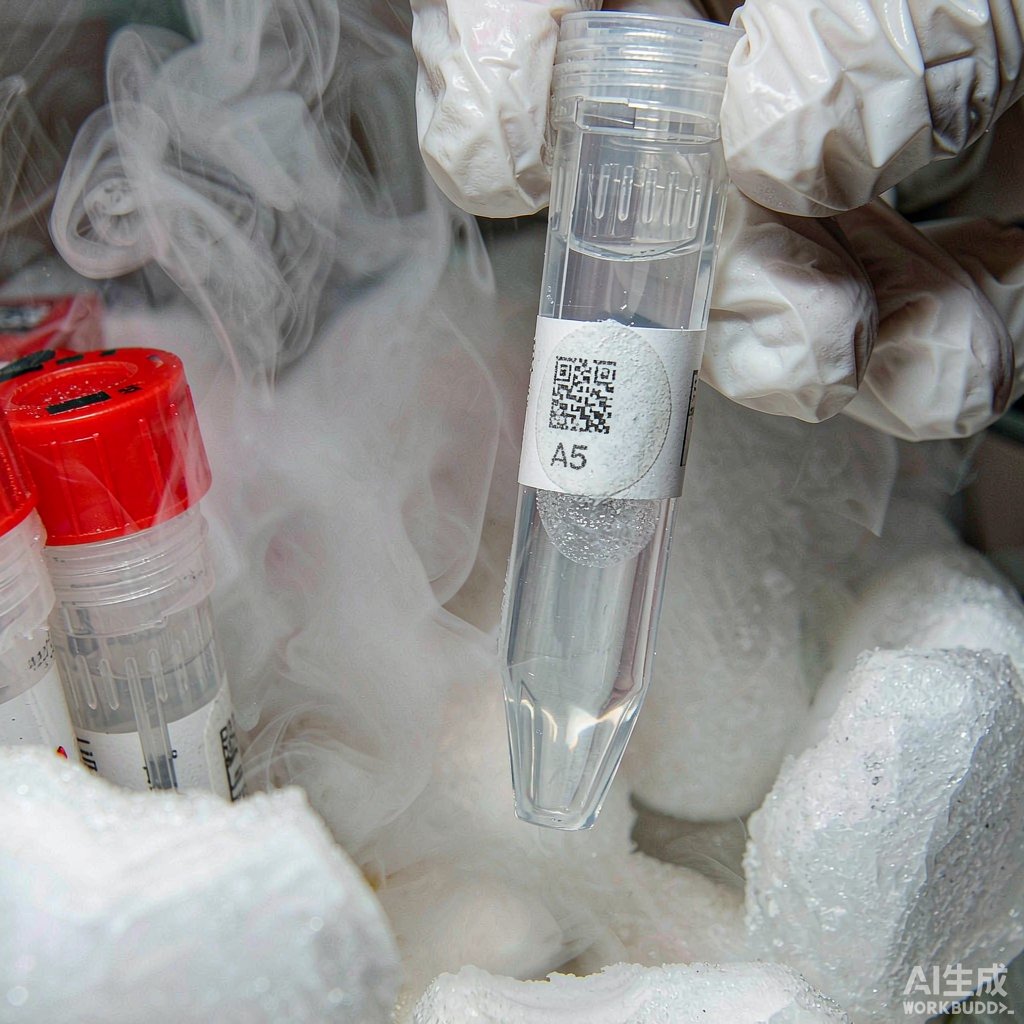
Overlap length is the most easily overlooked parameter in the wrap-around process. The official material guide table gives an explicit requirement for T429: when applied to frozen tube surfaces, overlap at least 3 mm end-to-end; T409 likewise requires end-to-end overlap in freezer and cryogenic scenarios; T509 also requires overlap when used in LN₂ environments. The significance of the 3 mm value is that it ensures the overlap zone retains sufficient overlapping area to maintain closure after low-temperature contraction; with insufficient overlap, contraction stress will directly tear the seam open.
Application timing also affects the result. The recommended procedure is: complete surface cleaning and labeling in a low-temperature environment or under pre-cooled conditions; after labeling, roll evenly around the tube circumference two to three times with fingertip pressure to allow full adhesive wetting; then dwell in the target temperature environment for no less than 30 min before packing. During packing, avoid positioning the label directly against hard contact points on the rack; use dividers in the transport box to secure and reduce friction from vibration.
For larger 15 mL and 50 mL conical tubes, the available window for flat labels is more generous, but edge stress from the taper still requires attention. T629 nylon cloth label, with its good conformability and coverage from ambient to microscope slides to cryovials to conical tubes, can reduce the management complexity of material switching in mixed-specification batches.
VIII. Barcode Readability Under Condensation and Frost: DataMatrix and ISO/IEC 15416 Grades
The barcode challenge in transport centers on two moments: outbound scanning and arrival scanning. The former occurs at the instant of frost formation after removal from low temperature; the latter occurs under condensation coverage after rewarming. Both scans must succeed for the selection to pass.
Regarding symbology, DataMatrix is recommended over linear barcodes for primary containers. The reason is that cryovials have a small labelable area; DataMatrix can accommodate specimen number, project code, and check digits within a limited area and has error correction capability, remaining decodable despite partial damage. Linear barcodes such as Code 128 require a longer bar-space sequence for the same information content, making them difficult to place on small-diameter tubes.
Print quality is evaluated per ISO/IEC 15416 (linear barcodes) and ISO/IEC 15415 (2D barcodes), with grades determined jointly by parameters such as symbol contrast, modulation, and defect. A quantifiable acceptance floor should be maintained in the field—for example, 2D symbol overall grade not lower than C—and 5%–10% of outbound batches should be sampled with a verifier before storage. Post-cycling re-inspection should also use the same scanning device to avoid different device judgments masking true degradation.
Resin-based ribbon is recommended for printing. Wax-based and wax/resin ribbons perform less well than resin-based in low-temperature adhesion and abrasion resistance, and are more prone to edge roughness when condensation combines with friction after rewarming. The T424 model explicitly requires use with BRS series ribbon; this pairing relationship is equally worth referencing for other chemical-resistant models.
If the label structure permits, prefer self-laminating models. The self-laminating construction of T429 and T459 seals the printed content beneath a film layer; T459 also retains a transparent viewing window for liquid level observation, particularly useful on specimen tubes where the liquid level must be confirmed through the label. The film layer also blocks direct condensation wetting of the printed surface—a more reliable solution than simply upgrading the ribbon grade.
IX. Secondary Containers and Outer Packaging: Repositionable Materials and Reusable Crate Reuse
Secondary container labeling has long been underestimated. Its value lies in the fact that when outer packaging is damaged, the waybill is lost, or an entire box of specimens needs redistribution, the batch label on the secondary container is the only basis for re-aggregating scattered primary containers.
Secondary container labeling should include at minimum four items: batch number, tube count, primary container number range, and sealing date. The number range is key—writing only the batch number without the range means the recipient cannot determine whether a given tube belongs to that batch. Seal bag surfaces also frost at low temperatures, so the material must still be selected at the -80 °C tier; it cannot be switched to an ambient label just because it is a "packaging layer."
Outer packaging follows completely different logic. Cartons and reusable crates circulate at ambient temperature and require repeated reuse; the most suitable choice is a repositionable, removable, residue-free, reusable vinyl cloth label such as T625. Its temperature range covers only the ambient tier, but outer packaging never enters the low-temperature box interior, so this range is entirely sufficient. What must truly be avoided is applying permanent pressure-sensitive adhesive directly to reusable crates—old labels cannot be cleanly removed during reuse, and overlapping old and new labels cause the scanner to read the previous batch's box number.
The biohazard symbol is printed per the graphical specification of ISO 7010 W009; orientation arrows and "this way up" markings should be placed on two adjacent sides of the box rather than the same side, ensuring at least one is readable in any stacking orientation. The print size of outer packaging labels must satisfy the reading distance without opening the box; the X-dimension of the barcode should not be too small.
X. Linking Temperature Data Loggers, TTI, and Label Numbering
Temperature evidence during transport and specimen identification are two independent data sets. If there is no hard link between them, post-hoc traceability cannot answer "what temperatures did this tube experience and when."
The recommended practice is to assign a box number to each shipment, with the box number appearing simultaneously on the outer packaging label, the data logger ID field, and the packing list. The data logger sampling interval should be set to 5–10 min, covering the full journey; the dry ice transport alarm threshold can be set at -60 °C (above this value indicates insufficient cold source), and refrigerated transport limits set at 2–8 °C.
Time-temperature indicator (TTI) labels can serve as supplementary evidence for individual boxes or tubes. Their function is to provide an irreversible visual signal when specimens cross a threshold temperature, suitable for arbitrating "whether specimens ever exceeded limits upon arrival." Note that TTI monitors cumulative time spent deviating from the threshold temperature and has no indicating function for long-term stable cryogenic storage itself; it should be applied at the stage of transition from low temperature to the next temperature zone, not inside LN₂.
All temperature evidence must ultimately link back to the specimen number as the primary key. At storage, write the box number, logger file, and specimen number range into the record together. The traceability requirements of ISO 20387:2018 for biobanks fall precisely at this level: any specimen should be traceable back through its full lifecycle handling and storage conditions.
XI. Numbering Closed Loop and Two-Person Verification from Outbound to Transport to Receipt
A transport labeling process that can withstand audit requires the numbering closed loop to be written into the SOP rather than relying on operator memory. Below is a directly implementable procedure.
Step one, pre-outbound verification. Export the specimen number list for this batch from the LIMS or biobank system, compare physical labels against system records tube by tube, have the verifier and reviewer sign separately, and record the verification time and temperature. ISO 20387:2018 and ISO 15189:2022 both have corresponding requirements for record integrity in medical laboratories and biobanks; two-person verification is the most readily accepted form of evidence.
Step two, packing and sealing. After loading primary containers into the secondary container, apply the batch label to the exterior of the secondary container and annotate the number range; place into the transport box, start the data logger, and record the start time and initial internal temperature; after sealing, apply the box number label and waybill to the outer packaging.
Step three, arrival acceptance. The recipient first reads the outer packaging box number, then opens the box to verify the secondary container batch label, and finally scans the primary container barcodes tube by tube. Receipt is complete only when all three steps pass; if any step does not match, preserve the on-site condition and photograph for evidence rather than signing first and tracing later.
Step four, rewarming and re-inspection. After specimens are transferred to the target storage environment, re-inspect barcode readability once within 24 h and record the scan grade. This step surfaces "label damaged in transit but not discovered at the time" early, avoiding the situation where an entire batch is found unidentifiable months later at outbound.
Biosafety requirements involving infectious substances are implemented per GB 19489-2008 and WS 233-2002; if specimens are ultimately used for in vitro diagnostics or medical device-related purposes, labeling records should also meet the traceability requirements of ISO 13485:2016; for pharmaceutical or vaccine-related specimens, transport and acceptance records must simultaneously comply with the relevant GSP clauses.
Recommended Products
For the label materials and application scenarios covered in this article, the following BradyLAB (BRD) products are available for selection reference (click to view specifications and request a quote):
- T629 Biobank -196 °C nylon cloth cryogenic test tube biobank signing test sampling LN₂ label (¥999/roll)
- Lab032-429/30X20mm biobank cryovial microscope slide PET polyester label cryogenic adhesive (Price on request)
- Lab115-459/9.53+65x9.53 biobank conical tube cryogenic cryovial PET self-laminating label (Price on request)
- Lab208-509/25.4x63.5 wrap-around cryovial biobank small tube LN₂ classification label (Price on request)
XII. FAQ
Q1: Dry ice at -78.5 °C is higher than the freezer's -80 °C, so why still select at the -80 °C tier?
Because the failure mechanisms differ. The freezer interior is a stable low-temperature air environment; the dry ice box contains large amounts of gaseous CO₂ and repeated frost–melt cycles, and dry ice replenishment and opening for access cause temperature spikes. The temperature tiers in the specification are engineering boundaries that include margin for such conditions; only materials selected using them have headroom in dry ice scenarios.
Q2: T419 is labeled "rated -40 °C cryogenic"—can it be used for -78.5 °C dry ice transport?
No. The official boundary for T419 and T329 is -40 °C and above, corresponding to the lower limit of standard medical freezer refrigerators, and cannot cover dry ice and LN₂ scenarios. Primary containers for dry ice transport should use T629, T429, T459, T409, T509, or T439.
Q3: Must wrap-around labels overlap? How much overlap is appropriate?
Overlap is mandatory in cryogenic scenarios. The official requirement for T429 is at least 3 mm end-to-end overlap when applied to frozen tube surfaces; T409 requires end-to-end overlap in freezer/cryogenic scenarios; T509 likewise requires overlap when used in LN₂ environments. The purpose of overlap is to have contraction stress borne by the overlap zone rather than directly tearing the seam open.
Q4: On arrival the label surface is covered in condensation and the barcode won't scan—what to do?
First absorb surface moisture with a lint-free cloth; do not wipe the printed surface to avoid abrasion. Wait until the label returns to room temperature and is completely dry, then re-scan. If it still cannot be read, the print quality or material has been compromised; record the batch and evaluate symbol grade per ISO/IEC 15415. For prevention, prefer self-laminating structures (T429, T459) and use resin-based ribbon.
Q5: Can pressure-sensitive adhesive labels be used on outer packaging?
Applying permanent pressure-sensitive adhesive to reusable crates is not recommended; old labels are difficult to remove, causing old-new overlap and incorrect box number scanning. T625-type repositionable, removable, residue-free, reusable vinyl cloth labels are recommended; their ambient tier range fully covers the outer packaging circulation environment.
Q6: T424 is rated for LN₂ -196 °C—can it be used as a general-purpose cryogenic label?
No. T424 is officially checked for LN₂, hot water 100 °C, ambient, and microscope slides; the freezer -80 °C column is marked "No." It is a chemical-resistant model for microscope slides and pathology staining scenarios and must be used with BRS series ribbon. Using it for dry ice transport is outside the specification's scope.
Q7: How to determine whether a model not in the specification table can be used for cryogenic transport?
Do not judge, do not infer. No specific values are given in this article for the materials and temperature ranges of unlisted models; contact the product manager to confirm specification parameters before deciding, and do not follow old documents or old articles. The original wording at the end of the table is "for more materials and specific applications, please contact the product manager for selection."
The BRD BradyLAB Lab & HC series has established a complete material matrix around four temperature tiers—LN₂ -196 °C, freezer -80 °C, hot water 100 °C, and autoclave 121 °C—and, combined with resin-based ribbon and laboratory printers, can cover full-chain labeling needs from static storage to dry ice and LN₂ vapor-phase transport. In actual selection, using the lowest temperature of the transport mode as the first constraint, container diameter and labeling window as the second constraint, and the three-layer packaging numbering structure as the third constraint will keep labeling failures within an acceptable range.