
Labeling lyophilized formulation vials is not the same problem as labeling standard reagent bottles
Conclusion first: For lyophilized (freeze-dried) formulation vials, the core of label selection is not "low-temperature resistance," but whether the label can simultaneously withstand continuous switching across four process windows: the deep-freezing pre-freeze stage, the vacuum sublimation stage, the secondary drying heating stage, and the ambient/refrigerated storage stage after capping. Standard reagent bottle labels face only a single temperature zone, whereas lyophilized vial labels must undergo a complete cycle within 24–72 hours from -80 °C to +40 °C, from atmospheric pressure to 0.1–0.3 mbar vacuum, and from dry to high-humidity rehydration. There is only one selection criterion: select according to the most demanding tier in the entire process, not according to the final storage temperature. Among the BRD 博锐迪 Lab series, only three products cover all four tiers: T629 nylon cloth label, T429, and T459; all other models must be strictly matched to their applicable columns in the official material guide table and must not be mixed across tiers.
For biobanks, innovative drug R&D institutions, hospital pharmacy departments, and CDC systems, lyophilized vials represent a long-underestimated labeling challenge: they are neither typical cryovials (small diameter, highly curved surface, no threaded structure) nor standard reagent bottles (they enter vacuum chambers and withstand sublimation vapor impingement). Once a label detaches inside the lyophilization chamber, the entire batch must be classified as pending inspection or rejected because the batch number and expiry date cannot be traced—resulting in losses far exceeding the cost of the label itself. This article follows the actual sequence of the lyophilization process to break down the decision logic for label selection, the material matching matrix, adhesive mechanics requirements, and compliance verification methods.
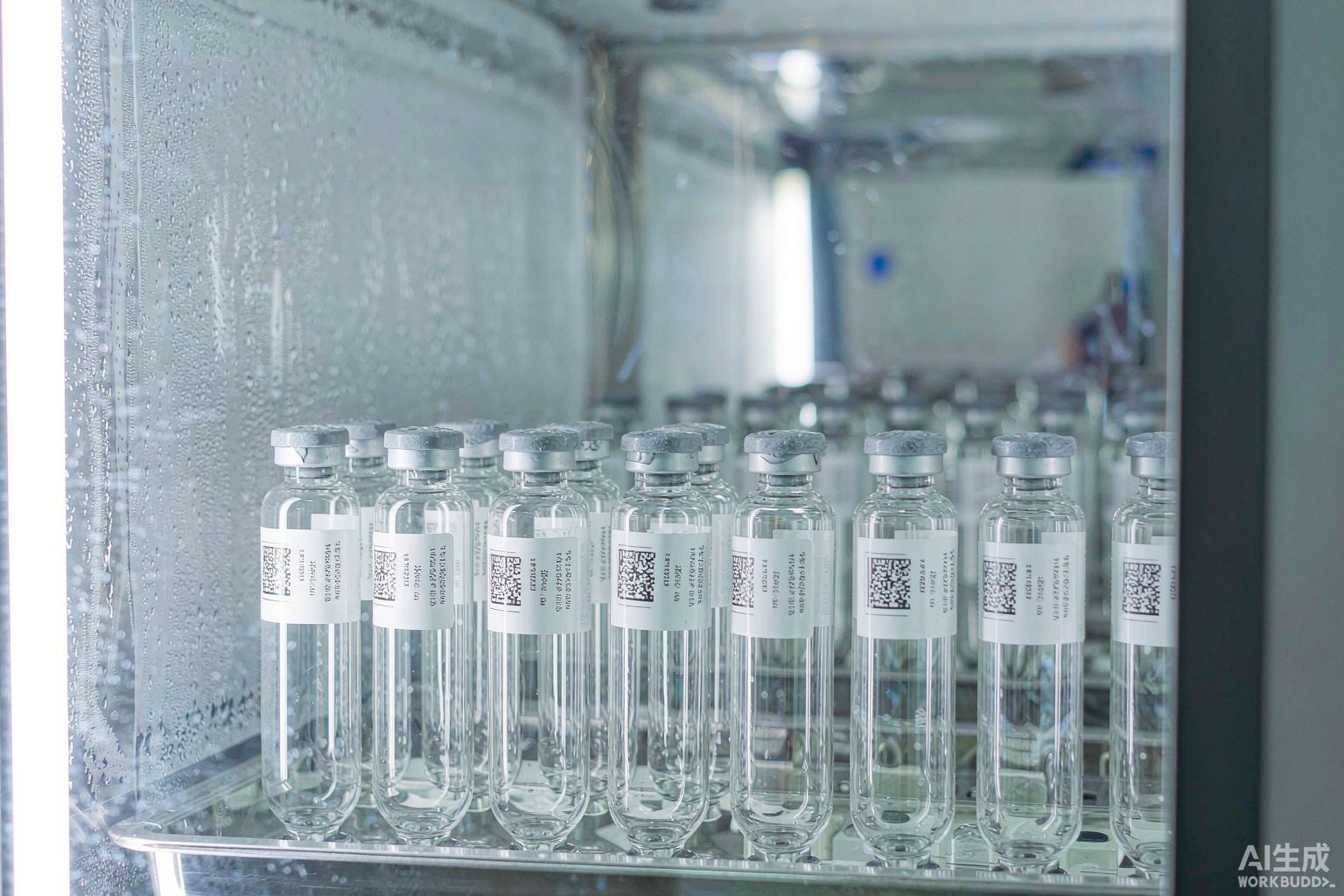
1. Why lyophilized vial labels cannot follow the selection logic for standard reagent bottles
Standard reagent bottle labels face a relatively stable environment: room-temperature storage, occasional refrigeration, and essentially no movement after application. Lyophilized vial labels, however, must traverse a severe operating curve. Taking a typical injectable lyophilized formulation process as an example, from filling to completion of capping, a batch of product requires the label to undergo the following four stages:
Stage 1: Filling and partial stoppering. The drug solution is filled into tubular glass vials at ambient temperature or 2–8 °C, after which butyl rubber stoppers are placed in a "partially stoppered" manner—the stoppers are not fully pressed in, leaving channels for sublimation vapor to escape. At this point the vial body temperature is near room temperature, but ambient humidity is typically between 45%–60% RH. The label is applied at this stage, and the adhesive layer must complete initial wetting under high-humidity conditions.
Stage 2: Pre-freezing. The product is cooled with the shelf to below the eutectic point. The pre-freeze endpoint of industrial lyophilizers is typically set at -40 °C to -50 °C; for heat-sensitive biological products (proteins, vaccines, cytokines), it is often lowered to -60 °C to -80 °C, and some processes use liquid nitrogen snap-freezing for even lower instantaneous temperatures. This stage is the first high-incidence point for label failure: the difference in thermal expansion coefficients between the face stock and adhesive layer is sharply amplified under deep freezing. If the adhesive layer has not sufficiently wetted during the ambient-temperature stage, shrinkage mismatch will generate edge-peel stress at this point.
Stage 3: Primary drying (sublimation). The chamber is evacuated to 0.1–0.3 mbar (approximately 10–30 Pa), and the shelf is slowly heated to supply sublimation heat; ice crystals sublime directly into water vapor. The label withstands three challenges at this stage: outgassing under vacuum (volatiles escaping from the face stock and adhesive layer may create micro-bubbles), adhesive embrittlement at low temperature, and prolonged low-temperature residence lasting from several hours to tens of hours. Most label detachment incidents do not occur at the moment of temperature reduction, but between the 8th and 20th hour of this stage.
Stage 4: Secondary drying and capping. The shelf is raised to 20–40 °C to remove bound water, reducing the residual moisture of the product to 1%–3%; then full stoppering is performed under vacuum or nitrogen, the chamber is opened, and aluminum caps are crimped. The label now returns directly from the low-temperature zone below -40 °C to ambient temperature, undergoing a large temperature rise within minutes—this is the second high-incidence point for failure. During rewarming, a layer of water film rapidly condenses on the vial surface. If the label edge has already developed micro-peeling during the low-temperature stage, the water film will penetrate along the interface via capillary action, causing extensive edge lifting.
As can be seen, the four stages cover a temperature range from -80 °C to +40 °C, a pressure range from atmospheric to 0.3 mbar, and a humidity range from dry to condensation. Selecting a label based on the final storage temperature (ambient or 2–8 °C for most lyophilized formulations) is the most common selection error in this scenario—because the final storage stage is precisely the mildest tier in the entire process.
2. Failure mechanisms and acceptance criteria corresponding to the four process windows
To select the correct label, "failure" must be broken down into observable physical quantities. The following table lists the failure modes, key causes, and executable acceptance criteria for the four stages, for direct reference during process validation.
| Process window | Typical parameter range | Primary failure mode | Failure cause | Quantifiable acceptance criterion |
|---|---|---|---|---|
| Filling and partial stoppering | 18–25 °C, 45%–60% RH | Insufficient initial adhesion, slight edge lifting | Insufficient contact area on curved vial surface, uneven labeling pressure | Edge peel ≤1 mm at 24 h after labeling (GB/T 2792-2014) |
| Pre-freezing | -40 °C to -80 °C | Face stock embrittlement, adhesive shrinkage mismatch | Difference in thermal expansion coefficients between face stock and adhesive | No cracking, no peeling after 4 h at constant -80 °C |
| Primary drying (sublimation) | 0.1–0.3 mbar, -30 °C to -10 °C, 8–40 h | Delayed detachment, micro-bubbles, barcode blurring | Vacuum outgassing, low-temperature adhesive creep, prolonged residence | 180° peel strength retention ≥80% after 20 h vacuum residence |
| Secondary drying and capping | 20–40 °C, rewarming condensation | Rewarming edge lifting, water film capillary penetration | Interfacial micro-peeling + surface condensation | Edge lift area ≤3% at 2 h after rewarming to room temperature, barcode ISO/IEC 15416 grade ≥C |
| Post-capping storage | Ambient or 2–8 °C | Long-term tack decay | Adhesive cold flow | No displacement in GB/T 4851-2014 holding tack test |
The practical value of this table lies in the fact that it converts "whether a label is usable" from a subjective judgment into five hard criteria that can serve as go/no-go gates. During process validation, running a pilot batch of 30–50 vials according to this table can intercept the vast majority of selection errors before formal production. It should be noted that the peel strength retention and edge lift area thresholds in the table represent commonly accepted industry validation criteria; specific limits should be determined in conjunction with the organization's deviation management procedures and product risk classification.
3. Material matching matrix for the BRD Lab series in lyophilization scenarios
The official material guide table forms a selection matrix based on four temperature tiers (liquid nitrogen -196 °C, freezer -80 °C, hot water 100 °C, autoclaving 121 °C) and seven application categories (ambient, microscope slides, cryovials/test tubes, conical tubes, cells, general purpose, packaging identification). Mapping the lyophilization process onto this table yields clear matching relationships:
| Model | Material and official description | -196 °C | -80 °C | 100 °C | 121 °C | Positioning in lyophilization process |
|---|---|---|---|---|---|---|
| T629 | Nylon cloth label, easy to apply, high/low temperature resistance, good conformability; officially specified for all laboratory locations requiring identification | Applicable | Applicable | Applicable | Applicable | First choice for full process. Covers all four tiers and simultaneously covers ambient, microscope slides, cryovials/test tubes, and conical tubes; conforms to curved surfaces; the same product can be used for aseptic area equipment requiring 121 °C sterilization |
| T429 | Ideal choice for labeling frozen flat surfaces; when applied to frozen tube surfaces, at least 3 mm overlap at head and tail | Applicable | Applicable | Applicable | Applicable | Covers all four tiers and is officially designated for "packaging identification," suitable for scenarios requiring unified vial body labels + intermediate box identification; for small-diameter vials, ≥3 mm head-to-tail overlap must be ensured |
| T459 | Ultra-thin polyester label, self-laminating label with transparent tail, protects printed content and provides a transparent window for observing liquid level | Applicable | Applicable | Applicable | Applicable | Self-laminating structure resists vapor and abrasion during sublimation; transparent window facilitates observation of product state inside the vial; suitable for batch traceability labels requiring long-term protection of printed content against abrasion |
| T409 | Excellent chemical resistance and abrasion resistance; for labeling frozen/low-temperature (head-to-tail overlap) or ambient-temperature bottles and test tubes | Applicable | Applicable | Applicable | — | Suitable for products containing organic solvents or highly active ingredients; head-to-tail overlap required for low-temperature stages; official table does not indicate 121 °C applicability, not for use in steps requiring moist heat sterilization |
| T509 | Durable vinyl label, suitable for wrapping, good conformability; overlap required for liquid nitrogen environments | Applicable | Applicable | Applicable | — | Wrap-around structure adapts to small-diameter vial bodies and curved surface conformability, superior to flat labels; overlap mandatory for liquid nitrogen snap-freezing processes |
| T439 | 6-color cryogenic label with pre-printed color band at top, facilitating rapid visual identification and classification of container types | Applicable | Applicable | Applicable | — | Suitable for color-coding to distinguish multiple specifications/formulations lyophilized in parallel within the same batch, reducing the risk of picking errors |
| T625 | Vinyl cloth label, repositionable, removable, no adhesive residue, reusable | — | — | — | — | Officially specified for ambient temperature only; must not enter the lyophilization process; only suitable for temporary identification during process development or temporary marking after chamber unloading |
| T419 / T329 | T419 gloss white PET, resistant to -40 °C and above; T329 matte white PP adhesive, resistant to -40 °C freezer conditions | — | — | — | — | Officially specified for ambient temperature, resistant to -40 °C and above; must not be used in the -80 °C pre-freeze stage; only for outer packaging identification after capping |
The most critical information in this matrix table is the -40 °C boundary: the temperature columns for T419 gloss white PET face stock and T329 matte white PP adhesive in the official guide table are uniformly marked as -40 °C and above, with only the ambient tier checked; however, the pre-freeze endpoint of industrial lyophilizers is generally set in a lower deep-freezing range, and the two do not match. Any practice of using these two products on vial bodies that enter the deep-freezing stage with the product constitutes a typical cross-tier misuse. It should also be clearly understood that the removable characteristic of T625 conflicts with the long-term stability requirements of the lyophilization process—removability means the cohesive strength of the adhesive layer is deliberately reduced, making it precisely the type most prone to failure under combined vacuum and deep-freezing conditions.
A necessary note on model parameters: the materials, temperature tiers, and applicable categories of all models listed in this article are taken item by item from the BRD 博锐迪 Lab&HC laboratory medical cryogenic/ultra-low temperature/solvent-resistant label material guide table. For model specifications not included in the guide table, the specific materials and temperature ranges are subject to the product specification sheet; it is recommended to contact the product manager for selection confirmation and not to infer based on model number sequences.
4. Adhesive mechanics on small-diameter curved surfaces: why vials are harder to label than cryovials
Although cryovials and microcentrifuge tubes also face low temperatures, they have threaded structures, flat areas for alignment, and relatively larger diameters. Tubular glass vials are completely different: common 2 mL, 5 mL, 10 mL, and 20 mL vial body diameters are approximately 16 mm, 22 mm, 30 mm, and 40 mm respectively. After the label is wrapped, the radius of curvature is extremely small, and the resilience of the label face stock itself continuously opposes the adhesive bonding force, creating a constant peel moment.
The magnitude of this moment can be understood qualitatively: the thicker and stiffer the label face stock, the greater the resilient peel force; the smaller the vial diameter, the more concentrated the curvature stress. Therefore, three practical principles in this scenario are:
First, prioritize thin face stocks and materials with good conformability. In the official guide table, T629 is explicitly described as having "good conformability," T509 as "suitable for wrapping, good conformability," and T459 as an ultra-thin polyester structure—all three outperform conventional thick film face stocks in conformability on small-diameter curved surfaces. Conversely, thicker films with higher stiffness, despite excellent chemical resistance, will exhibit noticeable edge resilience on 16 mm diameter vial bodies.
Second, control label width to reduce curvature stress. For 2–5 mL small-volume vials, the label width should be controlled within 1/3 of the vial circumference (approximately 16 mm width for 16 mm diameter vials and approximately 23 mm width for 22 mm diameter vials). The greater the width, the farther the edge is from the neutral plane, and the peel moment increases non-linearly.
Third, overlap is a mandatory requirement for low-temperature stages, not optional. Official rules clearly state: T429 requires at least 3 mm head-to-tail overlap when applied to frozen tube surfaces; T409 requires head-to-tail overlap in frozen/low-temperature scenarios; T509 requires overlap for liquid nitrogen environments. The essence of overlap is to allow the label to form a circumferential self-constraint, eliminating the "free edge" as a peel initiation point. In practice, the overlap should be ≥3 mm, and the overlap area should avoid the barcode symbol area to prevent affecting ISO/IEC 15416 symbol grade assessment.
Additionally, vial surface preparation before labeling is equally critical. Tubular glass vial surfaces may retain a hydrophobic layer from siliconization treatment (some pre-fillable vials are siliconized to facilitate stopper movement), and such surfaces significantly reduce initial adhesion. It is recommended to add a surface energy confirmation step during process validation: test the vial surface tension with a dyne pen; if below 38 mN/m, assess whether labeling position adjustment or a more conformable model is needed.
5. Vacuum and sublimation stages: vacuum outgassing and barcode readability
The effect of vacuum environments on labels is often overlooked. At a vacuum level of 0.1–0.3 mbar, adsorbed air and volatiles in the label face stock and adhesive layer slowly escape. If the escape rate exceeds the material's permeability, micro-bubbles will form at the adhesive interface, manifesting as fine protrusions or localized whitening on the label surface. This process is particularly pronounced on film-type face stocks, whereas cloth-based and nylon face stocks have inherently breathable structures and significantly better outgassing resistance—this is one of the physical reasons why T629 nylon cloth labels are listed as the first choice in vacuum-related scenarios.
Regarding barcode readability, two verification time points must be distinguished. The first is before chamber loading: at this point, samples from each batch of labels should be evaluated for symbol grade per ISO/IEC 15416 (linear barcodes) or ISO/IEC 15415 (2D barcodes) to establish baseline data. The second is after chamber unloading: this is the true decision point, because vapor impingement during sublimation, low-temperature embrittlement, and rewarming condensation can all alter print contrast and edge sharpness. If the difference between the two grades exceeds one level (e.g., from grade B to grade C), it indicates that the combination carries a print layer durability risk in the lyophilization process, and the ribbon should be changed or printing parameters adjusted.
Printing consumable matching also cannot follow conventional configurations. If the process involves subsequent staining or solvent contact steps (e.g., some R&D scenarios require residual testing on vial bodies), refer to official rules: T424 requires BRS series ribbons to withstand xylene and H&E staining processes. For general lyophilization processes, resin-based ribbons outperform wax-based and mixed-based ribbons in low-temperature resistance and abrasion resistance; specific model matching should be confirmed together with the printer model.
6. From vial body to intermediate box: interface design for two-level coding
Traceability of lyophilized formulations cannot rely solely on vial body labels. The reason is that the vial body label area is limited (the labelable area on a 2 mL vial is extremely small), making it difficult to carry complete batch number, specification, expiry date, storage conditions, and traceability code; and after chamber unloading and capping, the product immediately enters the packaging stage, where the vial body label is obscured inside the intermediate box and cannot be directly scanned for inventory.
A reasonable approach is to establish two-level coding: the vial body carries minimum necessary information + unique traceability code, and the intermediate box carries complete readable information + the same traceability code. The two levels are linked through a shared unique code field, achieving "scan the box to know the vial, scan the vial to trace the box." In terms of material selection, the vial body side is constrained by the lyophilization process and must use low-temperature tier models; the intermediate box side is not constrained by low temperature and can use ambient-temperature models such as T429 (officially designated for "packaging identification"), T419, or T329, resulting in a more reasonable cost structure.
A four-segment coding structure is recommended: product code (fixed) + batch number (including production date) + serial number (sequential) + check digit. For long-term storage in biobank scenarios, it is recommended to simultaneously assess the requirements of ISO 20387:2018 for specimen identification and traceability records, ensuring that the coding rules can support information retrieval throughout the specimen lifecycle. For medical laboratory scenarios, ISO 15189:2022 also sets clear requirements for the uniqueness and traceability of clinical specimen identification; coding design should be included in the review at the project initiation stage rather than remedied afterward.
7. Compliance anchors: which standards actually govern this scenario
The standards involved in lyophilized vial labeling are not concentrated in a single specialized specification but are distributed across three levels: quality management systems, laboratory competence, and biobank requirements. Those most frequently cited in practice and most deserving of inclusion in validation protocols include:
ISO 20387:2018 (General requirements for biobanking)—if lyophilized products are preserved long-term as biological specimens, this standard sets systematic requirements for identification, traceability, and record retention, and is the core anchor for biobank scenarios. ISO 15189:2022 (Medical laboratories—Requirements for quality and competence)—applicable to identification management of self-prepared reagents in hospital clinical laboratories and third-party medical laboratories. ISO 17025:2017 (General requirements for the competence of testing and calibration laboratories)—applicable to R&D and testing institutions; its equipment and sample identification clauses can be extended to label management. ISO 13485:2016 (Medical devices—Quality management systems)—if lyophilized products fall within the medical device category, labels as part of product identification must be incorporated into design control and traceability systems.
At the physical performance verification level, GB/T 2792-2014 (Pressure-sensitive adhesive tapes—180° peel strength test) and GB/T 4851-2014 (Pressure-sensitive adhesive tapes—Holding tack test) are two domestic method standards that can be directly cited for quantifying the initial value and decay rate of adhesive performance. Barcode quality is assessed according to ISO/IEC 15416 (linear) and ISO/IEC 15415 (2D). If lyophilized products enter pharmaceutical distribution channels, identification and records during storage and transport must also meet relevant GSP requirements.
For products involving biosafety risks (e.g., lyophilized live vaccines containing pathogenic microorganisms, diagnostic antigens), container identification should also reference GB 19489-2008 (General requirements for laboratory biosafety) and ISO 7010 W009 (international biohazard symbol) for warning labels, and warning symbols must not fade or detach due to low-temperature or vacuum environments.
8. Implementation SOP: eight-step execution checklist
| Step | Process node | Key operation points | Verification method | Responsible function |
|---|---|---|---|---|
| 1 | Selection confirmation | Select tier based on pre-freeze endpoint temperature: -80 °C and below select T629/T429/T459/T509/T439; explicitly prohibit T419/T329/T625 from entering the lyophilization chamber | Verify item by item against the official material guide table | Process/QA |
| 2 | Dimensions and layout | Label width ≤ 1/3 of vial circumference; barcode area avoids overlap zone; overlap ≥3 mm | First article confirmation and recording | Process |
| 3 | Printing | Resin-based ribbon; allow ≥15 min stabilization after printing for ink layer | ISO/IEC 15416 or 15415 baseline grade ≥B | Production |
| 4 | Labeling (ambient stage) | Vial body clean and dry, no silicone residue; uniform labeling pressure; record ambient temperature and humidity | Edge peel ≤1 mm at 24 h | Production |
| 5 | Pre-freeze inspection | Full-batch visual inspection; remove individuals with edge lifting and bubbles | Vial-by-vial visual inspection, retain images | Production/QA |
| 6 | Chamber loading | Record loading time, shelf position, pre-freeze profile setpoints | Process parameter records archived | Production |
| 7 | Chamber unloading inspection | Vial-by-vial inspection for detachment/edge lifting/bubbles; sample barcode grading | Difference between unloading grade and loading baseline ≤1 grade level | QA |
| 8 | Capping and packaging | Intermediate box labels linked via two-level coding; ambient-temperature models may be used for packaging identification | Box-to-vial consistency spot check ≥5% | Packaging/QA |
The design principle of this checklist is to move quality decision points upstream: Steps 4 and 5 intercept the vast majority of adhesive defects before chamber loading, because once inside the lyophilization chamber, any label problem will escalate into a traceability deviation for the entire batch. The chamber unloading inspection at Step 7 is the final gate, and its barcode grading data should be incorporated into batch records as input for continuous improvement.
9. Troubleshooting pathways for high-frequency failures
On-site troubleshooting should proceed in a three-stage manner: "symptom → stage → root cause." If labels show extensive detachment immediately after pre-freezing, the root cause is mostly in the labeling stage: insufficient initial adhesion or inadequate overlap; at this point, review the labeling pressure and ambient humidity records from Step 4. If labels detach during the middle of primary drying, this is a typical delayed failure; the root cause is usually adhesive low-temperature creep or interface degradation caused by vacuum outgassing, and the solution is to switch to a more breathable cloth-based model (T629) or self-laminating structure (T459). If labels exhibit edge lifting after chamber unloading and rewarming, it indicates that micro-peeling already existed at the interface during the low-temperature stage, and rewarming condensation amplified the defect through capillary action; focus on inspecting adhesion quality and face stock conformability before pre-freezing. If labels are intact but barcodes cannot be scanned, the problem lies in the print layer rather than the adhesive layer; check ribbon matching, print darkness, and printhead condition, and re-perform ISO/IEC 15416 or 15415 grading.
It must be emphasized that the four types of symptoms correspond to four completely different root cause directions. Using "switch to a more low-temperature-resistant label" as a universal response often masks the real problem—this is precisely the thinking habit most necessary to avoid in lyophilized label management.

10. Minimum conclusion for selection decisions
Compressing the decision logic of this article into one sentence: use the pre-freeze endpoint temperature as the selection baseline, use all-four-tier models as the default choice, use overlap technique and two-level coding as quality assurance, and use post-unloading barcode grading as the final determination. For most organizations using -40 °C to -80 °C pre-freeze processes, T629 nylon cloth label is the lowest-risk general starting point due to its all-four-tier coverage and multi-container applicability; if printed content abrasion protection is needed, T459's self-laminating structure is superior; if unified vial body and packaging identification with cost sensitivity is needed, T429 is the balanced option; for products involving harsh chemical environments, consider T409.
Finally, the source discipline for material data must be reiterated: the material descriptions, temperature tiers, and applicable container ranges of all models are from the BRD 博锐迪 official material guide table, and any model parameters beyond that table should not be presumed based on experience. For specific applications not covered by the guide table, contact the product manager for selection confirmation before writing into process documents—this is not procedural redundancy but the most effective means of avoiding systematic selection errors.
Recommended Products
For the label materials and application scenarios covered in this article, the following 博锐迪 (BRD) products are available for selection reference (click to view specifications and request a quote):
- Lab296-629 Biobank cryovial microscope slide -196 °C liquid nitrogen nylon low-temperature label (¥999/roll)
- Lab032-429/30 × 20 mm Biobank cryovial microscope slide PET polyester label low-temperature adhesive (Price on request)
- Lab115-459/9.53+65 × 9.53 Biobank conical tube low-temperature cryovial PET self-laminating label (Price on request)
- Lab208-509/25.4 × 63.5 Wrap-around cryovial biobank small tube liquid nitrogen classification label (Price on request)
FAQ
Q1: Can lyophilized vial labels be selected based on the final storage temperature (ambient or 2–8 °C)?
No. The most demanding conditions experienced by labels during the lyophilization process are the pre-freeze stage (-40 °C to -80 °C) and the vacuum sublimation stage, which are far more severe than the final storage conditions. Selection must be based on the most demanding tier in the entire process. The T419 gloss white PET and T329 matte white PP models, officially rated for -40 °C and above, have only the ambient tier checked in their temperature column; once they enter the lower pre-freeze deep-freezing stage with the product, there is a substantial risk of failure.
Q2: Which models in the BRD Lab series cover all four tiers from -196 °C to 121 °C?
According to the official material guide table, T629 (nylon cloth label), T429, and T459 are all applicable across the four tiers of liquid nitrogen -196 °C, freezer -80 °C, hot water 100 °C, and autoclaving 121 °C. T409, T509, and T439 cover the first three tiers; the official table does not indicate 121 °C applicability, and they should not be written into process steps requiring moist heat sterilization.
Q3: Why is overlap mandatory for labeling small-diameter vials? What is the appropriate overlap amount?
Small-diameter vial bodies have high curvature, and label face stock resilience generates a continuous edge peel moment. The purpose of overlap is to allow the label to form a circumferential self-constraint, eliminating the peel initiation point. Official rules require T429 to have at least 3 mm head-to-tail overlap when applied to frozen tube surfaces; T409 requires head-to-tail overlap in frozen/low-temperature scenarios; T509 requires overlap for liquid nitrogen environments. In practice, the overlap should be ≥3 mm, and the overlap position should avoid the barcode symbol area.
Q4: What special effects does a vacuum environment have on labels?
At a vacuum level of 0.1–0.3 mbar, adsorbed gases and volatiles in the face stock and adhesive layer escape, potentially forming micro-bubbles at the adhesive interface, manifesting as fine surface protrusions or localized whitening. Film-type face stocks are more sensitive to this, while cloth-based and nylon face stocks have better outgassing resistance due to their breathable structures. This is also the reason why nylon cloth labels have a physical advantage in vacuum-related scenarios.
Q5: At what time points should barcode quality be verified?
Two verifications are recommended. Establish a baseline before chamber loading (ISO/IEC 15416 symbol grade assessment for linear barcodes or ISO/IEC 15415 for 2D barcodes), and perform a second assessment after chamber unloading. If the difference between the two exceeds one grade level, it indicates that the label and ribbon combination carries a print layer durability risk in the lyophilization process, and the ribbon should be changed or printing parameters adjusted.
Q6: Can the same product be used for both vial body labels and intermediate box labels?
Yes, but it is usually unnecessary. Vial body labels are constrained by the lyophilization process and must use low-temperature tier models; intermediate box labels do not enter the lyophilization chamber and can use ambient-temperature models to optimize cost. The key is that the two-level coding must be linked through a shared unique traceability code field, achieving bidirectional traceability of "scan the box to know the vial, scan the vial to trace the box."