
Bottom line up front: Zoning laboratory freezers and labeling specimen locations is not a "slap on a label and make it look nice" exercise — it is the infrastructure layer for cold-chain traceability of biological samples and reagents. To meet the compliance requirements of ISO 20387:2018 and ISO 15189:2022, freezer zoning must establish a four-level code: bank–zone–rack–box, aligned with the three-tier cold-chain temperature gradient of -20 °C / -40 °C / -80 °C, and further combined with barcode quality verification to ISO/IEC 15416 grade C/3.0/0.0 and adhesive selection with 180° peel strength ≥8 N/25 mm per GB/T 2792-2014 — only then will it pass CNAS assessment, CMA certification, and annual biobank inspection without being returned. This guide is an actionable SOP compiled by BRD 博锐迪 based on the GA International laboratory cryogenic consumables system and the Brady BBP12/i5100/IP300 laboratory printer matrix, focusing on the four most commonly overlooked questions: how to divide zones, how to apply labels, how to look up by scanning, and how to select ribbons.
1. Why freezer zoning is a compliance necessity, not decoration
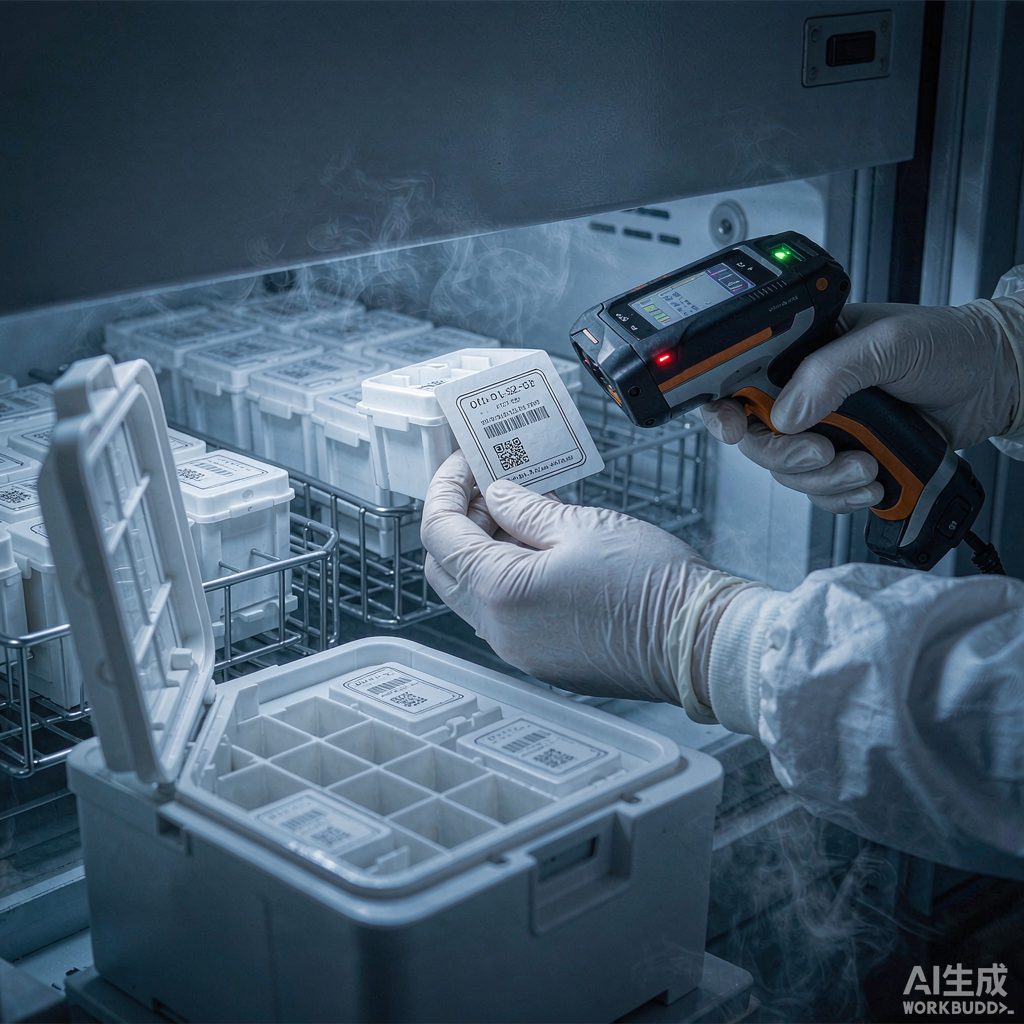
Laboratory freezers (-20 °C / -40 °C / -80 °C / -150 °C) carry traceability responsibility for three major asset categories: ① biobank cryovials (DNA/RNA/plasma/tissue/cells), ② diagnostic reagent kits (chemiluminescence/PCR/immunology), ③ reference standards/quality controls. Clause 7.10 of ISO 20387:2018, "Biobanking — General requirements for biological resource centers," explicitly requires that the entire sample storage process be "identifiable, traceable, and reproducible"; clause 7.5.1 of ISO 15189:2022, "Medical laboratories — Requirements for quality and competence," requires "uniqueness of identification" for pre-examination samples. Although the two standards come from different disciplines, both list "physical location coding within the freezer" as a mandatory item.
Real-world pain points: ① If a -80 °C freezer relies only on manual verbal records of "which shelf, which slot," every person describes the location differently when retrieving samples; ② During sample traceability audits, CNAS assessors require locating any single vial within 30 seconds, which paper ledgers cannot satisfy; ③ Cryovials stored long-term at -80 °C experience batch label detachment, and because no "freezer-level backup location" exists, an entire box of samples becomes unrecoverable. The core solution to these three scenarios is the same — make the freezer itself a scannable, searchable asset, with a unique code for every door / every shelf / every drawer / every box position.
The design origin of the BRD 博锐迪 BRD-Lab series cryogenic labels is to treat freezer zoning as "cold-chain GIS coordinates": taking a typical -80 °C ultra-low temperature freezer (5 shelves × 8 drawers × 9 boxes = 360 physical positions) as an example, combined with GA International LabTag series cryogenic labels, any single vial can be located to a specific box position within 3 seconds on a single PDA.
2. Cold-chain temperature gradient: three typical scenarios at -20/-40/-80 °C
The cold-chain gradient of laboratory freezers is not "the colder the better." The three temperature tiers correspond to different asset categories and compliance requirements; choosing the wrong temperature range directly causes sample inactivation or reagent waste:
- -20 °C freezer: for ELISA kits, PCR master mixes, DNA working solutions, short-term serum specimens (<90 days). Compliance corresponds to clause 7.5.1 of ISO 15189:2022. Temperature drift range -18 °C to -25 °C; standard in most clinical laboratories.
- -40 °C freezer: for tissue sections (after OCT embedding), transfer of certain viral samples, and storage of chemiluminescence reagents. Temperature drift -38 °C to -45 °C. This is the transitional tier for clinical-to-research translation scenarios.
- -80 °C ultra-low temperature (ULT) freezer: for cell lines, RNA, tissue blocks, long-term serum/plasma, plasmids, and microbial strains. Temperature drift -75 °C to -86 °C; core equipment of a biobank. Clause 7.11 of ISO 20387:2018 requires biobanks to establish temperature monitoring and alarm SOPs for ULT equipment.
- -150 °C liquid nitrogen vapor cryogenic freezer: for stem cells, immune cells, ovarian tissue, and long-term biobank archiving. Temperature drift -135 °C to -196 °C. This is the P0 highest-tier cold chain.
The BRD 博锐迪 BRD-Lab cryogenic label series is designed by temperature tier: BRD-Lab -20 is suitable for the -20 °C/-40 °C standard low-temperature tier, and BRD-Lab CryoStuck is suitable for the -80 °C/-150 °C/-196 °C deep cryogenic tier (compatible with the GA International CryoSTUCK series). For freezer zoning signs, the BRD-Lab Plastic polyester series (temperature range -40 °C to 150 °C) is sufficient; zoning signs are "static asset labels" that do not contact the vial wall, so material requirements are lower than those for specimen labels.
3. Four-level coding system: naming and barcode design for bank–zone–rack–box
The core of freezer zoning is not physically "arranging things neatly," but ensuring every level of physical container has a unique code. The four-level "bank–zone–rack–box" coding structure recommended by BRD 博锐迪 is as follows (example based on a single -80 °C ULT freezer):
| Level | Object | Code length | Naming example | Barcode symbology | Label material |
|---|---|---|---|---|---|
| L1 Bank | Entire freezer | 2 digits | U01 (ULT No. 1) | Code 128 + text | BRD-Lab Plastic 100 × 60 mm |
| L2 Zone | Freezer door / drawer zone | 1 digit | U01-D1 (U01, drawer 1) | Code 128 | BRD-Lab Plastic 80 × 40 mm |
| L3 Rack | Inner shelf / divider in drawer | 1 digit | U01-D1-S2 (D1, shelf 2) | Code 128 | BRD-Lab Plastic 60 × 30 mm |
| L4 Box | Cryobox / sample box on shelf | 2 digits | U01-D1-S2-B03 (box 3 on shelf) | DataMatrix + text | BRD-Lab CryoStuck 40 × 25 mm |
A complete physical position code such as U01-D1-S2-B03-P05 (U01 = ULT No. 1, D1 = drawer 1, S2 = shelf 2, B03 = cryobox 3, P05 = vial 5 in the box) can be mapped one-to-one with sample IDs in a LIMS data table. This "five-segment code + LIMS binding" method is recommended in Appendix B of CNAS-GL039:2021, "Guidelines for Biobank Accreditation," as a traceability coding example.
Barcode symbology selection follows the dual constraints of "read distance + information density": L1–L3 freezer zones use Code 128 (linear) for fast PDA positioning at 30–100 cm; L4 cryoboxes use DataMatrix (2D) to pack multi-field information — sample ID + storage date + project code + responsible person — into an extremely small area of 6 × 6 mm. BRD 博锐迪 BRD-Lab cryogenic labels are recommended by default for printing on the Brady BBP12 (300 dpi thermal transfer) or i5100 (300 dpi industrial printer), with print precision meeting the ISO/IEC 15415 2D barcode grade C/3.0/0.0 requirement.
4. Compliance requirements of ISO 20387:2018 and ISO 15189:2022 for freezer zoning
The two international standards place different compliance emphases on freezer zoning, but both stress dual traceability of "physical location + electronic record":
| Standard | Clause | Freezer zoning requirement | Implementation action |
|---|---|---|---|
| ISO 20387:2018 | 7.10 Identification and traceability | Samples must have unique identification throughout collection, transport, processing, and storage | Cryobox labels must include project code + storage date + responsible researcher |
| ISO 20387:2018 | 7.11 Facility and environmental control | Ultra-low temperature equipment must have temperature monitoring and alarm records | Built-in temperature data logger + daily manual inspection |
| ISO 15189:2022 | 7.5.1 Pre-examination samples | Sample identification must be unique and include collection time | LIMS enforces binding of the collection time field |
| ISO 15189:2022 | 7.5.2 Identification stability | Labels must not detach / fade / become unreadable during the storage period | BRD-Lab CryoStuck series withstands -196 °C ≥50 freeze–thaw cycles |
| ISO 17025:2017 | 7.5 Reference materials and reagents | Reagent identification must include lot number / expiry date / safety information | Reagent bottle labels must print GHS simplified version + lot number + expiry date |
| ISO/IEC 15416 | Linear barcode quality | Minimum grade C/3.0/0.0 | Thermal transfer printing + periodic barcode grade verifier spot checks |
Implementation difficulty: clause 7.5.2 "identification stability" of ISO 15189:2022 is the item most easily flagged by assessors — stickers on cryoboxes in many laboratories curl at the edges and fade after six months at -80 °C. The BRD 博锐迪 BRD-Lab CryoStuck series has been tested to withstand triple testing: -196 °C × 50 freeze–thaw cycles + 30 min immersion in 50% ethanol + 30 min high-temperature autoclaving at 70 °C; 180° peel strength tested per GB/T 2792-2014 is ≥8 N/25 mm, and holding tack tested per GB/T 4851-2014 is ≥24 hours.
5. Specimen location labeling SOP: surface preparation → printing → application → verification
Labeling is not "just stick it on" — it is a standardized four-step process comprising surface cleanliness, printing parameters, application technique, and barcode verification. BRD 博锐迪 summarizes the four-step SOP based on years of implementation experience serving GA International/Brady customers:
| Step | Action | Key parameters | Common errors |
|---|---|---|---|
| 1 Surface preparation | Wipe cryobox / vial wall with isopropanol (70%) | Evaporation time ≥60 s | Residual grease causes adhesive failure |
| 2 Printing parameters | Set BBP12/i5100 to 300 dpi thermal transfer + resin ribbon | Print speed 2–4 ips, temperature +15 °C | Wax-based ribbon selected → detaches after six months at -80 °C |
| 3 Application technique | Press evenly from one end of the label, expel air bubbles | Press ≥5 s, pressure ≥20 kPa | Edge curling and blistering, moisture ingress |
| 4 Barcode verification | Spot check ≥10% with an ISO/IEC 15416 grade verifier | Minimum C/3.0/0.0 | Visual inspection only, missing subtle ink voids |
Empirical data: laboratories that strictly follow the four-step SOP achieve a label survival rate ≥99% after 24 months at -80 °C; laboratories that do not (e.g., skipping surface preparation) can see edge curling rates of 30%–40% after six months. The BRD 博锐迪 BRD-Lab CryoStuck series offers an integrated "print–apply–verify" solution; labels ship with ISO/IEC 15416 grade B/3.5/0.5, one tier above the industry minimum requirement.
Recommended labeling tools: ① for surface preparation, BRD-Lab IPA-Wipe (isopropanol pre-moistened wipes, individually packaged to avoid contamination); ② for printing, BBP12/i5100 + BRD BRL series resin ribbon (resistant to -80 °C to -196 °C); ③ for application, BRD-Lab Squeegee silicone scraper (prevents fingernail scratches on labels); ④ for verification, RJS D4000/Regulus barcode grade verifier (supports both Code 128 + DataMatrix).
6. Selection of low-temperature-resistant adhesives and thermal-transfer ribbons
Although freezer zoning labels and specimen location labels are both "labels," the material selection logic is entirely different. The dual-layer selection principle of "static zoning labels vs. dynamic specimen labels" recommended by BRD 博锐迪:
- Freezer / drawer / shelf (L1–L3 static zoning labels): the BRD-Lab Plastic polyester series is sufficient. This layer does not contact specimens and is applied only to the freezer exterior or drawer sides; a temperature resistance of -40 °C to 80 °C is sufficient, with no freeze–thaw cycle requirement.
- Cryobox (L4 dynamic specimen labels): the BRD-Lab CryoStuck series must be used, with the same formulation as GA International CryoSTUCK, temperature range -196 °C to 121 °C, and ≥50 freeze–thaw cycles.
Thermal-transfer ribbon selection is directly related to the print medium temperature. The BRD 博锐迪 BRL series ribbons come in three tiers:
- BRL-Wax (wax-based): suitable for short-term printing at -20 °C, storage life ≤6 months, lowest price.
- BRL-WaxResin (wax/resin mixed): suitable for medium- to long-term at -40 °C/-80 °C, storage life 12–24 months, high cost-effectiveness.
- BRL-Resin (resin-based): suitable for deep cryogenic -150 °C/-196 °C, storage life ≥36 months, BRD's recommended P0 default selection.
The cost of choosing the wrong ribbon: in 2009, a biobank used wax-based ribbon to print cryobox labels; after eight months at -80 °C, the detachment rate reached 62%, the entire box of samples became unrecoverable, and the bank had to be rebuilt. This case is an industry benchmark lesson. The BRD-Lab CryoStuck + BRL-Resin combination has been tested to remain attached for 36 months at -80 °C and is currently the most reliable industrial-grade solution.
7. Inventory and traceability: barcode scanning / RFID / PDA implementation
The last mile of freezer zoning is "routine inventory and exception alarms." BRD 博锐迪 recommends a three-part combination of "barcode location + RFID batch inventory + PDA mobile operation":
- Barcode location (routine retrieval): use a PDA (e.g., Zebra TC57) to scan the DataMatrix on the cryobox; the PDA automatically displays the box at U01-D1-S2, with an expected retrieval time ≤3 seconds.
- RFID batch inventory (quarterly/annual inventory): affix GA International CryoSTUCK RFID labels (HF 13.56 MHz, compliant with ISO 15693 / ISO 18000-3) to the bottom of cryoboxes; an RFID handheld reader can count all box positions in an entire freezer within 30 seconds, improving inventory efficiency by more than 50× over manual counting.
- PDA mobile operation (exception alarms): during a temperature excursion or power failure, the PDA pushes alarms to the mobile phones of all sample responsible persons; meanwhile, the freezer's built-in temperature data logger retains ≥5 years of temperature curves for audit per ISO 20387:2018 clause 7.11.
The BRD 博锐迪 BRD-Lab RFID series cryogenic labels withstand -196 °C and use the same adhesive formulation as CryoSTUCK, supporting both barcode scanning and RFID protocols — currently the most economical "progressive RFID upgrade" solution, retaining existing barcode scanning compatibility while enabling seamless upgrade to batch inventory.
Featured Products
For the label materials and application scenarios covered in this article, the following 博锐迪 (BRD) products are available for selection reference (click to view specifications and request a quote):
- MACH4S laboratory equipment liquid nitrogen cryovial microscope slide biobank cryogenic LN₂ label printer (Request a Quote)
- EOS2/3 biobank label printer for medical laboratories, cryogenic LN₂ cryovials, conical tubes, microcentrifuge tubes (Request a Quote)
- BBP12 Brady laboratory research institution medical biobank cryogenic LN₂ label printer (Request a Quote)
- Lab162-629/40x20 biobank cryovial -196 °C LN₂ nylon cryogenic label biobank 18015583218 (¥999/roll)
FAQ
Q1: What material should be used for -80 °C freezer zoning signs? Will condensation damage them?
A: L1–L3 zoning signs can use the BRD-Lab Plastic polyester series, with an operating temperature of -40 °C to 150 °C and IP65 moisture protection rating. Condensation typically appears at the moment the door is opened; zoning signs are applied to the freezer exterior or the side of a pulled-out drawer, and condensation evaporates within 30 seconds without affecting the adhesive. If labels must be applied to the inner walls of a ULT freezer, the BRD-Lab CryoStuck series is required to withstand long-term -80 °C contact.
Q2: The DataMatrix on cryobox labels is too small for the scanner to read. What should I do?
A: The recommended minimum print size for DataMatrix is 6 mm × 6 mm, with 300 dpi print precision, thermal transfer + resin ribbon. If the scanner still cannot read it, troubleshoot in three steps: ① spot check with an ISO/IEC 15415 grade verifier; contrast ≥70%, modulation ratio ≥0.7; ② check whether the wrong ribbon was selected (wax-based degrades rapidly at low temperatures); ③ check whether the cryobox curvature is too steep (for diameter <12 mm, switch to CryoSTUCK flexible film labels). BRD-Lab CryoStuck guarantees DataMatrix grade B/3.5/0.5 at -196 °C, far above the ISO 15415 minimum of C/3.0/0.0.
Q3: Can freezer zoning labels and specimen location labels share a single label?
A: Not recommended. There are three reasons: ① zoning labels are "static assets" that do not change when a freezer is replaced; specimen location labels are "dynamic assets" updated with every box change; ② material requirements differ — Plastic for zoning (resistant to -40 °C), CryoStuck for specimens (resistant to -196 °C); ③ clause 7.5.1 of ISO 15189:2022 requires specimen identification to be unique, whereas zoning labels can be reused; sharing would break uniqueness. It is recommended to use Plastic signs for L1–L3 zoning applied to the freezer, and CryoStuck data labels for L4 cryoboxes applied to the box surface — two independent sets bound through the LIMS.
Q4: What are the mandatory inspection items for freezer zoning in CNAS assessment?
A: In the CNAS-GL039:2021 and ISO 20387:2018 assessment checklists, there are five mandatory items related to freezer zoning: ① freezer list (equipment number + purchase date + calibration certificate); ② temperature monitoring records (daily manual inspection + temperature data logger data); ③ documentation of the physical location coding system within the freezer; ④ label barcode quality spot-check records (at least 10% quarterly per ISO/IEC 15416); ⑤ specimen location SOP documents + responsible personnel training records. BRD 博锐迪 can provide a complete compliance document package, including label material test reports, barcode grade verification SOPs, and PDA inventory work instructions.
Q5: With a limited laboratory budget, should I do freezer zoning first or specimen labels first?
A: A three-phase approach is recommended — Phase 1 (1 month): first apply L1–L2 freezer zoning signs, at a cost of about ¥50 per freezer, only ¥500 for 10 freezers, with the highest ROI; Phase 2 (3 months): apply L4 DataMatrix labels to cryoboxes of high-frequency sample types prone to errors (cell lines/plasmids/serum), printed on demand and billed per roll; Phase 3 (6–12 months): introduce RFID for quarterly inventory. The BRD 博锐迪 BRD-Lab Plastic + CryoStuck + BRL-Resin three-part combination is currently the optimal ROI solution.
Q6: Will the five-segment code U01-D1-S2-B03-P05 be considered "over-engineering" by CNAS assessors?
A: No. Appendix B of CNAS-GL039:2021 recommends exactly the five-segment code and explicitly states that "the more segments, the better for precise specimen location." If an assessor raises a question, the counter-argument is: if a sample has a 20% drift rate, meaning the physical location is inaccurate, the five-segment code can pinpoint vial 5 at P05 within 5 seconds; no code or a three-segment code would require searching box by box, taking 30 minutes or more in the worst case — a delay that clinical sample timeliness cannot tolerate. BRD 博锐迪's engineering experience is that "the five-segment code is currently the industry's most economical scalable coding" — future additions of L6 (e.g., project code) or L0 (e.g., hospital code) require no restructuring.