
The ribbon is the other half of a cryogenic label: the label stays on, but the text is gone
BradyLAB BRD Cryogenic Label Product Matrix Quick Reference
| Series | Typical Material | Temperature Range | Typical Applications | Specifications / Printing Method |
|---|---|---|---|---|
| T629 | Nylon cloth | -196 °C to +121 °C | LN₂ cryovials, cell freezing bags, deep cryogenic specimens | Thermal-transfer printing / 6 mm–50 mm width |
| T509 | Vinyl | -196 °C to +100 °C | ULT freezer specimens, microplates, microscope slides | Thermal-transfer printing / wrap-around |
| T449 | Polypropylene (PP) | -80 °C to +120 °C | Microcentrifuge tubes, cryovials, PCR plates | Thermal-transfer printing / roll continuous |
| T249 | Polyolefin | -40 °C to +80 °C | Ambient/refrigerated specimens, QR code traceability | Thermal transfer / laser printing |
| T189 | Synthetic paper | -20 °C to +60 °C | Reagent bottles, document and archive management | Thermal transfer / inkjet printing |
| T109 | Vinyl | -20 °C to +80 °C | Equipment identification, instrument labeling | Thermal transfer / full-sheet A4 |
Data source: BradyLAB BRD laboratory cryogenic identification product specifications · Temperature ranges are typical laboratory test values; please verify according to your specific application.
Among labeling failures in biobanks and laboratories, one scenario is the most frustrating: the label adheres firmly, the adhesive is fine, the face stock hasn't embrittled, but when you take out the cryovial, the barcode and text on it are smeared beyond recognition and the scanner cannot read them no matter what. What went wrong? Nine times out of ten, the wrong ribbon was selected.
The "text" in thermal-transfer printing is not printed on—it is transferred onto the label face stock by the printhead heating the coating on the ribbon. In other words, label durability is determined jointly by "face stock + ribbon"—the face stock governs "whether it stays attached," and the ribbon governs "whether the text survives freezing and withstands solvents." If you focus only on face stock and adhesive for cryogenic labels while ignoring the ribbon, it is like fitting a leaky lid on a thermos.
In serving biobanks, pathology departments, and IVD manufacturers, BradyLAB BRD has found that over 60% of cryogenic label text failure cases are directly related to ribbon type mismatch, and these problems can almost all be avoided at the selection stage.
Three ribbon types explained at once: wax, wax/resin, and resin
Thermal-transfer ribbons are divided into three major categories by coating resin content, with performance and price increasing in that order. Wax ribbons use wax as the primary coating component, with a low melting point, low printhead wear, and the lowest cost—suitable for everyday labels on paper-based face stocks such as coated paper; wax/resin ribbons mix some resin into the wax, significantly improving abrasion and scratch resistance—suitable for synthetic paper face stocks; resin ribbons use synthetic resin as the main coating body, offering the strongest solvent resistance, high-temperature resistance, and low-temperature resistance—the only ribbon type that can go into -80 °C freezers and -196 °C liquid nitrogen.
The most direct way to determine a ribbon's type is to check the packaging label or consult the supplier, not to judge by appearance—the black appearance of all three ribbon types is nearly identical and cannot be distinguished by eye. If a laboratory uses multiple ribbon types, it is recommended to note the type on a label attached to the ribbon spool to avoid picking up the wrong one.
Why cryogenic labels can only use resin-based ribbons
Wax and wax/resin ribbons perform acceptably at ambient temperature, but their true nature is exposed in low-temperature environments. The wax coating of wax ribbons begins to embrittle at around -20 °C; during freeze–thaw cycles, the difference in thermal expansion coefficients between the coating and the face stock is amplified, fine cracks appear in the text area, barcode edges become dull, and after a few freeze–thaw cycles the barcode becomes unreadable. At -196 °C in liquid nitrogen, the wax coating directly powders and flakes off, and the printed content disappears completely.
Resin-based ribbons are completely different. The resin coating maintains a stable molecular structure at -196 °C, its adhesion to PET face stock does not change with temperature, and the text remains clear and sharp after liquid nitrogen immersion. BradyLAB BRD test data: a resin ribbon + cryogenic label combination, in cyclic testing of -196 °C liquid nitrogen immersion, rewarming to room temperature, and re-immersion in liquid nitrogen, maintained a barcode grade of ANSI Grade B or above after 50 cycles; whereas wax ribbons under the same conditions showed extensive blurring of text after the first immersion.
Another easily overlooked dimension is solvents. In laboratory settings, cryovials taken out of liquid nitrogen are wiped with 75% alcohol for disinfection, and DMSO, xylene, and isopropanol are also common in specimen processing workflows. Wax coatings dissolve on contact with alcohol, and the text smears with a single wipe; resin coatings cure into a crosslinked network that conventional solvents cannot dissolve. This is why all professional cryogenic label manufacturers recommend only resin-based ribbons—not because they are "more expensive and therefore better," but because "nothing else can hold up."
Key parameters of resin ribbons: temperature range, solvent resistance, and printhead energy
When selecting resin-based ribbons, focus on three sets of parameters. The first is temperature range. A qualified cryogenic ribbon should have a rated operating temperature covering -196 °C to +100 °C or above, able to enter liquid nitrogen as well as withstand water bath thawing and high-temperature baking steps. The second is solvent resistance rating. The product specification sheet should clearly state resistance data for ethanol, isopropanol, DMSO, xylene, and other reagents, preferably with third-party immersion test reports, rather than just a statement of "chemical resistant."
The third is printhead energy requirements, the most easily overlooked engineering parameter. The melting point of resin coatings is significantly higher than that of wax, requiring higher printhead heating energy for complete transfer. The recommended printing energy for typical resin-based ribbons is above 8 mJ/mm²; if the printer's heating parameters are not adjusted for resin ribbons, incomplete coating transfer and faint text will result—this is not a ribbon quality issue but a device calibration issue.
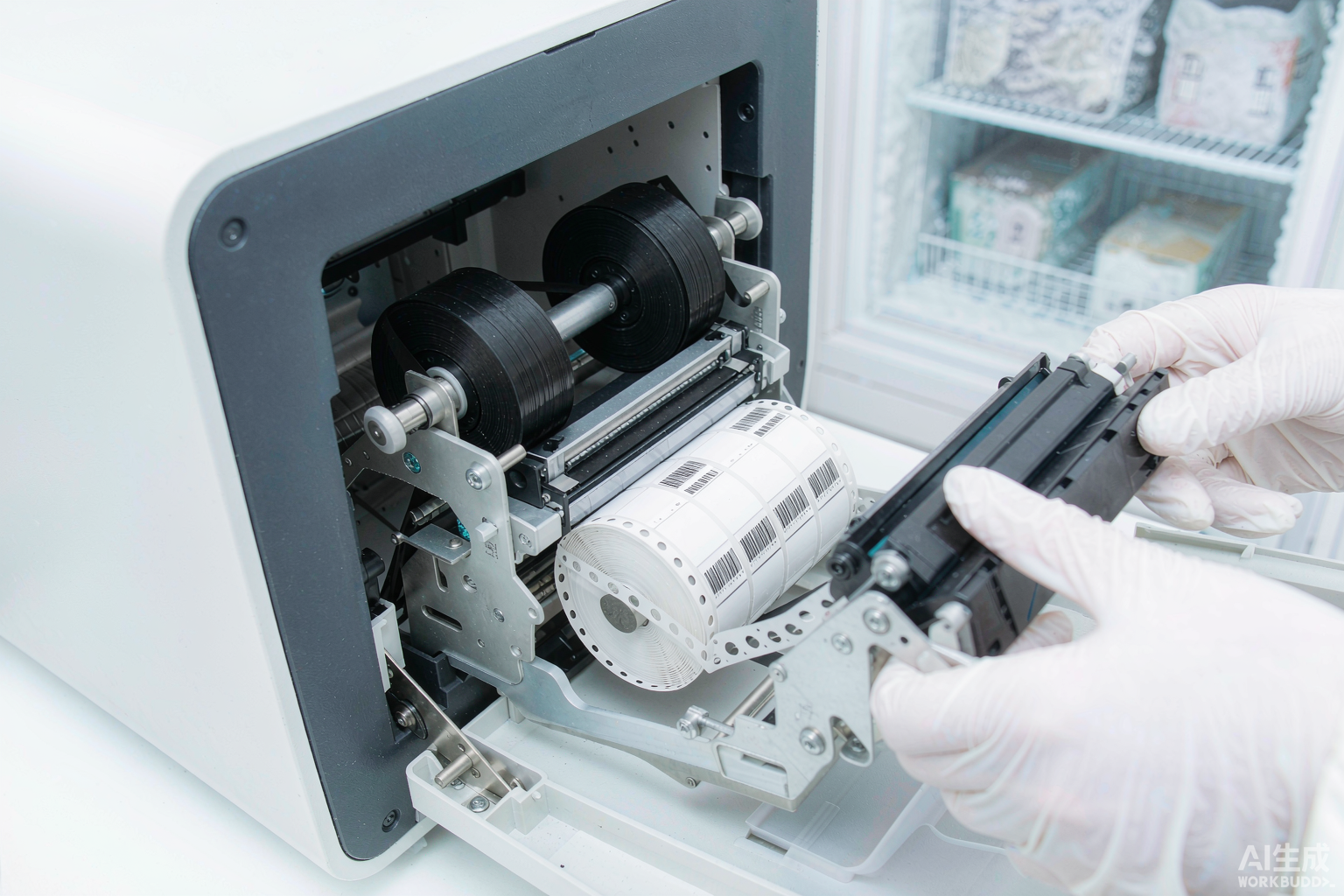
Matching ribbons to face stocks: what to pair with PET, synthetic paper, and self-laminating
A ribbon is not a universal key; it must match the label face stock to be effective. PET (polyester) face stock is the mainstay of cryogenic labels, with a dense, smooth surface that requires a resin-based ribbon—wax ribbons have extremely low adhesion on PET and fall off at a touch after printing; synthetic paper face stock has a coated ink-absorbing layer on the surface and is compatible with resin-based and wax/resin ribbons; if it needs to go into environments below -80 °C, resin-based is still recommended; the print layer of self-laminating labels is protected by a transparent laminate, so the scratch resistance requirement for the ribbon is slightly lower, but in cryogenic scenarios the text itself still needs resin coating support.
A practical matching rule: the denser the face stock, the lower the operating temperature, and the more frequent the solvent contact, the more "resin" the ribbon must be. BradyLAB BRD's cryogenic label product line is designed throughout for use with resin-based ribbons; customers only need to state their printer model to receive corresponding ribbon specifications and printing parameter recommendations, avoiding the common pitfall of "buying labels only to have the entire batch scrapped due to ribbon mismatch."
Selecting ribbons by temperature band: -20 °C, -80 °C, and -196 °C tiered approach
Ribbon selection for cryogenic scenarios can be tiered by temperature band to avoid both over-configuration and under-configuration. For -20 °C cold-chain transport and short-term storage, wax/resin ribbons meet text durability requirements at lower cost; for long-term storage in -80 °C ULT freezers, upgrading to resin-based ribbons is essential to ensure barcodes remain readable after repeated freeze–thaw cycles; for -196 °C liquid nitrogen liquid-phase or gas-phase storage, resin-based ribbons are the only option, and it is recommended to simultaneously verify the liquid nitrogen-grade validation reports for face stock and adhesive—only when all three are matched is the solution complete.
BradyLAB BRD recommends that laboratories validate "label + ribbon + printer" as a whole: conduct a small-batch freeze–thaw test using the actual temperature environment to be used for storage, observe text clarity and barcode readability, and then decide on bulk purchasing. This validation process is extremely low-cost but can expose most compatibility issues in advance.
BradyLAB BRD BRL cryogenic ribbons: BRL-80-B09 and BRL-110-13
For laboratory cryogenic identification scenarios, BradyLAB BRD offers the BRL series cryogenic ribbons, using a pure resin-based coating formulation, with a temperature range covering -196 °C to +110 °C, resistance to ethanol, isopropanol, and DMSO wiping, and compatible with the full BRD cryogenic label range (T629 liquid nitrogen labels, T429/T419 freezer labels, T329/T319 refrigerated labels, TRF cryogenic RFID labels) for stable output. Two standard specifications are currently available: BRL-80-B09 (80 mm width × 300 m/roll) for desktop thermal-transfer printers, and BRL-110-13 (110 mm width × 300 m/roll) for wide-format models and batch printing scenarios.
The principle for choosing width is simple: the ribbon width must be no less than the label width and no greater than the printer's maximum ribbon spool width. The 80 mm specification covers the format requirements of mainstream cryovial labels and microplate labels; the 110 mm specification suits batch scenarios requiring parallel multi-column printing, such as microscope slides and pathology embedding cassettes; a 300 m roll length combined with cost-effective pricing suits laboratories with large sample volumes and IVD production lines.
Print parameter settings: 300 dpi is the minimum threshold for cryogenic labels
With the right ribbon selected, print parameters must also keep up. Regarding resolution, cryogenic labels are recommended to start at 300 dpi—barcode module edges printed at 203 dpi are more prone to dulling after freeze–thaw cycles, and the scan rate decays significantly with storage time; 300 dpi barcode edges are sharper, with more contrast margin after freeze–thaw. For scenarios requiring QR codes or high-density Data Matrix codes on narrow labels, 600 dpi models can be considered.
Recommended print darkness and speed: set darkness at the device's mid-range or above, and reduce speed from 4 ips to 2 ips to allow full transfer of the ribbon coating, improving text durability by approximately 30%. Control the printing environment at 18–25 °C and 40%–60% relative humidity to avoid ribbon coating blocking at high temperature and humidity or incomplete transfer in low-temperature environments. After printing, it is recommended to let labels rest for 1–2 minutes before application to allow the coating to cool and cure.
Recommended Products
For the label materials and application scenarios covered in this article, the following BradyLAB (BRD) products are available for selection reference (click to view specifications and request a quote):
- Lab296-629 biobank cryovial microscope slide -196 °C liquid nitrogen nylon cryogenic label (¥999/roll)
- Lab208-509/25.4x63.5 wrap-around cryovial biobank microtube liquid nitrogen classification label (Price on request)
- Lab032-429/30X20mm biobank cryovial microscope slide PET polyester label cryogenic adhesive (Price on request)
- Lab307-419/32x18 biobank cryovial microscope slide gloss white biobank cryogenic label BRD BradyLAB (Price on request)
FAQ: Common questions about cryogenic ribbons
Must cryogenic labels use resin-based ribbons? It depends on the scenario. For short-term use at -20 °C, wax/resin ribbons are sufficient; for -80 °C and below (especially liquid nitrogen), resin-based ribbons are required. The criterion is not "expensive or not" but the lowest temperature the label will experience and the frequency of solvent contact.
What happens to wax ribbons in liquid nitrogen? The wax coating embrittles and powders at low temperature, and the text and barcode become extensively blurred or even disappear after the first freeze–thaw. Using wax ribbons on liquid nitrogen labels is as good as not printing at all.
Can resin ribbons be used on ordinary paper labels? Yes, but the cost is relatively high and the printhead energy requirement is also high—this is a waste of performance. Paper-based face stocks such as coated paper only need wax or wax/resin ribbons.
How can I tell whether the ribbon I have is resin-based? Check the packaging label or consult the supplier; do not judge by appearance. Laboratories that use multiple ribbon types are advised to attach a label to the ribbon spool to distinguish the type.
Which printers are compatible with BRL cryogenic ribbons? BRL-80-B09 and BRL-110-13 are standard 1-inch core ribbons, compatible with mainstream thermal-transfer printers on the market. BradyLAB BRD can provide printing parameter tuning recommendations and free sample testing; you are welcome to consult for selection.
Related Compliance Standards
For cryogenic label ribbon selection, barcode print quality is referenced to ISO/IEC 15416, and label durability meets the specimen identification requirements of ISO 20387:2018.