
Why Microplate Labels Need Their Own Standards Discussion
BradyLAB BRD Cryogenic Label Product Matrix Quick Reference
| Series | Typical Material | Temperature Range | Typical Applications | Specifications / Printing Method |
|---|---|---|---|---|
| T629 | Nylon cloth | -196 °C to +121 °C | LN₂ cryovials, cell freezing bags, deep cryogenic specimens | Thermal-transfer printing / 6 mm–50 mm width |
| T509 | Vinyl | -196 °C to +100 °C | ULT freezer specimens, microplates, microscope slides | Thermal-transfer printing / wrap-around conformability |
| T449 | Polypropylene (PP) | -80 °C to +120 °C | Microcentrifuge tubes, cryovials, PCR plates | Thermal-transfer printing / roll continuous feed |
| T249 | Polyolefin | -40 °C to +80 °C | Room-temperature/refrigerated specimens, 2D barcode traceability | Thermal-transfer / laser printing |
| T189 | Synthetic paper | -20 °C to +60 °C | Reagent bottles, document and archive management | Thermal-transfer / inkjet printing |
| T109 | Vinyl | -20 °C to +80 °C | Equipment identification, instrument labeling | Thermal-transfer / full-sheet A4 |
Data source: BradyLAB BRD laboratory cryogenic identification product specifications · Temperature ranges are typical laboratory test values; verify against actual application conditions.
Microplates are a core carrier for life sciences, drug discovery, and IVD reagent testing, with common formats covering 6-, 12-, 24-, 48-, 96-, 384-, and 1536-well plates, of which the 96-well format is the most widely used standard. The plate body itself has well-established dimensional specifications: in 2003 the American National Standards Institute (ANSI) published specifications defining a plate footprint of 127.76 mm × 85.48 mm and well structure parameters, a system later unified as the ANSI/SLAS standard.
Labels, however, are often treated as an afterthought consumable. In reality, microplate labels have a small surface area, densely packed wells, and limited skirt and side-lip areas available for adhesion; if the dimensions, adhesive, or temperature resistance are wrong, labels can obscure wells, interfere with barcode scanning, or even contaminate specimens. While serving biobanks and IVD customers, the BradyLAB BRD technical team found that most label problems are not about "expensive or cheap" but about parameters not aligned with the use scenario.
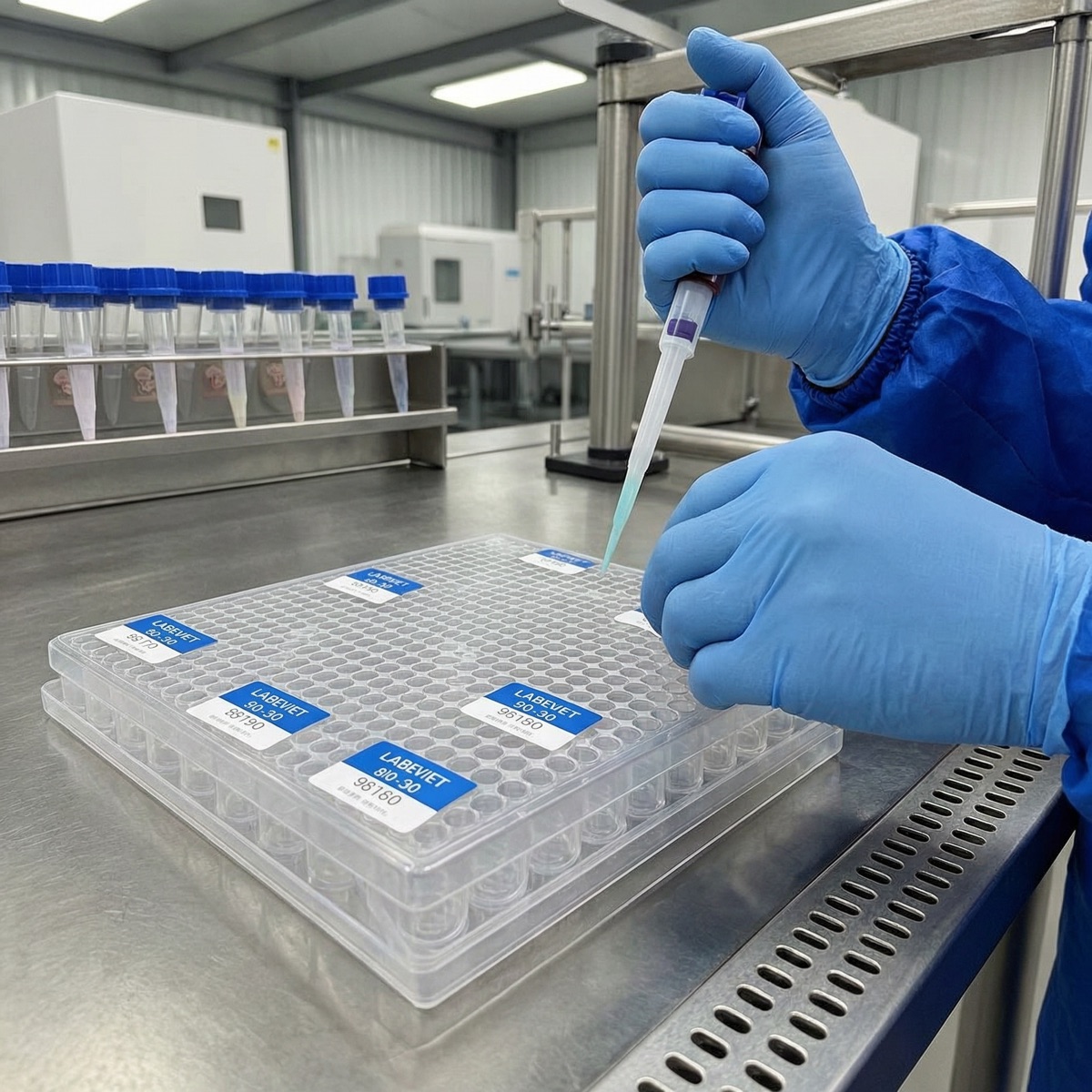
Understanding the ANSI/SLAS series standards is the first step to understanding the dimensional boundaries of microplate labels. ANSI/SLAS 1-2004 defines the plate footprint, 2-2004 defines height, 4-2004 defines well positions, and 6-2012 defines well-bottom elevation. Labels can only be applied to plate edges, skirts, or top lips—positions that do not interfere with the detection light path—and dimensions must follow the plate body.
What Each of the Five ANSI/SLAS Standards Covers
The SLAS (Society for Laboratory Automation and Screening) maintains a total of five microplate standards: ANSI/SLAS 1-2004 footprint dimensions, 2-2004 height dimensions, 3-2004 bottom outside flange dimensions, 4-2004 well positions, and 6-2012 well-bottom elevation. These five standards provide a unified foundation for automated instruments and high-throughput screening systems, and are also the prerequisite for labels to "fit on and not block wells."
From a labeling perspective, the most critical are 3-2004 bottom outside flange dimensions and 1-2004 footprint dimensions. Full-skirt, half-skirt, and no-skirt plate types leave completely different usable widths for labels, so before selecting a label you must first confirm which category your plate belongs to. BradyLAB BRD's selection advice is to measure the plate body first, then determine label width—not the other way around.
The Higher the Well Density, the Tighter the Labelable Area
A 96-well plate has a maximum well volume of approximately 300 µL, a 384-well plate approximately 100 µL, and a 1536-well plate approximately 15 µL. The higher the well density, the narrower the well spacing, the tighter the side-lip and skirt area available for labels, and the higher the requirements for barcode contrast and precision.
On high-density plates such as 384- and 1536-well formats, a label that deviates by just 0.5 mm can obscure edge wells, causing pipetting or detection errors. BradyLAB BRD recommends narrow-width, high-precision die-cut thermal-transfer labels for high-density plates, and verifying well alignment with a sample proof before running on the instrument, reducing the risk of "one misaligned label ruining a whole plate."
Temperature Range Determines Whether a Label Can Follow the Plate Through the Entire Process
Microplates span a wide temperature range in use: PCR thermal cycling repeatedly ramps up and down near 95 °C, routine storage is 4 °C refrigeration, long-term cryopreservation is in -20 °C, -40 °C, or -80 °C freezers, and LN₂ is -196 °C. For a single label to follow the plate through the entire process, its temperature range must cover all of the above.
Dedicated microplate labels on the market typically have temperature ranges from -80 °C to +110 °C or -80 °C to +72 °C, with some products covering -196 °C to +120 °C or even -196 °C to +150 °C, suitable for LN₂ vapor phase, long-term deep freezing, and mixed thermal cycling scenarios. BradyLAB BRD cryogenic labels match different face stocks and adhesives to different temperature bands, avoiding the typical failure of "withstanding heat but not freezing."
Adhesive Matching: Permanent or Removable
Microplate label adhesives fall into two categories—permanent and removable. Choosing the wrong one can cause lifting and detachment at best, or leave residue that contaminates specimens upon removal at worst. Permanent types suit specimen management requiring long-term archiving and repeated freeze–thaw cycles, while removable types suit process labels that can be peeled off once an experiment ends.
The key to adhesives in cryogenic scenarios is the glass transition temperature (Tg): ordinary pressure-sensitive adhesives harden and become brittle at low temperatures, losing tack, and labels then curl and detach. BradyLAB BRD cryogenic labels use specially formulated pressure-sensitive adhesives that remain soft and conformable in LN₂ and -80 °C environments, while also maintaining adhesion on smooth polypropylene plate surfaces and moist surfaces.
Thermal Transfer or Laser Printing: Determined by Roll Format and Platform
Microplate labels are mainly printed by thermal transfer or laser printing. Thermal transfer with resin ribbons offers solvent resistance, scratch resistance, and high barcode contrast, and is the mainstream solution for biobanks and IVD mass production; laser printing is available in sheet or roll format and suits small-batch desktop scenarios.
Choosing a printing method depends on your existing equipment platform and daily capacity. BradyLAB BRD offers roll labels compatible with mainstream barcode printers and also supports custom die-cut dimensions per customer plate type, providing one-stop service from template design and barcode format to printing parameters, reducing the time laboratories spend repeatedly adjusting equipment.
Recommended Products
For the label materials and application scenarios covered in this article, the following BradyLAB (BRD) products are available for selection reference (click to view specifications and request a quote):
- Lab162-629/40x20 Biobank Cryovial -196 °C LN₂ Nylon Cryogenic Label Biobank 18015583218(¥999/roll)
- Lab208-509/25.4x63.5 Wrap-Around Cryovial Biobank Thin Tube LN₂ Classification Label(Price on request)
- Lab127-449/60x30 Biobank Medical Device Identification Gloss White PET Biobank Label(Price on request)
FAQ: Common Questions About Microplate Labels
Can microplate labels go directly into LN₂? Yes, provided both the face stock and adhesive are designed for -196 °C scenarios and have been validated through repeated freeze–thaw cycles. Ordinary labels will crack and their adhesive will fail in LN₂; only dedicated cryogenic versions can withstand it. BradyLAB BRD LN₂ series labels have passed freeze–thaw cycle testing and maintain fully readable barcodes.
Are label dimensions the same for skirted and non-skirted plates? No. Full-skirt, half-skirt, and no-skirt plate types differ significantly in usable width; no-skirt plates have very narrow side lips and can only use narrower labels. Plate type must be confirmed before selection; BradyLAB BRD can provide custom die-cut dimensions per plate type.
Will PCR thermal cycling damage labels? Ordinary labels may blister or curl during repeated temperature ramping. Labels for PCR plates must have a temperature range covering the thermal cycling peak (commonly around +110 °C) and use temperature-resistant face stock and resin ribbons. BradyLAB BRD PCR plate labels are designed for compatibility with both thermal cycling and cryopreservation scenarios.
How is barcode scan rate ensured? The key lies in printing resolution, ribbon type, and contrast. Thermal transfer with resin ribbons produces high-contrast, sharp barcodes; at the same time, minimum barcode size must be controlled to prevent 2D codes from blurring on the narrow labels of high-density plates. BradyLAB BRD supports printing parameter calibration based on actual scanning equipment.
Key Technical Specification Points for Microplate Labels
| Specification Item | Basis / Requirement |
|---|---|
| Plate dimensions | ANSI/SLAS 1-2004 |
| Barcode quality | ISO/IEC 15416 |
| Specimen identification | ISO 20387:2018 |
| Peel strength | GB/T 2792-2014 |
From Standards to Compliance Implementation
Implementing microplate label technical specifications requires three things in place: "dimensional fit + barcode compliance + temperature validation." When label dimensions fit the plate, barcodes scan reliably, and the label withstands -196 °C LN₂ cryopreservation, specimen identification can meet the traceability requirements of ISO 20387:2018, providing compliance support for specimen management in high-throughput experiments.