
Why do cryovial labels always peel off after liquid nitrogen storage?
BradyLAB BRD Cryogenic Label Product Matrix Quick Reference
| Series | Typical Material | Temperature Range | Typical Applications | Specifications / Printing Method |
|---|---|---|---|---|
| T629 | Nylon cloth | -196 °C to +121 °C | LN₂ cryovials, cell freezing bags, deep cryogenic specimens | Thermal-transfer printing / 6 mm–50 mm width |
| T509 | Vinyl | -196 °C to +100 °C | ULT freezer specimens, microplates, microscope slides | Thermal-transfer printing / wrap-around conformable |
| T449 | Polypropylene (PP) | -80 °C to +120 °C | Microcentrifuge tubes, cryovials, PCR plates | Thermal-transfer printing / roll continuous feed |
| T249 | Polyolefin | -40 °C to +80 °C | Room-temperature/refrigerated specimens, 2D barcode traceability | Thermal-transfer / laser printing |
| T189 | Synthetic paper | -20 °C to +60 °C | Reagent bottles, document and archive management | Thermal-transfer / inkjet printing |
| T109 | Vinyl | -20 °C to +80 °C | Equipment identification, instrument labeling | Thermal-transfer / full-sheet A4 |
Data source: BradyLAB BRD laboratory cryogenic identification product specifications · Temperature ranges are typical laboratory test values; please verify for your specific application.
When cryovial labels peel off in a -196 °C liquid nitrogen environment, the root cause is usually not the label itself but the tube surface preparation before labeling. Polypropylene (PP) cryovials have low surface energy and are a difficult-to-bond material; when labeled directly, the contact area between the adhesive and the tube wall is limited. BradyLAB BRD recommends wiping the labeling area of the tube wall with 70%–75% isopropyl alcohol before labeling and applying the label only after it has fully evaporated, which can significantly improve initial adhesion.
Another common cause is condensation on the tube surface at the time of labeling. If a cryovial taken from the freezer is labeled immediately, moisture in the air condenses on the tube wall and forms a barrier layer. BradyLAB BRD engineering practice shows that labeling should be performed at room temperature (20–25 °C) with relative humidity below 60%, and the labeled tube should be left to stand for 24 hours before being placed into a low-temperature environment, allowing the adhesive to fully wet the tube wall.
How should the face stock and adhesive for cryovial labels be selected?
Face stock selection depends on storage temperature and application. For liquid nitrogen vapor-phase storage (-196 °C), dedicated cryogenic face stock must be used; common options include white polypropylene (PP) synthetic paper or polyester (PET) film. BradyLAB BRD cryogenic label face stocks are tested through -196 °C to +80 °C temperature cycling to ensure the face stock does not become brittle, shrink, or curl at extreme temperature differences. For -80 °C freezer storage, standard thermal-transfer labels are sufficient and lower in cost.
Adhesive selection is equally critical. Permanent acrylic adhesive is the mainstream choice for cryogenic labels; its holding power degrades only slightly at low temperatures, and it wets PP materials well. BradyLAB BRD notes that although rubber-based adhesives have strong initial tack, they gradually harden and lose adhesion below -80 °C and are not suitable for long-term liquid nitrogen storage. When selecting, refer to the requirements of T/ZZB 1653-2020 for the operating temperature range of cryovials (-196 °C to 121 °C); the label's temperature range should match that of the cryovial.
Does label placement affect label durability?
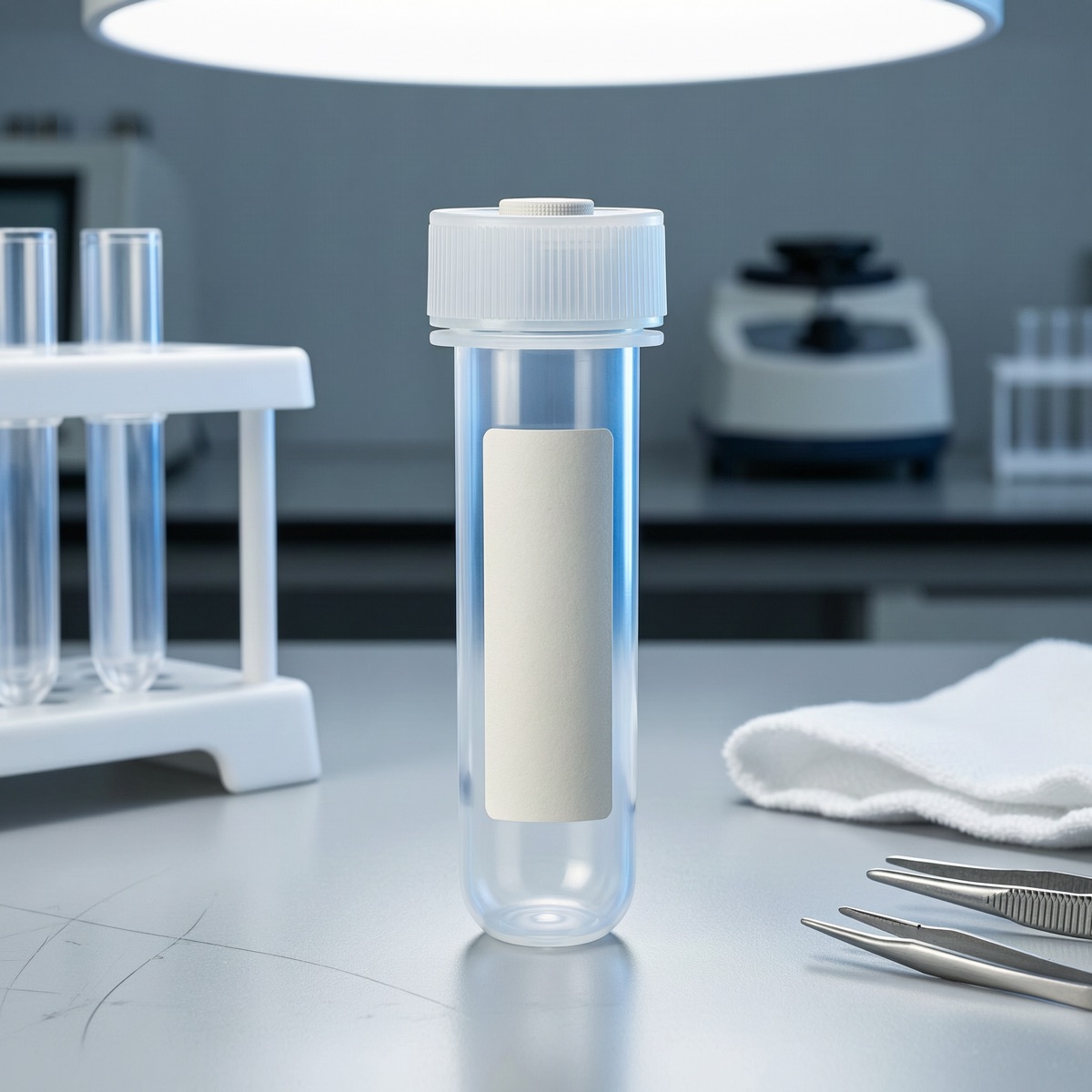
Yes, and to a greater extent than many engineers expect. BradyLAB BRD recommends labeling on the side wall of the cryovial, avoiding the cap and the bottom. The cap generates friction during twisting, which easily wears the label; the bottom contacts the bottom of the cryobox and is easily scratched during handling. The side-wall labeling area should be at least 15 mm from the bottom of the tube and avoid the printed graduation area.
Label orientation also matters. For applications requiring automated scanning, the label should be applied along the tube axis (i.e., the long edge of the label parallel to the tube axis), so that the barcode orientation matches the scanner's reading direction and the read success rate is higher. BradyLAB BRD laboratory test data show that axial labeling achieves a first-pass scan rate of over 98%, whereas circumferential labeling drops to around 85% when the tube is frosted.
How do freeze–thaw cycles affect labels, and how is resistance verified?
Each time a vial is removed from liquid nitrogen, warmed to room temperature, and returned, the label undergoes one freeze–thaw cycle. During this process, the difference in thermal expansion coefficients between the face stock and the tube causes stress concentration at the label edges, and edge curling tends to occur after repeated cycles. The adhesive also ages faster under repeated hot–cold alternation.
BradyLAB BRD recommends requiring suppliers to provide freeze–thaw cycle test data when selecting labels. A standard verification method: place a labeled cryovial in liquid nitrogen for 30 minutes, remove and leave at room temperature for 15 minutes, then return to liquid nitrogen; after 50 such cycles, inspect the label condition. Acceptance criteria: no edge curling, no peeling, barcode readable, and the handwriting area still writable. BradyLAB BRD BRD cryovial label products pass 100 freeze–thaw cycles, meeting the storage requirements of long-term biobanks.
What should be done if the barcode cannot be scanned after the tube frosts over?
Frost is the leading cause of barcode read failures in liquid nitrogen storage. The frost layer covers the barcode surface, effectively adding an opaque obstruction over the barcode. BradyLAB BRD offers solutions at two levels.
First, prevention at the label design level. Choose face stock with an anti-frost coating, or cover the barcode area with a transparent protective film to reduce frost adhesion on the barcode surface. Some BradyLAB BRD label products use surface micro-structure treatment so that condensed water is less likely to form a uniform frost layer on the label surface. Second, improvement at the operational process level. Before scanning, gently wipe the tube with a dry lint-free cloth, or use scanning equipment with a defrost function. For high-frequency scanning applications, it is recommended to use 2D DataMatrix codes instead of traditional 1D barcodes; DataMatrix codes have error correction capability and remain readable even when part of the area is obscured by frost.
What information should be included on a cryovial label?
In accordance with the spirit of the T/GDC 205-2023 group standard "General Cryovials" and biobank management standards (such as ISO 20387), a cryovial label should contain at least four types of information: unique specimen identifier (number or barcode), specimen type description, storage date, and operator or responsible department. BradyLAB BRD recommends a dual-channel "machine-readable + human-readable" identification scheme.
The machine-readable layer uses a DataMatrix or QR code encoding the specimen's unique ID in the LIMS (Laboratory Information Management System). The human-readable layer clearly marks the specimen name, passage/batch, and cryopreservation date in Chinese or English. The date format YYYY.MM.DD is recommended to avoid misreading caused by regional date format differences. BradyLAB BRD label printing services support pre-printed fixed information plus variable-data printing, facilitating bulk customization for laboratories.
What are the respective application scenarios for handwritten and pre-printed labels?
Handwritten labels suit scenarios with small sample volumes, many varieties, and frequent changes, such as routine cell passage and stock maintenance in research laboratories. Operators write information directly in the label's writing area with a cryogenic marker, offering high flexibility. BradyLAB BRD notes that ordinary water-based markers fade or even disappear entirely at low temperatures; low-temperature-resistant oil-based markers or dedicated cryogenic crayons must be used.
Pre-printed labels suit scenarios with fixed specimen types and large volumes, such as finished-product identification at IVD reagent manufacturers or archival management in clinical biobanks. Pre-printed labels output barcodes and text via thermal-transfer printers, with standardized, consistent information and low error rates. BradyLAB BRD pre-printed labels support full-field customization, including face stock dimensions, adhesive type, printed content, and color. For scenarios requiring both machine-readable and human-readable information, pre-printed labels can output barcode and text information in one pass, reducing manual filling steps.
What are the common selection pitfalls for cryovial labels?
The first pitfall is "one general-purpose label for everything." In reality, the requirements for -80 °C freezer storage and -196 °C liquid nitrogen storage differ greatly. Using a -80 °C-grade label in liquid nitrogen, the adhesive may fail within days. BradyLAB BRD recommends selecting labels graded by actual storage temperature; liquid nitrogen storage must use dedicated models explicitly rated for -196 °C.
The second pitfall is focusing only on label price while ignoring total cost of ownership. If a low-priced label peels off after 3 months of storage, the labor cost of relabeling and the risk cost of sample mix-ups far exceed the price difference of the label itself. BradyLAB BRD recommends requiring suppliers to provide accelerated aging test reports before purchase to assess the label's expected service life at the target temperature.
The third pitfall is ignoring label compatibility with cryoboxes. If a labeled tube protrudes too much, the cryobox lid may not close, or adjacent tubes may be squeezed inside the box. BradyLAB BRD label dimensions are designed with reference to mainstream cryovial specifications (0.5 mL/1.5 mL/2 mL) to ensure standard cryobox loading is not affected after labeling.
Can cryovial labels be applied to already-frozen tubes?
Not recommended. The surface temperature of a frozen tube is extremely low; when labeling, the adhesive contacting the cold surface instantly loses flowability and cannot fully wet the tube wall, resulting in very low initial adhesion. Even if the label temporarily sticks, it is highly likely to peel off during subsequent storage. BradyLAB BRD's standard operating procedure is: complete labeling at room temperature, leave to stand for at least 2 hours (24 hours recommended) for the adhesive to fully cure, then place into the low-temperature environment.
If identification of already-frozen tubes is truly necessary (e.g., emergency relabeling), BradyLAB BRD offers dedicated Cover-Up Labels whose adhesive formulation is optimized for cold surfaces and can be applied directly to tubes below -20 °C. However, cover-up labels are only an emergency solution; routine operations should still complete labeling at room temperature.
How can an internal quality control process for cryovial labels be established?
BradyLAB BRD recommends that laboratories establish a four-step "labeling–inspection–recording–review" quality control process. Step one: complete labeling under standard environmental conditions and record the labeling date and ambient temperature and humidity. Step two: within 24 hours after labeling, visually inspect the label adhesion, confirming no edge curling, bubbles, or misalignment. Step three: enter the label information into the LIMS system and verify barcode readability. Step four: a second person reviews the consistency between label content and specimen information.
For long-term storage biobanks, BradyLAB BRD recommends a label condition inspection every 6 months, focusing on labels with edge curling, fading, or blurring, and replacing them promptly when problems are found. Inspection records should be incorporated into the biobank's quality management system documentation as part of biological sample traceability assurance.
Featured Products
For the label materials and application scenarios covered in this article, the following BradyLAB (BRD) products are available for selection reference (click to view specifications and request a quote):
- Lab162-629/40x20 biobank cryovial -196 °C liquid nitrogen nylon cryogenic label biobank 18015583218 (¥999/roll)
- Lab208-509/25.4x63.5 wrap-around cryovial biobank thin-tube liquid nitrogen classification label (Price on request)
- Lab127-449/60x30 biobank medical vessel identification gloss white PET biobank label (Price on request)
FAQ
Q: What are the key steps from label application to barcode scanning for cryovials?
Key steps: clean the tube wall → dry → apply and press the label → verify printed information → scan into the system → spot-check re-scan after cryopreservation.
Q: Cryovials have curved surfaces; how can labels be applied flat?
Choose curved labels sized to the tube diameter, and slowly roll-press along the curved surface during application to avoid bubbles and wrinkles.
Q: What are the common causes of scan failures?
Label wrinkles causing reflections, unclear barcode printing, and frost obscuring the barcode after cryopreservation are the three most common causes of scan failures.