
Why do microcentrifuge tube labels need a "standard" to govern them?
BRD Cryogenic Label Product Matrix Quick Reference
| Series | Typical Material | Temperature Range | Typical Applications | Specifications / Printing Method |
|---|---|---|---|---|
| T629 | Nylon cloth | -196 °C to +121 °C | LN₂ cryovials, cell cryopreservation bags, deep cryogenic specimens | Thermal-transfer printing / 6 mm–50 mm width |
| T509 | Vinyl | -196 °C to +100 °C | ULT freezer specimens, microplates, microscope slides | Thermal-transfer printing / wrap-around |
| T449 | Polypropylene (PP) | -80 °C to +120 °C | Microcentrifuge tubes, cryovials, PCR plates | Thermal-transfer printing / roll continuous feed |
| T249 | Polyolefin | -40 °C to +80 °C | Room-temperature/refrigerated specimens, 2D barcode traceability | Thermal-transfer / laser printing |
| T189 | Synthetic paper | -20 °C to +60 °C | Reagent bottles, document archiving | Thermal-transfer / inkjet printing |
| T109 | Vinyl | -20 °C to +80 °C | Equipment identification, instrument labeling | Thermal-transfer / full-sheet A4 |
Data source: BRD laboratory cryogenic identification product specification sheet · Temperature ranges are typical laboratory test values; please verify for your specific application.
In biopharmaceutical laboratories, microcentrifuge tube labels seem like the most inconspicuous consumable—pick up a tube, apply a label, write a few lines, all in under ten seconds. But in the eyes of a CNAS assessor, those ten seconds determine whether specimen identification is compliant. In SZDB/Z 91-2014 "Specification for Construction and Management of Human Biobanks," Chapter 11 "Specimen Labels" occupies a full three pages, specifying barcode selection, label dimensions, application orientation, and chemical resistance requirements item by item. This is not making a mountain out of a molehill—when a microcentrifuge tube must be stored in a -80 °C ULT freezer for three years, undergo multiple freeze–thaw cycles, and withstand splashes of dilute hydrochloric acid or ethanol, label compliance is the safety rope for specimen traceability.
In actual service, the BRD technical team has found that a considerable proportion of laboratory identification incidents are not caused by the label material itself, but by application procedures and size selection that violate standard specifications. This article starts from the standard text and breaks down the technical compliance requirements for microcentrifuge tube labels item by item.

Dimensional requirements: label width must be less than the container wall circumference
Clause 11.3.3 of SZDB/Z 91-2014 imposes an explicit constraint on label dimensions: "The size of the label should be selected according to the size of the container, and the length of the wide side should be less than the circumference of the container wall." This rule appears simple but is repeatedly overlooked in practice. Take a 0.5 mL microcentrifuge tube, for example: tube diameter is approximately 8 mm, circumference approximately 25 mm. If a label wider than 25 mm is selected, the label will overlap itself after application, creating stress concentration points during low-temperature contraction, causing the label to lift starting from the overlapping edge.
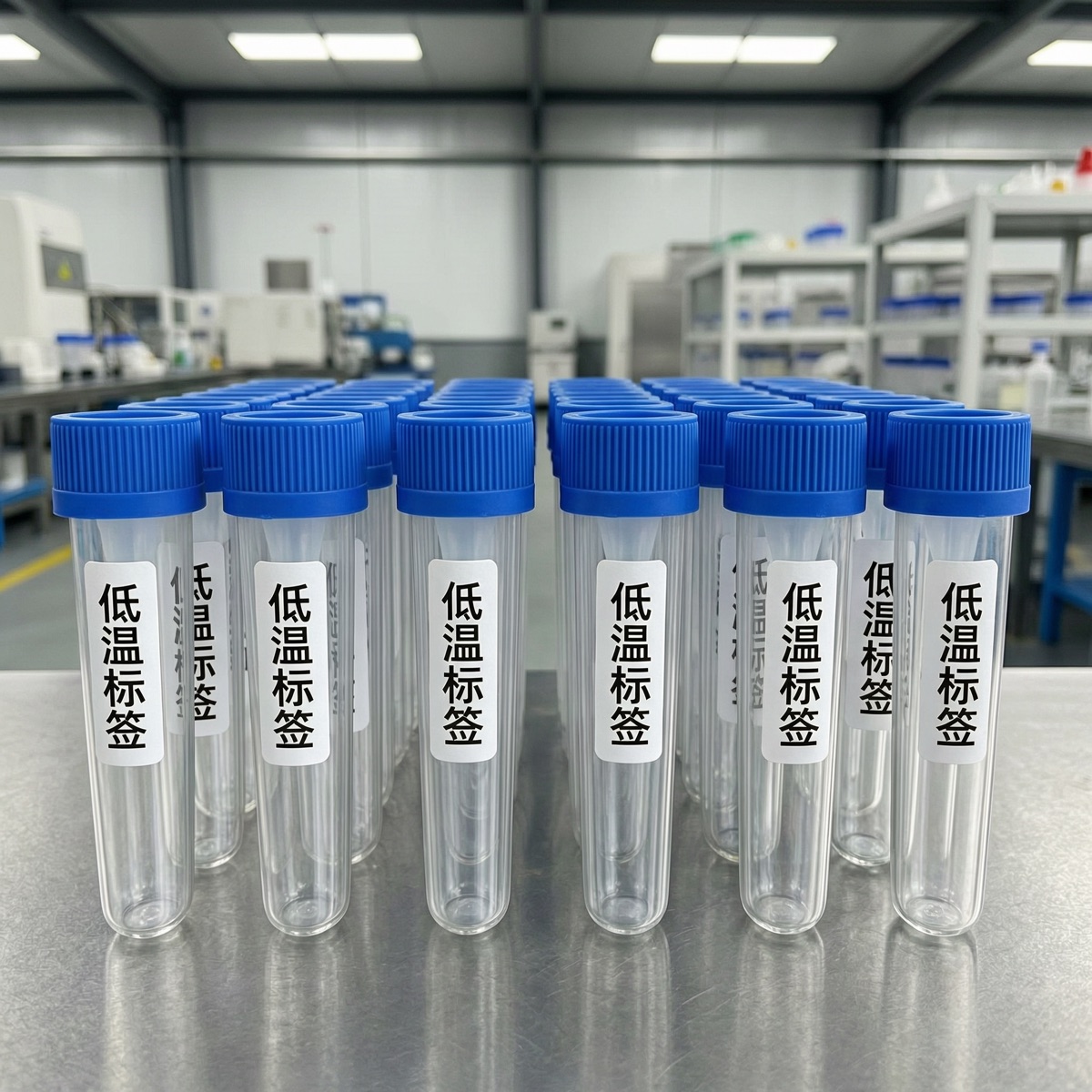
BRD cryogenic microcentrifuge tube labels are precisely matched to tube diameters: 0.8 × 2.5 cm labels for 0.5 mL microtubes, 1.2 × 3.0 cm labels for 1.5 mL tubes, 2.5 × 4.5 cm labels for 15 mL conical tubes, and 3.0 × 6.0 cm labels for 50 mL conical tubes. Each specification ensures the label does not wrap the full circumference of the tube wall after application, leaving at least a 15% transparent viewing window for operators to observe the specimen volume and graduations inside the tube. This window is critical in actual work—confirming layering after centrifugation, judging specimen volume before aliquoting, and checking for leaks after freeze–thaw all depend on it.
Labels that are too small are equally problematic. The effective application height on the outer wall of a 1.5 mL tube is approximately 2.5 cm; if the label height is only 1 cm, the information capacity is severely limited. According to the specimen coding specification in Chapter 10 of SZDB/Z 91-2014, a complete specimen code contains at minimum year (4 digits) + serial number (7 digits) + organ code (3 digits) + specimen type code (3 digits) + aliquot number (3 digits), totaling 20 characters. At Code 128 barcode density, a 1 cm-high label cannot actually accommodate the character capacity required for a 20-digit code. Therefore, BRD's dimensional design balances both information capacity and the constraint of not wrapping the full circumference.
Application orientation: must be parallel to the tube's central axis
Clause 11.3.5.3 of SZDB/Z 91-2014 explicitly states: "For cylindrical specimen containers such as microcentrifuge tubes and cryovials, the label application orientation should be parallel to the central axis of the tube," with an accompanying diagram (Figure 4) in the standard text. The engineering logic behind this orientation constraint is that the centrifugal force on the specimen during centrifugation runs from the tube bottom to the tube opening (along the central axis); when the label is applied parallel to the central axis, the shear force on the adhesive layer from centrifugation is minimized. If the label is wrapped transversely, centrifugal force applies shear perpendicular to the label's long edge, and the adhesive layer fails faster under repeated centrifugation–freezing cycles.
There is another overlooked reason: barcode scanning. When the label is applied along the central axis, a scanner can complete the read by moving linearly along the tube axis. If applied transversely, the scanner must perform an arc scan across the tube wall, and reflection scattering from the curved surface significantly reduces the first-read rate of 1D barcodes. Measured data shows that on tube walls with frost after removal from -80 °C, the first-read rate of transverse labels is approximately 60% that of parallel labels. BRD includes an application orientation diagram with product deliveries to help laboratories embed correct operating habits in their SOPs.
Printed material requirements: water-resistant, chemical-resistant, low-temperature-resistant
Clause 11.3.4 of SZDB/Z 91-2014 sets three mandatory requirements for printed materials: waterproof, resistant to common laboratory reagents (dilute hydrochloric acid, dilute sulfuric acid, sodium hydroxide, ethanol, methanol, acetone, etc.), and low-temperature-resistant (no detachment or damage under dry ice and liquid nitrogen conditions). These three requirements correspond to the three major challenges microcentrifuge tube labels face in actual use.
Waterproofing is the baseline threshold for all cryogenic labels. When a specimen is removed from a -80 °C ULT freezer into room temperature, the tube wall surface rapidly frosts and condenses; the label must not be infiltrated by water droplets causing ink smearing at that moment. BRD microcentrifuge tube labels use PET (polyester film) face stock with thermal-transfer ribbon printing. PET itself has a water absorption rate below 0.8% (ASTM D570 standard), so the face stock does not change dimensions in condensing environments, and the ink does not diffuse.
Chemical resistance is an easily underestimated metric. Tube cap seal failure during centrifugation causing reagent overflow, ethanol disinfectant splashing on the bench, acetone used as an organic solvent in protein precipitation experiments—these are everyday laboratory scenarios. BRD label face stock and adhesives have passed 72-hour immersion tests in four categories of reagents: dilute hydrochloric acid (10%), sodium hydroxide solution (10%), ethanol (70%), and isopropanol (70%), with no decrease in print legibility and no label detachment. This test result is especially important for laboratories seeking CNAS accreditation, because identification legibility is directly linked to the "correct labeling" assessment item in CNAS-GL048:2021 (10-point scale, directly affecting slide quality rating).
Adhesive glass transition temperature (Tg) and low-temperature matching
Although SZDB/Z 91-2014 only sets a goal-oriented requirement for "low-temperature resistance" without delving into adhesive parameters, engineers must understand the relationship between adhesive Tg (glass transition temperature) and storage temperature during actual selection. Simply put, Tg is the critical temperature at which an adhesive transitions from "soft and elastic" to "hard and brittle like glass." When the storage temperature is below the adhesive's Tg, the adhesive layer becomes brittle, and any minor external force (tube wall deformation from thermal expansion/contraction, contact during handling) can cause the adhesive layer to crack and detach.
Conventional acrylic adhesives have a Tg of approximately -15 °C to 0 °C; when placed in a -80 °C freezer, the adhesive layer has already entered the glassy state. BRD cryogenic labels use specialty acrylic copolymer adhesives with Tg as low as below -50 °C. At -80 °C, the adhesive layer retains micro-elasticity; combined with a 10 μm adhesive coating thickness and thermal shrinkage matching with the PET face stock (PET thermal shrinkage from -80 °C to room temperature ≤ 0.3%), the label does not develop peeling stress from differences in thermal expansion coefficients during freeze–thaw cycles.
For microcentrifuge tube labels intended for liquid nitrogen (-196 °C) environments, lowering Tg alone is insufficient. The embrittlement point of the face stock itself at -196 °C must also be verified. BRD liquid nitrogen-grade microcentrifuge tube labels use polyimide (PI) face stock with an embrittlement temperature below -269 °C, combined with a silicone adhesive system, and have passed 10 cycles of liquid nitrogen immersion–room temperature rewarming verification.
Barcode strategy: 1D or 2D?
Clause 11.1 of SZDB/Z 91-2014 explicitly states: "When selecting barcodes, the advantages and disadvantages of 1D barcodes and 2D barcodes in terms of information capacity, error correction capability, printing area, and barcode reader requirements should be fully compared, and 1D barcodes, 2D barcodes, or a combination of both should be selected according to actual conditions."
This "combination of both barcode types" strategy is highly practical. Microcentrifuge tube labels typically have 2–3 cm² of printable area; a 1D Code 128 barcode carrying a specimen number (10–15 characters) occupies only about 1.5 cm². The remaining area can accommodate a 2D Data Matrix code carrying supplementary information (specimen type, collection date, number of freeze–thaw cycles, etc.). Labels printed with both a 1D barcode and human-readable characters allow manual specimen check-in/check-out registration even when scanning equipment fails. BRD standard microcentrifuge tube label templates have a built-in three-in-one layout of "Code 128 1D barcode + Data Matrix 2D code + human-readable characters," compatible with 300 dpi and 600 dpi output on mainstream printers such as Zebra and CAB.
Usage requirements: replace at the first sign of lifting—leave no hidden risks
Clause 11.3.5.4 of SZDB/Z 91-2014 contains a sentence that is easily overlooked but very important: "If, after a period of use, a label is found to have lifted corners, lifted edges, or other insecure adhesion, a new label should be printed promptly and re-applied." In practice, this means label inspection is not a one-time task at check-in but an ongoing activity requiring periodic inspection.
BRD recommends the following inspection intervals: quarterly label inspection for room-temperature stored specimens, semi-annual inspection for -20 °C storage, and annual inspection for -80 °C and liquid nitrogen storage (adhesive aging is slower at lower temperatures). During inspection, focus on the label edge at the junction between the tube cap and tube body—this location is most easily touched by fingers during repeated cap opening and closing for sampling, causing lifting.
Recommended Products
For the label materials and application scenarios covered in this article, the following BRD products are available for selection reference (click to view specifications and request a quote):
- Lab296-629 Biobank Cryovial Microscope Slide -196 °C LN₂ Nylon Cryogenic Label (¥999/roll)
- Lab208-509/25.4x63.5 Wrap-Around Cryovial Biobank Thin Tube LN₂ Classification Label (Price on request)
- Lab127-449/60x30 Biobank Medical Device Identification Gloss White PET Biobank Label (Price on request)
FAQ: Microcentrifuge Tube Label Selection and Application
What size label can fit on a 0.5 mL microcentrifuge tube?
A 0.5 mL microcentrifuge tube has a diameter of approximately 8 mm and a circumference of approximately 25 mm. Per SZDB/Z 91-2014's requirement that the label's wide side be less than the container wall circumference, label width should not exceed 20 mm (leaving a 15% viewing window). BRD offers 0.8 × 2.5 cm microtube labels, sufficient to print a 20-digit specimen code plus a 1D barcode. In the height direction, the applicable area on a 0.5 mL tube is approximately 2 cm; a label exceeding this height will extend into the cap area and interfere with cap operation.
Do manual labeling and machine labeling have different label requirements?
Yes. Manual labeling has lower release force requirements for the release liner—a peel force in the 15–30 cN/inch range is sufficient for easy manual removal. But automatic label applicators require lower release force (5–15 cN/inch); otherwise, high-speed peeling can cause label breakage or application position offset. BRD roll-format microcentrifuge tube labels are available with two release liner options—manual-apply and machine-apply versions—so laboratories can choose according to their actual labeling method.
How many freeze–thaw cycles can a label withstand after application?
This depends on how well the thermal expansion coefficients of the face stock and adhesive match. BRD PET face stock + cryogenic acrylic adhesive system labels have passed 10 freeze–thaw cycles from -80 °C to room temperature verification, with no edge lifting, no detachment, and barcode readability maintained at Grade B or above (ISO 15415 standard). If your laboratory's freeze–thaw frequency is higher (e.g., specimens retrieved multiple times daily from a biobank), it is recommended to request test data for 20 or more freeze–thaw cycles from the supplier before purchase.
Will thermal-transfer printed labels fade at low temperatures?
The resin composition of the thermal-transfer ribbon determines print durability. BRD's matching resin-based cryogenic ribbons have a transfer layer primarily composed of synthetic resin, forming a mechanical interlock bond with the PET face stock. At -80 °C, the print does not undergo chemical change, and scratch resistance is superior to wax-based ribbons. If the application involves liquid nitrogen environments, full-resin ribbons (resin content ≥ 90%) are recommended; wax-based ribbons become brittle and powdery at -196 °C.
A label on a microcentrifuge tube has bubbled after being placed in liquid nitrogen. What should be done?
Bubbling is caused by volume changes of gas or moisture trapped beneath the label at ultra-low temperatures. First, avoid labeling in environments with humidity > 60%, because at high humidity the tube wall adsorbs a microscopic moisture layer that becomes a breeding ground for bubbles once sealed by the label. Second, press the label for 3–5 seconds after application to expel air. If bubbling has already occurred, per SZDB/Z 91-2014 requirements, replace the label immediately—do not attempt to puncture the bubble with a syringe or reinforce with tape; both practices will be recorded as non-compliant identification in CNAS assessments. BRD recommends that biobanks establish a "labeling environment monitoring" SOP, place a thermo-hygrometer in the sample processing area, and use a dehumidifier or move to a biosafety cabinet (with its own dry airflow) for labeling when humidity exceeds the limit.