
1. Conclusion first: the primary criterion for strain bank identification is the numbering chain, not single-tube temperature resistance
When choosing labels for a microbial resource bank, the primary criterion is not whether a single tube can withstand -80 °C, but whether the number of the same strain can be transmitted with zero loss across the four ledgers—receipt, subculture, distribution, and destruction—when that strain exists in parallel in four preservation forms: slant, glycerol cryovial, bead preservation tube, and lyophilized ampoule. The most common traceability incident in a strain bank is not "the label fell off to the bottom of the freezer," but that the colonies grown after revival do not match the strain number in the ledger—the tube is still there, but the chain is broken. Temperature qualification of a single tube is only a necessary condition, not a sufficient one.
Projects that place the criterion in the wrong position fail in highly consistent ways: material is selected only by minimum temperature, and the tube-body label itself qualifies, but the numbering structure does not define subculture nodes and aliquot unit numbers, so after several passages no one can say how many passages the working strain in hand is from the original preservation; or all information is compressed onto one label, so when the status changes the whole label becomes invalid, and each relabeling introduces one more chance of transcription error. The executable order is exactly the opposite: first define the numbering system, then list the container and temperature matrix by preservation form, then perform geometric splitting by labeling location, and only then address material and printing process.
This article follows that order and provides directly actionable criteria: the three-segment numbering structure and minimum field set, the difference matrix of four preservation forms, the geometric quantification for the three locations of cap top/tube body/ampoule neck, the material suitability of the four temperature tiers in the official material guide table, and the capacity calculation of 2D barcode symbologies plus the tiered retest plan after freeze–thaw. Compliance anchors throughout include ISO 20387:2018 (biobanking), GB 19489-2008 (general requirements for laboratory biosafety), ISO 17025:2017 (competence of testing laboratories), ISO 15189:2022 (medical laboratory quality and competence), ISO/IEC 15415, ISO/IEC 15416, GB/T 2792-2014, GB/T 4851-2014, ISO 15693, and ISO 18000-3.
2. Four preservation forms in parallel: difference matrix of temperature, container, and identification carrier
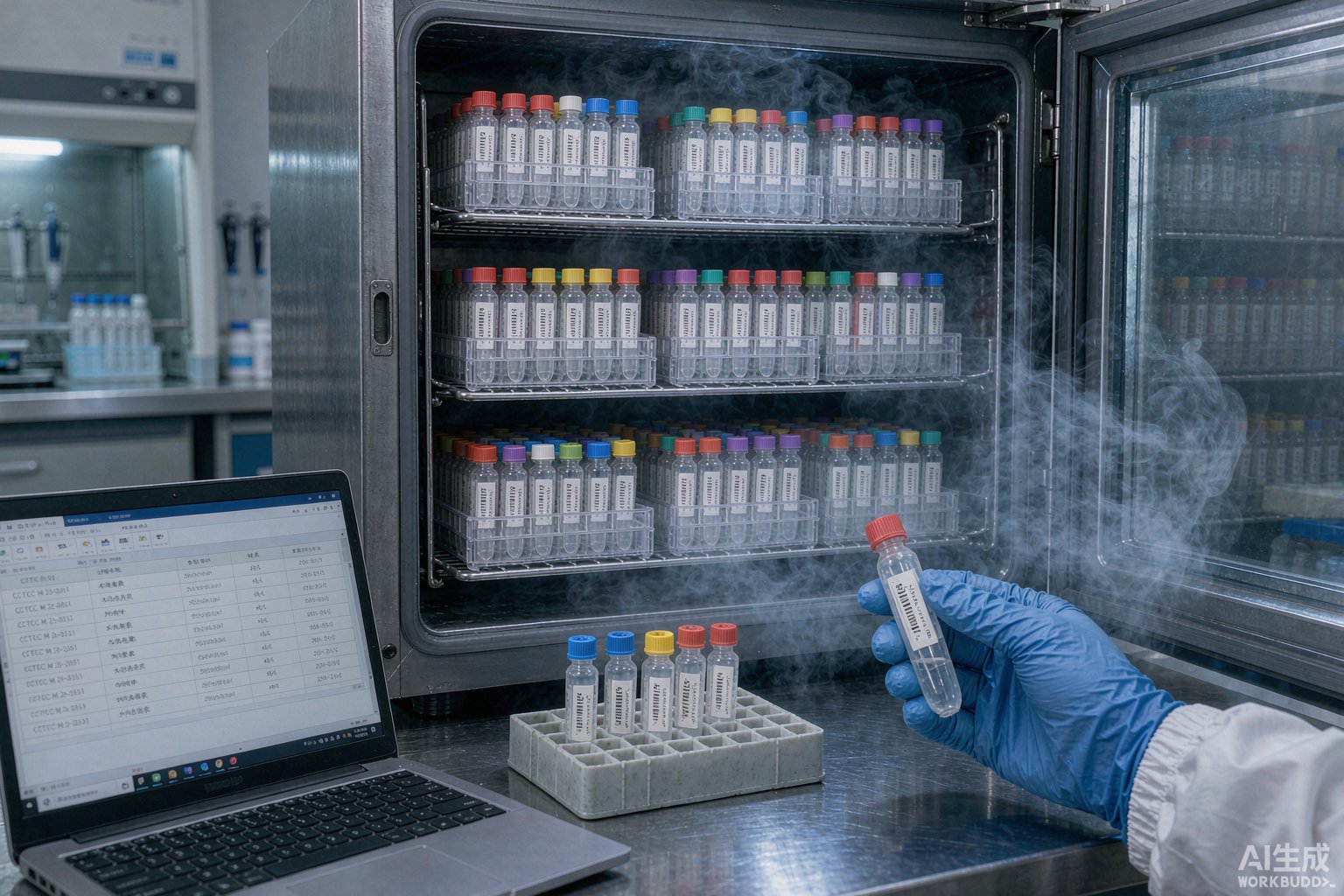
In a properly operating strain resource bank, the same strain almost always exists simultaneously in more than one form: the slant is the working form in use, the glycerol tube in the -80 °C freezer is the daily access library, the bead tube is the aliquoted backup, and the lyophilized ampoule is the long-term archiving library. The temperature ranges, container shapes, and expected lifespans of the four forms are completely different, so the identification strategy must also be layered; there is no "one label fits all" solution.
| Preservation form | Typical container | Storage temperature | Expected storage period | Core identification challenge |
|---|---|---|---|---|
| Slant culture | Test tube slant medium | 2-8 °C refrigerated | Weeks to months | Repeated condensation wetting, fast turnover of working form, frequent label replacement |
| Glycerol cryopreservation | 2 mL cryovial | -80 °C ultra-low temperature freezer | Years to decades | Establishment of cryogenic adhesion, freeze–thaw cycles, synchronization of cap and tube-body information |
| Bead preservation | Bead cryovial | -80 °C or -20 °C | Several years | Rolling friction of beads inside the tube, small tube diameter, small effective labeling area |
| Lyophilized preservation | Lyophilized ampoule / lyophilized tube | 4 °C protected from light or room temperature | More than five years | Wrap-around labeling on narrow neck, no labeling on high-temperature sealed section, light-protection requirement |
This table also explains a question that reviewers easily raise: why the same strain uses different labeling schemes in different forms. Because the failure mechanisms of each form differ—slant labels die from condensation, glycerol tube labels die at the freeze–thaw interface, bead tube labels die from internal friction and small curved surfaces, and lyophilized ampoule labels die from the neck wrap-around process. Only after identifying the failure mechanism is there a basis for choosing material and labeling location.
3. Strain numbering system: three-segment numbering and aliquot unit number
The numbering system is the foundation of strain bank identification. Reviews and audits (ISO 20387:2018 has clear requirements for unique sample identification and traceability, and GB 19489-2008 for strain and virus management records) focus not on whether the label looks good, but on "whether any physical tube can be located to its unique record in the ledger within two steps." A three-segment structure is recommended, with each segment carrying a different uniqueness responsibility.
| Field segment | Example | Uniqueness responsibility | Printing carrier |
|---|---|---|---|
| Library code + strain serial number | CC-2026-0187 | Locates the "strain"; shared by all forms of the same strain | Tube-body permanent layer, 2D barcode + plain text |
| Subculture node | P0 / P1 / P2… | Locates the "passage"; distinguishes original library from working library | Cap-top color code or text, updated with passage |
| Aliquot unit number | V07 | Locates the "tube"; unique among aliquots of the same passage | Tube-body permanent layer, same code as strain number |
| Form code | G glycerol / B bead / D lyophilized / S slant | Prevents revival condition mismatch caused by form confusion | Pre-printed color block + plain text, linked to color-code system |
The value of the three-segment structure lies in splitting "one tube, one code" into three independently verifiable links: a wrong strain number is a ledger problem, a wrong passage number is a subculture discipline problem, and a wrong aliquot unit number is an aliquoting operation problem. When a problem occurs, it can be immediately located to the link instead of vaguely saying "the numbering is messed up." There are two hard disciplines in implementation: first, the unique number must be printed at room temperature before storage, and no handwritten supplementary numbers are allowed after storage—the handwritten layer is the first information to disappear under low temperature and repeated defrosting; second, the form code should preferably be carried by color, because visual discrimination is much faster than scanning, and the color should be redundantly accompanied by plain text to avoid misreading due to color vision differences.
4. Breakdown by labeling location: cap top, tube-body circumference, and lyophilized ampoule neck
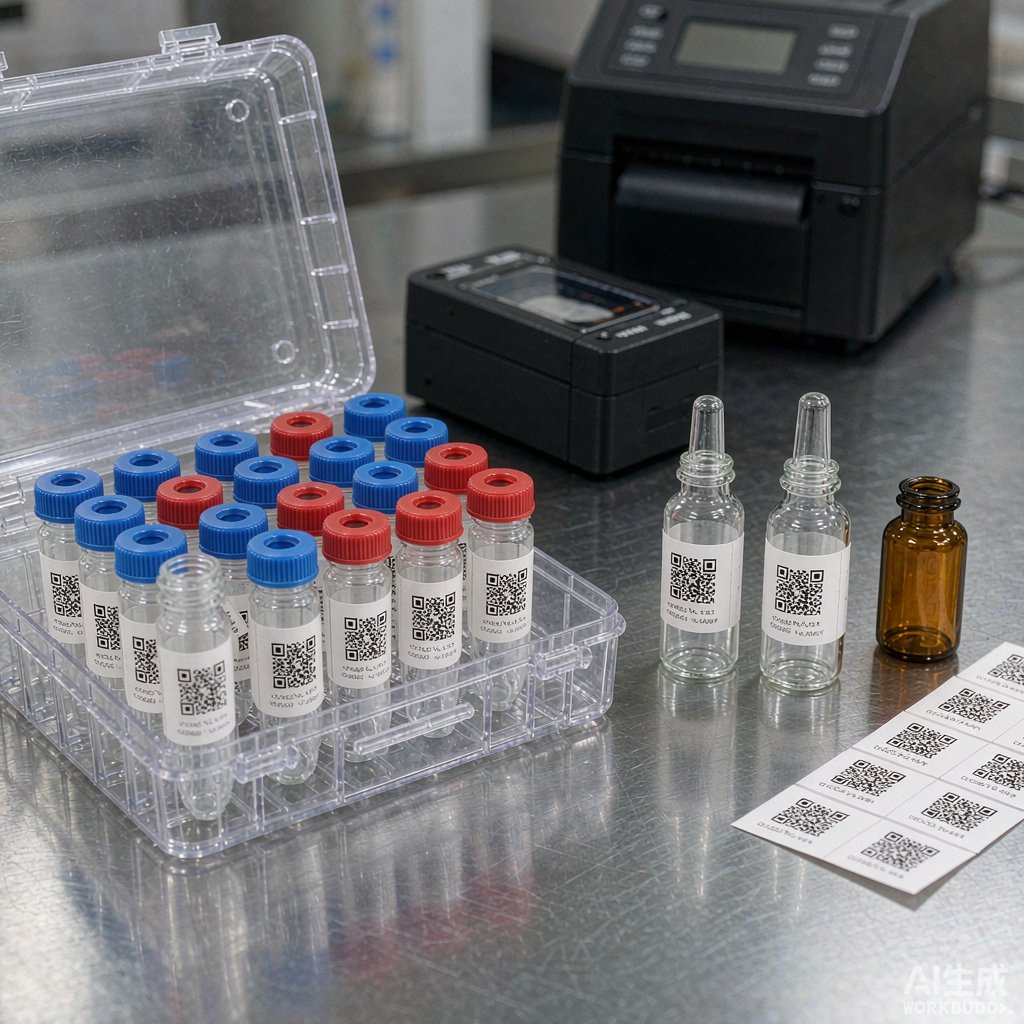
On the same cryovial, different locations have completely different mechanical loads and information responsibilities. Taking a common 2 mL cryovial as an example, the tube outer diameter is about 12.5 mm, and the circumference is about 39.3 mm (π × 12.5). To apply a label with head-to-tail overlap on the circumference, the label width must leave margin for overlap—in ultra-low temperature scenarios, head-to-tail overlap is a general requirement for many materials in the official material guide table (e.g., at least 3 mm overlap when applied to frozen tube surfaces). With an overlap of 3-5 mm, the actual usable width of the tube-body label should be controlled within 30 mm, and the remaining arc surface is used for the starting and finishing press-down transition.
The division of labor between cap top and tube body must be clear: there is relative rotation between the cap and the tube body, and the cap may also be swapped as a whole, so the unique number must never be placed only on the cap top. The correct responsibility of the cap top is to carry status and color codes—passage node color blocks, revived/to be revived/destroyed status, form color codes—using high-contrast information that can be read visually; the tube-body circumference is the permanent layer for the unique number, 2D barcode, and plain text fields. The two are complementary. Printing status fields into the tube-body permanent layer is the most common structural error: when the status changes, the whole label must be replaced, and the lifespan advantage of the permanent layer is immediately lost.
Lyophilized ampoules are another extreme: the neck diameter is usually only 8-12 mm, with a circumference of 25-38 mm, and any composite structure with thickness will create overlapping edges after wrapping. For this location, a material specifically designed for wrapping should be selected—for example, the vinyl wrap-around type T509 (officially described as durable and conformable, requiring overlap when used in liquid nitrogen environments), wrapped around the neck more than one full turn and pressed down at the end; the flame-sealed section is a high-temperature zone where labeling is strictly prohibited, and the label position must remain in the cooling zone below the seal line. If the ampoule is subsequently stored in liquid nitrogen or ultra-low temperature, the overlap amount should be tightened according to the same principle.
5. Material suitability: four temperature tiers and the -40 °C boundary in the official guide table
Bringing the conditions of the four locations down to materials, the four temperature tiers in the official material guide table (liquid nitrogen -196 °C / freezer -80 °C / hot water 100 °C / autoclave 121 °C) are the most reliable screening baseline. In strain bank scenarios, the tiers actually encountered are -80 °C and -196 °C (some bank types submerge the master library in liquid nitrogen vapor), and the -40 °C boundary clearly separates economical materials from cryogenic materials—this must be fixed in the selection table and must not be mixed by feel.
| Material code | Key points of official description | -196 °C | -80 °C | 100 °C | 121 °C | Positioning in strain bank |
|---|---|---|---|---|---|---|
| T629 | Nylon cloth label, easy to apply, high/low temperature resistant, good conformability | Suitable | Suitable | Suitable | Suitable | Main force for tube-body permanent layer, most stable conformability on small-curvature tube bodies |
| T459 | Ultra-thin polyester with transparent tail self-laminating, protects printing and leaves a transparent window for observing liquid level | Suitable | Suitable | Suitable | Suitable | Glycerol tube body, verify liquid level and fill volume through the window |
| T429 | Ideal choice for labeling frozen flat surfaces, at least 3 mm head-to-tail overlap when applied to frozen tube surfaces | Suitable | Suitable | Suitable | Suitable | Cryobox outer packaging layer and tube body, supplementary labeling of already frozen containers |
| T439 | 6-color pre-printed cryogenic freezer label, top pre-printed color for quick differentiation | Suitable | Suitable | Suitable | Not checked in official table | Form color-code layer, visual management by preservation form color |
| T509 | Durable vinyl label, suitable for wrapping, requires overlap when used in liquid nitrogen environments | Suitable | Suitable | Suitable | Not checked in official table | Lyophilized ampoule neck and narrow tube wrapping |
| T329 | Matte white/PP self-adhesive, -40 °C resistant freezer label | Not suitable | Not suitable | Not suitable | Not suitable | Limited to workbench surfaces and 2-8 °C slant layer |
| T419 | Glossy white PET, for cryovials and microcentrifuge tubes, resistant to environments above -40 °C | Not suitable | Not suitable | Not suitable | Not suitable | Limited to room-temperature operation areas and short-term refrigerated steps |
Two things must be made clear here. First, the -40 °C boundary is the official position: both T329 and T419 stop at the -40 °C tier and cannot cover the -80 °C and liquid nitrogen tiers. Their place is on freezer door racks, workbenches, and the 2-8 °C refrigerated layer—locations with large temperature fluctuations but shallow lower limits, where economical materials can significantly reduce whole-bank costs; once entering the -80 °C main storage area, materials with all four tiers checked must be selected. Second, the application column of the official guide table does not separately list "strain preservation"; the suitability in this article is inferred from the four temperature tiers, material descriptions, and container checkmarks. Specific available specifications are subject to the product specification sheet; for more materials and specific applications, please contact the product manager for selection.
6. Printing and barcodes: from symbology selection to tiered retest after freeze–thaw
The 30 mm width budget on the tube-body circumference directly determines symbology selection. One-dimensional barcodes have poor survival space on narrow curved surfaces: taking Code 128 as an example, each data character occupies a fixed 11 modules, and with start, check, and stop characters, 20 pure digits at X=0.25 mm are about 36 mm long, already exceeding the 30 mm tube-body width budget. 2D barcodes do not have this problem: a Data Matrix 24×24 symbol typically holds about 40 alphanumeric characters, and at X=0.30 mm the symbol side length is about 7.2 mm (about 10 mm square including quiet zone), still leaving sufficient complete fitting window on the curved surface of a 12.5 mm outer diameter tube body. For small-curvature containers such as strain tubes, Data Matrix is the realistic solution; 1D barcodes are only valuable on large labels outside the box.
In terms of printing process, thermal transfer is the mainstream for cryogenic labels: the resin-based ink layer transferred by ribbon is significantly more stable at cryogenic and condensation interfaces than water-based inkjet, while handwritten markers have the weakest survival under repeated -80 °C defrosting and 75% ethanol wipe disinfection, and are only allowed on the status layer. For ribbons, it is recommended to directly select the laboratory cryogenic dedicated series, such as the BradyLAB BRL series cryogenic ribbon (designed to match Lab series labels), and avoid making do with general-purpose ribbons—the wax-based formulation of general-purpose ribbons tends to cause print layer powdering at cryogenic interfaces.
Acceptance and retesting must be quantified to grades: after labeling at receipt, perform a barcode grading baseline according to ISO/IEC 15415 (2D) and ISO/IEC 15416 (1D), with an internal release grade recommended no lower than C; thereafter, sample and retest quarterly or after each freeze–thaw peak cycle (e.g., after the concentrated revival season), and trigger relabeling when the grade drops. Adhesive performance acceptance at receipt can be sent for testing according to GB/T 2792-2014 (180° peel strength) and GB/T 4851-2014 (holding tack); specific limits are set by each bank's system documents—the standards provide methods, not compliance values.
7. Subculture, distribution, and destruction: minimum field set of the three ledgers
For the numbering system to come alive, it depends on the linkage between ledgers and labels. The table below gives the minimum field set—fields can be added, but it is not recommended to remove any.
| Ledger | Trigger event | Minimum fields | Linked action with label |
|---|---|---|---|
| Receipt / accession ledger | New strain received or externally introduced | Library code, strain serial number, source, original number, form, storage location, operator, date | Print tube-body permanent layer + cap-top form color code, scan code to write back storage location |
| Subculture ledger | New passage inoculated after revival | Previous passage number, new passage number, passage number, medium, culture conditions, operator, date | Reprint all fields on new passage tube, update cap-top passage color block |
| Distribution / return ledger | Lending, requisition, transfer | Strain number, passage number, aliquot unit number, recipient, use approval, date | Add distribution slip label to distributed tube, write off after return |
| Destruction / disposition ledger | Expired, contaminated, planned disposal | Strain number, destruction reason, approver, executor, date, inactivation method | Add destroyed status label to cap top, lock ledger and mark unavailable |
Three disciplines make this system stand up during review: first, one strain, one passage, one file; subculture records must include a back-link to the previous passage number, and any broken link in any passage is regarded as invalid subculture for that tube; second, labels must not be altered; any field change must be reprinted and relabeled, because the altered layer is the first information to fall off under cryogenic conditions and disinfection wiping, and the hardest to evidence; third, ledgers and physical items must be spot-checked weekly, with the sampling ratio set according to bank capacity; when inconsistent, the physical scan result prevails and the source of discrepancy is traced back. Most quality systems set a clear upper limit on the passage number of working strains (a common practice is that working strains do not exceed a certain number of passages; the specific requirement is subject to the governing system documents and standards). The upper limit itself is not the focus of this article; the focus is whether there is a ledger that can prove the current passage number.
8. Applicable boundaries of RFID batch inventory
Batch inventory in ultra-low temperature freezers is the most attractive and most error-prone RFID scenario. The technical boundary is clear: the interior of a -80 °C freezer is an environment of metal shelves plus densely packed liquid containers, UHF signals attenuate severely at metal and liquid interfaces, and tube-by-tube reading inside the freezer is generally unstable in real banks; the HF band is relatively controllable under metal and liquid influence and is supported by ISO 15693 and ISO 18000-3, making it more suitable for box-level and rack-level positioning and receipt/dispatch registration. In other words, the correct role of RFID is "box-level and rack-level location management," while single-tube confirmation still relies on the tube-body 2D barcode—positioning RFID as a replacement for tube-by-tube barcodes is the primary reason such projects fail.
If the bank type decides to introduce RFID, a three-step approach is recommended: first, create an RFID positioning layer outside boxes and at rack positions to verify low-temperature read rates; then connect receipt/dispatch registration to the ledger system; finally evaluate whether to tag individual tubes in the high-value master library. Throughout the process, the barcode layer is always retained as a fallback when RFID reading is abnormal. For specific available RFID label specifications and low-temperature performance, please refer to the product page parameters or contact the product manager for selection.
Recommended Products
For the label materials and application scenarios covered in this article, the following BradyLAB (BRD) products are available for selection reference (click to view specifications and request a quote):
- Lab014-629/50x30mm Sample bank cryovial EP tube microscope slide -196 °C liquid nitrogen nylon cloth label (¥1890/roll)
- Lab361-329-500C/60x60mm Sample bank cryovial conical tube microcentrifuge tube + cap label/-80 °C (¥769/roll)
- Lab169-429/25X17mm-3 columns Sample bank cryovial microscope slide -80~-196 °C polyester label (Price on request)
- Lab084-439/30x15mm Sample bank cryovial polyester label cryogenic biological sample bank classification label (Price on request)
- BRL-80-BK Borjer LAB laboratory-specific cryogenic ribbon black 80MM×300 m (Price on request)
FAQ
Q1: The strain number has already been entered into the LIMS system. Does the tube-body label still need to repeat the number?
Answer: Yes. LIMS is an electronic ledger, while the tube-body label is the only physical carrier in scenarios of power failure, offline operation, system switching, and manual verification. The two are backups for each other, not substitutes. The most common action at a review site is to pull one tube and compare it with the ledger; if the label has no plain text and barcode, the tube itself cannot prove its identity. The correct division of labor is: the electronic system handles retrieval and statistics, and the label handles "confirming which tube this is without looking at the system."
Q2: Can a -80 °C glycerol tube be labeled with a room-temperature label first and then put directly into the freezer?
Answer: This cannot be done to save effort. The adhesive system of room-temperature self-adhesive cannot establish effective adhesion at cryogenic interfaces, and in most cases the label will lift at the time of application or after the first freeze–thaw. The correct practice is to complete printing and labeling at room temperature, press down and let stand, and then store; when supplementary labeling is needed for already frozen tubes, select materials that are officially checked for the corresponding low-temperature tier and require head-to-tail overlap, and contact the product manager to confirm specific operations and available specifications. Do not directly copy room-temperature practices to -80 °C scenarios.
Q3: The neck of a lyophilized ampoule is so narrow that the label cannot stick at all. What should be done?
Answer: Neck labeling should use wrap-around material rather than forcing a flat label to stick. Vinyl wrap-around types (such as T509) are designed for narrow tubes and necks, wrapped more than one full turn with overlap allowance and pressed down; the labeling position must be in the cooling zone below the flame seal line, and labeling on the high-temperature sealed section is strictly prohibited. If the ampoule will subsequently be stored in liquid nitrogen or ultra-low temperature, the overlap amount and material selection should follow the liquid nitrogen tier requirements in the official guide table.
Q4: How should the passage number in the subculture ledger be recorded so that it will not be challenged during review?
Answer: The key is "back-link to the previous passage number." Every subculture record must state from which tube and which passage it was derived, forming a complete chain from original preservation to the current working strain; recording only "passage 3" without the previous passage number will break the chain after the first aliquoting. With the subculture node field in the three-segment numbering, anyone holding a tube can trace back to the master library along the ledger. Most quality systems set an upper limit on working strain passages, and the burden of proving passage number rests on this ledger.
Q5: Will the beads in a bead preservation tube wear away the printed layer inside the tube?
Answer: Wear of the printed layer in bead preservation tubes mainly comes from bead rolling during freezing and retrieval, and printed content near the inner wall is most noticeably affected. Two countermeasures: first, print all key fields on the outer-wall label, and keep only batch information in the pre-printed content inside the tube; second, use a material with a laminate or self-laminating structure on the outer wall to isolate the printed layer from condensation and friction interfaces. Bead tubes have small diameters, so label width should also be controlled according to the geometric calculation in Section 4.
Q6: Can RFID completely replace barcodes for strain inventory?
Answer: No, and it should not. The interior of a -80 °C freezer is an environment of metal shelves plus densely packed liquid containers, and tube-by-tube reading is unstable in real banks; the realistic positioning of RFID is box-level and rack-level location management and receipt/dispatch registration, implemented with HF standards such as ISO 15693. Single-tube confirmation, revival verification, and outgoing handover still rely on the tube-body 2D barcode. Running the two technology lines in parallel with barcode fallback is a proven and reliable architecture.
Q7: An old strain bank uses handwritten paper labels. How can it migrate to a printed system?
Answer: Proceed in two batches. First batch: for all active strains that will be subcultured, distributed, or revived, reprint and relabel synchronously at the next operation, establish new labels together with ledger records, and keep the old labels on the tubes until verification is complete before removal; second batch: dormant inventory is counted and migrated by storage zone in batches, and the barcode grading baseline is completed during counting. During migration, old and new labels coexist, and it is forbidden to apply the new label and tear off the old one only—any tube left "bare" is a tube that cannot prove its identity.