
Bottom line up front: For slide label selection in frozen sections (also called cryosections or cryostat sections), the first deciding factor is not "can it survive the -20 °C of the cryostat chamber," but rather whether it can first establish adhesion at room temperature, then complete an entire four-point temperature chain intact—isopentane snap freezing at -80 °C to -100 °C, cryostat chamber at -15 °C to -30 °C, room-temperature reading station, and archiving at -20 °C or -80 °C—and remain readable after continuous short immersions in alcohol/acid/alkali at the third stage. Under this criterion, the answer given by the official BradyLAB (BRD) Lab&HC laboratory medical label material guide is convergent: the only materials checked for the "microscope slide" application in that table are T629 and T424, and T424 is not checked for the "freezer -80 °C" temperature tier required for archiving, so only T629 satisfies both requirements simultaneously. Two accompanying hard constraints apply: intraoperative frozen sections typically allow only 15–30 minutes from grossing to report issuance, so labels can only be pre-printed and pre-applied at room temperature—there is no operational window for "printing on the spot inside the cryostat while wearing thick gloves"; and the frosted area of a slide offers only 25.4 mm × 20 mm of usable area, compressing the 1D barcode digit budget to 6–9 digits, so the full pathology number or specimen number must use a Data Matrix 2D code.
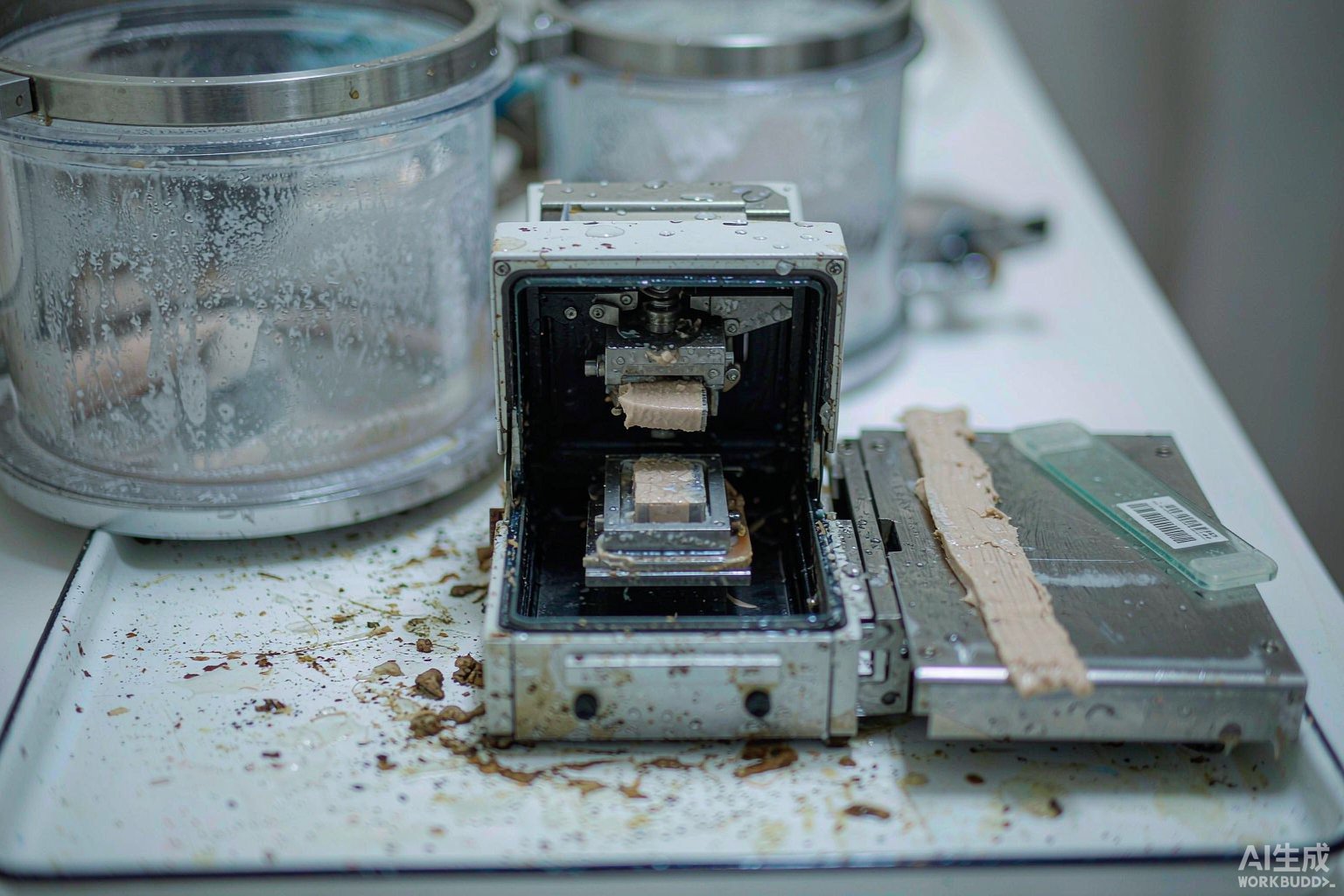
1. First, correct a premise: frozen sections are not "paraffin sections minus xylene"
Many departments understand frozen sections as a simplified version of paraffin sections and therefore purchase labels using paraffin workflow standards. In terms of chemical exposure this is indeed relaxed, but the temperature chain follows an entirely different curve—the two cannot be inferred from each other.
First, the chemical side. The paraffin workflow involves 10% neutral buffered formalin fixation, graded ethanol dehydration, xylene clearing, infiltration with molten paraffin at 60–65 °C, and after sectioning, xylene dewaxing and baking at around 60 °C—the core challenge for the label is the combination of "prolonged single-solvent immersion plus moderate-to-high temperature." The frozen workflow eliminates the clearing, dewaxing, and infiltration stations entirely, replacing them with brief fixation in 95% ethanol plus rapid hematoxylin–eosin staining plus aqueous mounting medium, so the core challenge becomes a combination of "many reagent types but short time at each station." The attack mode has changed, and the yardstick for judging label quality changes accordingly.
Now the temperature chain. The lowest temperatures in the frozen section chain occur at both ends rather than the middle: one end is snap freezing after grossing (the tissue holder is immersed in isopentane cooled by liquid nitrogen, bath temperature -80 °C to -100 °C; direct immersion in liquid nitrogen approaches -196 °C), and the other end is returning unsectioned embedded blocks to a -80 °C ULT freezer for long-term storage. The cryostat in between is actually the warmest link in the entire chain: the chamber is conventionally set to -20 °C, adjustable from -15 °C to -30 °C, with the specimen head at -18 °C to -22 °C. So what truly determines the material tier is not the cryostat stage, but the two ends—snap freezing and archiving.
| Station | Paraffin section workflow | Frozen (cryostat) section workflow | Dominant impact on label |
|---|---|---|---|
| Time limit from sampling to fixation | Formalin fixation for hours to overnight | Grossing to snap freezing recommended ≤3 minutes | Time window dictates pre-printing |
| Freezing and setting stage | Graded ethanol dehydration + xylene clearing | Isopentane at -80 °C to -100 °C for 15–30 seconds | Very brief ultra-low temperature shock |
| Embedding medium | Molten paraffin at 60–65 °C | OCT water-soluble embedding medium, used at room temperature | No water bath high temperature |
| Sectioning chamber temperature | Room-temperature microtome | Cryostat chamber -15 °C to -30 °C (typically -20 °C) | Continuous moderate-to-low temperature |
| Section thickness | Typically 3–4 μm | Typically 5–10 μm (commonly 7 μm, trimming 20–30 μm) | Thickness does not affect label selection |
| Mounting method | Float on warm water in a flotation bath, then pick up | Room-temperature slide picks up by vertical light touch via temperature differential | Instant thermal shock during mounting |
| Staining path | Xylene dewaxing + graded rehydration + HE + dehydration, clearing, and mounting | 95% ethanol fixation for 60 seconds + rapid HE + aqueous mounting | Many solvent types, short time per station |
| Typical duration | Fixation to mounting spans days | Slide preparation 10–20 minutes, report issuance 15–30 minutes | No long time margin |
| Archiving conditions | Long-term storage in room-temperature slide cabinet | Mounted slides stored short-term at -20 °C; unsectioned blocks long-term at -80 °C | Long-term deep cold plus repeated in-and-out |
| Reversibility | Completed once | Same batch repeatedly taken from freezer to reading station dozens of times | Temperature cycling frequency becomes a variable |
2. The 15–30 minute time window: why only room-temperature pre-printing and pre-application
The value of intraoperative frozen sections lies in speed. From the surgeon delivering fresh tissue to the pathology department to the pathologist issuing a report, the industry-recognized window is 15–30 minutes, of which slide preparation itself takes about 10–20 minutes. Breaking down this time budget yields a frequently overlooked conclusion: labels cannot be printed on site—they must already be printed and applied before the tissue arrives.
There are three reasons. First, operations inside the cryostat chamber require cryogenic protective gloves; picking up forceps or turning a knob is slower than usual, let alone performing a millimeter-level action like "taking out a thin-film label and precisely aligning it"—and the usable slide area is only 25.4 mm × 20 mm, where a positioning deviation exceeding 1 mm may press onto the tissue area or cross the slide edge. Second, the printer is usually not in the frozen section preparation area; each trip in and out means opening the cryostat lid once, and the chamber temperature rise will soften already-trimmed embedded blocks and cause section shattering—a clear operational contraindication. Third, applying directly to a cold surface is inherently unworkable: common pressure-sensitive adhesives need above 10 °C to fully wet the adherend surface; applying a label to a frost-covered slide essentially seals air and moisture into the adhesive layer.
This yields the second hard conclusion of this article: the bonding interface in the frozen section workflow must be established at room temperature (18–28 °C), and only then exposed to cold for the first time. This is the exact opposite sequence from "applying a label to an already-frozen cryovial." Once the sequence is reversed, the criteria for accepting a label also change: no longer whether it can be pressed onto a cold surface, but whether it can withstand the first cooling and subsequent repeated in-and-out cycles after being applied at room temperature.
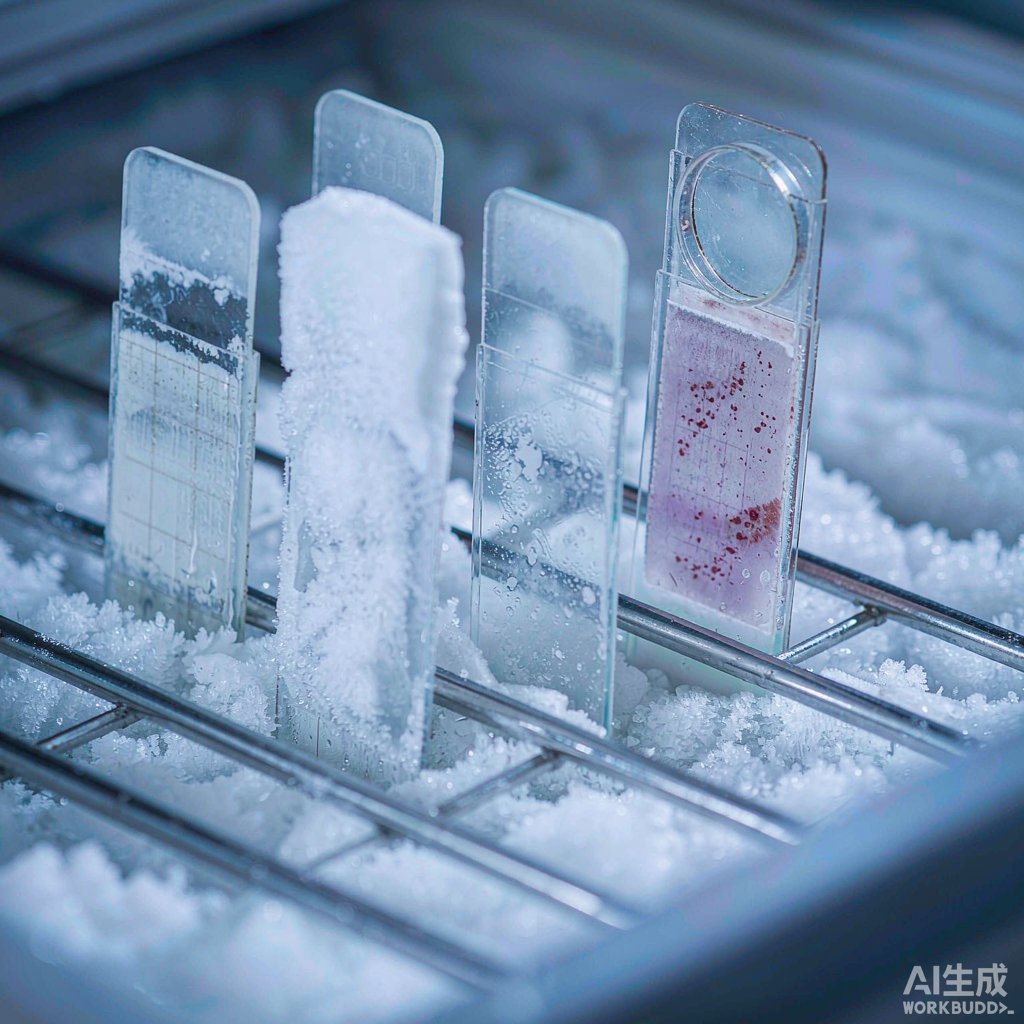
3. Geometric ceiling: how to calculate the label size limit from the 25.4 mm × 20 mm usable area
A standard microscope slide measures 25.4 mm × 76.2 mm (1 inch × 3 inches), 1.0–1.2 mm thick, with a frosted (matte white) identification area at one end; the depth of the frosted area along the slide length is only 20 mm. This 20 mm is the first geometric ceiling.
The second ceiling comes from the width direction. The slide is 25.4 mm wide, and a label cannot extend fully to the edge; after leaving 1.0 mm margin on one side, the upper limit for a label spanning the slide width is approximately 23.4 mm; if room is needed for coverslip overhang or handwriting, it is recommended to stay within 22 mm.
The third constraint comes from the other end: frozen tissue is usually mounted on the middle-to-rear portion of the slide, and the labeling area must maintain distance from the tissue area and coverslip area; otherwise, after mounting, the label will be pressed under the coverslip, or the moisture channel formed by a lifted label edge will extend all the way to the tissue. Combining all three, the integrated size window for frozen section slide labels is: ≤20 mm along the slide length, ≤23.4 mm along the slide width.
Comparing this window against products on the market, the fit is clear: the 25 mm × 15 mm nylon cloth model falls right within the window (the 15 mm length leaves 5 mm margin from the 20 mm upper limit; the 25 mm width slightly exceeds but can be fine-tuned for the matte white frosted area depending on visible margin conditions), while the 25.4 mm × 12.7 mm and 25.4 mm × 9.53 mm narrow strips are more comfortable, suitable for high-density formats with "2D matrix code only, no human-readable text."
4. Symbology: within 23.4 mm × 20 mm, a 1D barcode has only 6–9 digits left
Once the area is capped, symbology is no longer a matter of preference but of digit capacity. Calculated for Code 128, the symbol module count is approximately M ≈ 11n + 35 (n being the number of data characters), with quiet zones of 10 modules per side, yielding the following budget table:
| Symbology | Module width X | Quiet zone | Available symbol width | Digit capacity | Conclusion |
|---|---|---|---|---|---|
| Code 128 | 0.25 mm | 2.5 mm per side | 18.4 mm ≈ 73 modules | ~3 digits | Not applicable |
| Code 128 | 0.19 mm | 1.9 mm per side | 19.6 mm ≈ 103 modules | ~6 digits | Suitable only for short serial numbers |
| Code 128 | 0.15 mm | 1.5 mm per side | 20.4 mm ≈ 136 modules | ~9 digits | Requires high-resolution read/write equipment |
| Data Matrix 18×18 | 0.50 mm | 1 module per side | 9.0 mm + 1.0 mm | ~20 alphanumeric characters | Usable |
| Data Matrix 20×20 | 0.50 mm | 1 module per side | 10.0 mm + 1.0 mm | ~24 alphanumeric characters | Usable |
| Data Matrix 24×24 | 0.50 mm | 1 module per side | 12.0 mm + 1.0 mm | ~40 alphanumeric characters | Recommended |
In other words, at the conventional module width of X = 0.19 mm, Code 128 can carry only about 6 characters on a frozen section slide—not even enough for a full pathology number; even compressing X to 0.15 mm reaches only about 9 digits and imposes higher requirements on both printer resolution and scanning equipment. By contrast, Data Matrix at X = 0.50 mm in the 24×24 version occupies only 12.0 mm square (13.0 mm including quiet zone), falling entirely within the 20 mm height budget and still leaving about 7 mm for two lines of human-readable text (each line at 2.2–2.5 mm character height).
This is why the optimal solution for frozen section slides is a 2D matrix code plus a short human-readable line rather than a 1D barcode: the 2D matrix code has built-in error correction and can be decoded in any orientation—particularly critical for the scenario of "pulling a slide from the -20 °C freezer and immediately placing it on the stage, with no time to orient it"—and increases the digit budget by more than 6× within the same area.
5. Chemical exposure: attack mode shifts from "prolonged single exposure" to "brief multiple exposures"
Breaking down each step of rapid HE to the second level, the chemical attack in frozen sections has a distinct characteristic: many reagent types, short time per station, total immersion time of about 3.5–4 minutes, with no single station exceeding 90 seconds. This is entirely different from the prolonged single-exposure mode in the paraffin workflow, where xylene can be immersed for several minutes continuously.
| Station | Reagent | Duration | Attack mode | Key label response |
|---|---|---|---|---|
| Fixation | 95% ethanol | 60 seconds (extendable to 90 seconds) | Solvent swelling plus interfacial displacement | Face stock must be alcohol-resistant; ink must be thermal-transfer resin-based |
| Water rinse | Distilled water | 5–10 seconds | Water film penetrates label edges | Adhesive must resist water emulsification; edges must be firmly pressed |
| Hematoxylin staining | Harris hematoxylin | 45–60 seconds | Weakly acidic aqueous solution | Printed area must be fully covered by face stock |
| Differentiation | 1% hydrochloric acid in ethanol | 2–3 seconds | Acid plus alcohol, dual brief exposure | Single exposure negligible; only cumulative count requires validation |
| Rinsing | Running water | ~10 seconds | Mechanical washing plus shear | Depends on initial adhesion and peel strength |
| Bluing | 0.1% ammonia water | ~30 seconds | Weak base | Same as above |
| Eosin staining | 0.5% eosin in ethanol | 20–30 seconds | Alcohol-soluble dye adsorption | If face stock absorbs dye, it contaminates the reading field |
| Dehydration | 95% ethanol I / II | 5–10 seconds each | Alcohol dehydration | Evaluate by cumulative count |
| Mounting | Glycerol gelatin and other aqueous mounting media | Immediate, then stored at 4 °C for 1–2 weeks | Long-term moist interface | Adhesive must not emulsify or detach under moist conditions |
The operational recommendation from this table is direct: the face stock itself is not the bottleneck—the ink is. Content printed with a wax-based ribbon may begin to spread at the 95% ethanol fixation station; whereas the image layer formed by thermal transfer with a resin-based cryogenic ribbon is itself a continuous resin ink layer that remains essentially unchanged under brief alcohol contact. The second recommendation is "look at cumulative exposure, not single points": a 2–3 second hydrochloric acid-ethanol differentiation is meaningless in isolation, but if the same slide subsequently undergoes immunohistochemistry supplementation or special stain re-review, the cumulative number of immersions may exceed a dozen or more—only then does true cumulative effect come into play.
6. Material determination: in the official guide, only one material is the intersection of "microscope slide" and -80 °C
The official BradyLAB BRD Lab&HC laboratory medical cryogenic/ultra-low temperature/solvent-resistant label material guide provides a check matrix across "four temperature tiers plus seven application categories." Applying the hard requirements of frozen sections to this table yields the following results:
| Material | Liquid nitrogen -196 °C | Freezer -80 °C | Hot water 100 °C | Autoclave 121 °C | Microscope slide | Frozen section conclusion |
|---|---|---|---|---|---|---|
| T629 nylon cloth | √ | √ | √ | √ | √ | Only one satisfying all, first choice |
| T424 chemical-resistant polyester | √ | Not checked | √ | Not checked | √ | Archive -80 °C column not checked; cannot be primary selection |
| T429 for frozen flat surfaces | √ | √ | √ | √ | Not checked | Suitable for archive containers and embedding holders |
| T459 self-laminating | √ | √ | √ | √ | Not checked | Suitable when observing liquid level |
| T439 six-color pre-printed | √ | √ | √ | Not checked | Not checked | Suitable for color-coded zoning |
| T509 vinyl wrap-around | √ | √ | √ | Not checked | Not checked | Suitable for wrapping thin specimen holder handles |
| T409 chemical-resistant, abrasion-resistant | √ | √ | √ | Not checked | Not checked | Detailed resistance per datasheet |
| T419 gloss white PET | Not checked | Not checked | Not checked | Not checked | Not checked | Official specification covers only above -40 °C; cannot cover -80 °C archiving |
| T329 matte white PP synthetic paper | Not checked | Not checked | Not checked | Not checked | Not checked | Same as above; suitable only above -40 °C |
Cross-referencing yields a very clear conclusion: the only material checked for both the "microscope slide" application and the "freezer -80 °C" archive temperature tier in the official guide is T629.
T424 requires separate clarification. Its core capability in the official specification is excellent chemical resistance, capable of withstanding xylene and H&E staining processes, and must be used with BRS series ribbons—this capability set is clearly designed for the paraffin workflow (xylene clearing and dewaxing). Frozen sections do not pass through the xylene station at all, so this capability is idle in this workflow; and it is not checked in the "freezer -80 °C" column of the official guide, so it cannot serve as the primary selection for slides archived at -80 °C. This is the most important negative conclusion of this article: greater capability does not mean greater suitability; capability beyond requirements is often a waste of cost and may even introduce new constraints (such as requiring a specified matching ribbon).
Similarly, a reminder is needed for gloss white PET material T419 and matte white PP synthetic paper material T329. Their positioning in the official specification is suitable for environments above -40 °C, meaning they can handle the -20 °C short-term archiving tier but cannot cover -80 °C long-term archiving or the lower-temperature snap freezing stage. If the department's frozen slides are only kept short-term at -20 °C and cleared within a year, these two are temperature-sufficient; as soon as the workflow includes the step of "returning unsectioned embedded blocks to the -80 °C freezer overnight," it must be upgraded to the T629 tier.
There is another common pitfall: T429 has an explicitly stated application requirement in the official rules—when applied to the surface of a cryovial, the ends must overlap by at least 3 mm. This rule targets curved surfaces (cryovials, test tubes); slides are flat and do not present overlap conditions, so this rule does not apply; however, flat-surface application requires full-surface pressing with no edge channels, especially ensuring initial bond area when exposed to cold at the snap-freezing end. Applying a rule written for curved surfaces to flat surfaces, or conversely applying flat-surface practices to tubes, constitutes the same type of error.
7. Three labeling targets: slides, specimen holders, archive books
In the frozen section workflow, slides are not the only items requiring labels. Only by clearly separating the targets is the division of material and size complete.
| Labeling target | Temperature and conditions | Geometric window | Material recommendation | Replacement cadence |
|---|---|---|---|---|
| Slide frosted end | Room-temperature application → cryostat → room temperature → archive at -20 °C or -80 °C | 25.4 mm × 20 mm | T629 nylon cloth + resin-based ribbon | Per slide, same lifecycle as slide |
| Specimen holder / embedding block chuck | Snap freezing at -80 °C to -100 °C, returned to -80 °C for long-term storage | Holder handle can be wider; thin handles suitable for wrap-around | T629 nylon cloth or wrap-around vinyl | Per holder cleaning cycle |
| Slide book / archive slide box | Follows -20 °C or -80 °C freezer environment | Box front face, usable area ≥50 mm | T629 nylon cloth large-size models | Per storage location adjustment |
The specimen holder layer is most easily overlooked. The holder body is metal with high thermal conductivity; nearly every immersion bath exposes the label to a sudden chill approaching -80 °C to -100 °C, and it is reused—the previous label must be wiped off and reprinted. For this "metal substrate plus repeated cold exposure plus repeated replacement" target, conformable nylon cloth Lab112-629 is up to the task; if the holder handle diameter is small (e.g., ≤10 mm), it is recommended to switch to wrap-around vinyl Lab208-509 to increase contact area and resist shrinkage stress after sudden chilling.
8. Quality and compliance loop: turning "it sticks" into acceptance-testable metrics
Choosing the right material is only the beginning. To make frozen section identification stand up to review, at least three things must be converted from experience into procedures.
First, peel strength and holding tack. For each new batch of labels, it is recommended to conduct a comparative measurement against the peel strength test method of GB/T 2792-2014 and the holding tack test method of GB/T 4851-2014: measure after repeating the cycle of "room-temperature application for 24 hours → -30 °C for 2 hours → rewarming for 30 minutes" five times, and compare the ratio against an uncycled control group. This ratio is more meaningful than absolute values—it directly quantifies "whether it can withstand repeated in-and-out cycles."
Second, barcode print quality. Evaluate 1D barcodes per ISO/IEC 15416 and 2D matrix codes per ISO/IEC 15415, focusing on whether symbol grades meet requirements (specific grading criteria per the clauses of the test equipment used and the current version). Special note: frost layers and condensation films directly degrade the functional read grade—the same properly printed label may fail to read when covered by frost. Therefore, barcode verification should be performed under the condition of approximately 15 seconds after actual removal, equilibration to room temperature, and wiping, not under dry room-temperature conditions.
Third, identification requirements at the laboratory system level. Medical laboratories must ensure unique and traceable specimen identification throughout the entire examination process per ISO 15189:2022; laboratories involved in research testing or third-party testing should also refer to ISO/IEC 17025:2017; if frozen sections originate from the active storage segment of a biobank, the consistency of labeling information with traceability records should also be ensured per ISO 20387:2018. For tissues of laboratory animal origin, the housing environment of the source animals should follow GB 14925-2010; personnel protection and waste disposal throughout the operation should follow the general requirements of GB 19489-2008.
A boundary must be clearly drawn here: The liquid nitrogen used in the frozen section workflow is a cryogenic medium, and isopentane is a flammable low-boiling-point solvent; the color marking of their storage container bodies and the identification colors and flow-direction markings of transfer piping fall under the scope of statutory markings and engineering markings, set by the medium supplier and piping contractor in accordance with their respective statutory specifications. BradyLAB (BRD), as a label product supplier, does not provide such statutory marking products. All content discussed in this article is limited to operational-layer and archive-layer labels that the laboratory can print and apply itself.
9. Typical failures and troubleshooting
Listing the most frequent on-site problems and their root causes is more practical than memorizing specifications:
- Label edge lifting after entering the cryostat: Most likely not insufficient low-temperature resistance, but failure to press firmly during room-temperature application, leaving microscopic gaps at the edges; after cooling, air in the gaps contracts and frost forms, pushing the edges up. Solution: apply uniform roller pressure after room-temperature application, let stand at least 10 minutes before placing in the chamber.
- Barcode unreadable after H&E: First distinguish whether "the printed surface is covered by staining solution" or "the symbol is corroded." The former is a ribbon and print energy issue; the latter is a face stock resistance issue. A single light wipe with an anhydrous ethanol pad can differentiate: if it wipes clean, it is the former.
- Scan failure immediately after removing slide from -20 °C: This is a condensation issue, not a label issue. It is recommended to follow the fixed sequence of "remove → equilibrate to room temperature → wipe → read" and write this sequence into the work instructions.
- Faded text after one year of archiving: This is thermal-sensitive material mistakenly used in a scenario requiring long-term preservation. There is no legitimate place for thermal paper in the frozen workflow; all operational-layer and archive-layer labels must use thermal transfer.
- Specimen holder labels repeatedly detaching: Metal holders have low surface energy and high thermal conductivity. Prioritize conformable materials like nylon cloth; for thinner handles, switch to wrap-around to increase coverage area.
Recommended Products
For the label materials and application scenarios covered in this article, the following BradyLAB (BRD) products are available for selection reference (click to view specifications and request a quote):
- Lab005-629/25×15mm laboratory cryovial -196 °C liquid nitrogen nylon cloth label (¥999)
- Lab093-629/25.4×12.7 laboratory microscope slide cryovial -196 °C liquid nitrogen nylon cryogenic label (¥999)
- Lab062-629/25.4×9.53 laboratory cryovial EP tube microscope slide -196 °C liquid nitrogen nylon cloth (Price on request)
- Lab112-629/35×25mm biobank cryovial EP tube microscope slide -196 °C liquid nitrogen nylon cloth label (¥1490)
- BRL-110-BK Borjer LAB laboratory-specific cryogenic ribbon · black · 110 mm × 300 m (Price on request)
The matching of printing consumables deserves a separate emphasis. The T629 nylon cloth face stock recommended in the frozen workflow, combined with a resin-based cryogenic ribbon (such as the BRL series above), achieves the best solvent resistance; whereas T424 material requires a specified matching BRS series ribbon per the official specification—the two cannot be mixed. In addition, specific model matching for each material should be confirmed together with the printer model used.
FAQ
Q1: Must frozen section slides use labels rated to -196 °C?
Not necessarily to -196 °C, but definitely to -80 °C. The -196 °C tier is truly needed for tissues stored long-term in liquid nitrogen vapor phase, or samples snap-frozen by direct liquid nitrogen immersion. The conventional path of snap freezing in an isopentane bath (-80 °C to -100 °C) followed by archiving at -80 °C only requires coverage to the -80 °C freezer tier. Conversely, the gloss white PET and matte white PP synthetic paper tier, officially specified for environments above -40 °C only, can handle -20 °C short-term archiving but cannot cover -80 °C long-term archiving.
Q2: Why not recommend continuing to use xylene-resistant labels from the paraffin workflow?
Frozen sections do not pass through the xylene clearing and dewaxing stations, so xylene resistance is never realized in this workflow—it is idle capability. In the same official guide, the material corresponding to this capability is not checked in the archive -80 °C column; using it on slides requiring -80 °C archiving would instead introduce a class of risk that would not otherwise exist.
Q3: Can labels be pre-cooled in the cryostat before application?
Not recommended. Pressure-sensitive adhesives need room-temperature conditions to wet the adherend surface; applying to a frost-covered slide surface essentially seals air and moisture into the adhesive layer. The correct sequence is room-temperature printing, room-temperature application, pressing and standing, then cooling together with the slide.
Q4: Can a full pathology number fit in the 25.4 mm × 20 mm usable area?
Not in 1D barcode form—at conventional module widths only about 6–9 digits remain. Switching to Data Matrix 24×24 at X = 0.50 mm occupies only 12 mm square (13 mm including quiet zone), can carry about 40 alphanumeric characters, and still leaves 7 mm for two lines of human-readable text.
Q5: Will OCT embedding medium corrode labels?
OCT is a water-soluble mixture of polyethylene glycol and polyvinyl alcohol, paste-like at room temperature, and essentially non-corrosive to common face stocks. Note that OCT itself has high water content, and the embedded block undergoes volume changes during snap freezing; labels applied to the edge of the specimen holder must not extend into the OCT coverage area,