
I. Conclusion First: Selection Sequence for Water Quality Sampling Labels
The selection sequence for water quality sampling bottle labels is exactly the reverse of that for biological specimen labels: first determine the face stock by preservative, then determine the temperature grade by the lowest temperature across the entire chain, and only then consider bottle diameter and barcode size. The reason is that water quality sampling bottles typically range from 250–1000 mL in volume; rigid glass bottles have an outer diameter of approximately 80 mm and polyethylene bottles approximately 60 mm, giving available circumferential arc lengths of about 251 mm and 188 mm respectively—labeling space is very generous, and barcode size is hardly a constraint. What truly determines label success or failure are three things that are common in the laboratory but occur simultaneously in the field: preservatives will soak the label in acid or alkali (per HJ 493-2009, most metals and nutrients require addition of H2SO4 or HCl to pH≤2, while cyanide and volatile phenols require NaOH to pH≥12); condensation occurs throughout 0–4 °C refrigerated transport; every bottle has a legally defined maximum holding time (BOD5 only 12 h, COD and permanganate index 2 d, ammonia nitrogen and total phosphorus 24 h, total nitrogen and TOC 7 d, copper/lead/zinc/cadmium 14 d)—the label must state "when it expires" directly on the bottle rather than leaving it to memory.
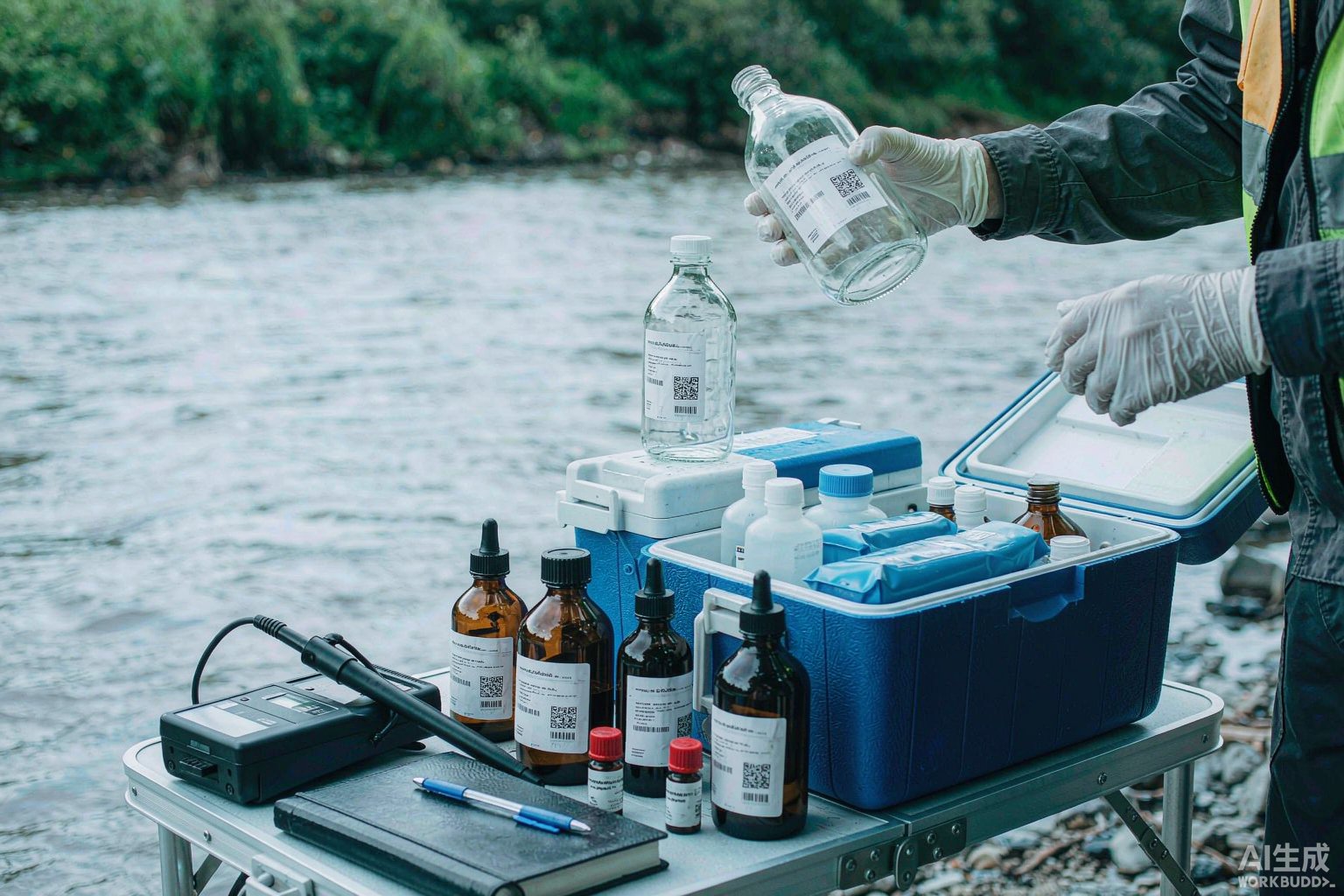
For CDC, environmental monitoring stations, third-party testing laboratories, and hospital wastewater monitoring positions, this selection sequence can be directly implemented as a single criterion: for any parameter requiring acid or alkali fixation, the label face stock must first pass the chemical resistance threshold; otherwise the label will fail during transport before the sample does. BRD's long-standing expertise in low-surface-energy adhesion and chemical-resistant face stocks is precisely built around scenarios where "the label fails before the contents do."
II. Three Fundamental Differences Between Water Quality Sampling Labels and Biological Specimen Labels
2.1 Bottle Diameter Is Not Tight; Chemical Exposure Is the Primary Challenge
The primary constraint for biological specimen identification is space: a 0.5 mL cryovial has an outer diameter of approximately 8 mm and an available arc length of approximately 25 mm; a 12×75 mm flow cytometry tube has an arc length of approximately 37.7 mm, forcing label width down to within 32 mm—sometimes even requiring DataMatrix instead of 1D barcodes. Water quality sampling is completely the opposite: a 500 mL rigid glass bottle (designated G in HJ 493-2009) has an outer diameter of approximately 80 mm and an available arc length of approximately 251 mm; a 250 mL polyethylene bottle (designated P) has an outer diameter of approximately 60 mm and an arc length of approximately 188 mm. Even with a label width of 60 mm, this occupies only 24%–32% of the arc length—application orientation is stable, and the barcode can have a complete quiet zone.
2.2 Time Is a Hard Constraint: The Label Must Carry "When It Expires"
The failure criterion for biological specimens is typically "how long can it be stored frozen and still be recoverable," measured in months or years; the failure criterion for water quality samples is measured in hours. Per HJ 493-2009 Table 1, BOD5 can be held for only 12 h at 1–5 °C in the dark; ammonia nitrogen with H2SO4 to pH≤2 can be held for 24 h; total phosphorus 24 h; COD and permanganate index 2 d; total nitrogen and TOC 7 d; suspended solids 14 d. This means the sampling time must be accurate to the minute and printed on the label, so that the laboratory can automatically calculate the remaining holding time upon receipt; expired samples are directly blocked in the LIMS and no longer enter the analytical queue.
2.3 Field Conditions Are Uncontrollable: Wet Hands, Rain, and Ice-Water Mixture
Biological specimen labeling takes place on the bench: 18–26 °C, 40%–60% RH, dry hands, no water film on the bottle wall. Water quality sampling takes place at riverbanks, outfalls, and water treatment plant sedimentation tanks: summer relative humidity can exceed 85%, winter bottle wall temperatures may be below 5 °C, sampling personnel wear wet nitrile gloves, bottles come out of the sampler with water on the exterior, and a condensation film forms within 10 min of placement in the cooler. The label's initial tack must hold under "cold + wet + water film + single-hand pressing" conditions—this is the part that cannot be directly transferred from laboratory labeling experience.
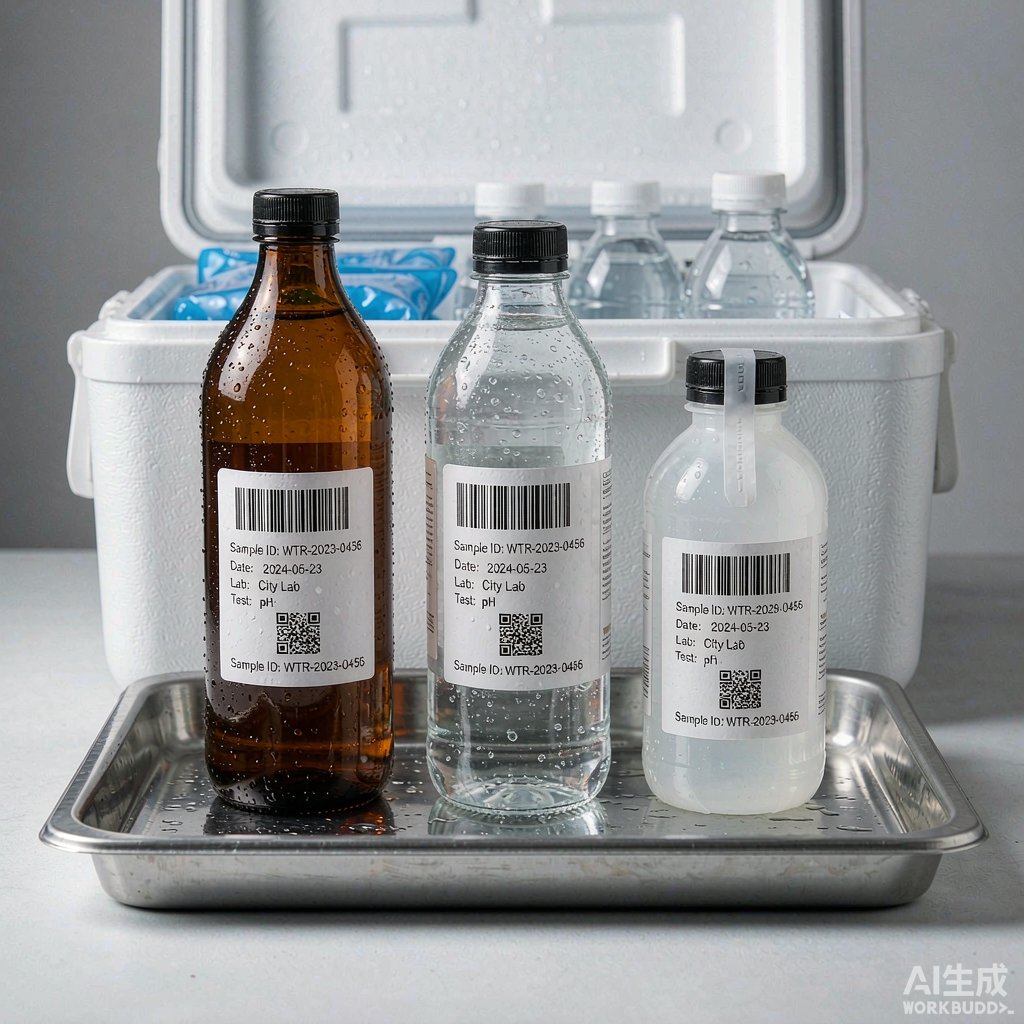
III. Preservative Chemical Exposure: The First Threshold for Face Stock Selection
3.1 Acid Preservation: H2SO4, HCl, HNO3 to pH≤2
Acidification is the most common fixation method in water quality sampling. Per HJ 493-2009, COD requires H2SO4 to pH≤2; TOC likewise requires H2SO4 to pH≤2; total phosphorus requires HCl or H2SO4 to pH≤2; total nitrogen requires H2SO4 to pH 1–2; petroleum requires HCl to pH≤2; metals (copper, lead, zinc, cadmium) require concentrated HNO3 to 1% HNO3 content. Acid addition is performed in the field using dropper bottles or pipettes—dripping onto the bottle shoulder is routine. If the label is applied within 20 mm below the shoulder, it will be directly soaked in acid. The face stock must be a chemical-resistant grade, and the printed layer must be protected by ribbon or overlaminate; otherwise the acid will first dissolve the printed content and then attack the face stock.
3.2 Alkali Preservation: NaOH to pH≥12
Cyanide requires NaOH to pH≥12 and can be held for 24 h; hexavalent chromium requires NaOH to approximately pH 8 and can be held for 24 h. Strong alkali saponification of ester-based face stocks is more insidious than strong acid—the label may appear intact, but the adhesive layer has undergone interfacial hydrolysis and may detach entirely under the vibration of refrigerated transport. Labels for alkalized samples must undergo a "2 h post-application recheck": after field recording, before packing, run a fingertip along the label edge to confirm no lifting.
3.3 Dechlorination and Antioxidant: Ascorbic Acid, Sodium Thiosulfate, Copper Sulfate
Samples containing residual chlorine (especially drinking water and wastewater treatment plant effluent) require dechlorination before refrigeration, typically with ascorbic acid or sodium thiosulfate; volatile phenol samples require phosphoric acid to pH≤2 plus copper sulfate at approximately 1 g/L, holding for 24 h; organic indicators per GB/T 5750.2-2023 require addition of ascorbic acid per liter of water sample to prevent oxidative interference. These additives themselves leave residual crystals at the bottle mouth; crystals absorb moisture and form localized high-concentration microzones, causing more severe attack on label corners than uniform immersion. Therefore, labels should avoid the crystal enrichment zone 15 mm below the bottle mouth threads.
3.4 Field Fixation: Manganese Sulfate and Alkaline Potassium Iodide-Sodium Azide
Dissolved oxygen (DO) is a field-fixation parameter: manganese sulfate and alkaline potassium iodide-sodium azide solution are added to the DO bottle at sampling to form a flocculent precipitate, holding for 24 h, with a sample volume of 250 mL. DO bottles are typically 250 mL ground-glass-stoppered bottles; the stopper and bottle body must be labeled together, otherwise once the fixed bottle is separated from its record, the data becomes untraceable.
3.5 Labeling of Preservative Bottles Themselves: GB 15258 and GB 30000
The concentrated H2SO4, concentrated HNO3, and NaOH solutions carried in the sampling kit are themselves hazardous chemicals; their dispensing bottles must bear safety labels per GB 15258 "Rules for the Compilation of Chemical Safety Labels" and the GB 30000 series (Specification for Classification and Labeling of Chemicals), including pictograms, signal words, hazard statements, and precautionary statements. Safety labels on preservative bottles and traceability labels on sample bottles are two separate systems and must not share the same label format; graphical symbols such as ISO 7010 W009 (general warning category) are used only for safety identification and do not enter the sample traceability code.
IV. 0–4 °C Cold Chain and Field Wet-Cold Conditions: The Second Threshold for the Bonding Interface
4.1 Field Sampling: Wet Hands, Rain, and Low Temperature
The establishment of pressure-sensitive adhesive initial tack depends on two conditions: the interface temperature is above the adhesive's minimum film-forming temperature, and there is no continuous water film at the interface. Both may fail under field conditions. Three feasible countermeasures: wipe the bottle wall dry with a lint-free cloth before labeling (one pass for glass bottles; two passes for polyethylene bottles, which are hydrophobic and more prone to water droplet retention); apply no less than 10 N of roller pressure for 3–5 s after labeling—single-point pressing is ineffective; in winter, pre-warm labels and bottles in the vehicle to above 10 °C before application to prevent the adhesive from losing flow at near 0 °C.
4.2 Refrigerated Transport: 0–4 °C Condensation and Light Protection
HJ 493-2009 requires 1–5 °C storage in the dark for most parameters; GB/T 5750.2-2023 requires 0–4 °C refrigeration in the dark for drinking water, using coolers with blue ice during transport. Light protection is typically achieved with black plastic bags or opaque transfer boxes, but this introduces a side effect: labels cannot be confirmed visually or by scanner in the dark. When the box is opened for batch scanning, if any label has detached en route, the identity of the entire batch is interrupted. Therefore, a two-level "box number–bottle position" coding should be established between the transport unit and the sample bottles, so that even if an individual bottle label is damaged, the identity can still be reconstructed from the box position number.
4.3 -20 °C Frozen Storage and the -40 °C Boundary
Some parameters use -20 °C freezing: per HJ 493-2009, BOD can be preserved for 1 month at -20 °C (1 month when concentration is below 50 mg/L), and dissolved phosphate can be preserved for 1 month at -20 °C. -20 °C is above -40 °C, falling within the above -40 °C range; therefore, as long as the entire transport chain does not go below -20 °C, the temperature threshold for selection falls at the -40 °C grade—there is no need to force selection at the -80 °C or -196 °C grade. Conversely, if a -80 °C freezer hold or liquid nitrogen vapor-phase transport is introduced into the chain, the threshold immediately rises to the corresponding grade, and both the face stock and the overlap method must change accordingly.
V. Timeliness: Printing the "Maximum Holding Time" Directly on the Bottle
5.1 HJ 493-2009 Holding Times and Sample Volumes
| Monitoring parameter | Sampling container | Preservative and fixation method | Holding time | Minimum sample volume |
|---|---|---|---|---|
| pH | P, G | None (determine on site where possible) | 12 h | 250 mL |
| Color | P, G | 4 °C refrigeration (determine on site where possible) | 12 h | 250 mL |
| Turbidity | P, G | 4 °C refrigeration in the dark | 12 h, 24 h in the dark | 250 mL |
| Conductivity | P, G | 4 °C refrigeration in the dark | 12 h, 24 h in the dark | 250 mL |
| Suspended solids | P, G | 1–5 °C in the dark | 14 d | 500 mL |
| Acidity | P, G | 1–5 °C in the dark, full bottle sealed | 30 d | 500 mL |
| Alkalinity | P, G | 1–5 °C in the dark, full bottle sealed | 12 h | 500 mL |
| COD | G | Add H2SO4 to pH≤2 | 2 d | 500 mL |
| Permanganate index | G | 1–5 °C in the dark | 2 d | 500 mL |
| Dissolved oxygen DO | DO bottle | Field fixation with manganese sulfate and alkaline potassium iodide-sodium azide | 24 h | 250 mL |
| BOD5 | DO bottle | 1–5 °C in the dark (frozen can hold 6 months) | 12 h | 250 mL |
| TOC | G | Add H2SO4 to pH≤2 | 7 d | 250 mL |
| Total phosphorus | P, G | Add HCl or H2SO4 to pH≤2 | 24 h | 250 mL |
| Ammonia nitrogen | G, P | Add H2SO4 to pH≤2 | 24 h | 250 mL |
| Total nitrogen | P, G | Add H2SO4 to pH 1–2 | 7 d | 250 mL |
| Copper, lead, zinc, cadmium | P | Add concentrated HNO3 to 1% content | 14 d | 100–250 mL |
| Hexavalent chromium | G | Add NaOH to approximately pH 8 | 24 h | 250 mL |
| Cyanide | G, P | Add NaOH to pH≥12 | 24 h | 500 mL |
| Volatile phenols | G | Add phosphoric acid to pH≤2, add copper sulfate approximately 1 g/L | 24 h | 500 mL |
| Petroleum | G | Add HCl to pH≤2 (do not rinse the sampling bottle) | 24 h | 1000 mL |
Table note: G = rigid glass bottle, P = polyethylene bottle (container). Data sourced from HJ 493-2009 Table 1 and the Ministry of Ecology and Environment's "National Surface Water Environmental Quality Monitoring Network Monitoring Task Work Instruction"; specific parameters are subject to the currently effective version of the standard.
5.2 Sampling Time Accurate to the Minute and Timeout Blocking
The time field on the label should be accurate to the minute (format YYYYMMDD-HH:mm) and written synchronously into the barcode. When the laboratory scans at receipt, the system automatically retrieves the maximum holding time from HJ 493-2009 by parameter and calculates the remaining time; samples with less than 2 h remaining are automatically flagged red and enter the priority queue, while expired samples are rejected and a nonconformity record is generated. Without minute-level timestamps, it is impossible to prove that samples were analyzed within the holding time—this is one of the most common traceability deficiencies in CNAS assessments based on ISO/IEC 17025:2017.
VI. Sampling Container Materials and Label Matching
6.1 Rigid Glass Bottles G, Polyethylene Bottles P, DO Bottles
| Container code | Typical material | Surface energy | Label adhesion key points |
|---|---|---|---|
| G (rigid glass bottle) | Soda-lime glass / borosilicate glass | Approximately 70 mN/m (clean state) | High surface energy, easy adhesion; but hydrophilic—forms a continuous water film after condensation, requiring drying and roller pressure |
| P (polyethylene bottle) | HDPE / LDPE | 29–31 mN/m | Low surface energy, requires high-initial-tack adhesive system; do not wipe bottles with silicone-containing cleaners—silicone residue permanently reduces adhesion |
| Amber glass bottle | Soda-lime glass (light protection) | Approximately 70 mN/m | Used for light-sensitive parameters; label color must contrast with the amber background—white face stock with dark printing is recommended |
| DO bottle | Ground-glass, stoppered | Approximately 70 mN/m | Bottle body and stopper must be labeled as a pair; stoppers are easily mixed up after removal—high-temperature-resistant labels on the stopper handle are recommended |
| Headspace bottle (VOCs) | Borosilicate glass + septum | Approximately 70 mN/m | Must be filled with no bubbles; labels must not cover the septum or bottle mouth sealing surface |
6.2 Surface Energy and Adhesion: Countermeasures for PE / PP at 29–31 mN/m
Polyethylene and polypropylene have surface energies of only 29–31 mN/m, far below the threshold required for good wetting by pressure-sensitive adhesives. Three countermeasures: select a high-initial-tack adhesive system (modified acrylic or rubber-based, not general-purpose acrylic); increase contact area (label width no less than 40 mm, conforming to the curved bottle surface); extend curing time (avoid severe temperature fluctuations within 24 h after application to allow the adhesive to complete wetting). GB/T 2792-2014 (peel strength) and GB/T 4851-2014 (shear adhesion) are two verifiable method standards for determining whether an adhesive system meets requirements; actual measured data for both should be requested during selection.
VII. Code Structure and Barcode Readability
7.1 Point Code + Unique Sample Number
| Field | Digits | Example | Basis |
|---|---|---|---|
| Section / point code | 6 | SH-014 | Point number designed per HJ 495-2009 sampling plan, bound to GIS coordinates |
| Sampling date | 8 | 20260926 | YYYYMMDD |
| Sampling time | 4 | 0837 | HH:mm, accurate to the minute |
| Parameter code | 3 | COD | Consistent with LIMS test parameter dictionary |
| Preservative flag | 2 | A2 / B12 | A2 = acidified to pH≤2; B12 = alkalized to pH≥12; N = none |
| Sample type | 2 | SA / FB / TB | Routine sample / field blank / transport blank; PA = parallel sample |
| Sequence number | 3 | 007 | Sequential number for the same point and time period |
Complete example: SH-014-20260926-0837-COD-A2-SA-007. This string is approximately 32 characters; encoded in Code 128 it requires approximately 190 modules, which at 0.25 mm narrow module width is approximately 47.5 mm, plus quiet zones on both sides approximately 57.5 mm—well within the 251 mm arc length of a 500 mL glass bottle. This is also why water quality sampling does not need to switch to DataMatrix as narrow tubes do.
7.2 Trade-offs Between DataMatrix and Code 128
When space is ample, Code 128 is preferred: it has the best reader compatibility—both laser scanners and image-based scan engines can read it—and its error tolerance relies on check characters, providing some resistance to localized damage. DataMatrix's advantage is high density in a small area (the same 32 characters can be compressed to 6–8 mm square), suitable for use as a redundant backup code on narrow areas such as the bottle shoulder. Recommended approach: use Code 128 for the primary code on the bottle body and add a DataMatrix backup code on the bottle shoulder with identical content, so that either one remains readable if the other is damaged.
7.3 ISO/IEC 15416 / 15415 and Ribbon Matching
Barcode quality is assessed per ISO/IEC 15416 (1D barcode print quality) and ISO/IEC 15415 (2D barcode print quality); a grade of no less than C (1.5) is generally required for stable reading. After exposure to acid splashes, condensation, and cooler abrasion, barcode grades will degrade significantly; therefore, the factory print grade should be no less than B (2.5) to provide margin. The printing ribbon must be resin-based: wax-based and wax/resin ribbons are insufficient in chemical resistance and abrasion resistance to support the transport of acidified samples—this is consistent with the ribbon selection logic for biological specimen LN₂ labels.
VIII. Labeling of Quality Control Samples
8.1 Field Blanks, Whole-Program Blanks, Transport Blanks, and Parallel Samples
Both GB/T 5750.2-2023 and HJ 91.1-2019 require quality control samples, including field blanks (blank water brought to the site, exposed to the same environment, and sealed and transported identically), whole-program blanks (blank water carried through the entire process from sampling to analysis), transport blanks (to assess whether the transport stage introduces contamination), and parallel samples (two independent samples collected simultaneously at the same point). Quality control samples must use exactly the same label format and coding rules as routine samples, distinguished only by the "sample type" field (TB / FB / PA in the table above). Using different colored labels to distinguish QC samples may seem intuitive, but it actually allows sampling personnel to "pre-judge" results in the field, undermining the purpose of blind samples; the correct approach is to distinguish by code while keeping appearance identical.
8.2 Spiked Samples and Preservative Blanks
Field spiked samples are used to assess matrix effects, and preservative blanks are used to verify whether preservatives introduce target analytes. Labels on these two types of samples must additionally indicate the standard solution lot number and actual spike volume; otherwise spike recovery cannot be traced. It is recommended to reserve a line in the label's variable information area for "SPK: lot/concentration/volume," to be filled in by hand in the field or printed on-site with a portable label printer.
IX. Material Selection Matrix: Grade by Lowest Temperature Across the Entire Chain
During selection, first determine the lowest temperature experienced across the entire chain from sampling to analysis, then select the grade from the table below. Note that the official material guide table does not list a separate application column for water quality sampling bottles; therefore, the table below provides selection boundaries by temperature grade and chemical exposure. Specific materials and temperature resistance are subject to the product specification sheet; contact the product manager for selection assistance.
| Lowest temperature grade across entire chain | Available models at this grade | Typical stages in water quality sampling and application requirements |
|---|---|---|
| Liquid nitrogen -196 °C | T629, T459, T429, T439, T409, T424, T509 | Control samples, proficiency testing samples, and reference materials requiring long-term deep cryogenic storage; overlap must be completed before entering the LN₂ environment, with an overlap of no less than 3 mm, and the overlap must not cover the barcode |
| Freezer -80 °C | T629, T459, T429, T439, T409, T509 | Heavy metal and organic samples held in a -80 °C freezer before analysis; confirm no continuous water film on the bottle wall before holding, otherwise frost will lift the label edges |
| Hot water 100 °C | T629, T459, T429, T439, T409, T509 | Reusable rigid glass sampling bottles requiring hot water bath rewarming or high-temperature cleaning; cleaning and reuse procedures per laboratory ware management regulations; after cleaning and complete drying, re-labeling is required before entering the next batch |
| Autoclave 121 °C | T629, T459, T429 | Microbiological parameter sampling bottles require autoclaving before sampling; labels must be applied before autoclaving; after autoclaving, inspect each bottle for print integrity; ware status must be traceable |
| Refrigerated 0–4 °C / Frozen -20 °C | T409, T509, T629, T625 | The routine stage for the vast majority of water quality samples, including BOD and dissolved phosphate samples preserved frozen at -20 °C for 1 month; this temperature range is above -40 °C, so the above -40 °C grade applies |
| Ambient transfer box reuse scenarios | T625 | Box number labeling for transfer boxes and coolers; must be completely removed after the sampling batch ends—requires removable with no adhesive residue |
| Above -40 °C (including -40 °C) | T329, T419 | For -20 °C frozen samples only; not for lower-temperature stages |
Note that the table above provides selection boundaries by temperature grade; the official material guide also includes dedicated versions for special processes (samples involving xylene and H&E staining processes require the specified ribbon series), as well as styles with 6-color pre-printed tops for color-coding by container type, whose applicable ranges are not entirely consistent with general-purpose versions. Specific materials and temperature resistance are subject to the product specification sheet; contact the product manager for selection assistance.
X. Six-Step Implementation SOP
10.1 Step One: Determine Preservatives by Test Parameter
Export the parameter list for this task from the LIMS, look up each parameter in HJ 493-2009 or GB/T 5750.2-2023, and determine the corresponding container code (G or P), preservative type and amount, holding time, and minimum sample volume. The output of this step is a four-column cross-reference table of "parameter–container–preservative–holding time," on which all subsequent label decisions are based.
10.2 Step Two: Determine Face Stock by Preservative
Handle in three categories: for parameters requiring acid to pH≤2 or alkali to pH≥12, select a chemical-resistant grade face stock with resin-based ribbon; for parameters requiring organic solvent extraction or xylene resistance, select the corresponding solvent-resistant version with the specified ribbon series; for parameters requiring no chemical fixation (e.g., physical parameters requiring only refrigeration), select the routine refrigerated grade.
10.3 Step Three: Select Grade by Lowest Temperature Across the Entire Chain
Confirm the coldest point in the chain: if only 0–4 °C refrigeration, use the refrigerated grade; if -20 °C freezing is involved, use the above -40 °C grade; if -80 °C or -196 °C is involved, the grade must be raised accordingly, with overlap performed per official requirements (overlap no less than 3 mm).
10.4 Step Four: Design the Code and Print Template
Define the coding rules per the seven-field structure in Section VII, and build the template in the label software: the primary Code 128 carries the complete code, the bottle shoulder DataMatrix serves as redundant backup, and the human-readable text area prints the point code, parameter code, sampling time, preservative flag, and expiration time. The expiration time is automatically calculated by the system at print time based on the holding time and printed as "Expires MM-DD HH:mm."
10.5 Step Five: Field Labeling and Recheck
Wipe the bottle wall dry → avoid the crystal enrichment zone 15 mm below the bottle mouth threads and the acid drip zone on the bottle shoulder → position and apply → apply no less than 10 N roller pressure for 3–5 s → before packing, run a fingertip along the label edge once more → record box number and bottle position. In winter at low temperatures, pre-warm labels and bottles in the vehicle to above 10 °C first.
10.6 Step Six: Receipt Scanning and Timeliness Blocking
At laboratory receipt, scan the box number first, then scan each bottle; the system automatically compares the sampling time with the maximum holding time; samples with less than 2 h remaining are flagged red for priority, and expired samples are rejected with a nonconformity generated. Labels with a scan grade below C are manually re-entered and recorded in the consumables evaluation.
XI. Common Failures and Troubleshooting
| Failure symptom | Direct cause | Troubleshooting points | Corrective action |
|---|---|---|---|
| Printed content dissolved by acid | Insufficient ribbon chemical resistance | Check whether resin-based ribbon is used; confirm print energy matches ribbon | Switch to resin-based ribbon; if necessary, use face stock with a protective structure |
| Label detaches entirely | Alkali causes interfacial hydrolysis of adhesive layer | Observe whether adhesive residue remains on the detached surface; verify whether preservative contains NaOH | Switch to chemical-resistant face stock; add 2 h post-application recheck step |
| Edges lift after packing | Water film on bottle wall not dried, or low-temperature labeling in winter | Reproduce labeling temperature and bottle wall condition | Dry bottle wall, pre-warm to above 10 °C, increase roller pressure |
| Barcode cannot be scanned | Acid mist or condensation reduces barcode contrast | Retest grade per ISO/IEC 15416 | Raise factory grade to B; add bottle shoulder backup code |
| QC samples "singled out" |