
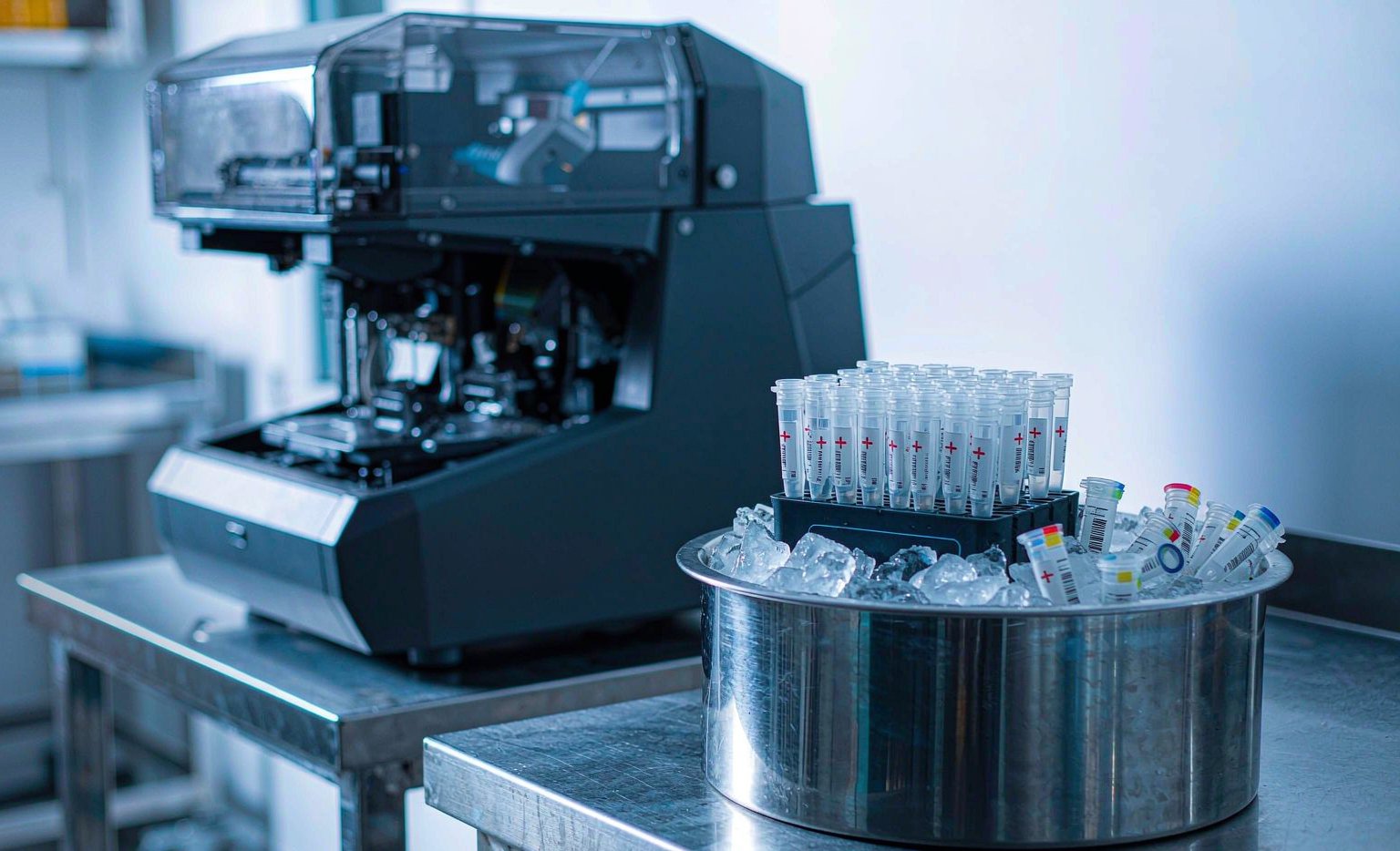
In the context of biobanks, cryogenic label selection has become almost a fixed formula: look at the lowest temperature endpoint first, then work backward to the material. This formula holds for cryovials, cryoboxes, and LN₂ dewars, but it fails when applied to collection tubes for cell sorting. For FACS and MACS product tubes, label failure is in the vast majority of cases not caused by freezing, but by condensation on the tube wall during the ten-odd minutes after sorting ends—when the sample is most precious—making labels impossible to apply, or causing them to peel off once applied.
1. Conclusion First: The Selection Sequence for Cell Sorting Collection Tubes Is the Reverse of That for Biobanks
Conclusion: For cell sorting collection tube label selection, the first determining factor is "labeling timing," not "minimum temperature." Labels must be applied before the instrument begins sorting and pre-cooled to 2–8 °C together with the empty tubes; labeling after sorting ends means staking the traceability of the entire product on a film of condensation.
The three supporting conditions for this conclusion all relate to "irreversibility":
- The product cannot be recovered. The recommended concentration for a single FACS loading is 20–30×10⁶ cells/mL, with a maximum loading volume of 3–4 mL; sorting speed is typically on the order of 1 000–2 500 events/s (low-pressure setting). Collecting 1×10⁶ cells takes approximately 7–17 min, and the collection tube holds the only copy of the product from that machine time. Discarding the product means re-preparing the single-cell suspension, re-staining, and re-queuing for machine time—at a cost measured in days.
- The labeling window occurs only once. Collection tubes must be pre-loaded with collection medium before running: approximately 3 mL for a 15 mL conical tube, approximately 750 µL for a 5 mL tube, and approximately 100 µL for a 1.5 mL tube. Once the tube is filled, loaded into the sorting chamber, and placed in the 2–8 °C cooled collection position, condensation begins to form on the outer wall; removing it during sorting to label it interrupts the fluid stream and violates the general sorting principle of "maintain low temperature, minimize handling time."
- The low-temperature endpoint is not extreme. Magnetic bead incubation at 2–8 °C, sorting buffer at 2–8 °C, collection chamber at 2–8 °C, transport on ice at 0 °C—the actual operating temperature range falls entirely within the refrigerated zone, not -80 °C or -196 °C. Only when the product is to undergo controlled-rate freezing and long-term LN₂ storage does ultra-low temperature become the primary constraint again.
Therefore, the sequence given in this article is: labeling timing → geometric window → temperature chain → media attack → material mapping → coding uniqueness. Material selection is placed fifth—this is the biggest difference between this article and biobank selection.
2. Why "Label First, Sort Later" Is a Hard Constraint: Three Real Failure Paths
Establishing "label first" as a hard constraint is not process purism, but because retroactive labeling simultaneously runs into three failure modes:
- The condensation film lifts the adhesive layer. When a collection tube is taken from a 2–8 °C environment to room temperature, condensation forms once the tube wall temperature drops below the dew point. The initial tack of pressure-sensitive adhesive on a water film drops sharply, and the label peels off entirely after the tube is returned to low-temperature storage.
- Double error from curved surfaces and wet hands. A 5 mL round-bottom tube has an outer diameter of only 12 mm; manual labeling in a wet, slippery state easily leads to misalignment and wrinkling, and a misaligned label will crack along the wrinkles in -196 °C LN₂ due to thermal expansion differences.
- Coded information is lost on the spot. Sorting is a "one tube, one product" operation; numbering uniqueness can only be carried by pre-printed labels—handwriting afterward cannot guarantee consistency with the sorting batch number in the LIMS.
The three accompanying operating disciplines: first, pre-cool labels and tubes in the same batch to avoid thermal stress from applying room-temperature labels to cold tubes; second, complete printing and labeling before running, and let the tube sit briefly after labeling before loading; third, prepare at least 2 labels per product (tube body + backup record), and since retaining 3–5 backup tubes per cryovial is standard practice in cell banks, label quantities should align with this.
3. Geometric Window: Labelable Area for Each of the Four Collection Container Types
There are four common collection container types for FACS: 1.5 mL microcentrifuge tubes, 5 mL (12×75 mm) polypropylene round-bottom tubes, 15 mL conical tubes, and 96-well plates for single-cell sorting. Their differences lie not in material but in "how much area a label can occupy."
| Collection Container | Nominal Size | Outer Diameter / Key Dimension | Circumference (max labelable width) | Usable Side Wall Height | Recommended Label Size |
|---|---|---|---|---|---|
| 1.5 mL microcentrifuge tube | 1.5 mL, conical bottom | Outer diameter approx. 11 mm | Approx. 34.6 mm (80% ≈ 27.7 mm) | Approx. 18–20 mm (conical bottom section not labelable) | ≤25 mm wide |
| 5 mL polypropylene round-bottom tube | 12×75 mm | Outer diameter 12 mm | Approx. 37.7 mm (80% ≈ 30.2 mm) | Approx. 30–35 mm | 25–30 mm wide |
| 15 mL conical tube | 17×120 mm | Outer diameter approx. 17 mm | Approx. 53.4 mm (80% ≈ 42.7 mm) | Approx. 50–60 mm | 30–40 mm wide |
| 96-well plate (single-cell sorting) | ANSI/SLAS 1-2004 footprint 127.76×85.48 mm, well spacing 9 mm | Only plate side face and plate bottom labelable | Plate side face long edge approx. 127 mm | Side face height approx. 14 mm | Plate-side strip label; covering wells prohibited |
This table determines two things: first, label width cannot simply copy cryovial specifications; second, the curved surface of round-bottom tubes requires a material with good conformability—wrap-around labels (T509 vinyl wrap-around) conform better on 12 mm tube diameters than rigid face stocks.
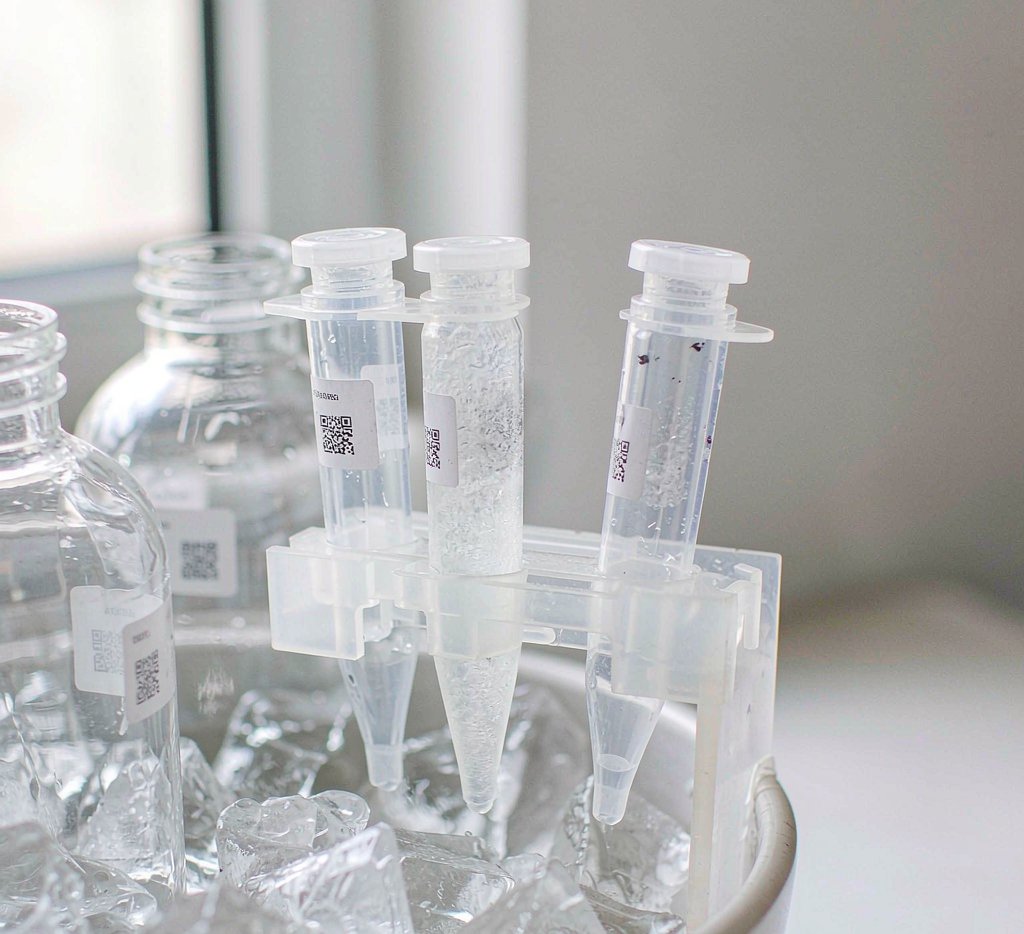
4. Temperature Chain: Six Temperature Zones from 2–8 °C Pre-Cooling to -196 °C LN₂
Breaking the entire workflow into six temperature zones gives material selection a clear reference table, rather than relying on an impressionistic, vague claim of "low-temperature resistance."
| Stage | Temperature | Typical Duration | Stress on Label | Material Requirement |
|---|---|---|---|---|
| Magnetic bead labeling incubation | 2–8 °C (protected from light) | 15 min | Condensation + light protection | Standard cryogenic adhesive, room-temperature grade sufficient |
| Sorting buffer and loading | 2–8 °C | Depends on sort volume, typically 10–60 min | Condensation | Standard cryogenic adhesive |
| Collection chamber cooling | 2–8 °C | Concurrent with sorting | Continuous condensation + droplet impact | Water-resistant, droplet-erosion resistant |
| Transport on ice | 0 °C | Minutes to tens of minutes | Condensation + ice water immersion | Water-resistant, conformable |
| Cryopreservation solution resuspension | 4 °C (pre-cooled cryopreservation solution) | Minutes | 10% DMSO solvent contact | Solvent-erosion resistant, chemical-resistant |
| Controlled-rate freezing and long-term storage | -1 °C/min → -80 °C overnight 12–36 h → -196 °C LN₂ | Overnight + long-term | Deep low-temperature embrittlement + repeated freeze–thaw | Requires dual-grade coverage of -80 °C and -196 °C |
Note the dual-grade requirement in the last row: if the product is only used for same-day downstream experiments (flow cytometry re-analysis, smears, plating), the endpoint temperature is 2–8 °C or a 37 °C incubator, unrelated to ultra-low temperature; once the product enters the cryopreservation route, it must cover both the -80 °C and -196 °C endpoints, and the two cannot substitute for each other.
5. The Real Enemy Is Not Low Temperature: Condensation Film, DMSO, and 100% Serum Pre-Coating
Ranked by frequency of occurrence, the top three causes of label failure on sorting collection tubes are none of them "freezing damage":
- Condensation film. Present throughout the 2–8 °C to 0 °C process, it is the number one cause of adhesive layer failure. Countermeasures: pre-cool before labeling + wipe the tube wall dry when labeling + select face stocks with cryogenic adhesive formulations.
- DMSO attack. Standard cryopreservation solution is 90% serum + 10% DMSO (or basal medium:serum:DMSO = 7:2:1), with a cryopreservation density of 1×10⁶–1×10⁷ cells/mL, 1–1.5 mL per tube. DMSO is a strongly polar solvent that swells some face stocks and penetrates the print layer, causing barcode edge diffusion and reduced read grades. DMSO is also toxic to cells at room temperature, so after adding cryopreservation solution the tube should not be left at room temperature for long—this constrains both the procedure and the label: the print must remain readable after DMSO contact.
- Serum pre-coating contamination. To improve post-sort viability, collection tubes are often pre-coated with 100% serum (some protocols incubate for 1 h or overnight coating), or culture medium containing 10%–50% serum is used as collection medium. Protein residue forms an oily interface at the label edge, weakening adhesive layer attachment. The labeling position should avoid the tube section below the collection medium level, and face stocks with good contamination resistance and conformability should be preferred.
There is another often-overlooked constraint on the printing side: thermal-transfer printing with resin-based BRL series cryogenic ribbons requires a matte rather than gloss barcode surface. Gloss surfaces produce specular reflection when covered by a condensation film, the scanner's return light is absorbed by the specular reflection, and the barcode quality grade (ISO/IEC 15416) drops directly.
6. Material Mapping: Applying the Official Guide Table to Sorting Scenarios
The BRD Lab series material guide table provides checkmarks across four temperature grades—"LN₂ -196 °C / freezer -80 °C / hot water 100 °C / autoclave 121 °C"—and seven application object categories. Mapped to sorting scenarios, the trade-offs are very clear.
| Material Code | Official Description | LN₂ -196 °C | Freezer -80 °C | Hot Water 100 °C | Autoclave 121 °C | Room Temp | Sorting Scenario Positioning |
|---|---|---|---|---|---|---|---|
| T629 | Nylon cloth label, easy to apply, high/low temperature resistant, good conformability | √ | √ | √ | √ | √ | The only one covering all four grades; handles everything from 2–8 °C operation to -196 °C long-term storage |
| T509 | Durable vinyl label, suitable for wrapping, good conformability, requires overlap in LN₂ environments | √ | √ | √ | — | — | First choice for 12 mm round-bottom tubes and thin-tube wrap-around labeling |
| T429 | Self-laminating label; when applied to frozen tube surfaces, ends must overlap by at least 3 mm | √ | √ | √ | √ | — | Requires dual-grade -80 °C and -196 °C, and needs to protect printed content |
| T459 | Ultra-thin polyester label, self-laminating label with transparent tail, transparent viewing window to observe liquid level | √ | √ | √ | √ | — | Microtubes, where liquid level observation and 121 °C sterilization are both needed |
| T439 | 6-color cryogenic label, top pre-printed color for quick differentiation | √ | √ | √ | — | — | Color-code differentiation for four-way simultaneous sorting |
| T419 | Glossy white PET material, for cryovials and microcentrifuge tubes, resistant to environments above -40 °C | — | — | — | — | √ | Same-day downstream at 2–8 °C only; not for -80 °C or -196 °C |
| T329 | Matte white PP adhesive, -40 °C low-temperature freezer label | — | — | — | — | √ | Same-day downstream at 2–8 °C only; not for -80 °C or -196 °C |
There are two boundaries in the table that must be followed to the letter: first, the official positioning of T419 and T329 is "resistant to above -40 °C"—they cannot be used for the -80 °C freezer grade, let alone the -196 °C LN₂ grade, even if they perform well at the 2–8 °C sorting operation end; second, the official requirement for T509 is "requires overlap in LN₂ environments"—when wrapping on 12 mm round-bottom tubes, end-to-end overlap must be ensured, not butt-joined flat.
T629 is the material with the broadest fit in this scenario: it is the only model in the guide table checked across all four temperature grades while covering both room-temperature and cryovial application object categories, so a single stock item covers both endpoints—"pre-cooled labeling at the operation end" and "long-term LN₂ storage"—avoiding label changes mid-workflow for the same product, since changing labels is itself a traceability break.
7. Coding and Symbology: Uniqueness Design for "One Tube, One Product" in Four-Way Sorting
Mainstream sorters support four-way simultaneous sorting, producing up to 4 product tubes per run. The goal of coding design is not "looking good," but ensuring that any single tube, taken alone, can answer four questions: which sample it came from, what markers it was sorted by, which channel, and which day it was done.
Recommended coding structure: Sample ID - Sorting marker combination - Channel number - Date - Operator code. For four-way sorting, the top pre-printed 6 colors of T439 can be used as channel color codes for visual分流 without opening caps or scanning, while the barcode carries the complete code.
| Container | Max Labelable Width | Code 128 Usable Characters (X=0.19 mm, quiet zone 10 mm) | Calculated Width | Recommended Solution |
|---|---|---|---|---|
| 1.5 mL tube (circumference 34.6 mm) | Approx. 27.7 mm | ≤8 characters | Approx. 33.37 mm at n=8 | Switch to DataMatrix 18×18 (approx. 4.0 mm) |
| 5 mL tube (circumference 37.7 mm) | Approx. 30.2 mm | ≤8 characters (10 characters leaves only 0.15 mm, marginal, not recommended) | Approx. 37.55 mm at n=10 | Prefer DataMatrix 20×20 (approx. 5.0 mm) |
| 15 mL conical tube (circumference 53.4 mm) | Approx. 42.7 mm | ≤17 characters | Approx. 52.18 mm at n=17 | 1D barcode usable; 2D still recommended for long codes |
| 96-well plate side | Approx. 127 mm | Ample | — | Plate-side 1D barcode + plate number; covering wells prohibited |
1D barcodes are estimated using the Code 128 module count formula M = 11n + 35 (n = number of characters). A 5 mL tube with a 12 mm diameter has only 37.7 mm of usable arc length; after deducting the quiet zone, only about 27.7 mm of encoding area remains, with a capacity of about 8 characters—far from enough to carry the complete coding structure above. Therefore, the mainstream solution for collection tubes is 2D DataMatrix: an 18×18 symbol has a side length of about 4.0 mm and a 20×20 about 5.0 mm, both easily fitting on the usable side wall of 1.5 mL and 5 mL tubes, and ISO/IEC 15415 grade evaluation for 2D symbols also applies to this curved-surface scenario.
8. FACS vs. MACS: Four Differences in Label Requirements
The two technical routes have different operating conditions and therefore different labeling solutions; mixing them causes problems in the details.
| Dimension | FACS | MACS | Impact on Labels |
|---|---|---|---|
| Temperature control | Collection chamber cooled to 2–8 °C, pre-cooled collection tubes | Incubation at 2–8 °C for 15 min, buffer pre-cooled throughout | Both require pre-cooled labeling |
| Container | 5 mL 12×75 mm polypropylene round-bottom tube / 15 mL conical tube / 1.5 mL tube / 96-well plate | 15 mL or 50 mL conical tube for flow-through, MS column 1 mL, LS column 5 mL elution | FACS favors smaller diameters; MACS favors conical tubes |
| Media | Sheath fluid dilution, buffer containing ≤2% serum, or 100% serum pre-coating | Buffer containing 0.5% BSA and 2 mM EDTA, pH 7.2 | Serum pre-coated tubes test adhesive contamination resistance more |
| Time pressure | Under a 70 µm nozzle, droplets impact the liquid surface at approx. 20 m/s; sorting window is tight | Each step requires waiting for the column liquid to drain before adding more; pace is controllable | FACS has a harder requirement to "complete labeling before running" |
MACS has another easily overlooked detail: the buffer used for column rinsing is recommended to be warmed to ambient operating temperature; rinsing a room-temperature column with pre-cooled buffer forms bubbles inside the column and affects sorting performance. This detail shows that "low temperature throughout" is not indiscriminate low temperature—buffer needs pre-cooling, collection tubes need pre-cooling, and labels also need to be applied within the same temperature zone.
9. Standards and Compliance Anchors
Most sorting products enter biobank or clinical research workflows, so the labeling solution needs to map to specific clauses rather than resting on "we've always labeled it this way."
| Standard No. | Related Clause / Topic | Specific Requirements for Sorting Collection Tube Labels |
|---|---|---|
| ISO 20387:2018 | Biobanking—competence and resource requirements | Traceability of samples and associated data; coding unique and uninterrupted throughout |
| ISO 15189:2022 | Medical laboratories—quality and competence | Sample identification and acceptance criteria in pre-examination procedures; identification errors are nonconformities |
| ISO 17025:2017 | Competence of testing and calibration laboratories | Identification and record retention for equipment and consumables; labels must carry verifiable information |
| ISO 13485:2016 | Medical devices—quality management systems | Identification and traceability records for cell therapy products; applies to GMP-grade sorting products |
| ISO/IEC 15416 | Print quality of 1D barcode symbols | Minimum requirements for barcode grade evaluation; condensation and specular reflection must not cause grade drops |
| ISO/IEC 15415 | Print quality of 2D symbols | Grade evaluation method for DataMatrix on small curved surfaces |
| GB/T 2792-2014 | Peel strength of adhesive tapes | Test method for peel force of adhesive layers on low-temperature and moist interfaces |
| GB/T 4851-2014 | Holding tack of adhesive tapes | Creep resistance of adhesive layers under sustained load; corresponds to long-term cryopreservation wall-hanging conditions |
| GB 19489-2008 | General requirements for laboratory biosafety | Identification requirements for containers holding active samples and for waste disposal |
| ANSI/SLAS 1-2004 | Microplate dimensional standard | 96-well plate footprint 127.76×85.48 mm; plate-side labeling must not affect stacking or plate reading |
10. Implementation SOP: Ten Steps from Pre-Cooling to LN₂
| Step | Action | Temperature | Label Action |
|---|---|---|---|
| 1 | Prepare single-cell suspension, filter through 20–70 µm cell strainer | 2–8 °C | Determine sample ID and sorting marker combination |
| 2 | Count and viability assay (viability >90% recommended) | Room temp | Determine number of product tubes; reserve for four channels |
| 3 | Print labels (with complete code and 2D symbol) | Room temp | Select material: for cryopreservation route, choose four-grade full-coverage material |
| 4 | Apply label to empty collection tube; wipe tube wall dry before applying | Room temp | Round-bottom tube wrapping must overlap end-to-end |
| 5 | Pre-cool empty tubes together with buffer | 2–8 °C | Labels cool in sync with tubes, eliminating thermal stress |
| 6 | Add collection medium (approx. 750 µL for 5 mL tube, approx. 3 mL for 15 mL tube) | 2–8 °C | Label position avoids tube section below liquid level |
| 7 | Run sorting; collection chamber maintained at low temperature | 2–8 °C | Do not remove or re-label during the process |
| 8 | Transport product on ice and re-test purity | 0–8 °C | Scan to confirm code matches channel |
| 9 | For cryopreservation, resuspend in pre-cooled cryopreservation solution, 1×10⁶–1×10⁷ cells/mL, 1–1.5 mL per tube | 4 °C | DMSO-resistant material; print must remain readable on re-scan |
| 10 | Controlled-rate freezing at -1 °C/min, -80 °C overnight 12–36 h, transfer to LN₂ | -80 °C → -196 °C | Final scan before storage; write location to LIMS |
There are three scanning nodes in the ten steps (before step 7, at step 8, and at step 10), and label changes are not permitted between the three scans. This is the key to turning the abstract principle of "labeling timing" into auditable actions: the label is applied only once per workflow, and all other stages only perform verification.
Recommended Products
For the label materials and application scenarios covered in this article, the following BRD products are available for selection reference (click to view specifications and request a quote):
- T629样本库-196℃尼龙布耐低温试管生物样本库签化验采样液氮标签(¥999/卷)
- Lab032-629/30x20mm样本库冻存管载玻片-196℃液氮尼龙耐低温标签(询价)
- Lab062-629/25.4x9.53实验室冻存管EP管载玻片-196℃液氮尼龙布(询价)
- Lab084-439/30x15mm样本库冻存管聚酯标签低温生物样本库分类标签(询价)
FAQ
Q1: Will pre-cooling after labeling before sorting cause labels to fall off?
Quite the opposite. Applying room-temperature labels to room-temperature tubes and then cooling everything together means the adhesive layer and tube wall contract in sync, minimizing stress; conversely, applying room-temperature labels to already-condensed cold tubes is the main cause of peeling. The prerequisite is selecting face stocks with cryogenic adhesive formulations and wiping the tube wall dry before labeling.
Q2: If the product will undergo flow cytometry re-analysis the same day, is -196 °C grade material still needed?
No. For products completing downstream experiments the same day, the endpoint temperature is 2–8 °C and a 37 °C incubator, and room-temperature grade is sufficient. Only when the product enters -80 °C controlled-rate freezing and -196 °C LN₂ long-term storage must a material covering both -80 °C and -196 °C grades be used. The determining factor is always the workflow endpoint, not the mid-workflow stage.
Q3: A 5 mL tube is only 12 mm in diameter—can a 1D barcode still fit?
Barely, but it is highly uneconomical. A 12 mm tube has a circumference of about 37.7 mm; after deducting the quiet zone, the encoding area is less than 28 mm, and per the Code 128 module count formula it can hold only about 8 characters—not enough for the complete structure of "sample ID + marker combination + channel + date." Switching to DataMatrix 20×20 (symbol side length approx. 5.0 mm) carries the complete code in the same area.
Q4: Will DMSO dissolve the label print?
DMSO is a strongly polar solvent that swells some face stocks and penetrates the print layer, manifesting as barcode edge diffusion and reduced read grades. Two countermeasures: first, select chemical-resistant and abrasion-resistant face stocks; second, on the printing side use resin-based cryogenic ribbons, avoiding wax-based ribbon migration after solvent contact. After aliquoting, do not leave at room temperature for long; transfer to controlled-rate freezing promptly.
Q5: Four-way sorting produces four tubes at once—how to prevent mix-ups?
Two layers of protection. The first layer is color coding: assign fixed colors to the four channels using top pre-printed 6-color cryogenic labels, enabling visual分流 without opening caps. The second layer is coding: each tube's label carries the complete code "sample ID - marker combination - channel number - date - operator," and is scanned once at each of the three nodes: machine exit, transport, and storage.
Q6: After pre-coating collection tubes with 100% serum, will labels still adhere?
Yes, but the approach must change. Serum residue forms a protein film on the outer tube wall that weakens adhesive layer attachment, so the labeling position should avoid the tube section below the collection medium level and any section likely contaminated by liquid; prefer cloth-based or vinyl face stocks with good conformability, and wipe the tube wall dry with a lint-free cloth before labeling.
Q7: For single-cell sorting in a 96-well plate, where should the label go?
Per ANSI/SLAS 1-2004, the 96-well plate footprint is 127.76×85.48 mm with 9 mm well spacing. Labels should be applied to the plate side face or plate bottom; covering wells and the plate-bottom optical reading area is strictly prohibited. The plate side long edge of about 127 mm provides enough space for a 1D barcode and plate number, while well information is carried by the row/column headers (A–H / 1–12), occupying no label area.
Q8: What if sorting is already finished before realizing no label was applied—is there a remedy?
Directly labeling a condensed cold tube is not recommended. The safer approach: first let the product tube stand at 2–8 °C until the tube wall warms and dries, then label; if the product has already entered -80 °C or LN₂, first transfer to gas-phase LN₂ temporary storage, warm to an operable range, wipe the tube wall dry, then label, and simultaneously record this "delayed labeling" event in the LIMS as a traceable timestamp