
Introduction
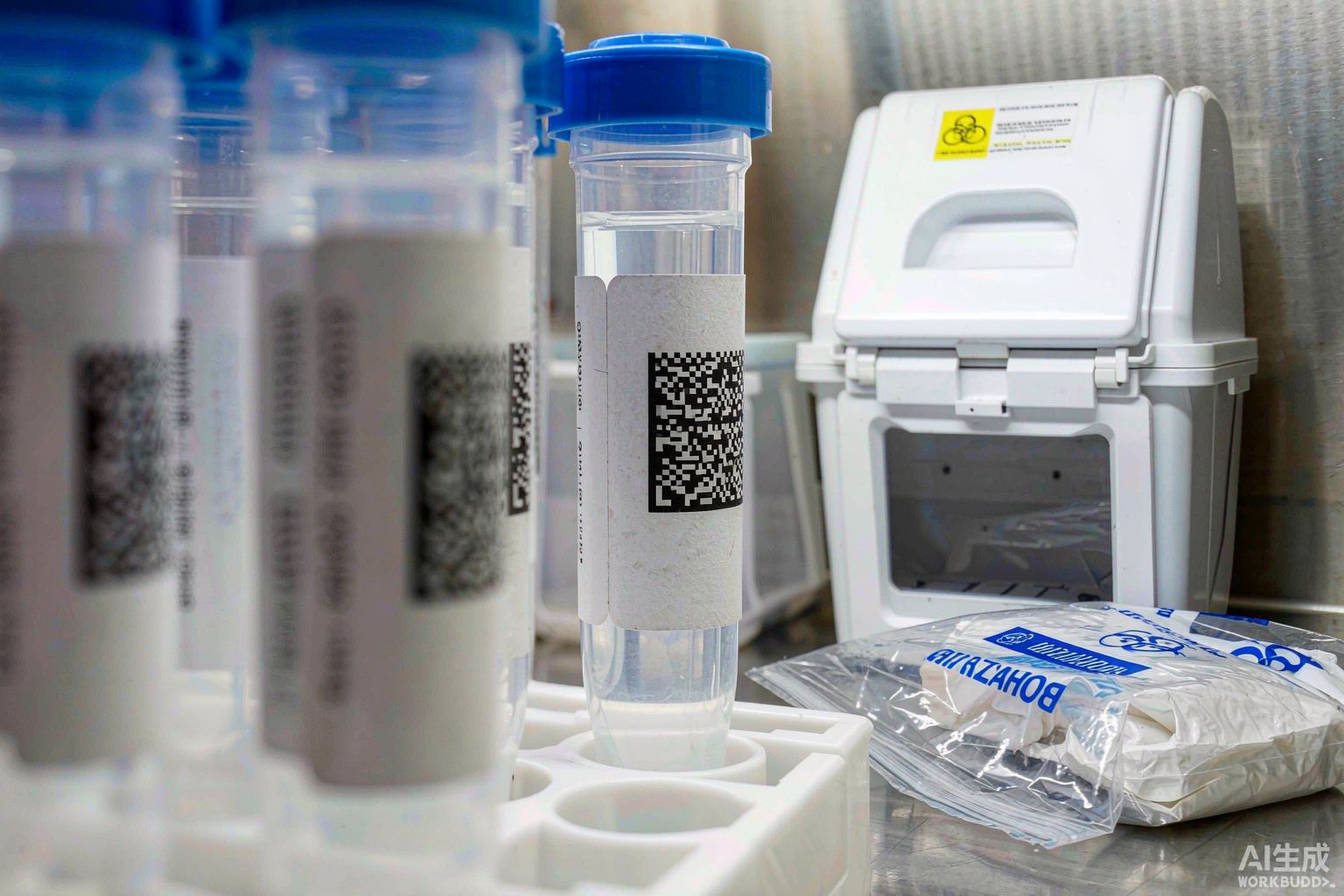
Conclusion first: the primary constraint on viral sampling tube labels is not ultra-low temperature, but the "curved-surface geometry imposed by a 16.20 mm tube diameter" combined with "chemical exposure to the preservation solution retained inside the tube"; temperature ranks only third. Taking the most common 10 mL disposable viral sampling tube in Class I medical device filing information as an example, the tube mouth outer diameter is 16.20 mm ± 0.2 mm, tube length 97.90 mm ± 0.5 mm, cap height 13.68 mm ± 0.2 mm, cap outer diameter 20.72 mm ± 0.2 mm, and the circumference around the tube mouth is π × 16.20 ≈ 50.89 mm. This number determines two things at once: a flat label can occupy less than half the circumference at most, and the printable length of a barcode is limited to this arc length.
Inside the tube is 1–20 mL of preservation solution, with pH controlled at 5.0–8.5 per product technical requirements, volume tolerance not exceeding ±10% of nominal capacity, and inter-batch pH variation not exceeding 0.5; the sampling tube body is manufactured per YY/T 0242-2007 "Polypropylene special material for medical infusion, transfusion, and injection devices." The resulting chain of requirements is: the label must simultaneously withstand 75% ethanol spraying at the sampling site, refrigerated condensation after boxing for several hours, cryogenic embrittlement during long-term storage, and repeated handling friction during transport.
1. Physical Baseline of Viral Sampling Tube Labels
1.1 Conclusion First: Three Steps to Determine a Usable Material Grade
Selection follows a fixed sequence, which eliminates most rework.Step one, ask about tube diameter: an outer diameter of 16.20 mm corresponds to a circumference of 50.89 mm; if flat application without edge lifting is required, the label width should fall around 12.7 mm; if a longer barcode and full text must be carried, switch to wrap-around format, with length taken as "circumference + overlap ≥ 3 mm" ≥ 53.89 mm.Step two, ask about chemistry: the preservation solution inside the tube constitutes continuous chemical exposure, and the outer wall is sprayed with 75% ethanol before boxing, so the face stock must have chemical and alcohol-wipe resistance, and the printed layer must use a thermal-transfer resin-based ribbon.Step three, only then ask about temperature: the natural chain for a sampling specimen is 25 °C room temperature (should not exceed 4 hours) → 4 °C refrigeration (testing within 24 hours) → -70 °C or below for long-term storage (when -70 °C is unavailable, -20 °C temporary storage), and the material grade is ultimately selected according to the lowest temperature in the chain.
Writing these three steps into procurement technical conditions is more reliable than copying an old checklist: it simultaneously covers the three failure root causes of geometry, chemistry, and thermodynamics, and facilitates item-by-item verification during incoming material evaluation.
1.2 The Geometry of a 16.20 mm Tube Diameter: How Much Arc Length Can a Flat Label Occupy
Treat the sampling tube as a cylinder with radius R = 8.10 mm. For a flat label of width w fully conformed, the occupied central angle converted to common grades is as follows:
| Central angle | Occupied arc length (mm) | Adhesion reliability | Recommended face stock |
|---|---|---|---|
| 60° | 8.48 | Extremely high, almost no edge-lifting risk | Rigid polyester face stocks usable |
| 90° | 12.72 | High, safe zone for standard polyester | Polyester |
| 120° | 16.96 | Moderate, requires thinner and more conformable face stock | Ultra-thin polyester, vinyl |
| 150° | 21.21 | Edge stress concentration, requires high conformability | Nylon cloth, vinyl |
| 180° | 25.45 | Occupies half the circumference, only highly conformable face stocks usable | Nylon cloth |
Therefore,the optimal solution for carrying complete information is wrap-around rather than widening the flat label. Taking Lab208-542 (vinyl wrap-around type, 25.4 mm × 63.5 mm) as an example: the 63.5 mm length minus the 50.89 mm circumference leaves 12.6 mm of margin, and after deducting the ≥ 3 mm overlap there is still about 9.6 mm of safety margin, sufficient to cover one full turn around the tube mouth; the 25.4 mm transverse width occupies only about one quarter of the tube body length and will not interfere with the screw threads. This is precisely the value of vinyl wrap-around face stocks such as T509 in tube applications: the official description explicitly states it is a durable vinyl label, suitable for wrapping, with good conformability, and requires overlap when used in liquid nitrogen environments.
Conversely, if for some reason flat application is mandatory, pressing the width down to around 12.7 mm is safest — at this point the occupied arc length approaches 12.72 mm (central angle about 90°), and ordinary polyester face stock can also conform long-term, at the cost of reduced printable area.
1.3 Trade-offs Among Three Structural Formats
| Structural format | Dimensional constraint | Information capacity | Risk point | Applicable stage |
|---|---|---|---|---|
| Flat | Width ≤ 12.7 mm most stable | Low, only enough for 2D barcode + short ID | Edge lifting and detachment after widening | Rapid tube labeling at collection site |
| Wrap-around (with ≥ 3 mm overlap) | Length ≥ 53.89 mm | High, can coexist with 1D barcode | Overlap position may lift if not pressed firmly | -70 °C long-term storage tubes |
| Self-laminating (with transparent tail) | Selected per transparent window requirement | High, and printed content protected by film | Lamination operation requires training | Requires repeated wiping or long-term retention |
Among self-laminating structures,T459 is an ultra-thin polyester face stock with a transparent-tail self-laminating design that protects printed content and leaves a transparent window for observing liquid level;T429 is another self-laminating label option, officially noted to require at least 3 mm overlap at head and tail when applied to cryovial surfaces. Both cover four temperature grades: liquid nitrogen -196 °C, freezer -80 °C, hot water 100 °C, and autoclaving 121 °C.
2. Preservation Solution: The Chemical Variable That Distinguishes Viral Sampling Tubes from Ordinary Cryovials
2.1 Formulation Differences Between Inactivated and Non-Inactivated Types
Ordinary specimen cryovials generally contain homogenate or cell suspension, whereas sampling tubes contain a preservation solution with a defined formulation, and the composition varies greatly between different types and models. According to publicly filed product descriptions:
| Type | Representative components | Actual impact on labels | Label process response |
|---|---|---|---|
| Non-inactivated | Sodium chloride, potassium chloride, calcium chloride, magnesium chloride, magnesium sulfate, disodium hydrogen phosphate, potassium dihydrogen phosphate, 4-(2-hydroxyethyl)piperazine-1-ethanesulfonic acid, Proclin-300, L-cysteine, L-glutamic acid, phenol red | Salts and buffer system are mild in themselves, but after leakage crystallize at label edges, pushing up edge lifting | Face stock must be water- and salt-resistant; leave ≥ 2 mm blank at edges |
| Inactivated (guanidinium salt-containing) | Guanidinium thiocyanate, disodium EDTA, anhydrous sodium acetate, urea, Triton X-100, acetic acid, phenol red | Guanidinium salt is a protein denaturant, surfactants reduce interfacial tension, and together they attack the interface between printed layer and adhesive layer | Resin-based ribbon + chemical-resistant face stock; film protection |
| Inactivated (other inactivating agents) | Buffer, surfactant, nucleic acid-protein separating agent, and ribonuclease inhibitor | Same as above, and formulation differences between manufacturers are greater | Perform 72-hour actual-liquid compatibility test on the same batch before finalizing |
A common misconception in practice is to use "disposable temporary labels" directly on sampling tubes. The tube wall is repeatedly touched by personnel at the sampling site, the outer wall is usually sprayed with 75% ethanol for disinfection before boxing, and after boxing, several hours of refrigeration form a condensed water film interface on the back of the label; these three effects combined cause ordinary paper or general coated paper labels to develop three types of problems within 24 hours: blurred printed layer, curled edges, and displaced adhesive layer.
2.2 Compatibility Uniformly Written as "Subject to Actual Testing" Rather Than "Suitable"
In the official material guide table, models explicitly stating both low-temperature and chemical resistance capabilities are limited. When writing and selecting, one must note:do not interpret a model's chemical resistance description as applicable to all preservation solutions. Surfactants in preservation solutions (such as Triton X-100) and the specific formulations of different companies vary greatly, and the official table does not provide compatibility data for the sampling tube scenario. The prudent approach is: use the official table's temperature grades and official descriptions as the basis for selection, leave "whether resistant to a specific preservation solution" to same-batch compatibility testing, and state in technical conditions "subject to product specification sheet and actual-liquid compatibility testing; contact product manager for selection."
The T629 corresponding to T629样本库-97 on this site is a nylon cloth face stock, officially described as easy to apply, resistant to high and low temperatures, with good conformability, suitable for all laboratory labeling occasions, covering all four temperature grades (liquid nitrogen -196 °C, freezer -80 °C, hot water 100 °C, autoclaving 121 °C), and in the application matrix it simultaneously checks room temperature, microscope slides, cryovials and test tubes, and conical tubes, making it the most broadly applicable general solution in tube applications.
3. Three-Stage Temperature Chain and Material Grades
3.1 From Sampling to Long-Term Storage: Temperature Is a Chain, Not a Single Point
The temperature history of a viral sampling specimen is completely different from "placing directly into liquid nitrogen at once"; it is a stepwise descending chain:
| Stage | Typical temperature | Duration | Main problems faced by labels |
|---|---|---|---|
| Sampling site | Room temperature | Several minutes of operation | Hand sweat, ethanol spraying, immediate barcode scanning |
| Boxing and transport | 25 °C (should not exceed 4 hours); recommended delivery to laboratory within 2–4 hours | Several hours | Ice pack condensation, sealed bag indentation, handling friction |
| Laboratory refrigeration | 4 °C (2–8 °C) | Within 24 hours | Interfacial condensed water, handwriting overwriting printed text |
| Long-term storage | -70 °C or below; when -70 °C unavailable, -20 °C temporary storage | Weeks to years | Adhesive embrittlement, face stock shrinkage mismatch |
| Serum specimens | 4 °C for up to 3 days; -20 °C or below for long-term | Per use | Same as long-term storage |
In addition, according to some manufacturers' filing descriptions, specimens after sampling in inactivated preservation solution can be stored at room temperature for 14 days (non-inactivated type at 2–8 °C for 72 hours); however, this is the manufacturer's statement for its own product and cannot conversely be used as a basis for lowering material requirements — testing institutions generally still follow the official technical document wording of "can be placed at 4 °C within 24 hours; if testing cannot be completed within 24 hours, place at -70 °C or below."
3.2 Correspondence Between Temperature Grades and Materials
| Temperature grade | Corresponding actual stage in chain | Usable materials | Unusable materials |
|---|---|---|---|
| Room temperature / 4 °C refrigeration | Sampling site, boxing and transport, refrigeration within 24 hours | Gloss white polyester, Matte white synthetic paper, nylon cloth | None (highest material freedom at this grade) |
| -20 °C temporary storage | Temporary storage when -70 °C unavailable | Gloss white polyester, matte white synthetic paper, nylon cloth, vinyl | Room-temperature-only paper labels |
| -70 °C / -80 °C long-term | Storage exceeding 24 hours | Nylon cloth, self-laminating polyester, top pre-printed 6-color freezer type, vinyl wrap-around | Polyester and synthetic paper rated only for -40 °C and above |
| Liquid nitrogen -196 °C | Individual control samples requiring gas-phase liquid nitrogen retention | Nylon cloth, self-laminating polyester, vinyl wrap-around (requires overlap) | Same as above |
The most easily overlooked point is:-20 °C is higher than -40 °C, so gloss white polyester (corresponding to Lab307-405) and matte white synthetic paper (corresponding to Lab091-302) rated for "environments above -40 °C" are fully adequate for -20 °C temporary storage and 4 °C refrigeration stages, and procurement cost is lower; only when the chain explicitly requires -70 °C or lower is it necessary to upgrade to the cryogenic freezer grade. This distinction can directly reduce consumable costs during regular sampling seasons.
Conversely,T439 is a top pre-printed 6-color cryogenic freezer label, suitable for quickly distinguishing single vs. pooled collection and throat vs. nasal swabs by color;T329 is a matte white polypropylene adhesive, officially rated as a -40 °C cryogenic freezer label, and must not be used as a cryogenic grade. The accurate boundaries of both are subject to the official material guide table and product specification sheet.
4. Barcodes and 2D Codes: Symbol Calculation Within a 50.89 mm Arc Length
4.1 Length Calculation for 1D Barcodes on Curved Surfaces
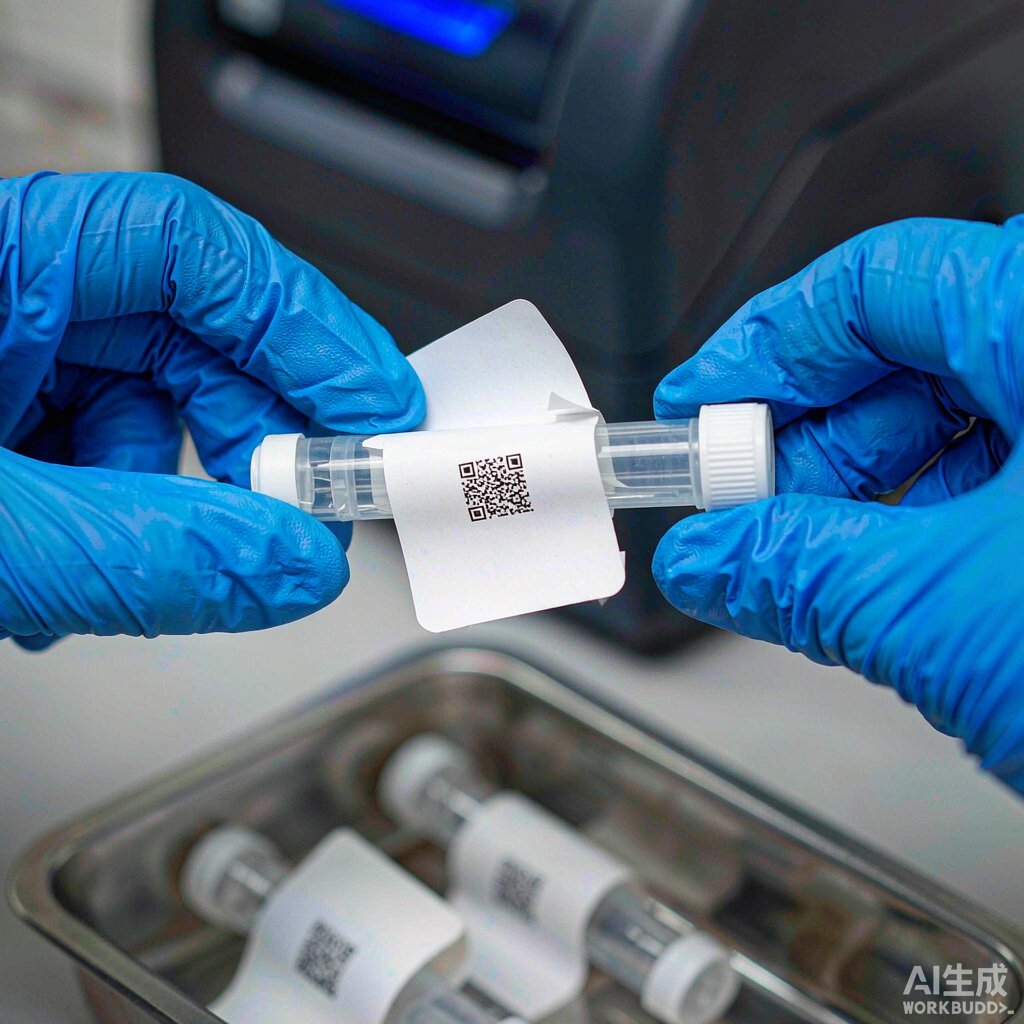
The complete symbol width of Code 128 consists of the start character, data characters, check character, and quiet zones on both sides. By the standard algorithm, the total number of modules for N data characters is 11N + 55 (including 20 modules of quiet zone), multiplied by the narrow module width X to obtain the physical length. Substituting the 50.89 mm circumference:
- N = 8 digits, X = 0.25 mm → symbol length about 35.75 mm, leaving 15.14 mm within one turn (wrap-around feasible, flat not feasible);
- N = 12 digits (close to a typical serial number with collection point prefix), X = 0.25 mm → about 51.25 mm, already exceeding one circumference, must reduce X or switch to a 2D symbol;
- If X is reduced to 0.19 mm (the lower limit range of most 300 dpi printers), N = 12 digits → about 38.95 mm, barely wrappable, but with minimal read margin.
The conclusion is direct:on a sampling tube with 16.20 mm diameter, a 1D barcode is only viable for "short code + wrap-around"; once complete serial numbers or subject-related fields must be carried, 2D symbols should be preferred.
4.2 Dimensional Advantages of 2D Symbols
The advantage of DataMatrix lies in distributing information density across two dimensions rather than a single length. A 26 × 26 module square symbol with cell size X = 0.25 mm has a symbol body of about 6.5 mm square, plus 1 module quiet zone on each side for about 7.0 mm square — this size fits completely within a 12.7 mm wide flat label, with about 2.8 mm margin remaining for hand tearing and pressing. In contrast, a 1D barcode carrying equivalent length information often requires 45 mm or more of linear length; the area efficiency advantage of 2D is an order of magnitude at this tube diameter.
Symbol quality is assessed per ISO/IEC 15416 (1D) and ISO/IEC 15415 (2D). It is recommended to specify two points in technical conditions: first, write "first-article inspection mandatory + per-batch sampling inspection" into the work instruction; second, solidify acceptance grades, photo documentation, and scan failure rate statistics. Wear, condensation, and obstruction during transport cause random drops in symbol grade; without baseline data, it is impossible to determine whether the problem comes from the label or the process.
4.3 Print Parameters and Ribbon Matching
Sampling tube labels must use thermal transfer rather than direct thermal. Direct thermal paper will darken overall or fade under refrigerated condensation and ethanol wiping; thermal transfer printed content durability is determined by the ribbon. The laboratory-specific black ribbons offered on this site, BRL-110-13 (110 mm × 300 m) and BRL-80-B09 (80 mm × 300 m), cover printing needs in this width range. The selection requirement for resin-based ribbons is: the printed layer must withstand ethanol wiping and low-temperature environments, and have sufficient adhesion fastness; specific matching is subject to printer manufacturer and ribbon manufacturer instructions.
It is also recommended to lock print density and print speed at validated values and centrally manage printers of the same model. Drift in barcode X dimension often comes from "the same file printed on different machines," not from the label itself.
5. Four-Layer Identification Responsibilities: Tube Body, Sealed Bag, Secondary Container, Transport Box
Sampling specimens use triple packaging plus the tube body itself, totaling four labelable levels. Cramming all information onto the tube body is unrealistic — the usable area on the tube body is only about 12.7 mm × 60 mm, and space must also be left for visual verification. The reasonable approach is layered carrying:
| Level | Content carried | Recommended label format | Requires cryogenic grade |
|---|---|---|---|
| Sampling tube body | Unique specimen ID (2D symbol primary) + sampling date + type color code | Wrap-around vinyl or nylon cloth | Yes, follows storage temperature |
| Sealed bag (primary container) | Same ID small barcode + biohazard symbol | Flat polyester | Yes |
| Secondary container | Batch number, sampling point, piece count, sealing date | Flat large size | No, usually not entering cryogenic |
| Transport box exterior | Biohazard symbol, sender and receiver, contact phone, temperature control requirements | Large size, easy to replace when box is reused | No |
The "transport box exterior" level deserves separate mention: transport boxes are repeatedly circulated and disinfected, making this the only position requiring "firm adhesion yet replaceable." If the box remains at room temperature long-term, products rated only for room temperature can be used; but if the box interior holds large amounts of ice packs or even dry ice, the box exterior will also condense, and face stocks with good conformability should be used. Small-format options for this position include Lab312-470 (self-laminating polyester) and Lab115-435 (self-laminating label with transparent window).
6. Biosafety and Compliance Anchors
From sampling to amplification, labeling is tied to multiple standards:
- GB 19489-2008 "Laboratories — General Requirements for Biosafety" — Opening of transport boxes should be completed within the core area of a Biosafety Level 2 laboratory, with operations performed after transfer to a biosafety cabinet; containers must have clear specimen identification on the exterior;
- WS 233-2002 "General Guidelines for Biosafety in Microbiological and Biomedical Laboratories" — Identification guidelines for specimen containers and transport stages;
- ISO 15189:2022 "Medical laboratories — Requirements for quality and competence" — Pre-examination procedures (subject preparation, specimen collection, transport, reception) require specimen traceability throughout the chain, with dual-signature records as a routine audit point;
- ISO 7010 W009 — Biohazard graphical symbol, a mandatory visual element for transport boxes and secondary containers;
- GB 15258 "Rules for the Compilation of Safety Labels for Chemicals" — Applicable to the safety labels on the original preservation solution bottles themselves containing guanidinium salts and other components;
- ISO/IEC 15416 and ISO/IEC 15415 — Print quality assessment methods for 1D and 2D symbols;
- ISO 13485:2016 "Medical devices — Quality management systems — Requirements for regulatory purposes" — Disposable viral sampling tubes themselves are medical devices, and their accompanying labeling consumables should also be included in the institution's supplier and batch management;
- ISO 20387:2018 "Biobanking — General requirements for biobanking" and ISO/IEC 17025:2017 — If specimens enter long-term biobanking or serve as formal testing objects, these two constitute the system anchors for storage and testing stages.
There are two frequently overlooked hard requirements on the process side: first, transport and reception personnel should perform dual sign-off, verifying at reception that the collection tube label information matches the submission form and checking the tube wall for damage and leakage — damaged or leaking specimens must be covered with absorbent paper, treated with 0.55% chlorine disinfectant, registered as nonconforming, and destroyed, during which the label must remain legible; second, avoid repeated freeze–thaw, with specimens stored in dedicated libraries or cabinets under dual-person dual-lock management. After specimens enter the extraction and amplification stage, they are usually transferred to 96-well plates, with well positions and spacing layout per ANSI/SLAS 1-2004; label information at this stage should form a hard "tube-to-well" association through a plate map to avoid identity disconnection after plate transfer.
7. Six-Step Labeling Procedure
| Step | Operation | Acceptance criteria | Record |
|---|---|---|---|
| 1 | Clean tube outer wall | No fingerprints, no liquid traces; after 75% ethanol wiping, allow to volatilize for no less than 30 seconds | Operator/time |
| 2 | Select material grade | Select per lowest temperature in chain, not per room temperature | Batch number |
| 3 | Symbol grade passes sampling inspection per ISO/IEC 15416 or ISO/IEC 15415 | Print parameter snapshot | |
| 4 | Apply | For wrap-around, overlap no less than 3 mm and press firmly; for flat, center on the straight section of tube body | Visual inspection |
| 5 | Dual-person verification | Subject information, tube label, and submission form all consistent | Dual signatures |
| 6 | Bag and box | Each container level sealed independently; no inter-layer compression after boxing | Packing list |
The three words "straight section" in step 4 are critical. The middle of a sampling tube with 16.20 mm outer diameter has a region of minimal curvature change; centering the label transversely on this section allows more uniform edge stress distribution; applying near the curved bottom closure or near the screw threads will cause premature failure due to abrupt surface change.
8. Failure Phenomena Quick Reference
| Phenomenon | Most likely root cause | Action |
|---|---|---|
| Edge lifting within minutes of application | Ethanol residue or condensation on surface; or exceeded 150° central angle | Wipe dry and reapply; switch to wrap-around |
| Complete detachment after overnight 4 °C refrigeration | Interfacial condensed water displacing adhesive layer | Switch to low-temperature adhesive type; press and delay boxing after application |
| Blurred printed content | Direct thermal used instead of thermal transfer; or ethanol sprayed directly on printed surface | Switch to resin-based ribbon; spray alcohol on tube body, not label area |
| Face stock cracking after removal from -70 °C | Material grade lower than chain minimum temperature | Upgrade to material covering -80 °C grade |
| Barcode scan failure from the start | Symbol crosses overlap position; X dimension too small | Keep barcode away from overlap zone; reset print parameters |
| Text unclear after storage for a period | Crystallization from preservation solution on outer wall | Leave no less than 2 mm blank at face stock edges; switch to self-laminating structure |
| Pooled and single collection confused | Lack of dedicated visual distinction | Introduce top pre-printed 6-color type + written color card definition |
| Box label detachment after transport | Box condensation combined with repeated disinfection | Switch box labels to highly conformable face stock and replace periodically |
Recommended Products
For the label materials and application scenarios covered in this article, the following BradyLAB (BRD) products are available for selection reference (click to view specifications and request a quote):
- T629样本库-196℃尼龙布耐低温试管生物样本库签化验采样液氮标签 (¥999/roll)
- Lab208-509/25.4x63.5缠绕式冻存管生物样本库细管液氮分类标签 (Price on request)
- Lab084-439/30x15mm样本库冻存管聚酯标签低温生物样本库分类标签 (Price on request)
- Lab115-459/9.53+65x9.53生物样本库锥管低温冻存管PET自覆膜标签 (Price on request)
9. FAQ
Q: Can viral sampling tube labels directly use ordinary specimen cryovial labels?
Direct reuse is not recommended. The core constraints of ordinary specimen cryovial labels are mostly "extremely small tube diameter + extremely low temperature"; viral sampling tubes also require cryogenic conditions, but the tube diameter is larger (common 10 mL specification has an outer diameter of 16.20 mm), and there is an additional key variable — the preservation solution retained inside the tube constitutes continuous chemical exposure to the label, and the outer wall is also sprayed with 75% ethanol before boxing. The information format must also be recalculated: at a circumference of 50.89 mm, the probability that the two product types are mutually unsuitable is high. It is recommended to re-determine the grade using the "tube diameter → chemistry → temperature" three-step approach in this article.
Q: Should the label be applied to the cap or the tube body?
Primary identity information must be on the tube body. The cap is discarded or swapped after opening, and the cap has an outer diameter of 20.72 mm and height of 13.68 mm, with a small labelable area and more complex curvature. The cap is only recommended for carrying an extremely short serial number or color code as an auxiliary verification position, and cannot replace the tube body primary label.
Q: For specimens that will be tested within 24 hours, is it still necessary to select cryogenic-grade material?
If the chain is confirmed to end at 4 °C refrigeration, then the grade below the -40 °C requirement can certainly be lowered. But note two points: first, after sampling, room temperature placement should not exceed 4 hours, and submission within 2–4 hours is recommended; once the chain is delayed, it may transfer to long-term storage; second, most institutions' technical documents require "selection based on the worst-case scenario that may occur" rather than "selection based on planned conditions." The recommended approach is to use cryogenic grade for critical batches on the main line, and room-temperature grade for auxiliary labels.
Q: Must the wrap-around overlap reach 3 mm?
The official material guide table explicitly states at least 3 mm overlap at head and tail for models suitable for this process; vinyl wrap-around types also note the need for overlap in liquid nitrogen environments. In practice, overlap serves both as a means to prevent end curling and to absorb operational deviation in label placement; its more important role is to prevent the seam from becoming an entry point for condensed water. Execute with 3 mm as the lower limit, and apply pressure to expel air at the overlap position during acceptance inspection.
Q: Should barcodes prioritize 1D or 2D?
The calculations in this article already provide the answer: a tube with 16.20 mm outer diameter has a circumference of only 50.89 mm, and a 1D barcode with 12 digits of data at X = 0.25 mm requires 51.25 mm, already exceeding one circumference. A 2D symbol at 0.25 mm cell size occupies about 7.0 mm square, fitting completely within a 12.7 mm wide flat label. Therefore, default to 2D, and consider 1D only when the code is extremely short.