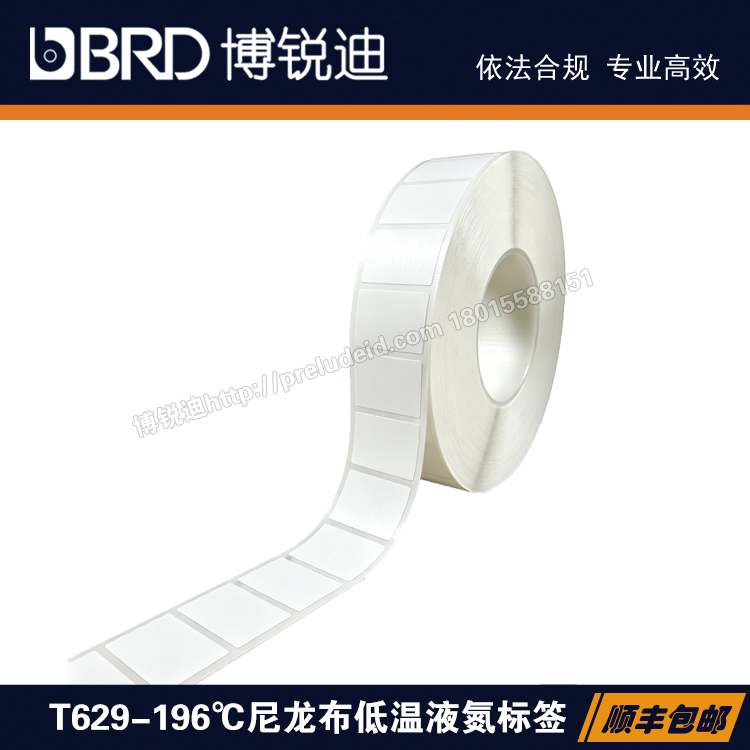
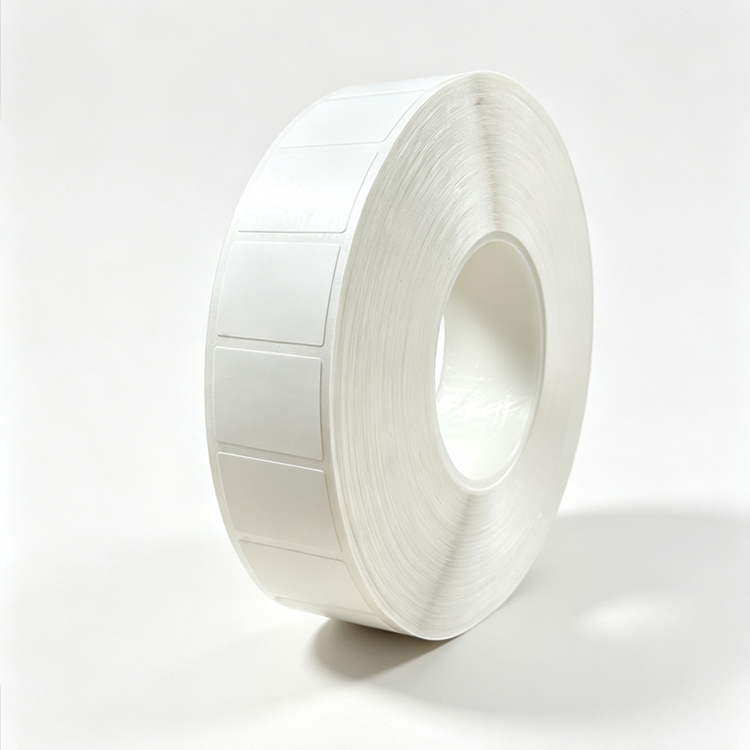
Full roll shown, white nylon cloth face stock
BRD 博锐迪 · T629 Series
Lab112-629 Small-Format Nylon Cloth LN₂ Label
35 × 25 mm small format · withstands -196 °C LN₂ / -80 °C freezer / 100 °C hot water / 121 °C autoclaving · direct application to small-diameter tubes and microscope slides
35 × 25 mmT629 nylon cloth-196 °C LN₂Direct application to small tubes
Product Overview
Lab112-629 is a small-format cryogenic label with T629 nylon cloth face stock and a single-label size of 35 × 25 mm, designed for labeling small-diameter cryovials, microcentrifuge tubes and microscope slides across -196 °C LN₂ to +121 °C autoclaving. Compared with larger formats, the label area is narrowed to the width that fits around a small tube body, so an ID, date and project code can be laid out in two or three lines of small text; the cloth substrate conforms to curved tube walls without lifting, and a single label carries a sample from collection through cryopreservation to water-bath rewarming and autoclaving without relabeling.
Key Features
Three benefits of the small format in ultra-low temperature workflows
Narrow
35 × 25 mm fits small-diameter tube bodies
The narrowed label area can be applied flat or wrapped directly onto small-diameter cryovials and microcentrifuge tubes without covering graduations or the cap thread area, keeping tube information readable at a glance.
Conform
Nylon cloth conforms to curved and frosted surfaces
The soft, bendable cloth face stock conforms to curved tube bodies and frosted slide surfaces, resisting edge lift and detachment during repeated insertion and removal from cryoboxes.
Range
Usable across four temperature environments
Per the official material guide, T629 is suitable for LN₂ at -196 °C, freezer at -80 °C, hot water at 100 °C and autoclaving at 121 °C, covering the full workflow from cryopreservation to rewarming and sterilization.
Save
One label for multiple container types
T629 is the cloth label material in the guide that simultaneously covers microscope slides, cryovials/test tubes, conical tubes and other applications, so a biobank can stock a single specification to cover multiple container types.
Specifications
Subject to the factory specification sheet; contact us to confirm before bulk orders
| Item No. | Lab112-629 |
| Face stock | T629 nylon cloth cryogenic label material |
| Label size | 35 × 25 mm (W × H) |
| Unit of quantity | PCS (refer to the ordering information on the product page) |
| Temperature range | -196 °C LN₂ / -80 °C freezer / 100 °C hot water / 121 °C autoclaving |
| Typical containers | Small-diameter cryovials · microcentrifuge tubes · microscope slides (frosted end) |
| Printing method | Thermal transfer, with BRL series cryogenic ribbons (BRL-80 / BRL-110 specifications on site) |
| Compatible printers | Laboratory label printers (M611 / EOS / MACH4S and others noted on same-series pages) |
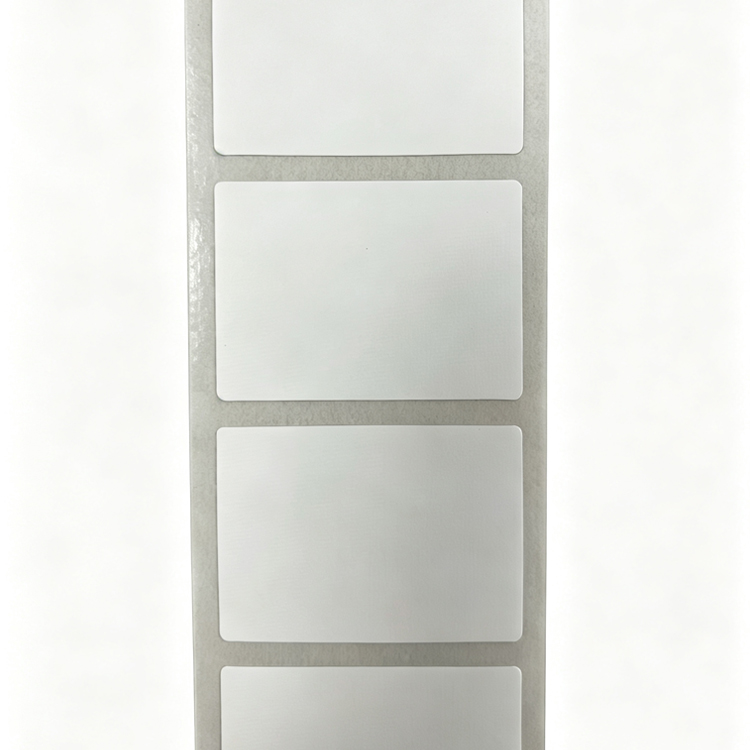
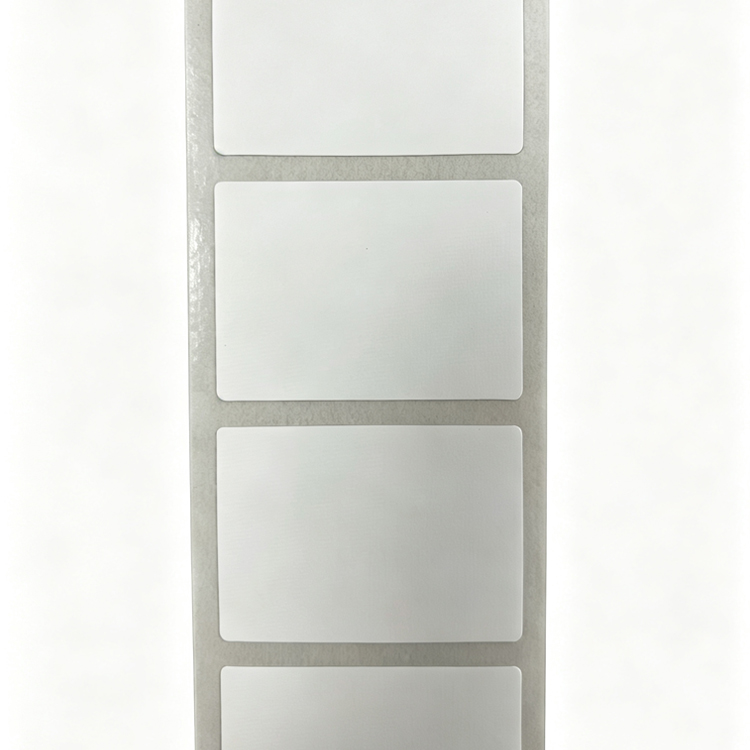
Flat-lay photo: 35 × 25 mm
Layout Tips for the Small Format
Laying out key information clearly within 35 × 25 mm
- Two-line main information: line 1 for the sample ID or barcode, line 2 for the cryopreservation date and operator initials; a character height of at least 2 mm is recommended to ensure legibility after freeze–thaw.
- Barcode first: when space is limited, use a 1D or 2D barcode to carry the full information, with only a short ID for human reading and all content retrieved by scanning.
- Avoid the cap and graduations: when labeling, avoid the cap thread and liquid-level graduation area, press the wrap-around label firmly end to end, and let it rest before LN₂ immersion until the adhesive bond is stable.
- Test print before scaling up: dense small-text layouts demand high print precision; run a small sample test print and scan verification before full production.
Typical Applications
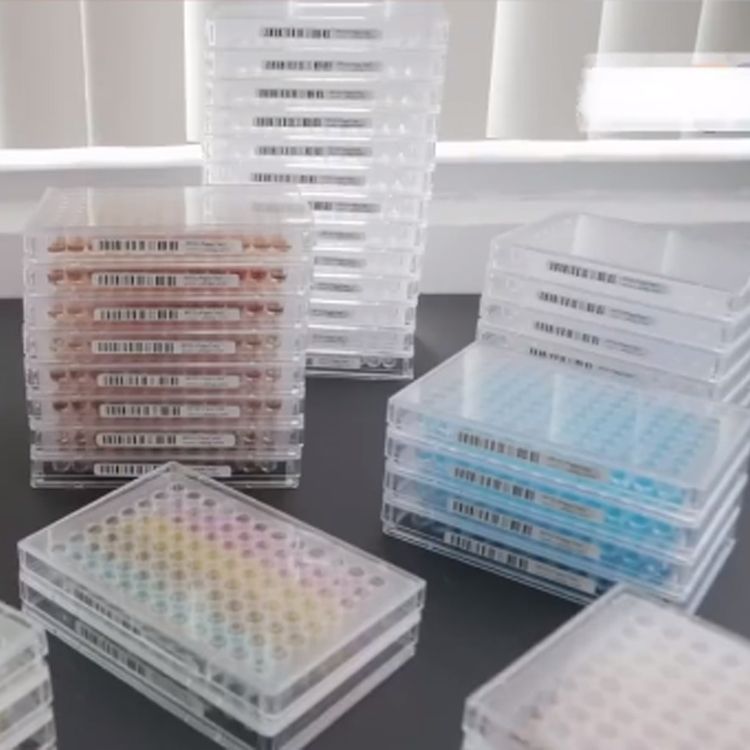
Biobank cryobox insertion and removal
LN₂ storage of small-diameter cryovials
Cell lines and strains are aliquoted into small-diameter cryovials and stored long-term in LN₂ tanks; labels do not become brittle or detach at -196 °C, and tubes are retrieved precisely by ID during recovery.
Microcentrifuge tube aliquoting and reagent tube labeling
The narrow format fits small tube bodies; aliquot batch, concentration and preparation date are laid out in two lines of small text, suitable for managing kit components and stock solution aliquots.
Labeling the frosted end of microscope slides
The 35 × 25 mm format aligns with and adheres to the frosted end of slides; markings remain intact through dehydration, clearing and staining, facilitating archival retrieval of tissue specimens.
Accompanying identification through autoclaving
Suitable for 121 °C autoclaving; labels on sterilization tubes and bags stay with the instruments throughout the entire process, with no need to apply labels after sterilization.
FAQ
Q: How do I choose between the 35 × 25 mm and 50 × 30 mm T629 versions?
A: Consider tube body and information volume: choose 35 × 25 mm for small-diameter cryovials, microcentrifuge tubes and the frosted end of microscope slides; for medium-diameter cryovials or flat application to microcentrifuge tubes needing more information lines, the 50 × 30 mm version offers more room.
Q: What should I watch out for when labeling tubes stored in LN₂ tanks?
A: Apply and press firmly at room temperature, let rest, then immerse in LN₂; wipe off frost on the tube wall before applying, as condensation significantly weakens initial adhesion. For wrap-around materials recommended for ultra-low temperature applications, see the T429/T409/T509 series; T629 is applied flat.
Q: Can small text still be scanned after freezing?
A: With BRL cryogenic ribbons and a 300 dpi laboratory printer, character heights of around 2 mm and standard barcodes remain legible after repeated freeze–thaw cycles; we recommend a freeze–thaw scan verification on actual containers before bulk use.
Selection & Usage Guide
Four steps to confirm whether this product suits you
1
Confirm the lowest temperature tier
If specimens go into LN₂ (-196 °C) or a -80 °C freezer, choose this T629 version; for refrigerated/frozen storage only above -40 °C, compare the more economical film and PP versions T419/T329.
2
Check container and label area
35 × 25 mm matches small-diameter cryovials, microcentrifuge tubes and the frosted end of microscope slides; for larger tube bodies or cap-top application, see larger sizes in the same series.
3
Prepare printing consumables
Thermal-transfer printing requires BRL series cryogenic ribbons; run a small test batch to confirm adhesion before changing ribbon models.
4
Test application and freeze–thaw verification
Apply and press 5–10 labels onto actual containers, complete one LN₂ in-and-out cycle, and confirm no edge lift and scannable barcodes before scaling up.
Note: Clean the labeling surface with 70% alcohol and let dry; press firmly at room temperature before LN₂ immersion, and wipe off frost on the tube wall first; labeling containers just taken from a low-temperature environment immediately will affect adhesion due to condensation—wait until they return to room temperature.
Need a custom small-format size or a bulk quotation?
Custom sizes and printed content available; samples can be provided for trial verification of freeze–thaw performance.
Sales Hotline 18015583218